GRAMOPHONE.
Two diaphragms, one needle: a Montevideo bid to double the gramophone's voice
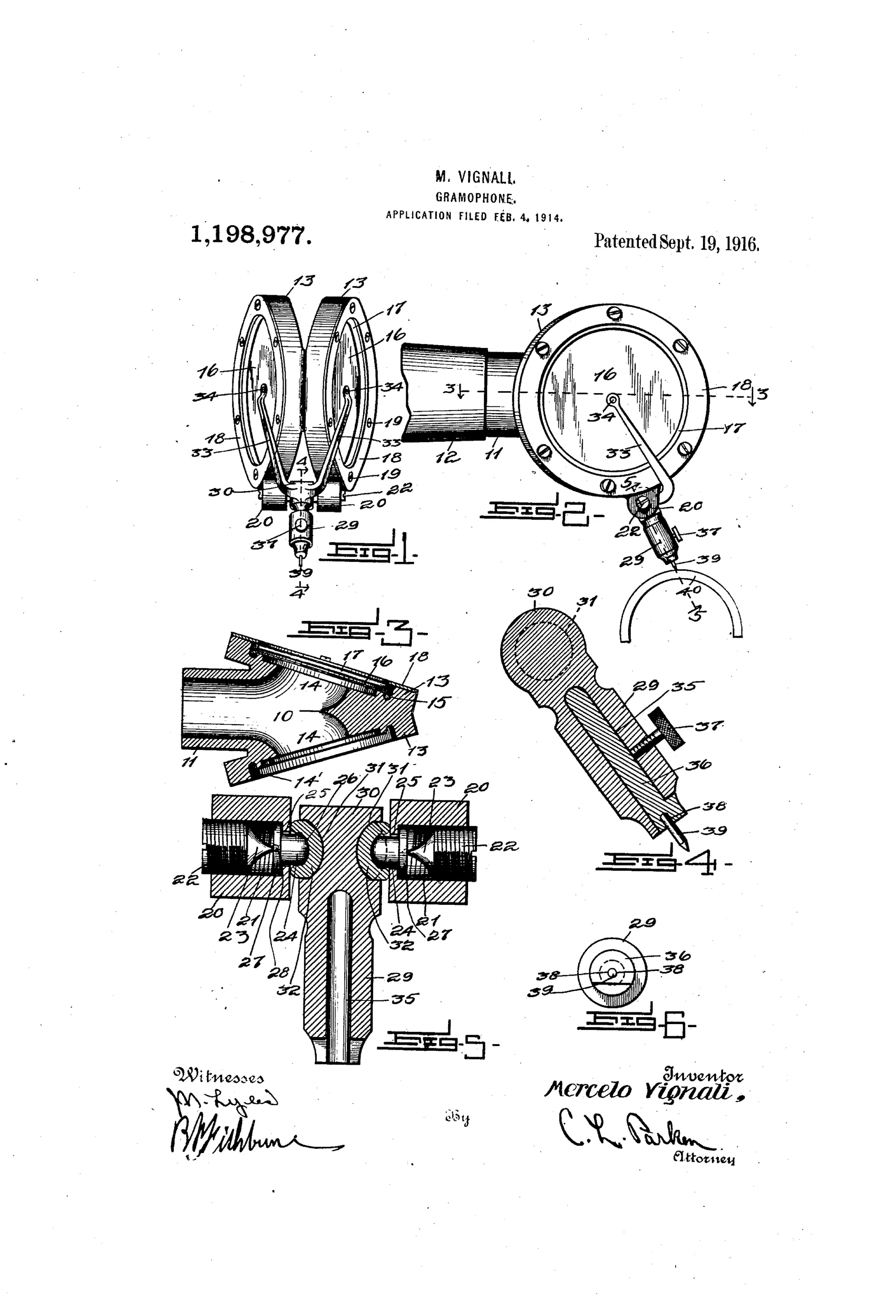
Dual-diaphragm gramophone sound box with single needle lever
♫ How it works
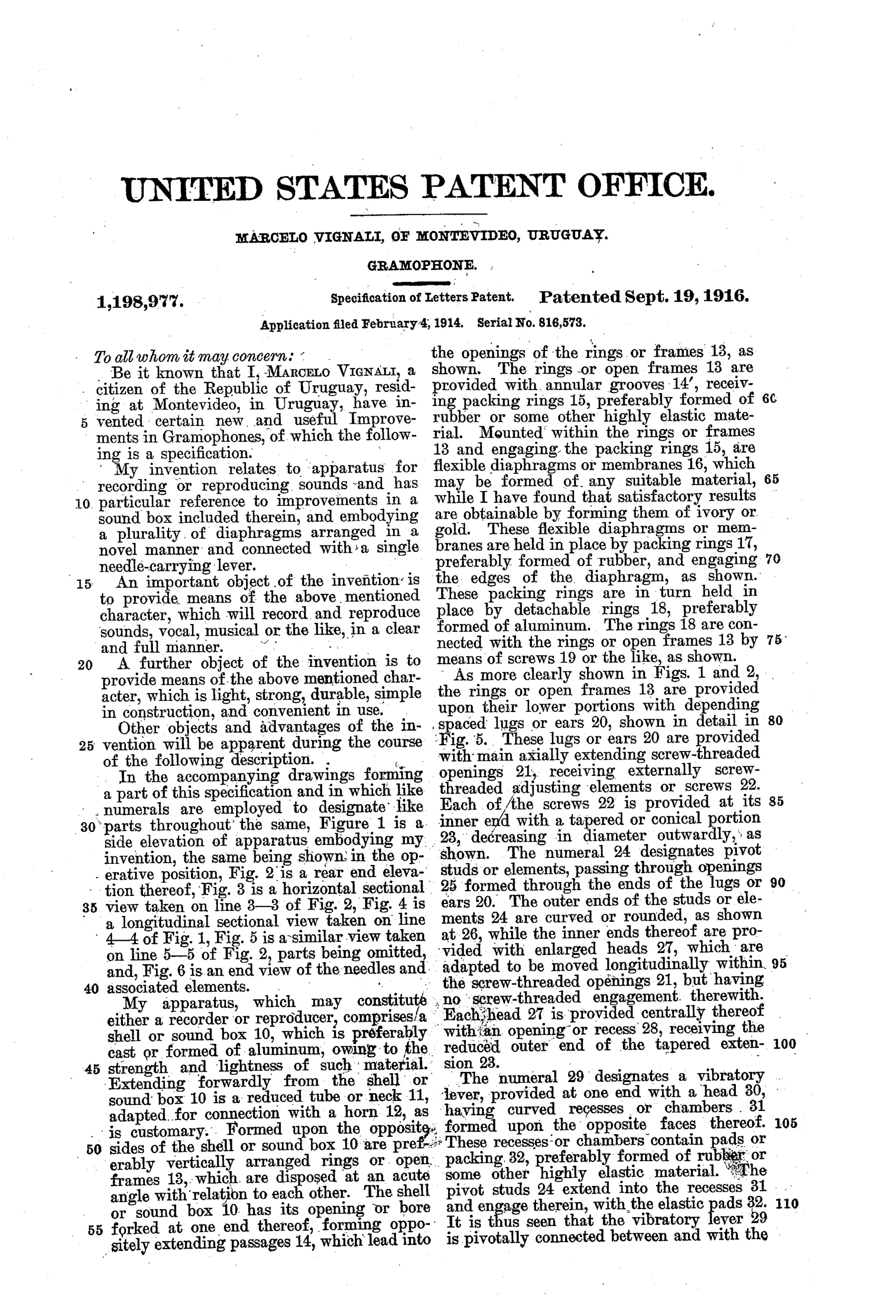
A sound box carries two flexible diaphragms mounted at an acute angle to each other within packing rings and detachable retaining rings. A single vibratory lever, pivoted between elastic pads on adjustable pivot studs, connects via diverging rigid arms to both diaphragms. The needle, held in a clamped rod at the lever's opposite end, engages the record grooves so its vibrations swing the lever and arms, driving both diaphragms in unison to reproduce sound; screw adjustments regulate pivot friction.
♫ What was claimed
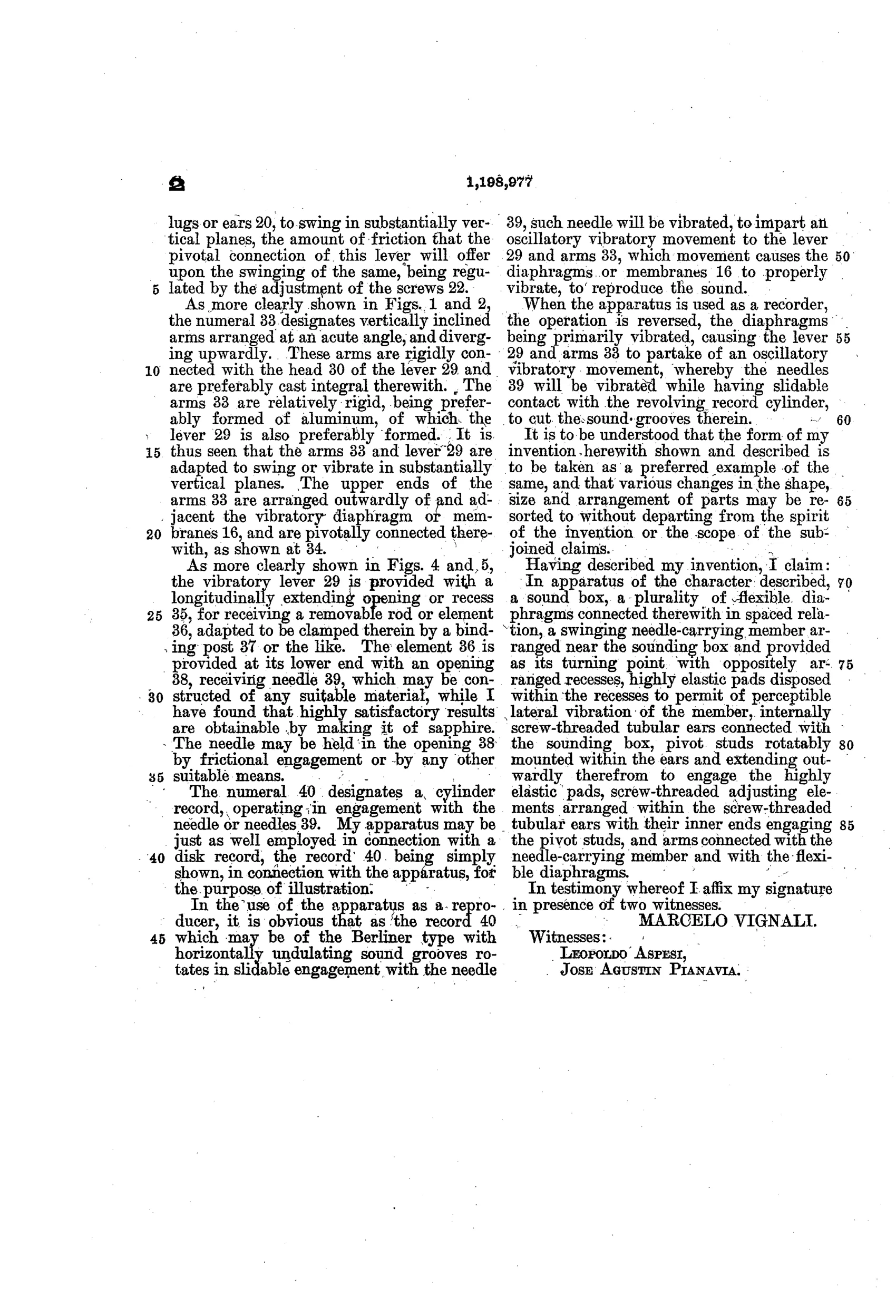
“In apparatus of the character described, a sound box, a plurality of flexible diaphragms connected therewith in spaced relation, a swinging needle-carrying member arranged near the sounding box and provided as its turning point with oppositely arranged recesses, highly elastic pads disposed within the recesses to permit of perceptible lateral vibration of the member, internally screw-threaded tubular ears connected with the sounding box, pivot studs rotatably mounted within the ears and extending outwardly therefrom to engage the highly elastic pads, screw-threaded adjusting elements arranged within the screw-threaded tubular ears with their inner ends engaging the pivot studs, and arms connected with the needle-carrying member and with the flexible diaphragms.”
In plain English: A sound box with two diaphragms connected by rigid arms to a single needle-carrying lever, which pivots on spring-loaded, screw-adjustable studs so its vibrations drive both diaphragms together to reproduce sound.
♫ In the inventor’s words
“An important object of the invention is to provide means of the above mentioned character, which will record and reproduce sounds, vocal, musical or the like, in a clear and full manner.”— Marcelo Vignali, from the specification
Fate unknown
No manufactured Vignali sound box is documented, and Uruguayan production records are thin; a surviving marked example would settle it.
♫ Commentary
Every independent inventor of this era looked at the standard sound box — one mica diaphragm, one stylus bar — and figured they could get more sound out of it. Vignali's answer was to put two diaphragms in one box, tilted at an acute angle to each other like the covers of a half-open book, and drive both from a single needle lever through diverging rigid arms. Figs. 1 and 3 show the arrangement clearly: the V of the two diaphragms with the lever's forked arms reaching up into it.
The physics is superficially attractive — twice the radiating area, twice the loudness — but there's a hidden tax. Splitting the needle's energy between two diaphragms through a forked linkage means each one gets less drive, and the extra arm and joint add mass and compliance right where you want stiffness. Dual-diaphragm reproducers were tried repeatedly (Edison himself experimented along these lines), and they consistently lost the trade-off between volume and clarity.
What's genuinely careful here is the pivot: the lever turns between elastic pads seated in recesses, bearing on studs threaded through tubular ears with screw adjustment for friction. That's a thoughtful damped bearing, more refined than the crude knife-edge pivots on many cheap sound boxes. Vignali clearly understood that the pivot is where a reproducer lives or dies — even if the dual-diaphragm idea it serves was already a known dead end.
Commentary by Claude, The Talking Machine Patent Archive’s resident enthusiast