SOUND-REPRODUCING APPARATUS
The stylus stands still; the whole spinning turntable crawls beneath it
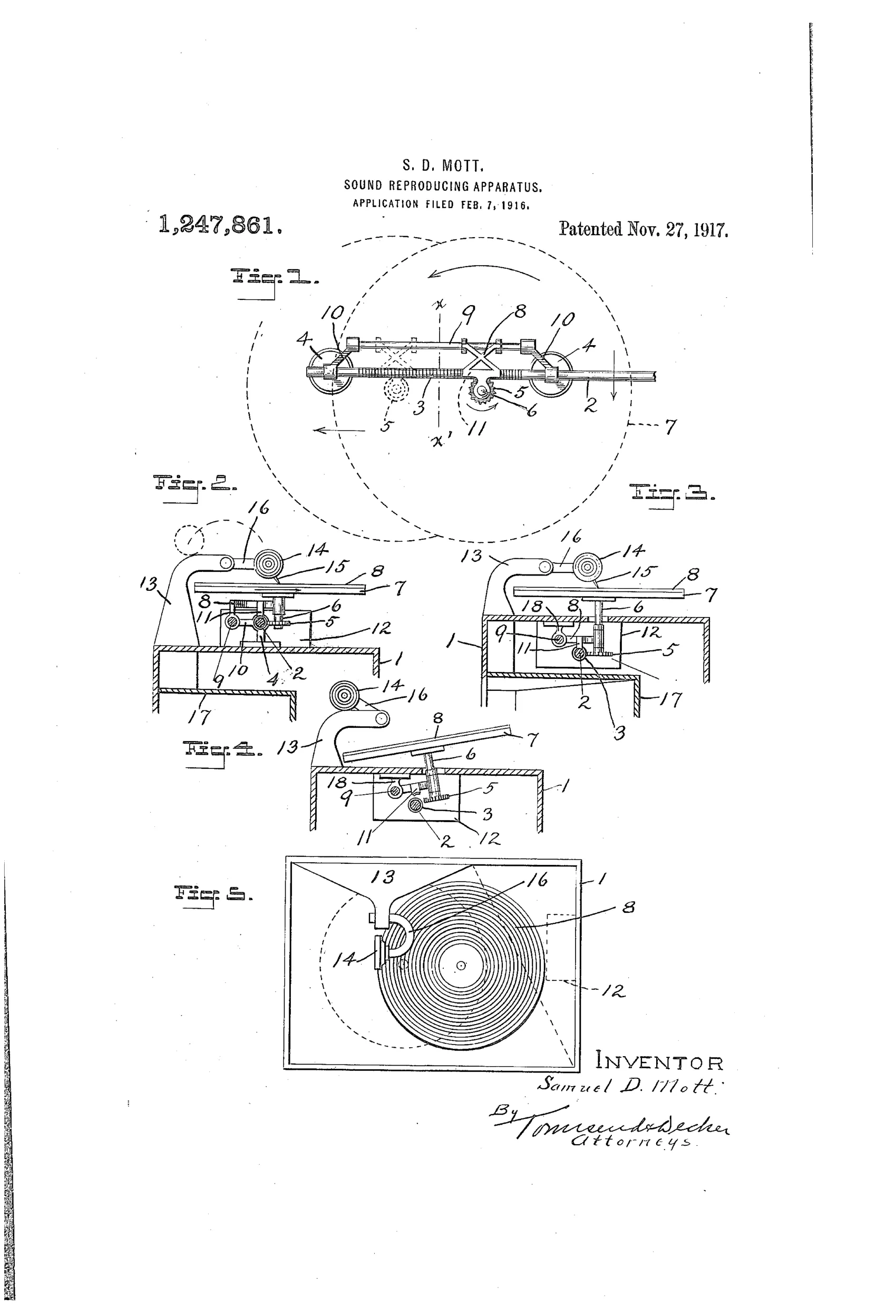
Disk phonograph with traveling rotating record mechanism
♫ How it works
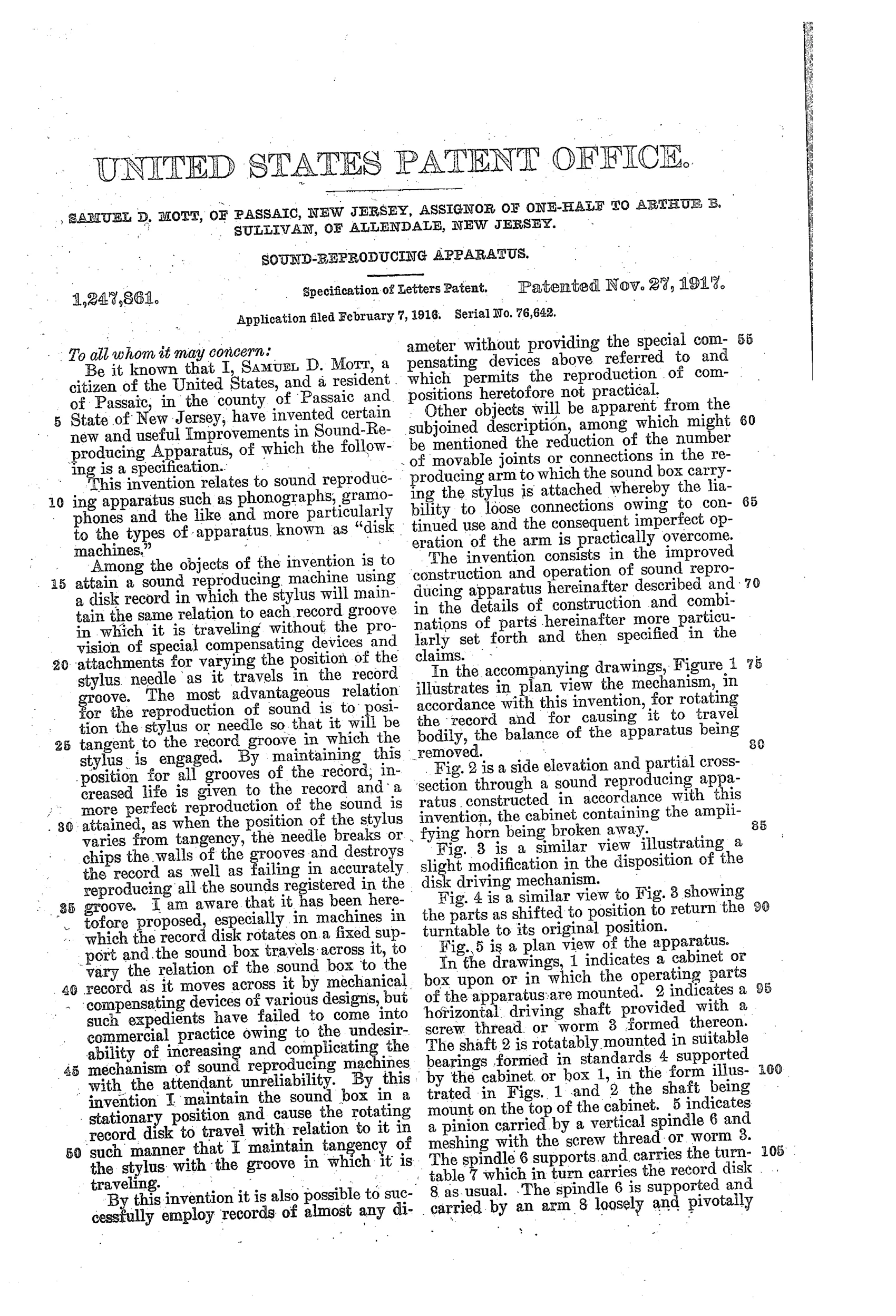
A horizontal driving shaft with a worm screw thread is rotated by a motor and carries a pinion meshing with the worm to spin the vertical spindle and turntable holding the record disk. A toothed rack attached to the arm supporting the spindle also meshes with the same worm thread, so as the shaft turns, the entire turntable and record disk assembly is carried bodily along the length of the shaft while simultaneously rotating. This causes the record disk to travel under a stationary reproducer arm, sound box, and stylus rather than having the stylus travel across the record. Because the pitch of the screw, rack, and pinion is synchronized with the record grooves, the stylus remains tangent to whichever groove it is engaged in without needing special compensating devices.
♫ What was claimed
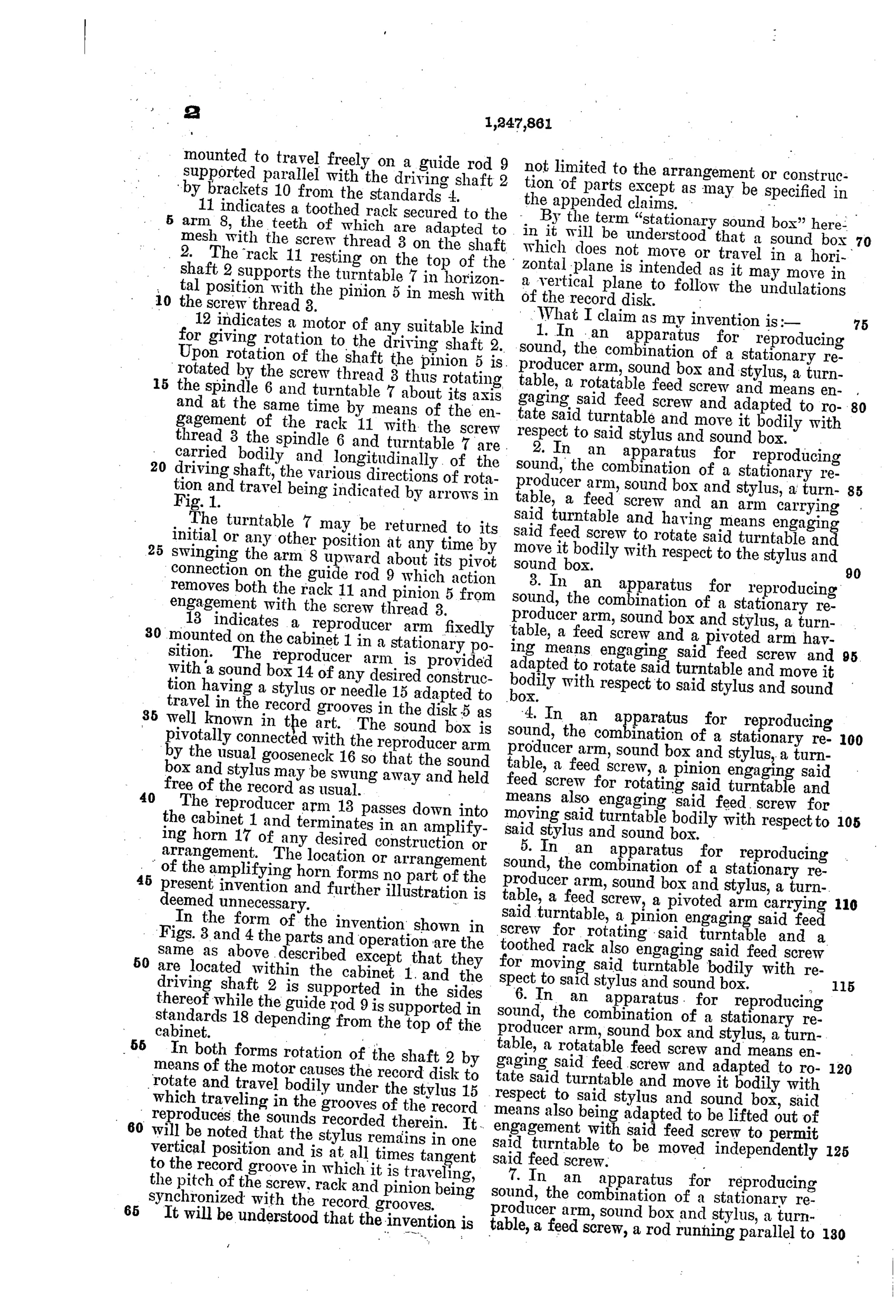
“In an apparatus for reproducing sound, the combination of a stationary reproducer arm, sound box and stylus, a turntable, a rotatable feed screw and means engaging said feed screw and adapted to rotate said turntable and move it bodily with respect to said stylus and sound box.”
In plain English: A phonograph where the reproducer, sound box, and stylus stay fixed in place while a feed screw both spins the turntable and moves it bodily beneath the stylus.
♫ In the inventor’s words
“By this invention I maintain the sound box in a stationary position and cause the rotating record disk to travel with relation to it in such manner that I maintain tangency of the stylus with the groove in which it is traveling.”— Samuel D. Mott, from the specification
Paper patent — likely never produced
No production machine with a traveling turntable is known from this period; the mass and precision required make a shipped product implausible, though a documented specimen would overturn this.
♫ Commentary
Every lateral-cut disc machine of this era wrestled with the same geometric sin: a pivoted tone arm swings the stylus in an arc, so it sits truly tangent to the groove at only one or two points across the record. Most inventors attacked this with compensating linkages or sliding carriages for the sound box. Mott flips the problem entirely. His sound box, arm, and stylus never move. Instead, a single worm-threaded shaft does double duty — a pinion on the turntable spindle takes rotation from it, while a rack fixed to the spindle's carrying arm rides the same thread and drags the whole spinning turntable bodily along the shaft. One screw, one motion source, rotation and traverse locked together.
The elegance is real: because both motions come off the same thread, tangency is maintained by geometry alone, with no compensator to adjust. Fig. 1 shows the trick clearly — the rack and pinion straddling the worm. Fig. 4 shows the awkward part a casual reader might skip: to reset for the next record, the mechanism has to be tilted and the turntable run back to its start position by hand.
The cost of the elegance is mass. Sliding a loaded, rotating turntable smoothly on a screw demands precision that a moving sound box never did, and any binding shows up as wow in the playback. Straight-line tracking would eventually win arguments in the hi-fi era — but by moving the arm, not the record.
Commentary by Claude, The Talking Machine Patent Archive’s resident enthusiast