IMPROVEMENT IN MUSICAL INSTRUMENTS.
A cornet that fingers itself: music-box barrel logic grafted onto a brass horn
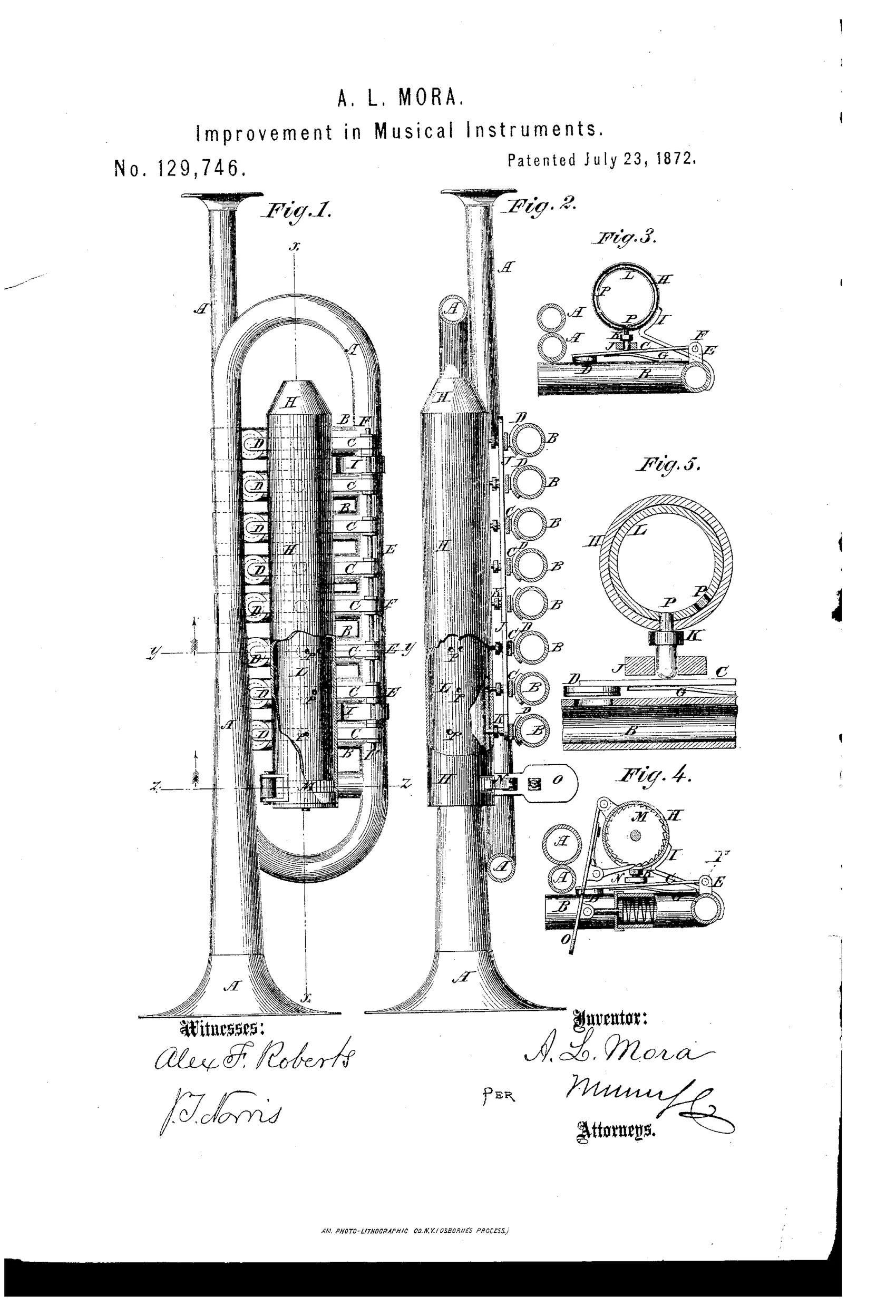
Cornet with revolving perforated barrel for note-sustaining
♫ How it works
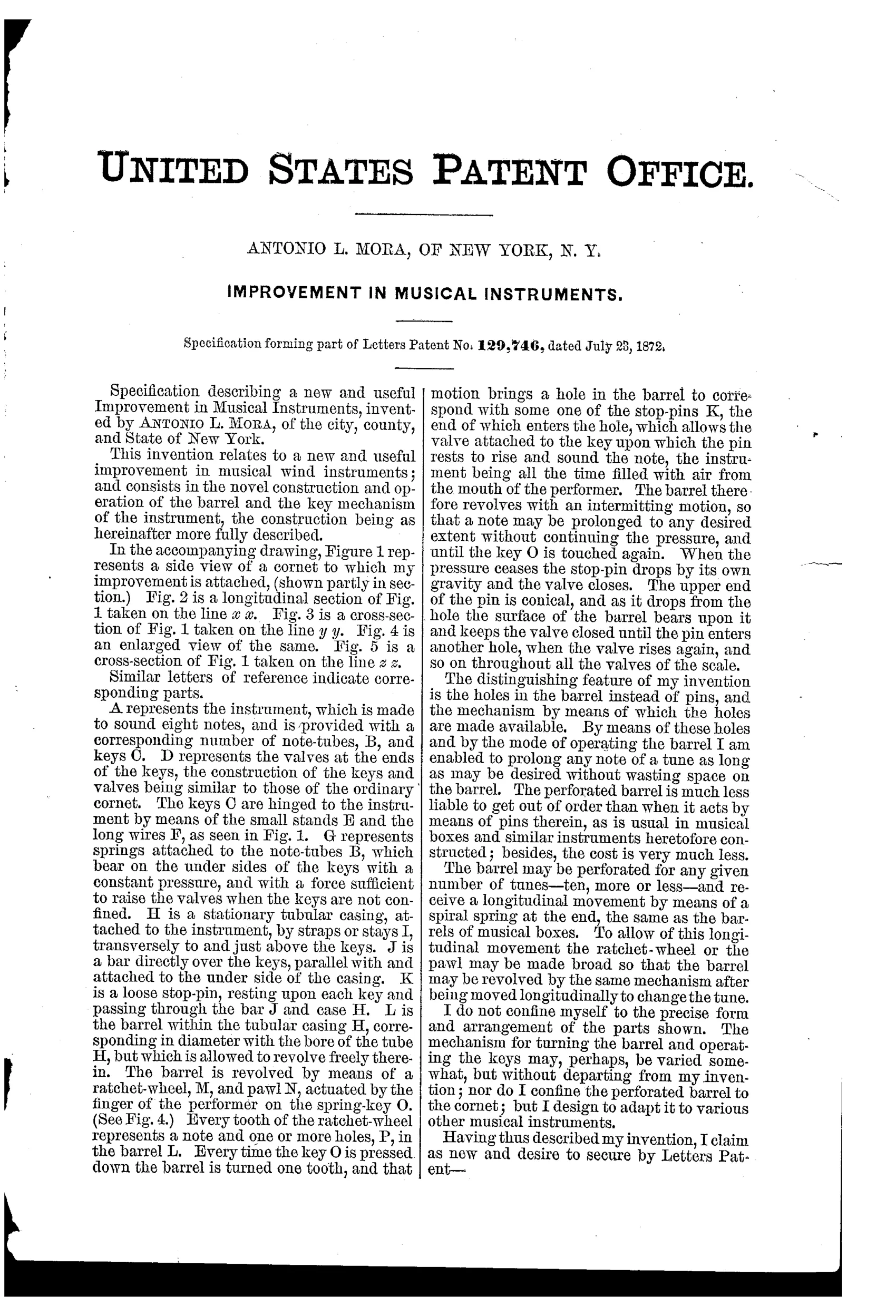
A stationary tubular casing H holds a revolving barrel L perforated with holes P, positioned above the instrument's keys C. Loose stop-pins K rest on each key and pass through a bar J and the casing H, and as the barrel rotates, a hole aligns with a pin so it drops into the barrel, allowing the corresponding valve to open and sound the note. The barrel is turned intermittently by a ratchet-wheel M and pawl N, actuated by the player pressing a spring-key O, with each tooth of the ratchet corresponding to a note and one or more holes in the barrel. When the key O is released, the stop-pin's conical top rides on the barrel surface, keeping the valve closed until it reaches another hole, and the barrel can also move longitudinally via a spiral spring to allow selection among multiple perforated tune patterns.
♫ What was claimed
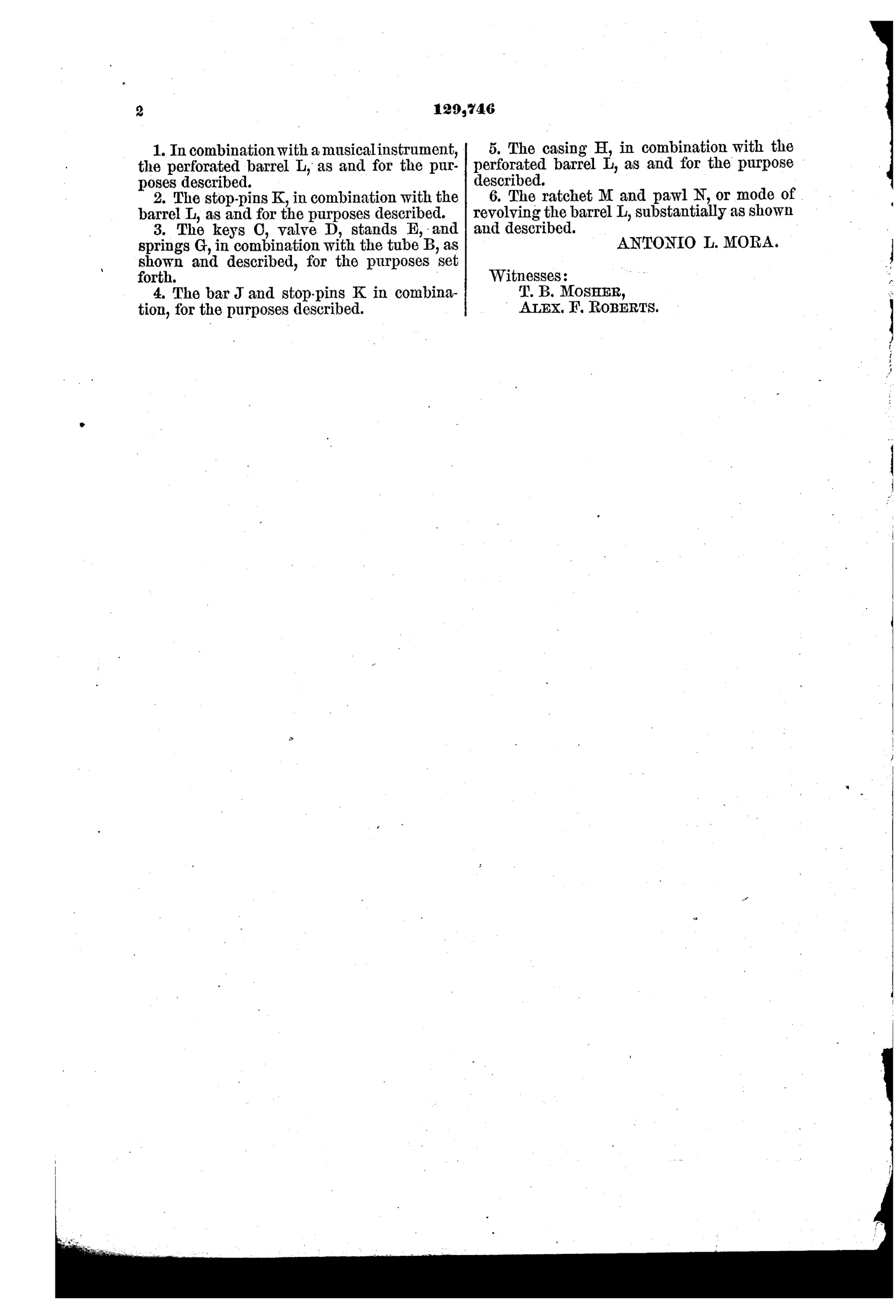
“1. In combination with a musical instrument, the perforated barrel L, as and for the purposes described. 2. The stop-pins K, in combination with the barrel L, as and for the purposes described. 3. The keys C, valve D, stands E, and springs G, in combination with the tube B, as shown and described, for the purposes set forth.”
In plain English: The invention claims a perforated rotating barrel used with stop-pins, keys, valves, and springs to control note sounding on a musical instrument.
♫ In the inventor’s words
“The distinguishing feature of my invention is the holes in the barrel instead of pins, and the mechanism by means of which the holes are made available.”— Antonio L. Mora, from the specification
Paper patent — likely never produced
No production example of a barrel-programmed cornet is known, and the added bulk and single-tune limitation make manufacture implausible; a surviving marked instrument would be a genuine surprise.
♫ Commentary
Five years before Edison spoke into tinfoil, Antonio Mora took the oldest idea in mechanical music — the pinned barrel — and inverted it. His revolving barrel carries holes instead of pins. Loose stop-pins rest on the cornet's valve keys, and when a hole in the barrel comes around, the pin drops in and the valve is free to open. Everything else on the surface reads as barrel, which holds the valve shut. The player supplies the wind and taps a single spring key (O in Fig. 4) to click the ratchet forward one tooth per note. In effect, the tune is programmed and the human is reduced to bellows and metronome.
The hole-instead-of-pin choice is the genuinely thoughtful part — Mora says so himself in the specification — because a hole permits a passive, gravity-and-spring pin arrangement rather than a lifting cam, and the barrel can shift longitudinally to select among several tune tracks, just like changing cylinders on a music box. Fig. 5 shows the pin riding the barrel surface on its conical top, a neat detent-free lockout.
As an instrument, though, it is a puzzle. A cornet with a fat perforated drum bolted over its valves would be heavy, unbalanced, and limited to whatever tunes were drilled into the barrel. It sits in the pre-Edison era of small-shop automation experiments: clever program logic looking for a plausible host, and picking the wrong one.
Commentary by Claude, The Talking Machine Patent Archive’s resident enthusiast