IMPROVEMENT IN SELF-PLAYING ATTACHMENTS FOR KEY-BOARD INSTRUMENTS.
An Iowa inventor tries to press piano keys with leather bumps on paper
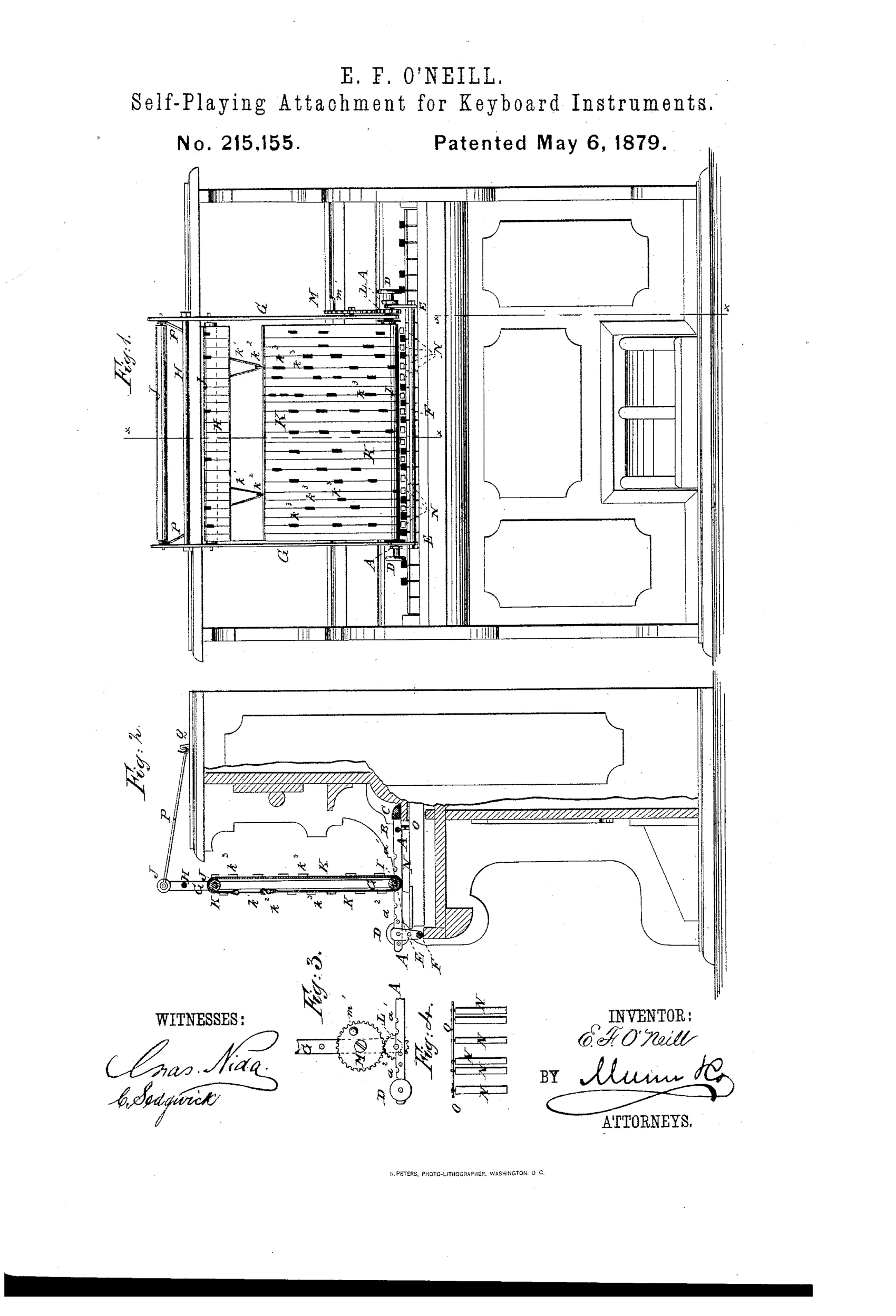
Mechanical music-roll attachment for playing keyboard instruments
♫ How it works
A frame carrying two bars G is set above the keyboard, holding two rollers I and J between which a paper or cloth music-chart K is stretched, its notes represented by small leather or rubber projections. A crank-handle turns a gear-wheel M meshing with a smaller gear L on roller I, advancing the chart so its projections press against black keys and pivoted false keys N resting on the white keys. The false keys N are hinged to a connecting strip O so they can be interposed between the black keys and operate the white keys beneath them. Adjustable bars A, uprights E, and clamping screws D let the whole frame be raised, lowered, or shifted laterally to fit different keyboards and adjust the chart to the correct key.
♫ What was claimed
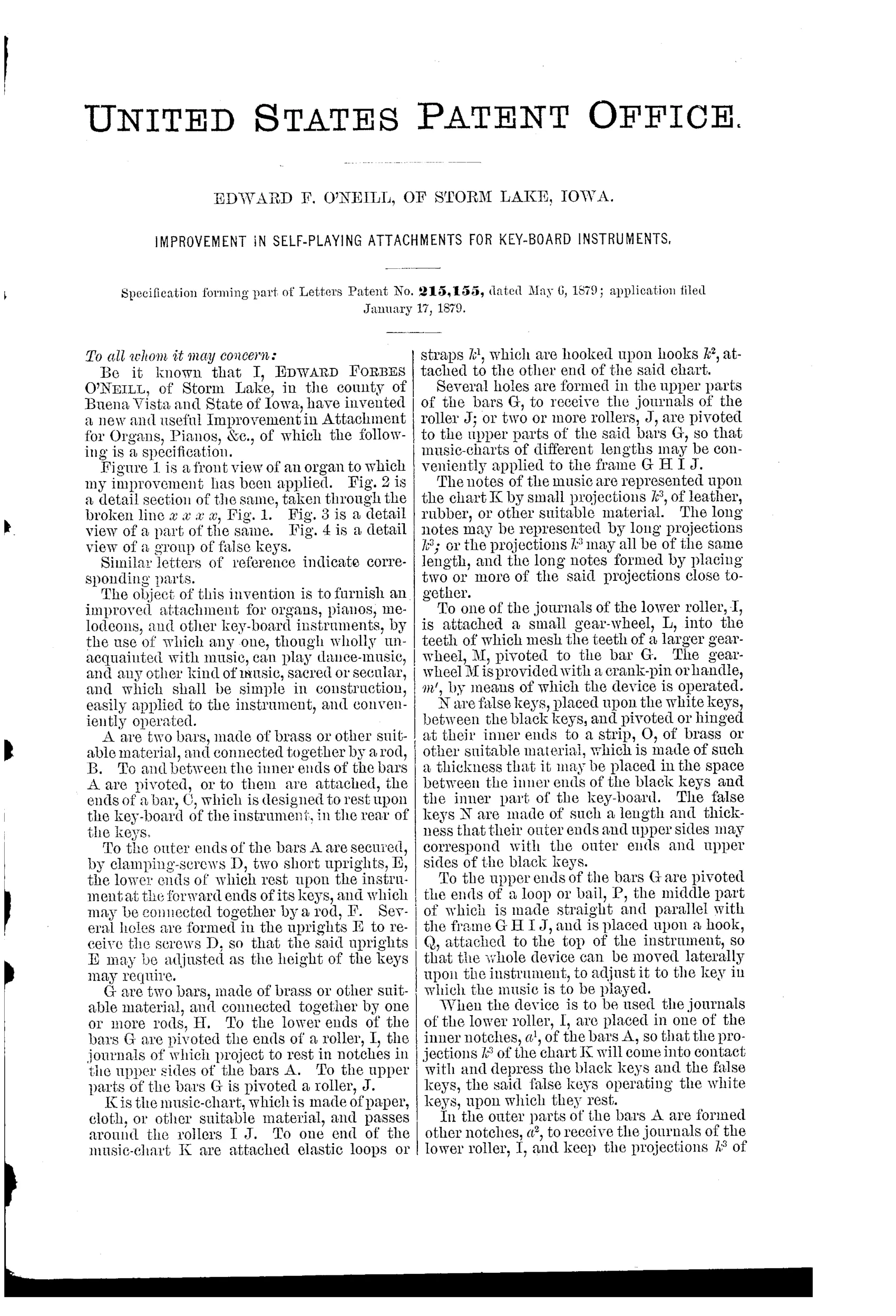
“The combination of the bars G, the rod or rods H, the rollers I J, the bail P, the gear-wheels L M, and the music-chart K, upon which the notes are represented by projections, with each other, and the frame A B C E D, substantially as herein shown and described.”
In plain English: A claim covering the whole assembly of support bars, rollers, gear-wheel crank drive, and a music chart with raised note-projections mounted on an adjustable frame that fits over a keyboard.
♫ In the inventor’s words
“The object of this invention is to furnish an improved attachment for organs, pianos, melodeons, and other key-board instruments, by the use of which any one, though wholly unacquainted with music, can play dance-music, and any other kind of music, sacred or secular.”— Edward Forbes O'Neill, from the specification
Paper patent — likely never produced
No production example or trade record is known, and the direct-pressure chart mechanism is mechanically implausible at working key forces; this reads as an earnest small-shop paper patent.
♫ Commentary
In 1879, two years after Edison's tinfoil phonograph, most people who wanted music at home still had to make it themselves — or find a machine to do it. Edward O'Neill of Storm Lake, Iowa, proposed clamping a frame over any keyboard, stretching a paper or cloth chart between two rollers, and letting little leather or rubber projections glued to the chart push the keys down as a crank advanced it. His stated goal is disarmingly frank: so that anyone 'wholly unacquainted with music' can play dance tunes and hymns alike.
The genuinely clever bit is the row of pivoted false keys N, hinged to a strip so they nest between the black keys and reach the white ones below — a workaround for the keyboard's staggered geometry that later player-piano designers would solve with pneumatics instead. The adjustable frame, meant to fit organs, pianos, and melodeons of any size, shows a practical mind thinking about the whole market.
But the physics is unforgiving. Depressing an organ or piano key takes real force, and a soft leather nub on a moving paper chart must deliver that force through friction and shear — the chart would buckle, the projections would peel, and the note timing would smear. The player-piano industry that arrived a generation later used pneumatic power precisely because direct mechanical pressure from a roll doesn't work. O'Neill saw the right problem and the wrong actuator.
Commentary by Claude, The Talking Machine Patent Archive’s resident enthusiast