IMPROVEMENT IN MECHANICAL MUSICAL INSTRUMENTS.
An 1879 organette whose paper roll also cues the dance caller
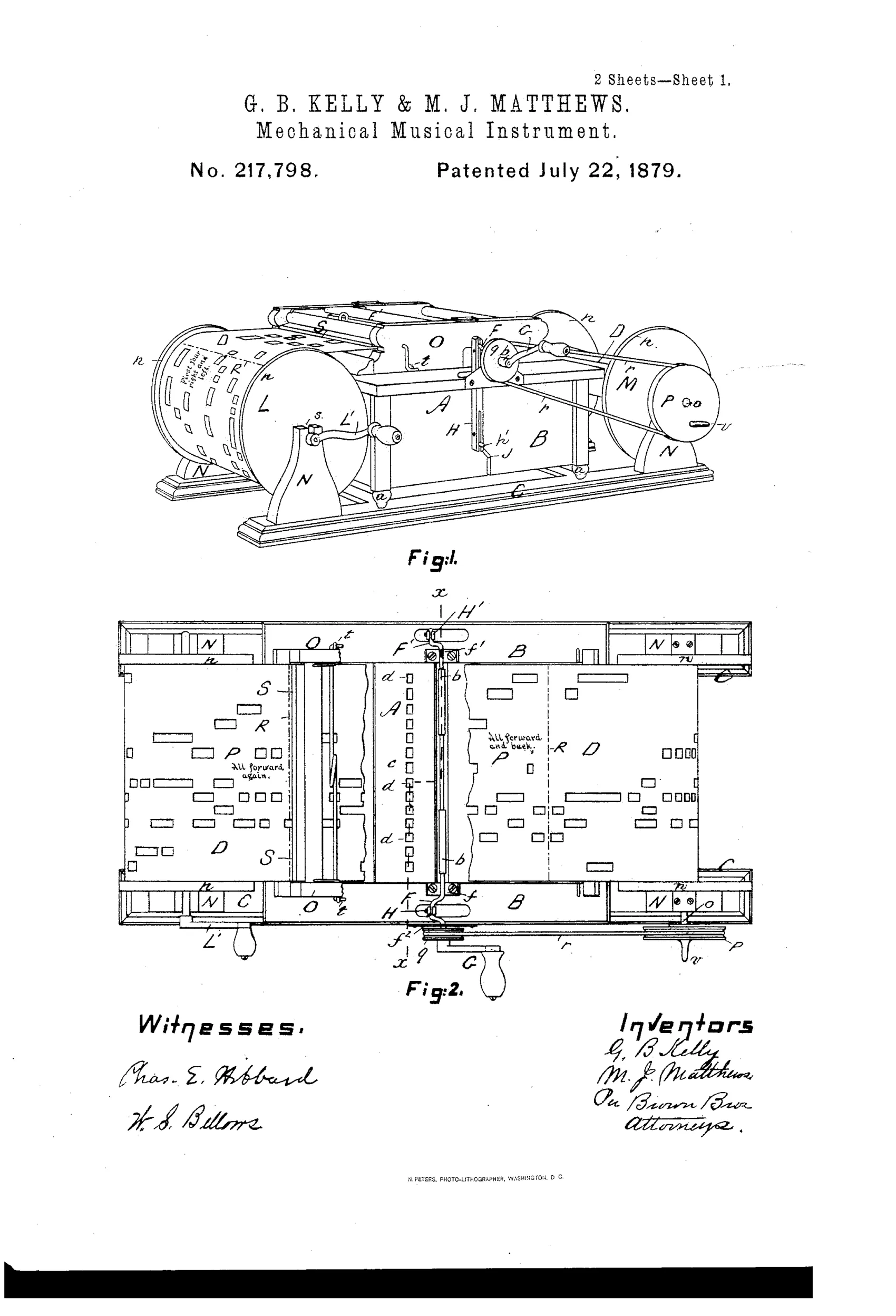
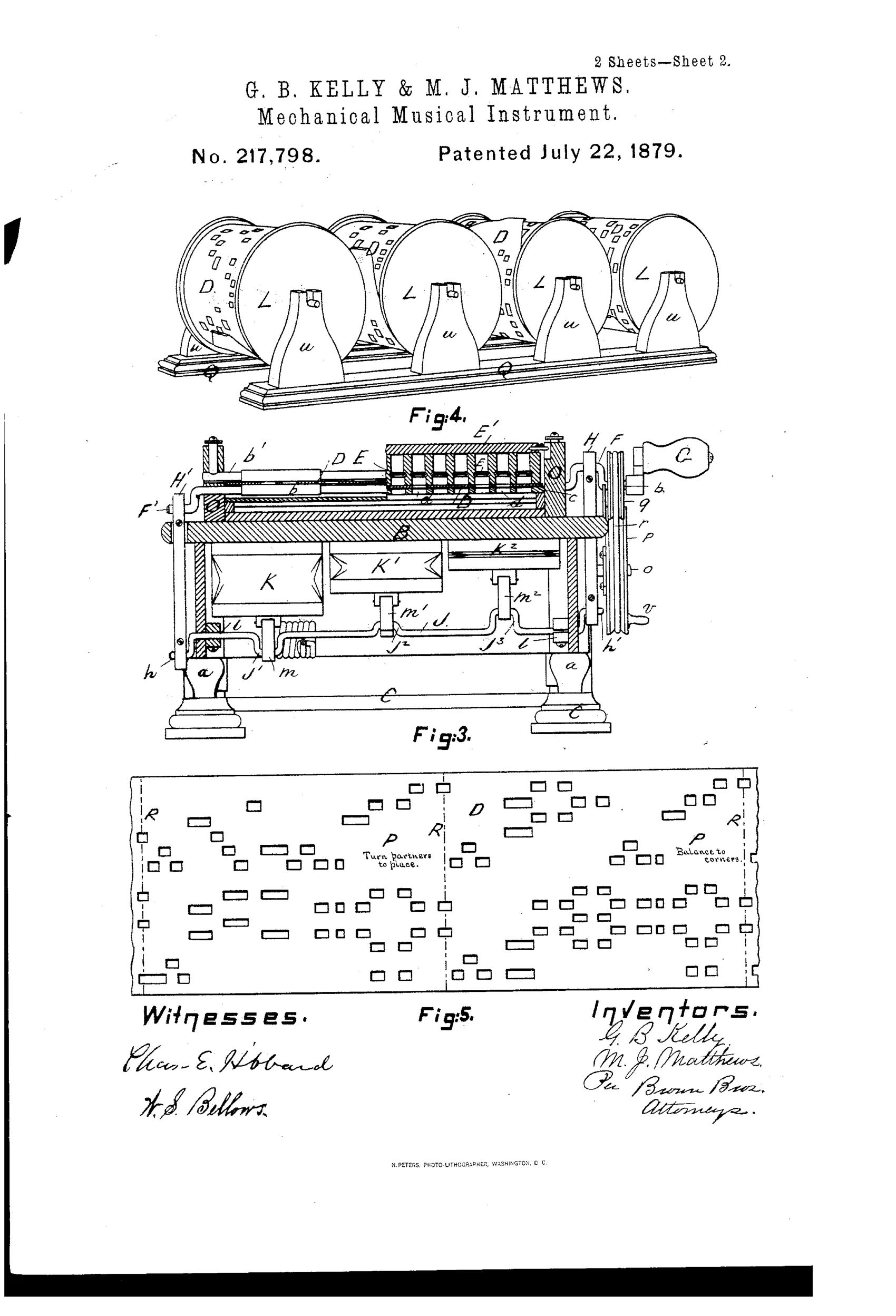
Paper-roll-operated mechanical reed organ (orguinette)
♫ How it works
A strip of perforated paper is drawn by feed rolls across air passages leading to musical reeds, so that each perforation opens a passage and sounds its corresponding reed as the strip moves. The main driving shaft turns via a crank handle and, through pitman-rods, drives a secondary rotary shaft fitted with crank-bends that are linked by pitmen to all the bellows exhausters, replacing earlier designs that used two separate rocking shafts. A belt-and-pulley connection from the driving shaft simultaneously winds the played-out paper onto a take-up roller, while a removable roller holds fresh paper strips so tunes can be changed. An indicator bar (S) is positioned over the paper so that printed dance calls and timing marks pass beneath it in sync with the music, letting an unskilled caller announce figures at the correct moment.
♫ What was claimed
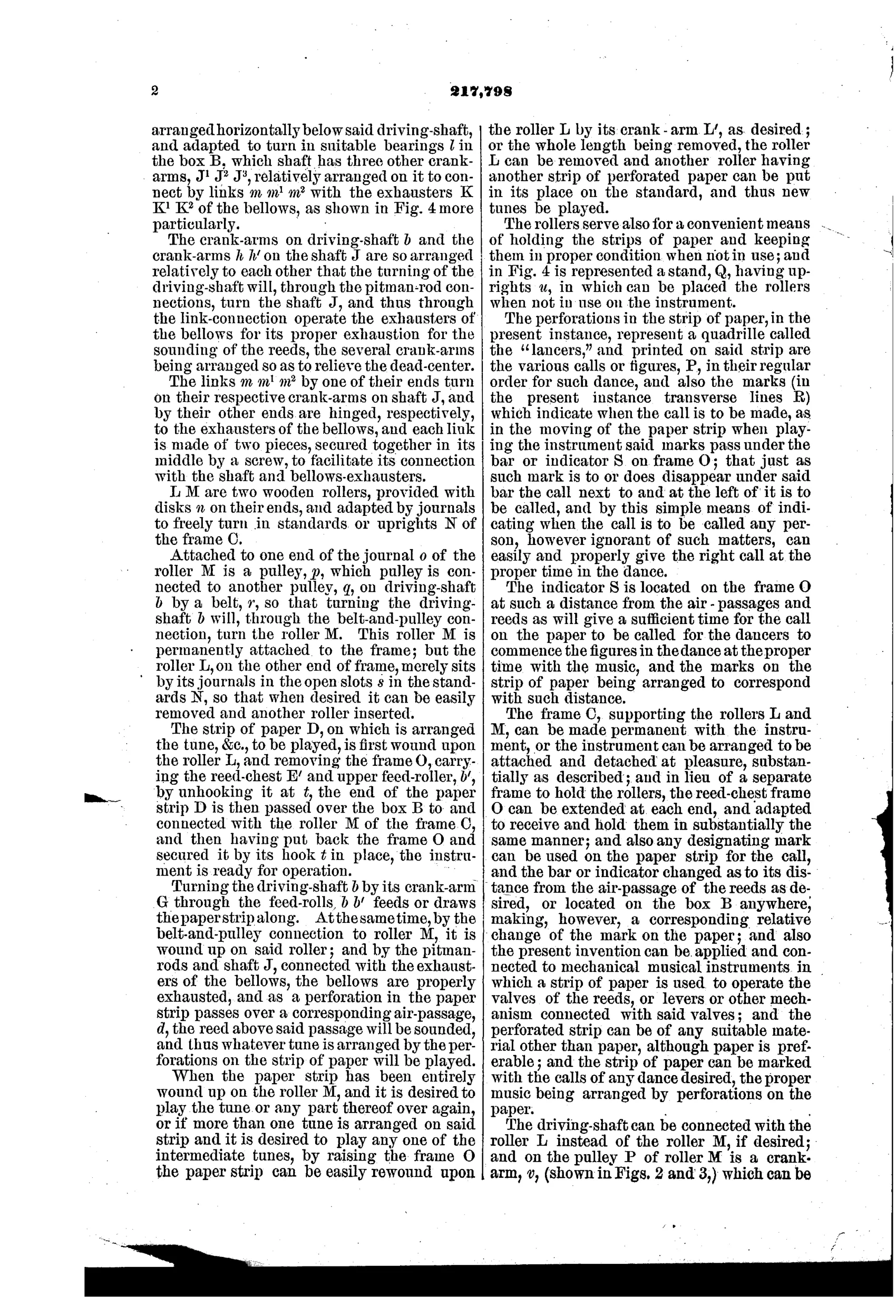
“1. In combination with the driving-shaft of the feed or draw rollers of a mechanical musical instrument, A, in which a strip of perforated paper is used, one or more pitman-rods connected to a crank or cranks on said shaft, a secondary rotary shaft connected by cranks with said pitman-rods and provided with crank-bends, connected by suitable links or pitmen with all the exhausters of the bellows of the instrument, substantially as and for the purpose set forth.”
In plain English: The main paper-feed shaft drives a second rotary shaft through connecting rods, and that second shaft's cranks are linked to all the bellows exhausters to work the reeds.
♫ In the inventor’s words
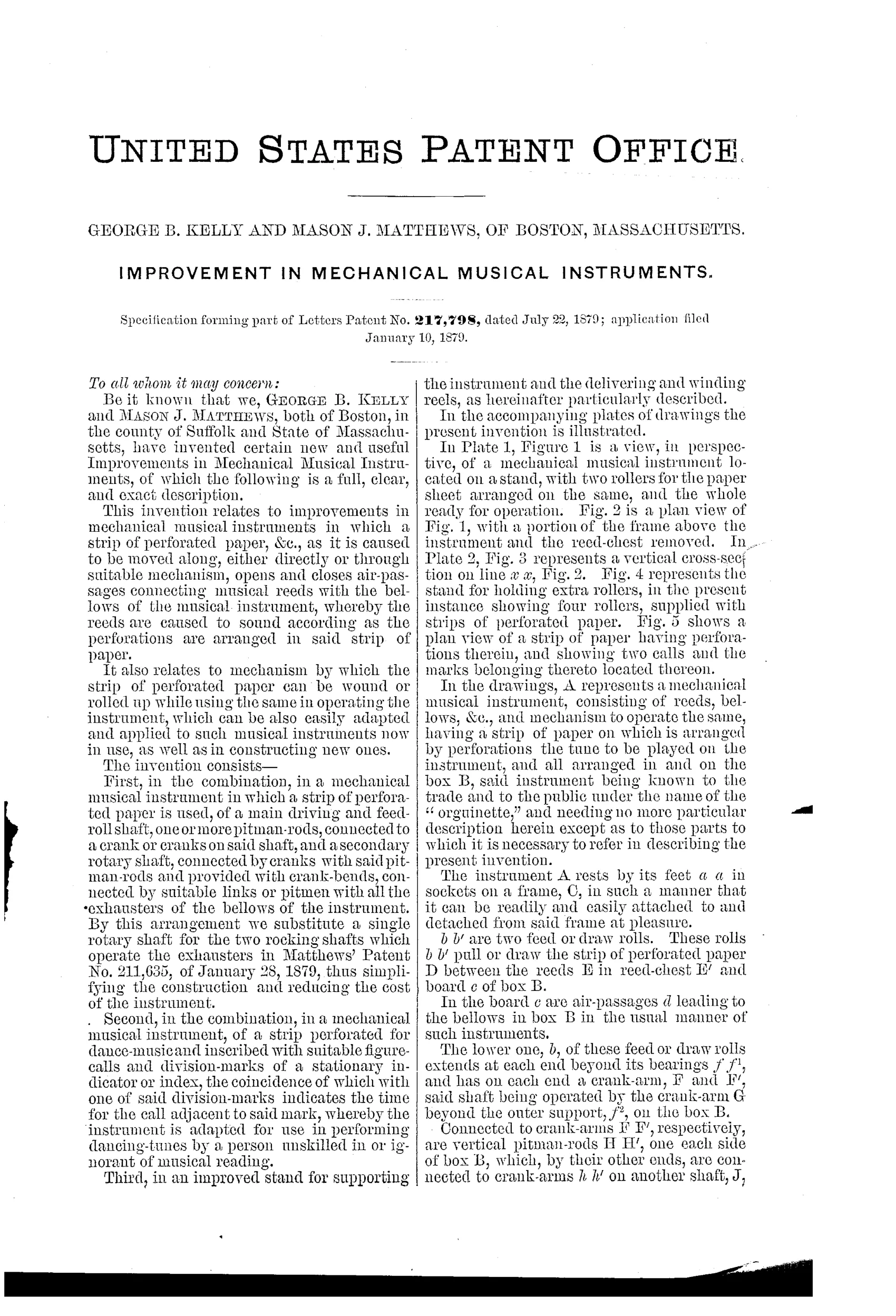
“said instrument being known to the trade and to the public under the name of the "orguinette," and needing no more particular description herein except as to those parts to which it is necessary to refer in describing the present invention.”— George B. Kelly and Mason J. Matthews, from the specification
Fate unknown
Matthews was deeply involved in the commercial orguinette trade, so production of this variant is plausible, but a surviving example with the take-up spool and call-indicator bar would settle it.
♫ Commentary
The patent admits up front that the orguinette itself was already "known to the trade," so this is a refinement, not an origin. Kelly and Matthews were tidying up the machine's guts: instead of two separate rocking shafts flapping the bellows, one crank-bent secondary shaft, driven by pitman-rods off the main feed shaft, works all the exhausters at once. Fewer parts, fewer things to go out of time with the paper feed — sensible small-shop engineering. The belt-driven take-up spool matters too: earlier strip machines simply spat the played paper onto the floor, and here it winds itself back onto a roller, with a stand (Fig. 4) holding four spares so tunes could be swapped like cartridges.
But the detail worth lingering on is the indicator bar S in Fig. 2, and the sample strip in Fig. 5. The paper carries printed dance calls — you can just read "all forward and back" among the perforations in the drawing — timed so each instruction passes under the bar exactly when it should be shouted. The machine doesn't just play the quadrille; it prompts an unskilled caller through it. That's a genuinely charming piece of interface design, decades before anyone would call it that.
This sits squarely in the organette boom of the late 1870s, the mechanical-music trade that Aeolian would grow out of. Matthews in particular was a serious name in that business, which makes this more than a hobbyist's fancy.
Commentary by Claude, The Talking Machine Patent Archive’s resident enthusiast