KEY-BOARD ATTACHMENT FOR MUSICAL INSTRUMENTS.
A hand-cranked robot pianist, sixteen years before the Pianola made it pneumatic
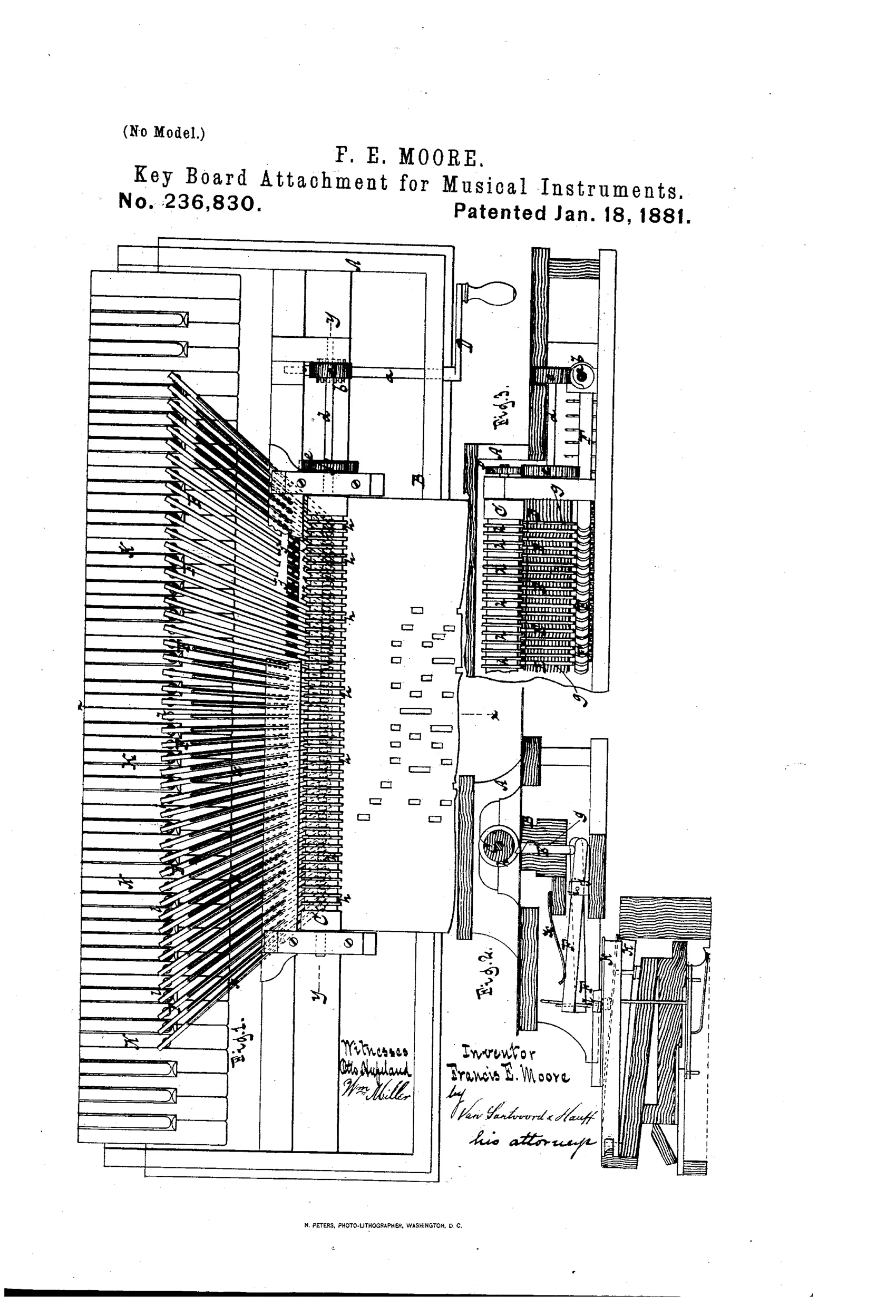
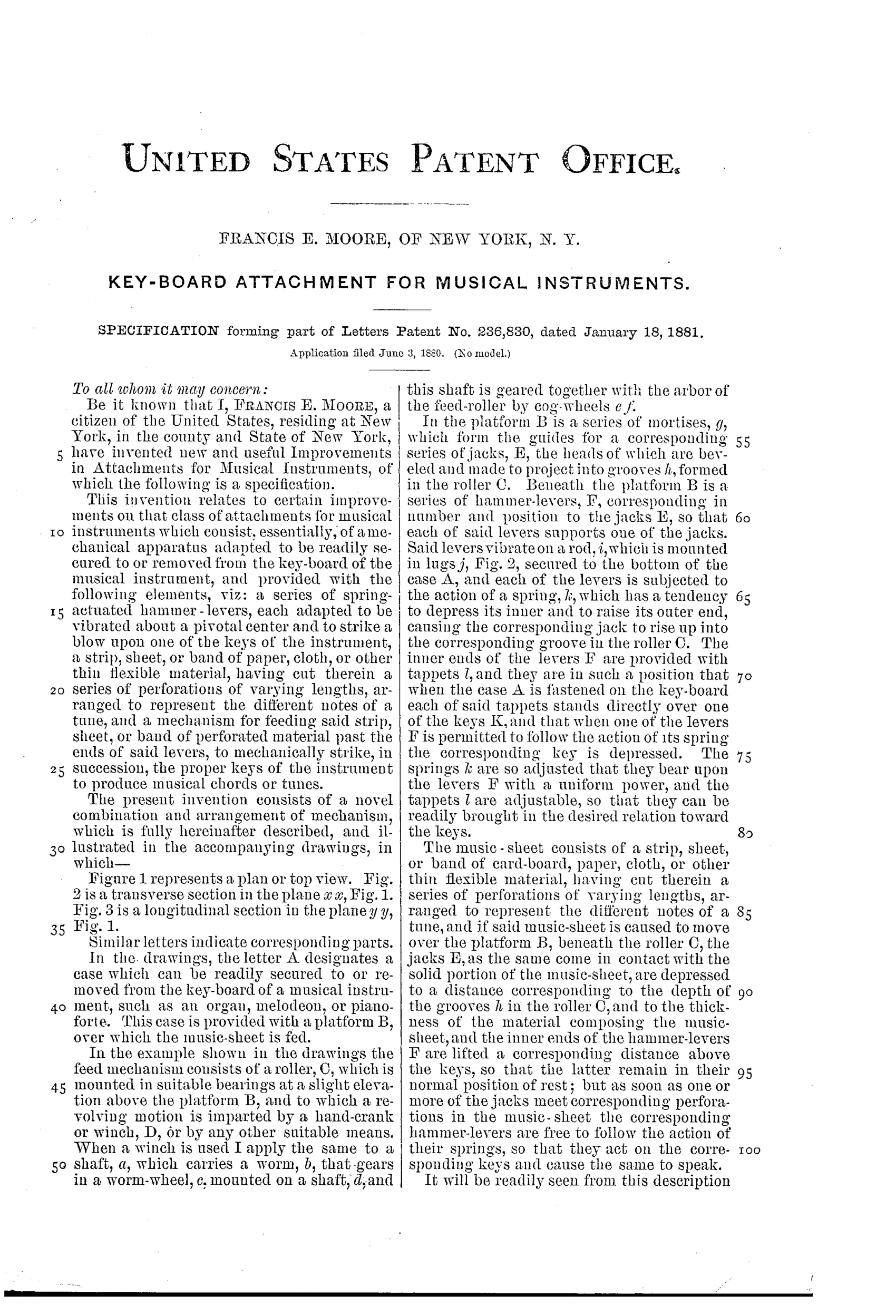
Mechanical player attachment for keyboard instruments
♫ How it works
A case attaches to the key-board of an organ, melodeon, or pianoforte, holding a grooved feed roller above a platform. A perforated music-sheet is fed by hand-crank between the roller and platform, its perforations aligned with sliding jacks. Springs bias hammer-levers to strike the keys, but the jacks normally hold them up; when a perforation in the music-sheet allows a jack to drop, its corresponding hammer-lever falls onto the key, sounding the note. The roller's grooves determine the throw of the levers, allowing thinner music-sheet material to be used without affecting operation.
♫ What was claimed
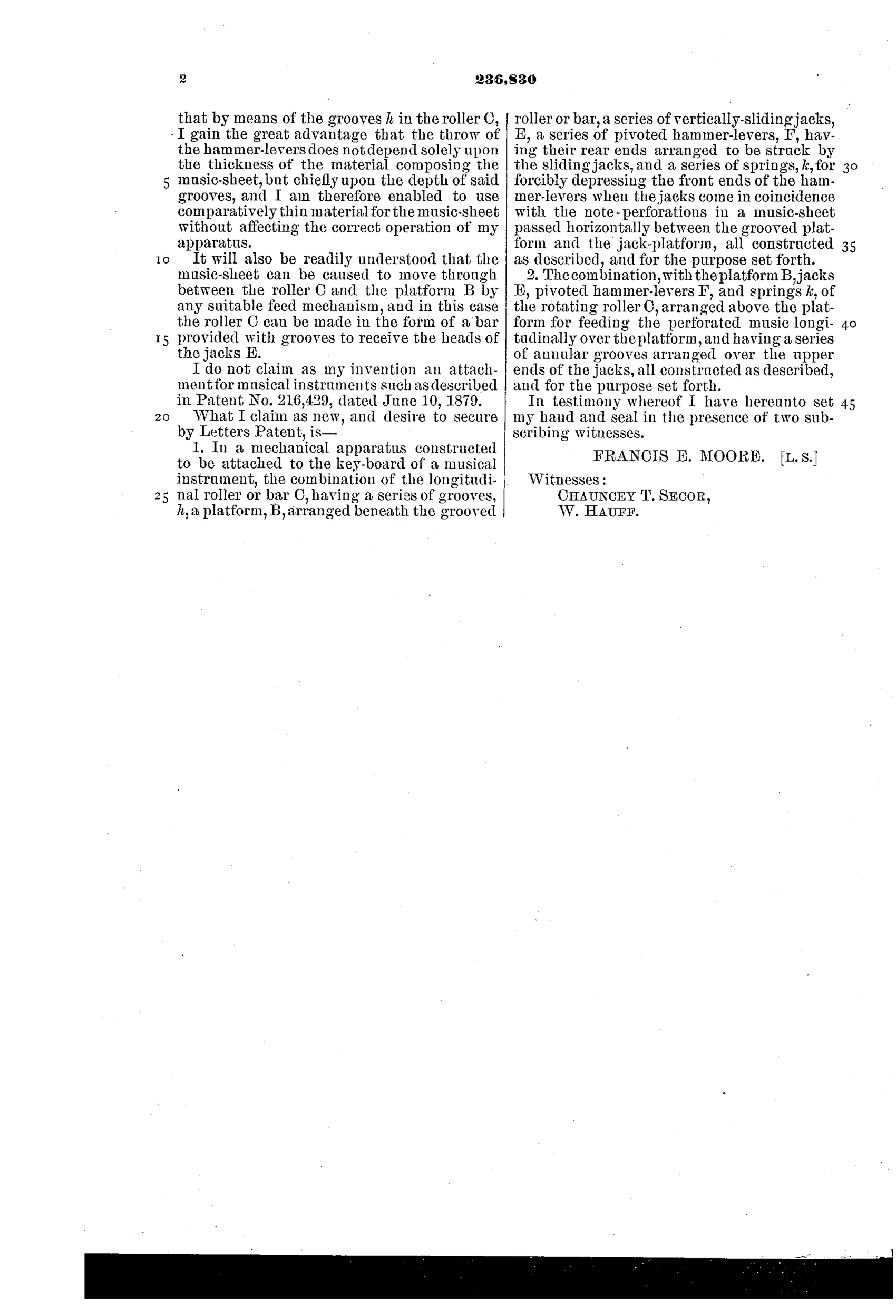
“In a mechanical apparatus constructed to be attached to the key-board of a musical instrument, the combination of the longitudinal roller or bar C, having a series of grooves, h, a platform, B, arranged beneath the grooved roller or bar, a series of vertically-sliding jacks, E, a series of pivoted hammer-levers, F, having their rear ends arranged to be struck by the sliding jacks, and a series of springs, k, for forcibly depressing the front ends of the hammer-levers when the jacks come in coincidence with the note-perforations in a music-sheet passed horizontally between the grooved platform and the jack-platform, all constructed as described, and for the purpose set forth.”
In plain English: The device combines a grooved feed roller, a platform, sliding jacks, spring-loaded hammer-levers, and a perforated music-sheet so that when a jack aligns with a perforation, the corresponding lever strikes the key.
♫ In the inventor’s words
“It will be readily seen from this description that by means of the grooves h in the roller C, I gain the great advantage that the throw of the hammer-levers does not depend solely upon the thickness of the material composing the music-sheet, but chiefly upon the depth of said grooves, and I am therefore enabled to use comparatively thin material for the music-sheet without affecting the correct operation of my apparatus.”— Francis E. Moore, from the specification
Fate unknown
No production example or maker tie is documented for this independent New York patent; a surviving marked attachment or trade-catalog listing would settle it.
♫ Commentary
Moore's box sits on top of an ordinary keyboard and plays it for you: crank a perforated paper sheet under a row of sliding jacks, and wherever a hole appears, a jack drops, releasing a spring-loaded hammer-lever that pushes down the key. It's a push-up player in embryo — the class of machine Aeolian would make famous with the pneumatic Pianola in 1897 — but done here entirely with springs and levers, no bellows anywhere.
The detail Moore was proudest of is the one worth stopping on: the feed roller is grooved. Without the grooves, the jack's travel would depend on the thickness of the paper — a sheet a few thousandths thicker or thinner would change the hammer stroke and the touch on every note. By letting each jack drop into a groove, the throw is set by the metal, not the paper, so cheap thin stock works. That's a real insight about tolerancing a paper-reading mechanism, and it anticipates the tracker-bar problem pneumatic players later solved with air.
The weakness is dynamics. Spring-fired levers give one loudness, always, and the crank speed is the only tempo control — fine on a reed organ, wooden on a piano. Mechanical (non-pneumatic) key-strikers like this were tried repeatedly in the 1870s-80s, and none of them stuck; the market waited for wind.
Commentary by Claude, The Talking Machine Patent Archive’s resident enthusiast