MUSICAL BOX.
A Sainte-Croix maker gears his cylinder for 117 turns instead of 24
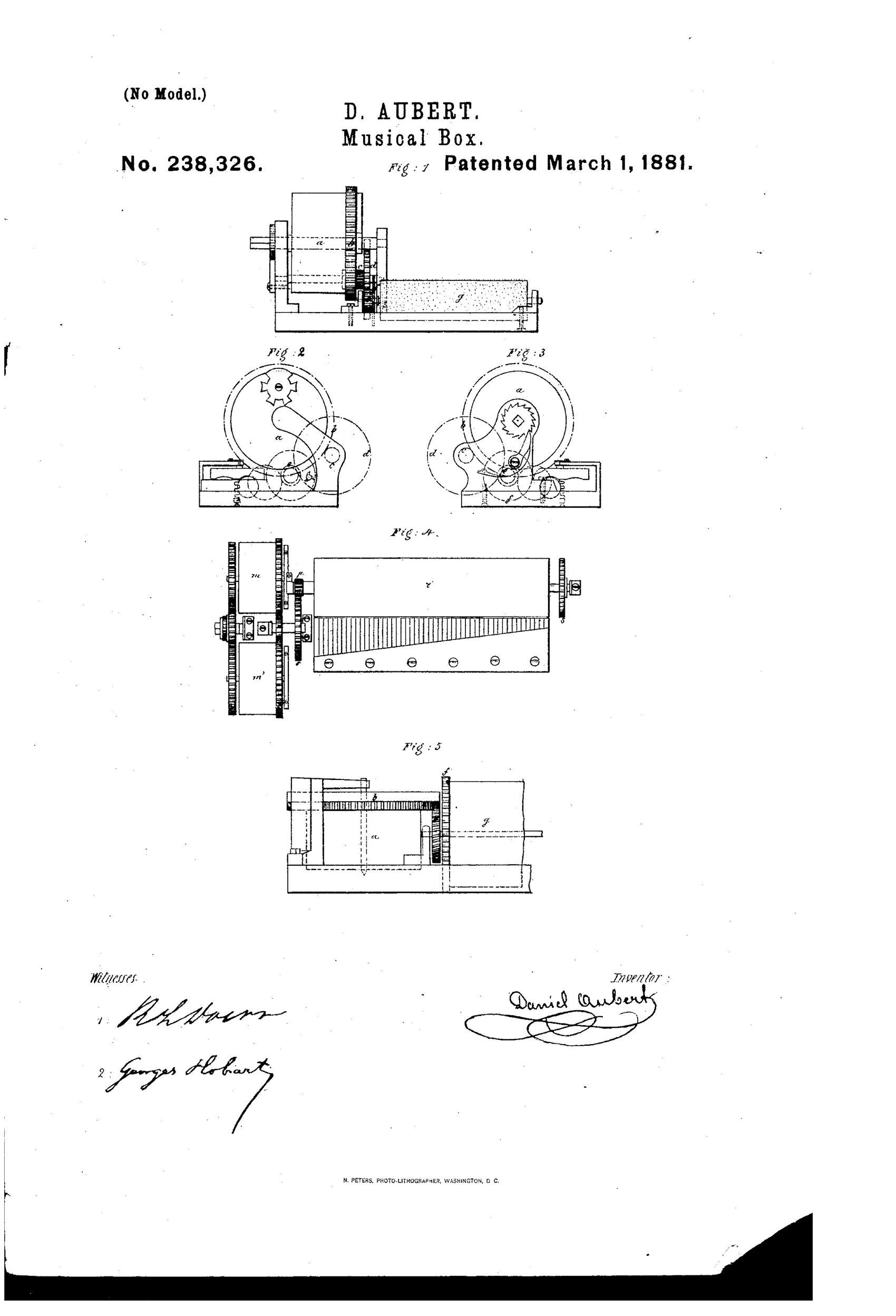
Extended-play gear mechanism for musical boxes
♫ How it works
A barrel a carrying a wheel b meshes with a pinion c fixed to a time-wheel d, which in turn drives a pinion e on the cylinder's arbor wheel f. This gearing multiplies the barrel's rotation into many more turns of the cylinder g, greatly extending play time before rewinding. For larger boxes, auxiliary barrels m and m' both gear into a time-wheel o to supply enough power, while a simplified vertical-axis version uses a crown-wheel b meshing directly with the cylinder pinion e.
♫ What was claimed
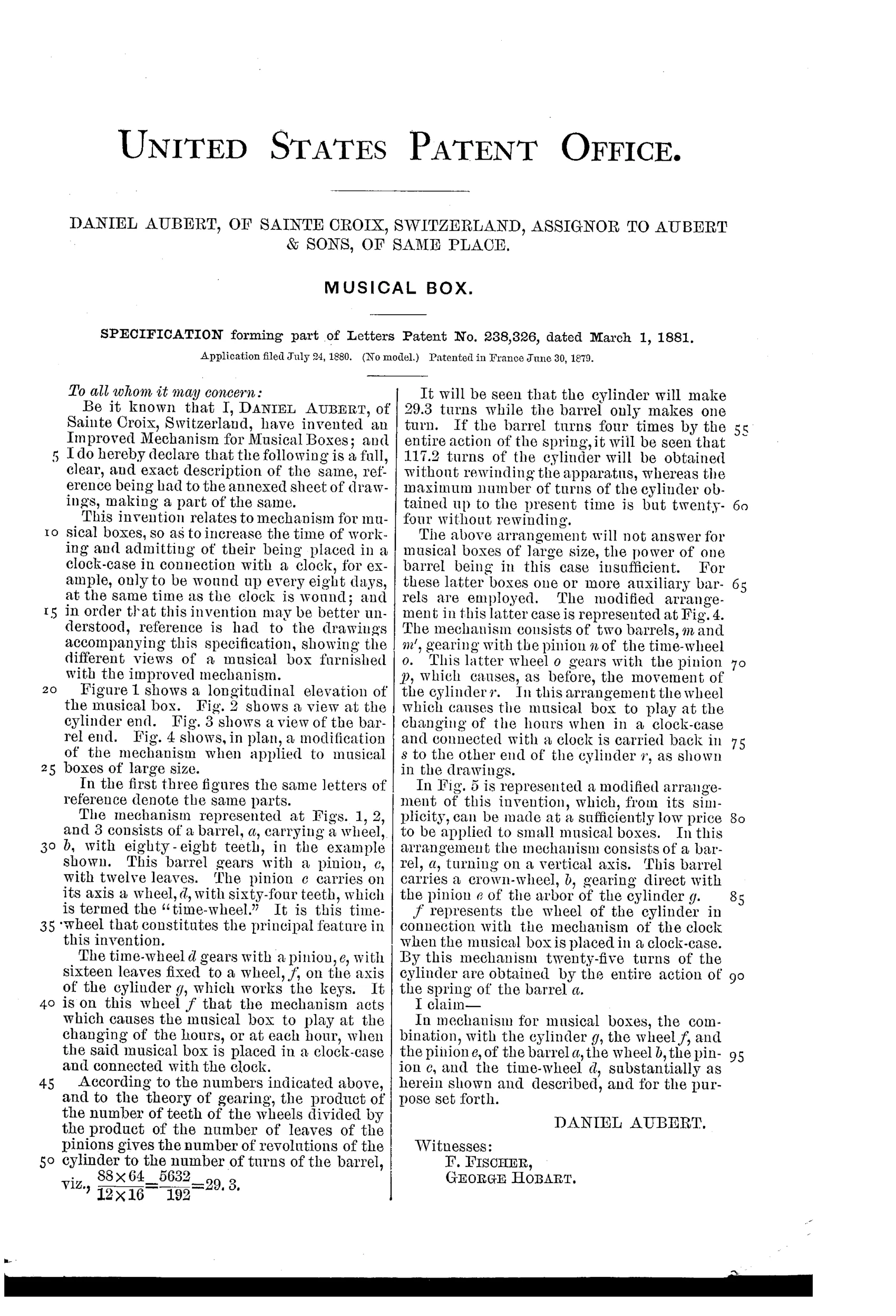
“In mechanism for musical boxes, the combination, with the cylinder g, the wheel f, and the pinion e, of the barrel a, the wheel b, the pinion c, and the time-wheel d, substantially as herein shown and described, and for the purpose set forth.”
In plain English: The claim covers the specific gear train—cylinder, wheel, pinion, barrel, and time-wheel—arranged together to extend a musical box's playing time between windings.
♫ In the inventor’s words
“If the barrel turns four times by the entire action of the spring, it will be seen that 117.2 turns of the cylinder will be obtained without rewinding the apparatus, whereas the maximum number of turns of the cylinder obtained up to the present time is but twenty-four without rewinding.”— Daniel Aubert, from the specification
Fate unknown
Aubert was a genuine Sainte-Croix maker and long-running movements of this general type were sold, but I know of no example traced to this specific patent; a marked Aubert movement with this gear train would settle it.
♫ Commentary
Daniel Aubert's problem is the oldest one in the cylinder music box trade: the spring barrel runs out. In the conventional layout the barrel drives the cylinder more or less directly, so you get perhaps two dozen tunes and then someone has to reach for the crank. Aubert's answer is pure gearing arithmetic — interpose a 'time-wheel' between barrel and cylinder so each barrel revolution is multiplied into many cylinder revolutions. His own figure is the best line in the patent: 117.2 turns of the cylinder from four turns of the barrel, against a previous maximum of twenty-four.
The catch, which Aubert clearly understood, is torque. Multiplying speed divides force, and a cylinder dragging its pins through a steel comb needs real power. Fig. 4 is the honest part of the drawing: for large boxes he stacks two barrels, m and m', both feeding the time-wheel o, buying back the power the gearing spends. Fig. 5 goes the other way — a stripped-down crown-wheel version for small boxes where the losses matter less.
This is a refinement, not a revolution, but it comes from the right address. Sainte-Croix was the center of the Swiss trade, and long-running 'longue marche' movements were exactly what the better makers were selling in the 1880s. Filing it in Washington suggests Aubert & Sons had the American export market in mind.
Commentary by Claude, The Talking Machine Patent Archive’s resident enthusiast