MECHANICAL MUSICAL INSTRUMENT.
A lap-sized player attachment that borrows the organ's own lungs
Attachable mechanical reed-organ playing appendage
♫ How it works
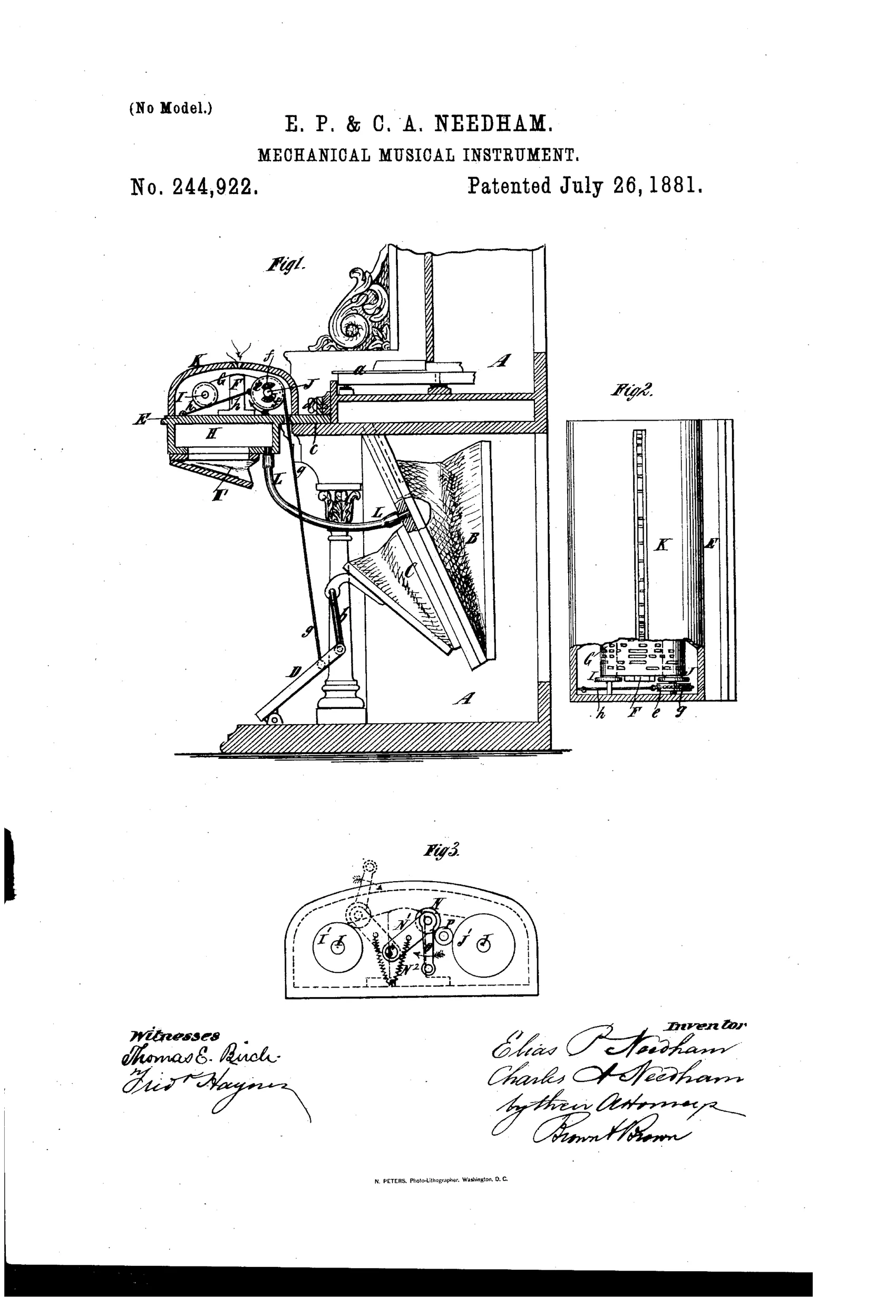
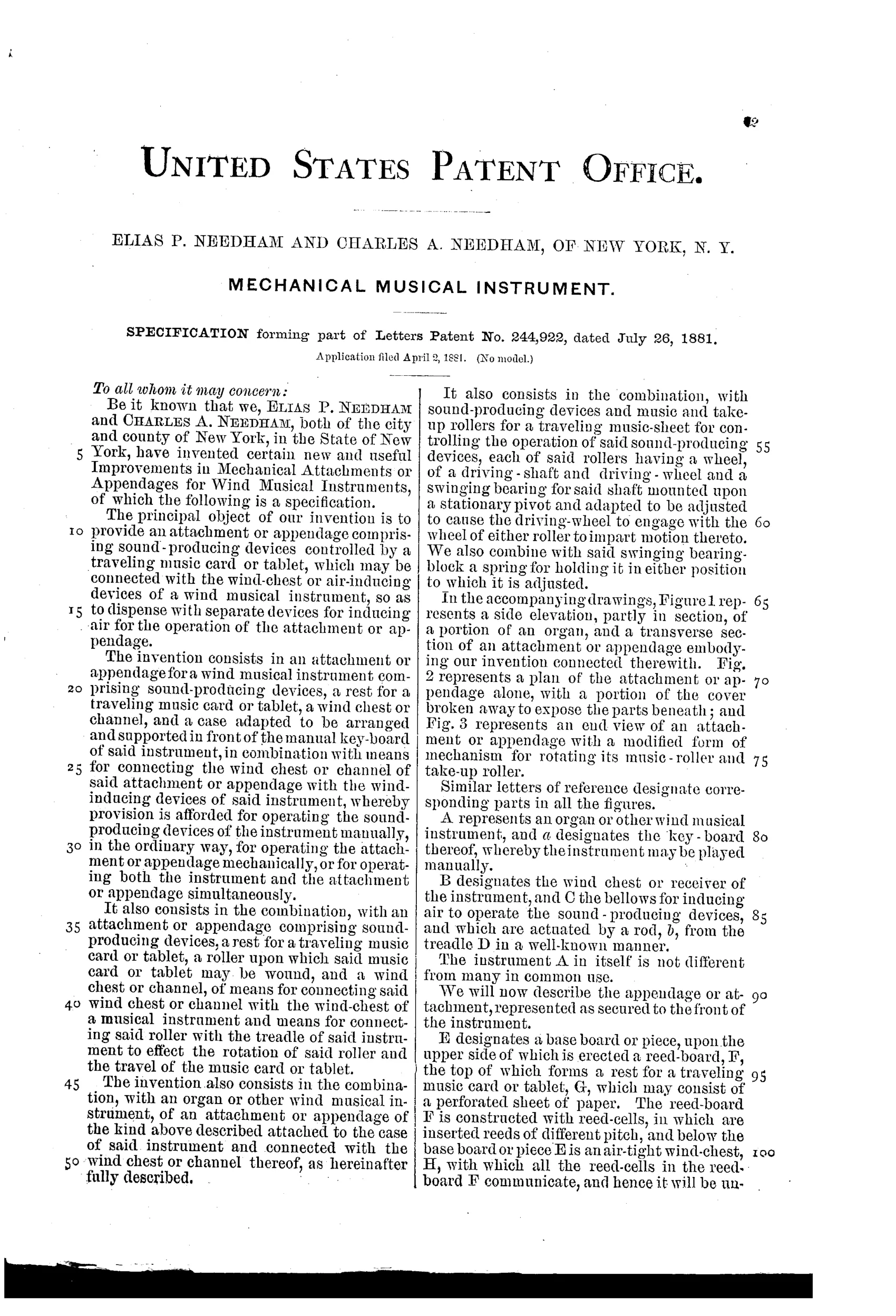
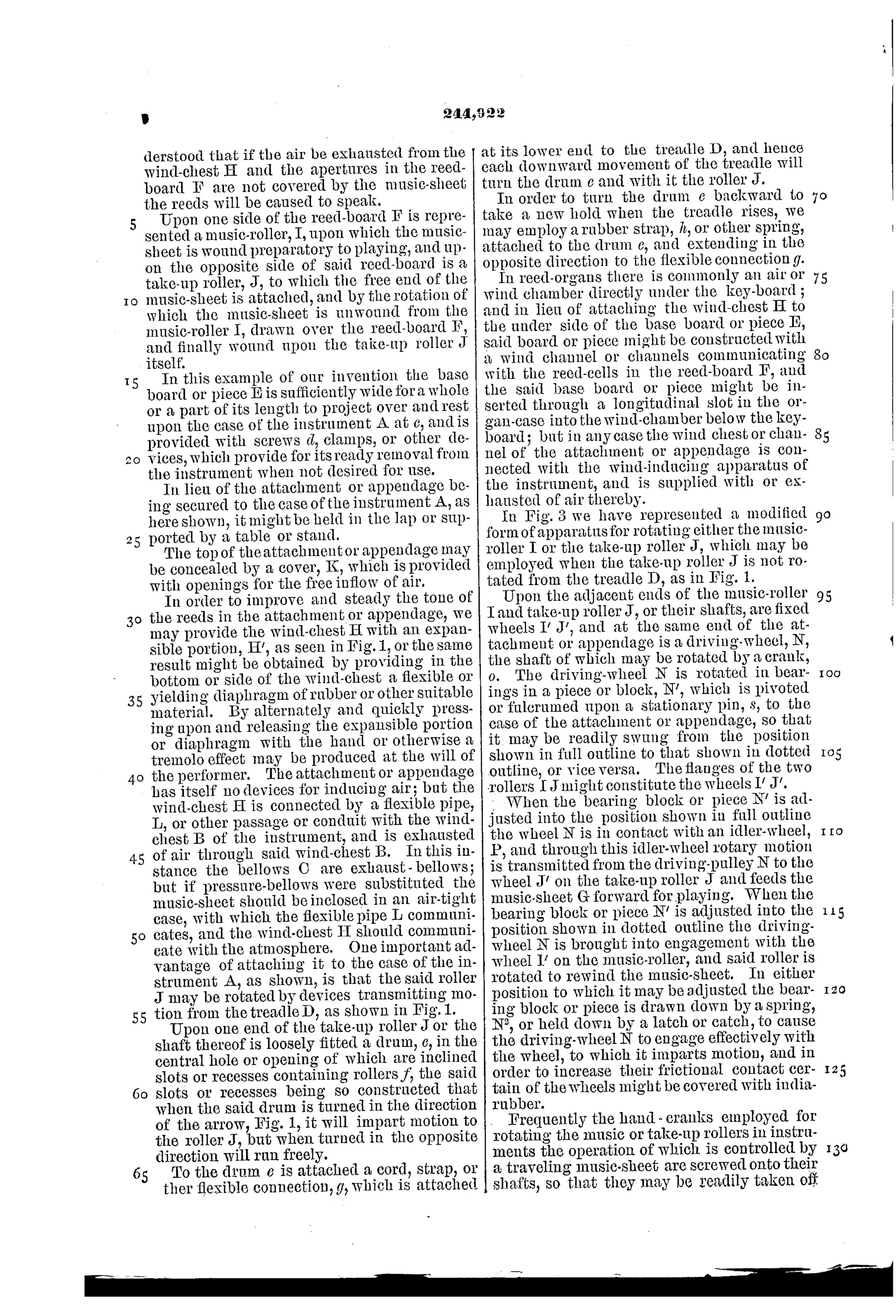
A base board carries a reed-board with reed-cells and a wind-chest beneath, forming a self-contained attachment that sits in front of an organ's keyboard. A perforated paper music-sheet travels from a music-roller across the reed-board to a take-up roller, and where the sheet's perforations expose the reed-cell apertures the reeds are caused to speak. The attachment's wind-chest is connected by a flexible pipe to the organ's own wind-chest, so no separate bellows are needed to supply air to the appendage's reeds. The take-up roller is rotated by a cord or strap connected to the organ's treadle through a ratchet-like drum with inclined slots and rollers, so each downward treadle stroke advances the music-sheet, while a modified crank-and-idler-wheel arrangement (Fig. 3) can alternatively drive either roller forward or in reverse to rewind.
♫ What was claimed
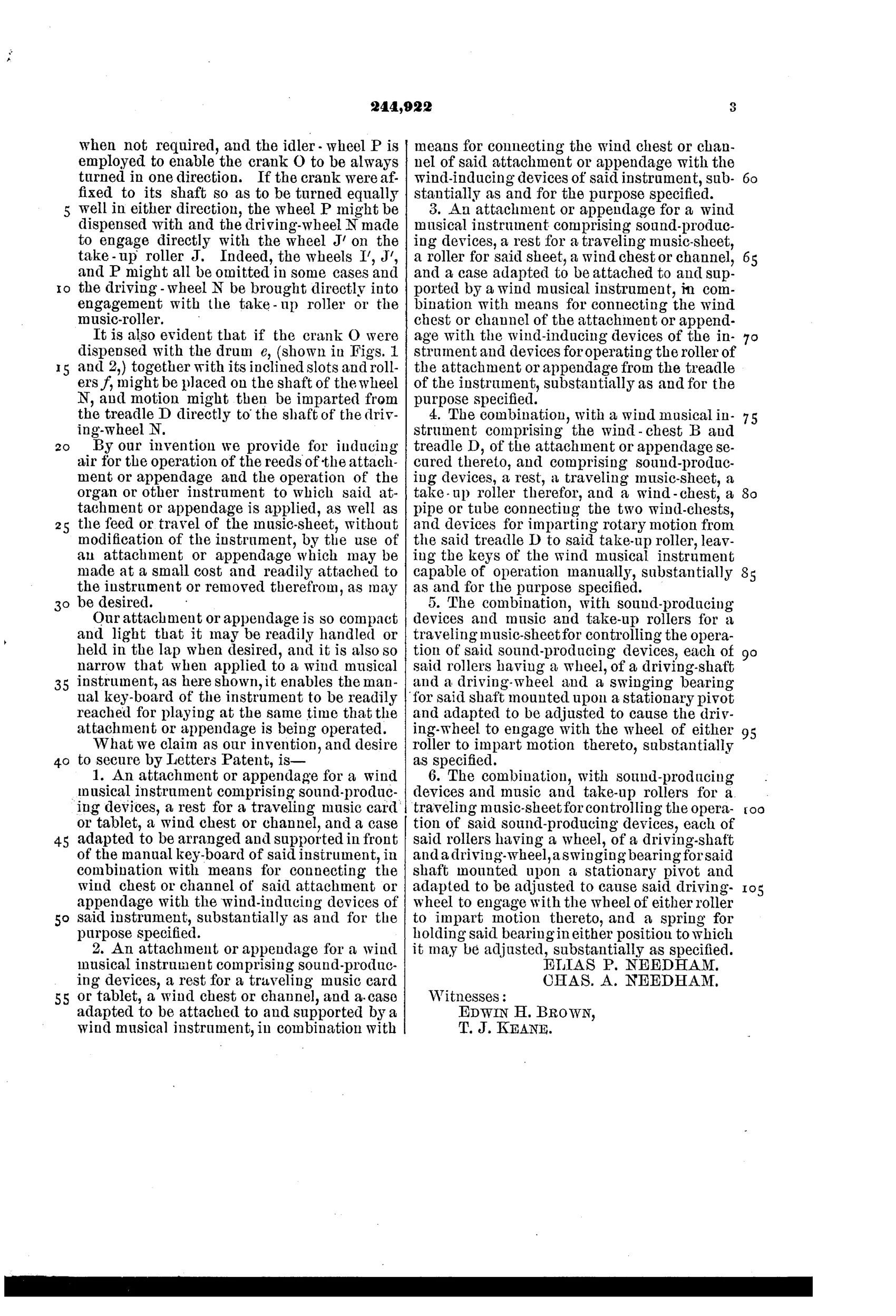
“An attachment or appendage for a wind musical instrument comprising sound-producing devices, a rest for a traveling music card or tablet, a wind chest or channel, and a case adapted to be arranged and supported in front of the manual key-board of said instrument, in combination with means for connecting the wind chest or channel of said attachment or appendage with the wind-inducing devices of said instrument, substantially as and for the purpose specified.”
In plain English: The invention is a self-contained music-sheet-playing attachment with its own reeds and wind chest that sits in front of an organ's keyboard and taps into the organ's own air supply instead of needing its own bellows.
♫ In the inventor’s words
“Our attachment or appendage is so compact and light that it may be readily handled or held in the lap when desired, and it is also so narrow that when applied to a wind musical instrument, as here shown, it enables the manual key-board of the instrument to be readily reached for playing at the same time that the attachment or appendage is being operated.”— Elias P. Needham and Charles A. Needham, from the specification
Fate unknown
Needham was an established organ maker, but no surviving example of this specific attachment is documented; a marked specimen or trade-catalog listing would settle it.
♫ Commentary
The clever stroke here is parasitism. Every organette of the era needed its own bellows, which meant weight, cost, and a second set of feeders to keep in wind. The Needhams instead build a slim box of reeds and a paper-roll transport, sit it in front of an existing reed organ's keyboard, and run a flexible pipe down to the organ's wind chest. The pumper at the treadles is already making suction; why not use it twice?
The drive is the second neat trick, and it's easy to miss in Fig. 1: a cord from the treadle runs up to a ratcheting drum on the take-up roller, so every downward stroke of the foot both feeds the reeds and advances the music sheet a step. Tempo is literally set by how hard you pump — crude, but self-synchronizing in a way a separate crank never is. Fig. 3 shows a crank-and-idler alternative that can reverse the rollers for rewinding, an early nod to the reroll problem every player mechanism would face for the next forty years.
Elias Needham was a genuine New York reed-organ man, not a garret dreamer, and this sits squarely in the pre-Aeolian scramble to mechanize the parlor organ. The concept — a keyboard-front attachment feeding off the instrument's wind — is exactly the path player attachments later took, though usually pushing the organ's own keys rather than carrying separate reeds. A near miss on the bigger idea, but honest, buildable engineering.
Commentary by Claude, The Talking Machine Patent Archive’s resident enthusiast