PIANOFORTE
A Fischer of the New York piano house rethinks the sustain pedal's lifting geometry
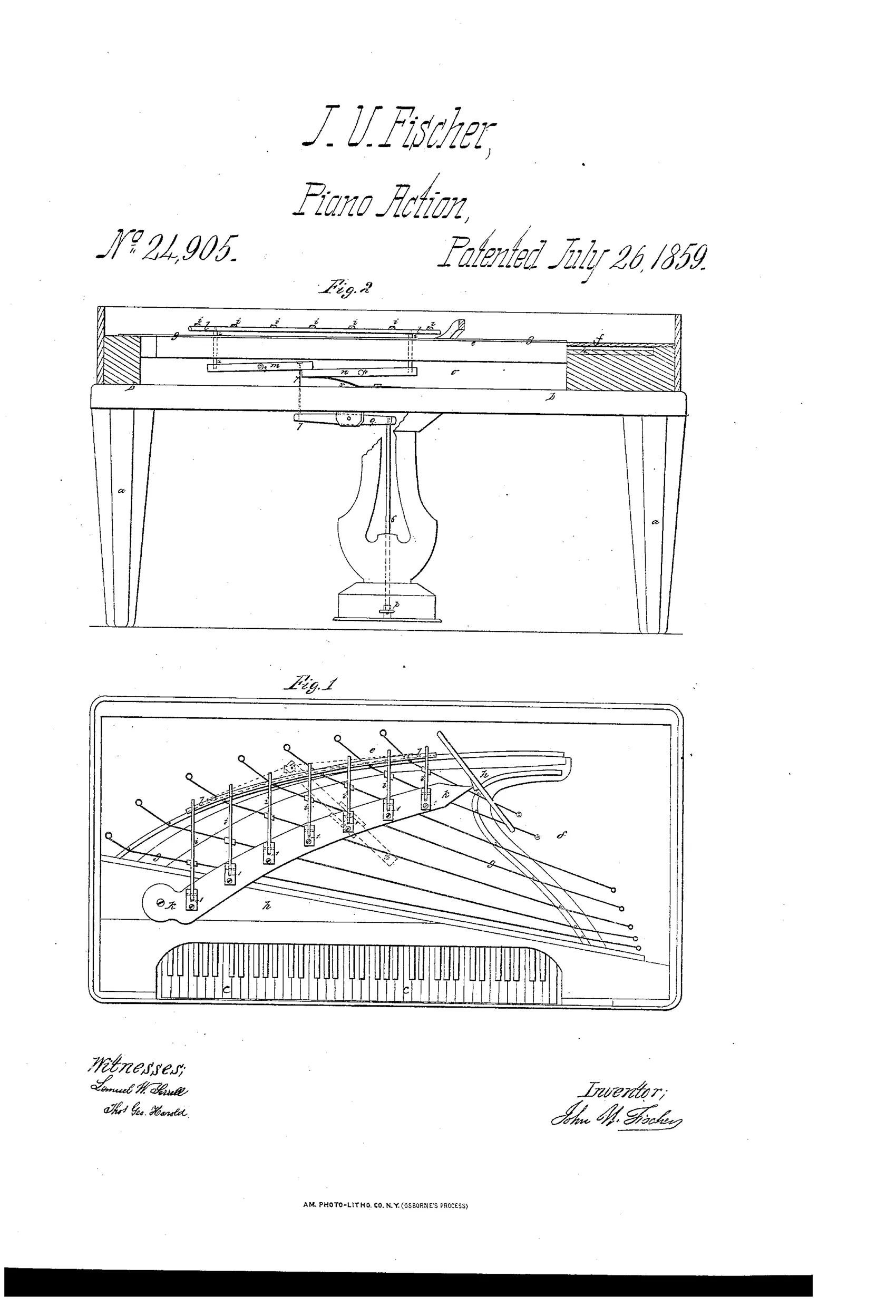
Improved damper-lifting mechanism for piano actions
♫ How it works
A curved metal bar l is placed beneath the dampers i,i and above the edge of the rest plank, fitted with vertical pins or rods 2 that pass through holes in the rest plank and rest on levers m,n mounted on fulcrums in the rest plank block. A spring 5 normally holds the levers apart, lowering the outer ends and the bar l, while depressing the pedal p raises rod 6, lever q, and link 7, which pivots levers m,n and lifts bar l, thereby raising the outer ends of the dampers while their inner fulcrum ends remain stationary in the bearing plate k. This design removes strain from the damper fulcrums and jaws that would otherwise be caused by a rocking or inclined lifting motion, making the pedal attachment more durable and easier to operate.
♫ What was claimed
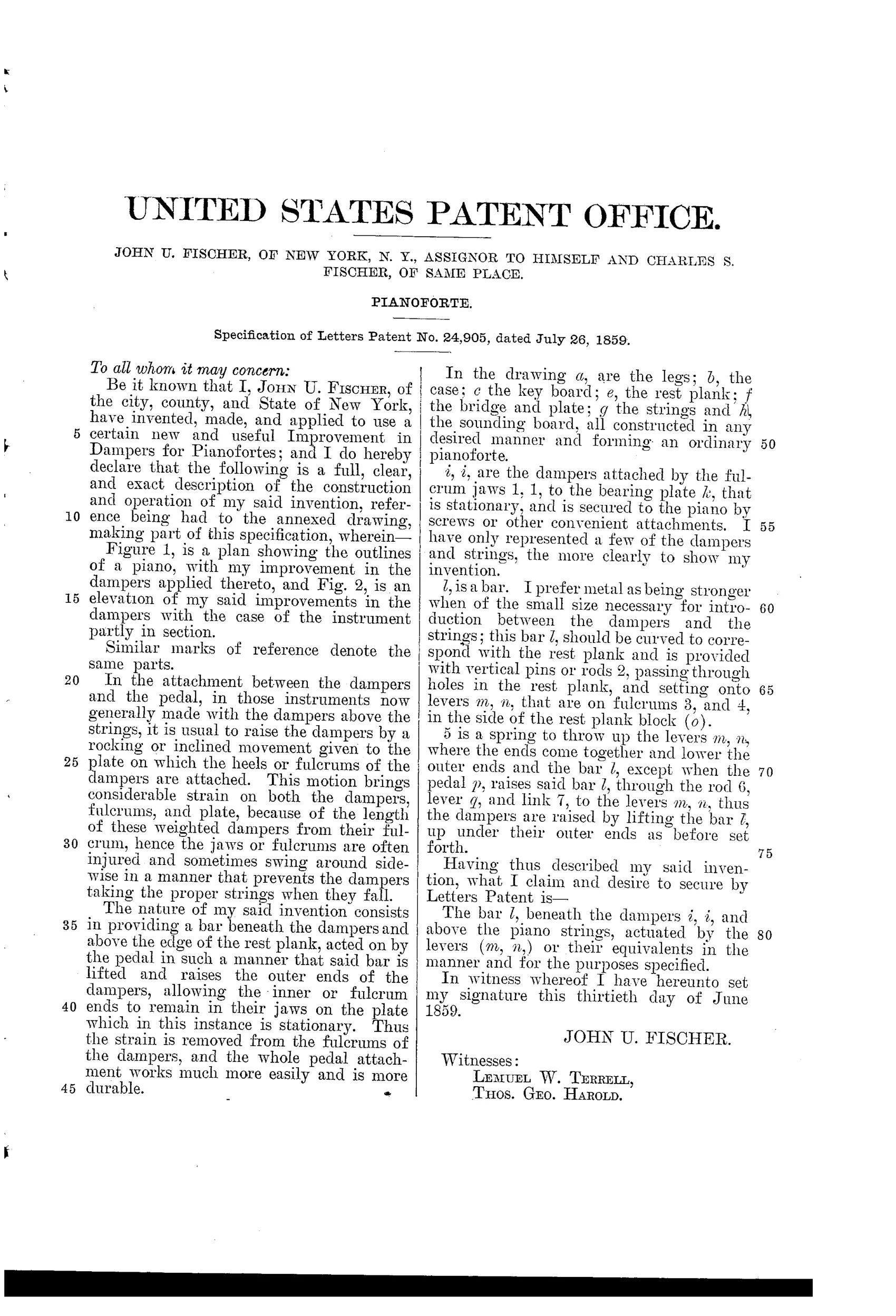
“The bar l, beneath the dampers i, i, and above the piano strings, actuated by the levers (m, n,) or their equivalents in the manner and for the purposes specified.”
In plain English: The invention claims a curved bar positioned beneath the dampers and above the strings, moved by paired levers to lift the dampers' outer ends while keeping their fulcrums stationary.
♫ In the inventor’s words
“The nature of my said invention consists in providing a bar beneath the dampers and above the edge of the rest plank, acted on by the pedal in such a manner that said bar is lifted and raises the outer ends of the dampers, allowing the inner or fulcrum ends to remain in their jaws on the plate which in this instance is stationary.”— John U. Fischer, from the specification
Fate unknown
The Fischer firm certainly built pianos in quantity, but whether this specific damper linkage entered their production would take a surviving square piano with this mechanism to confirm.
♫ Commentary
Before the phonograph, the patent office's music section was mostly piano hardware, and this one comes from serious people: John U. Fischer, assigning to Charles S. Fischer — the family behind J. & C. Fischer, one of New York's established piano houses of the era. That pedigree alone lifts it above the usual small-shop entry.
The problem is subtle and real. A sustain pedal has to lift dozens of dampers at once, and if the lifting motion rocks or tilts them, it grinds away at the fulcrums and jaws that hold each damper in place. Fischer's answer is a curved bar running under the whole rank of dampers, above the strings, raised by paired levers under the rest plank. Press the pedal, and the bar lifts every damper's outer end in a clean vertical stroke while the inner fulcrum ends stay seated in their bearing plate. No twisting, no side strain — the wear points simply don't move.
Fig. 2 is the one to study: follow rod 6 up from the pedal through lever q and link 7 to the paired levers m and n, with spring 5 holding everything down at rest. It's a straightforward force path with the elegance of doing less — the dampers pivot exactly as designed, never fighting the pedal. For our purposes it's context: this is the mechanical-music craft tradition that Edison's diaphragm-and-stylus world would later borrow its precision from.
Commentary by Claude, The Talking Machine Patent Archive’s resident enthusiast