MECHANICAL MUSICAL INSTRUMENT
One crank does everything: bellows, paper feed, and a self-coiling take-up tube
Player-instrument reading perforated paper music sheets
♫ How it works
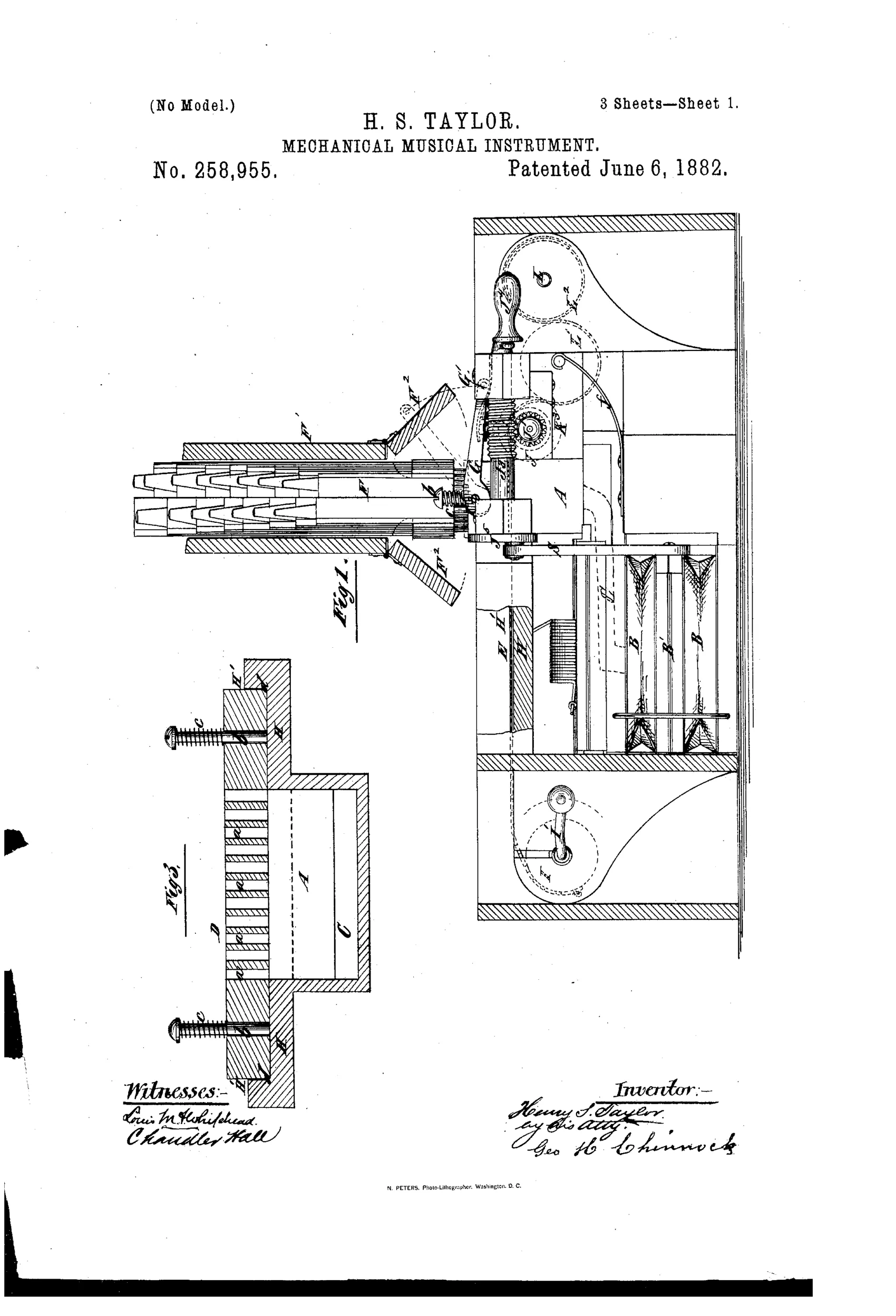
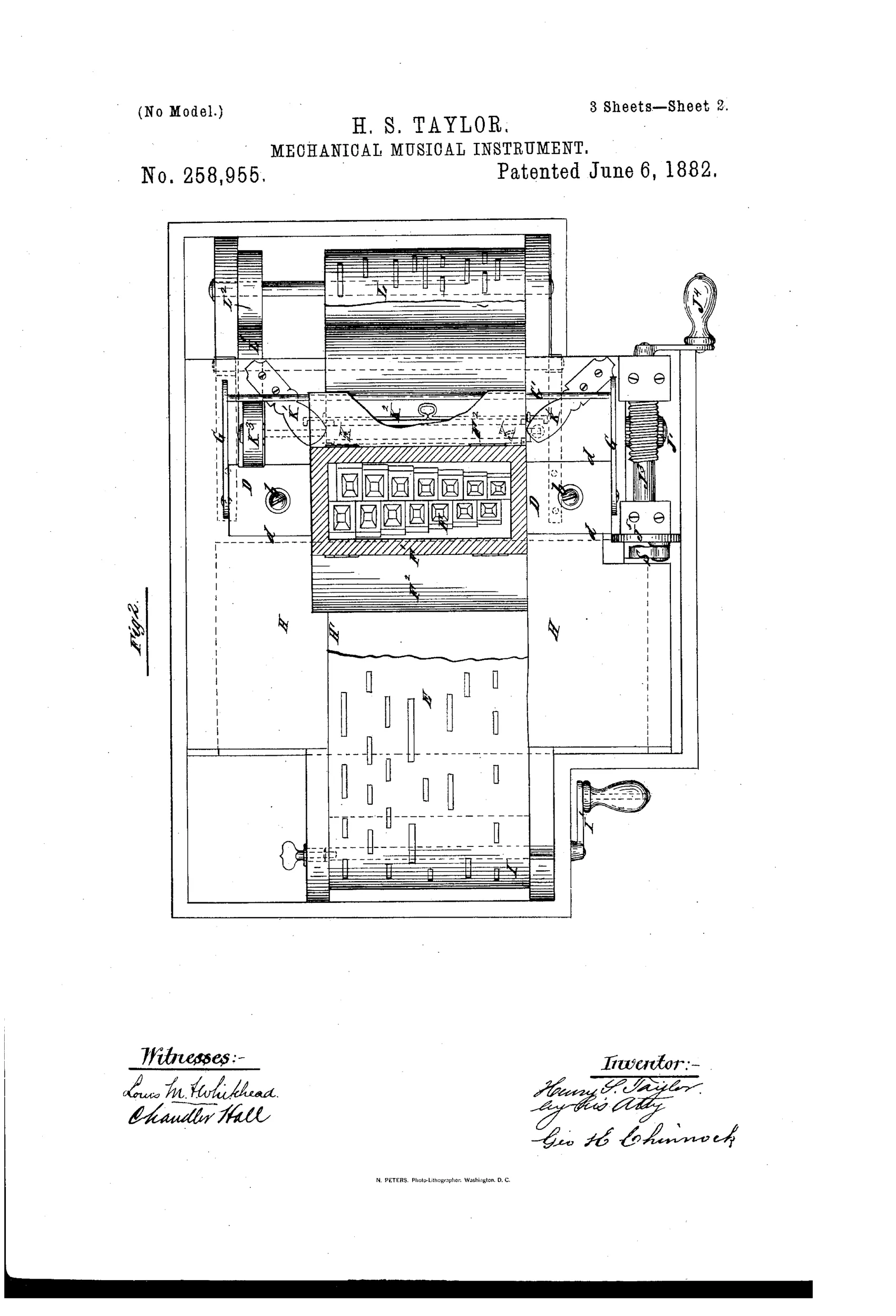
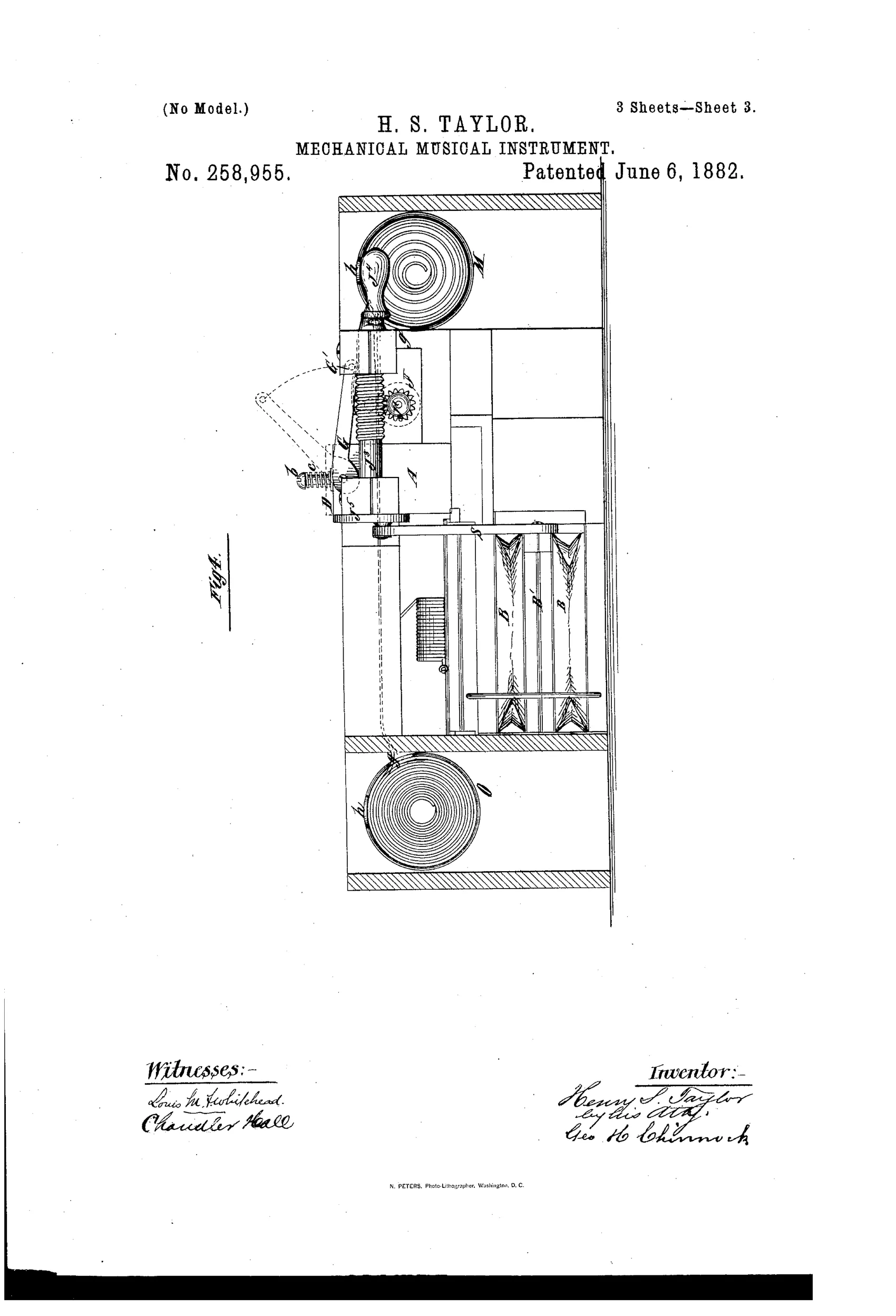
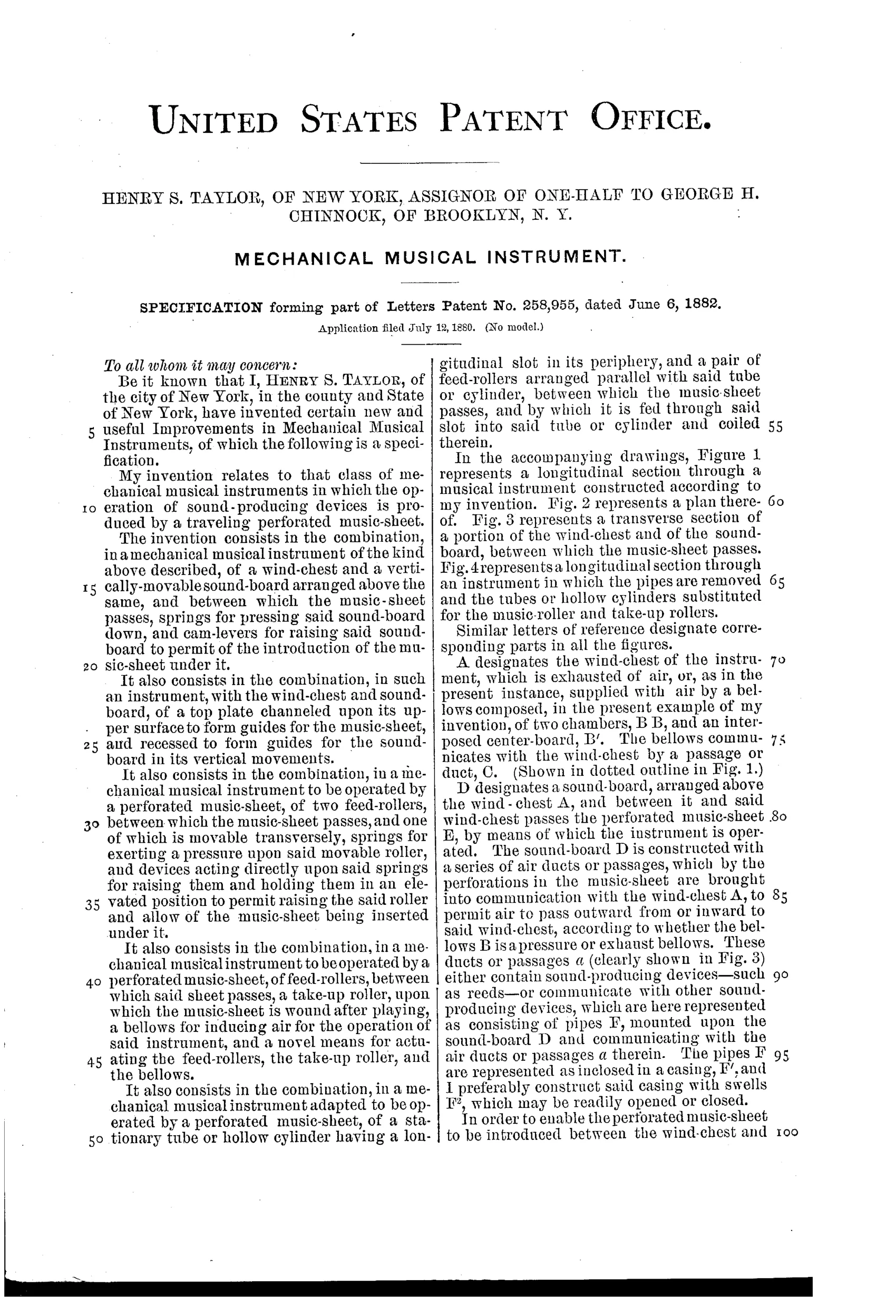
A wind-chest supplies air via a bellows to a movable sound-board perforated with air ducts, above which a perforated paper music-sheet passes between the chest and pipes or reeds mounted on the sound-board. Springs press the sound-board down against the wind-chest while cam-levers can raise it to allow a fresh music-sheet to be threaded underneath. A crank turns a screw that drives a worm-wheel on the lower feed-roller, which together with a spring-loaded upper roller advances the perforated sheet, while the same crank motion also actuates the bellows and a friction-wheel take-up roller that winds the played sheet. As an alternative to a take-up roller, the sheet can be fed through a slotted stationary tube or hollow cylinder, coiling itself inside as it is fed, with a notch allowing the roll to be withdrawn by hand.
♫ What was claimed
“The combination of the wind-chest A, the movable sound-board D, constructed with ducts or passages a, the springs c, and the cam-levers G, all substantially as specified.”
In plain English: The invention claims the combination of a wind-chest, a movable perforated sound-board held down by springs, and cam-levers used to raise that sound-board for inserting a music sheet.
♫ In the inventor’s words
“By my invention I produce a simple and cheap instrument adapted for use with either pipes or reeds, and which is very easily operated.”— Henry S. Taylor, from the specification
Fate unknown
The half-interest assignment to Chinnock suggests commercial intent, but no marked instrument is documented; a surviving example would settle it.
♫ Commentary
Filed in 1880, this drops Taylor squarely into the organette boom — the decade when small shops across New York and New England raced to put perforated-paper music into parlors before Edison's phonograph was anything more than a tinfoil curiosity. His pitch is honest and typical of the moment: a simple, cheap instrument working with pipes or reeds, turned by one crank.
The claimed combination is the loading mechanism, and it's a sensible one. The perforated sound-board is spring-pressed against the wind-chest to seal it, and cam-levers lift the whole board so a fresh music sheet can be threaded underneath without fighting the springs. Anyone who has wrestled a paper roll into a tight tracker bar will appreciate the courtesy. The single crank is doing triple duty — worm-driving the lower feed roller, pumping the bellows, and turning a friction take-up — which keeps the parts count down but ties air pressure to paper speed, a coupling that makes sustained notes wheeze if the operator slows.
The quiet gem is Fig. 4: instead of a take-up spool, the played sheet feeds into a slotted stationary tube and coils itself inside, to be plucked out by hand through a notch. It sidesteps rewinding entirely. Whether paper would coil obediently rather than jam is another question, but it's the kind of practical lateral thinking that makes these small patents worth reading.
Commentary by Claude, The Talking Machine Patent Archive’s resident enthusiast