MECHANICAL MUSICAL INSTRUMENT.
Move the booming bass to the middle, and the paper stops tearing
Improved perforated music-sheet layout for mechanical organ
♫ How it works
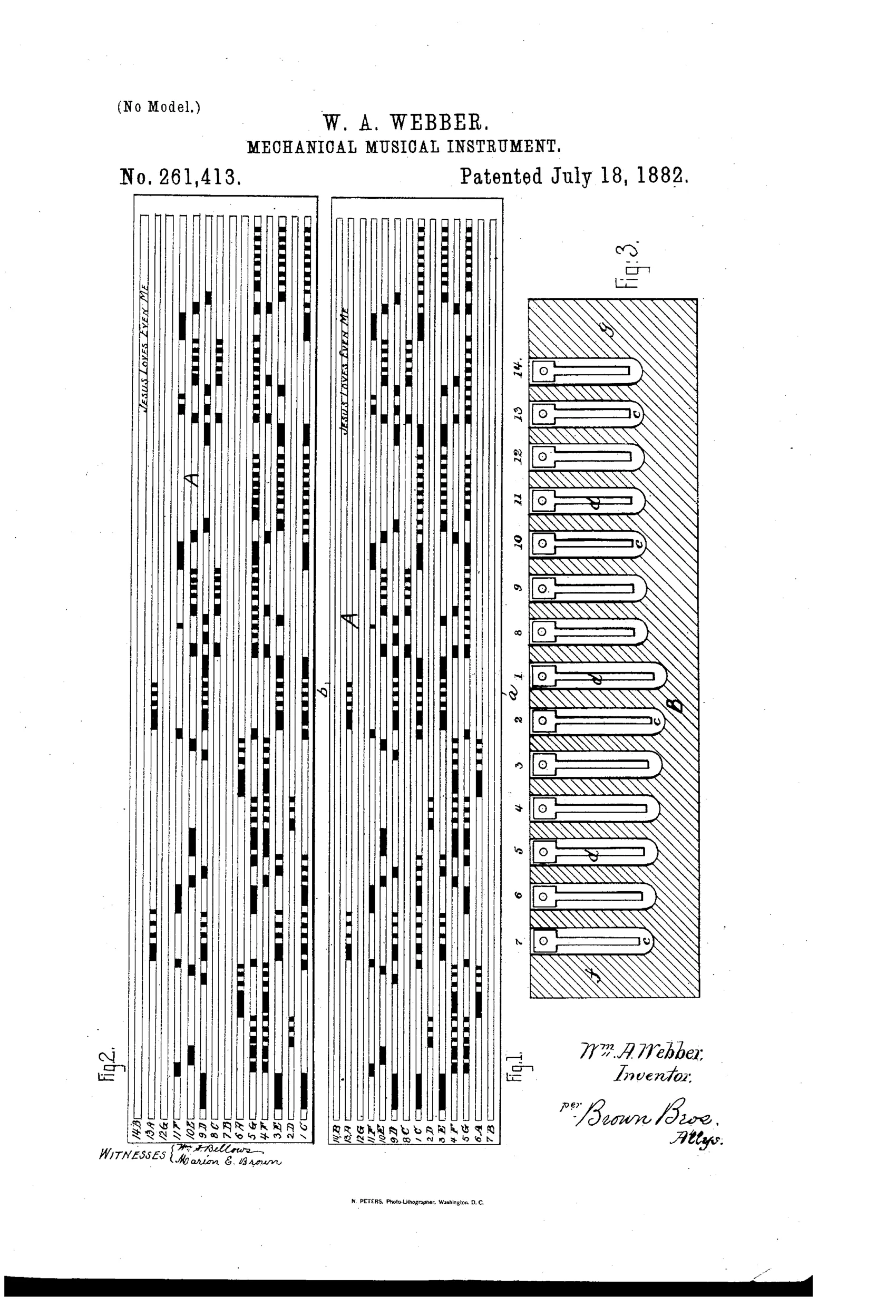
A perforated music-sheet has parallel rows of note-holes running lengthwise, with the lowest bass-note placed at the central row instead of at an edge. The remaining bass-notes are arranged in rows to one side of that center, and all treble-notes in rows to the other side, in regular ascending order toward each edge. A corresponding reed-board has reed-chambers and reeds arranged so the lowest bass-reed sits at the center of the board, with bass-reeds running to one end and treble-reeds running to the other end, matching the new sheet layout. This central placement of the lowest bass-note avoids putting the heavily-repeated, long-duration bass notes at the fragile edge of the paper strip, reducing tearing, air leakage, and sheet displacement during play.
♫ What was claimed
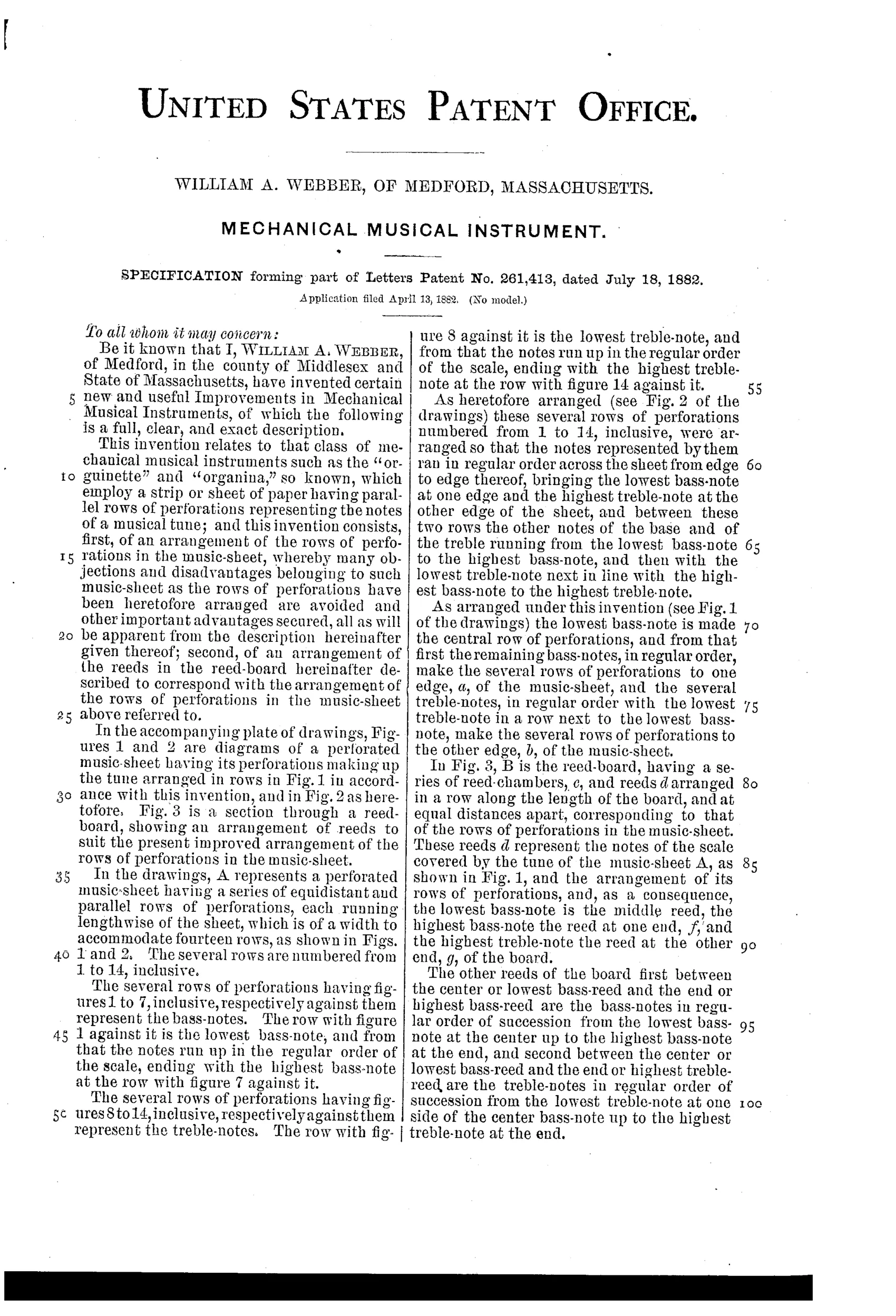
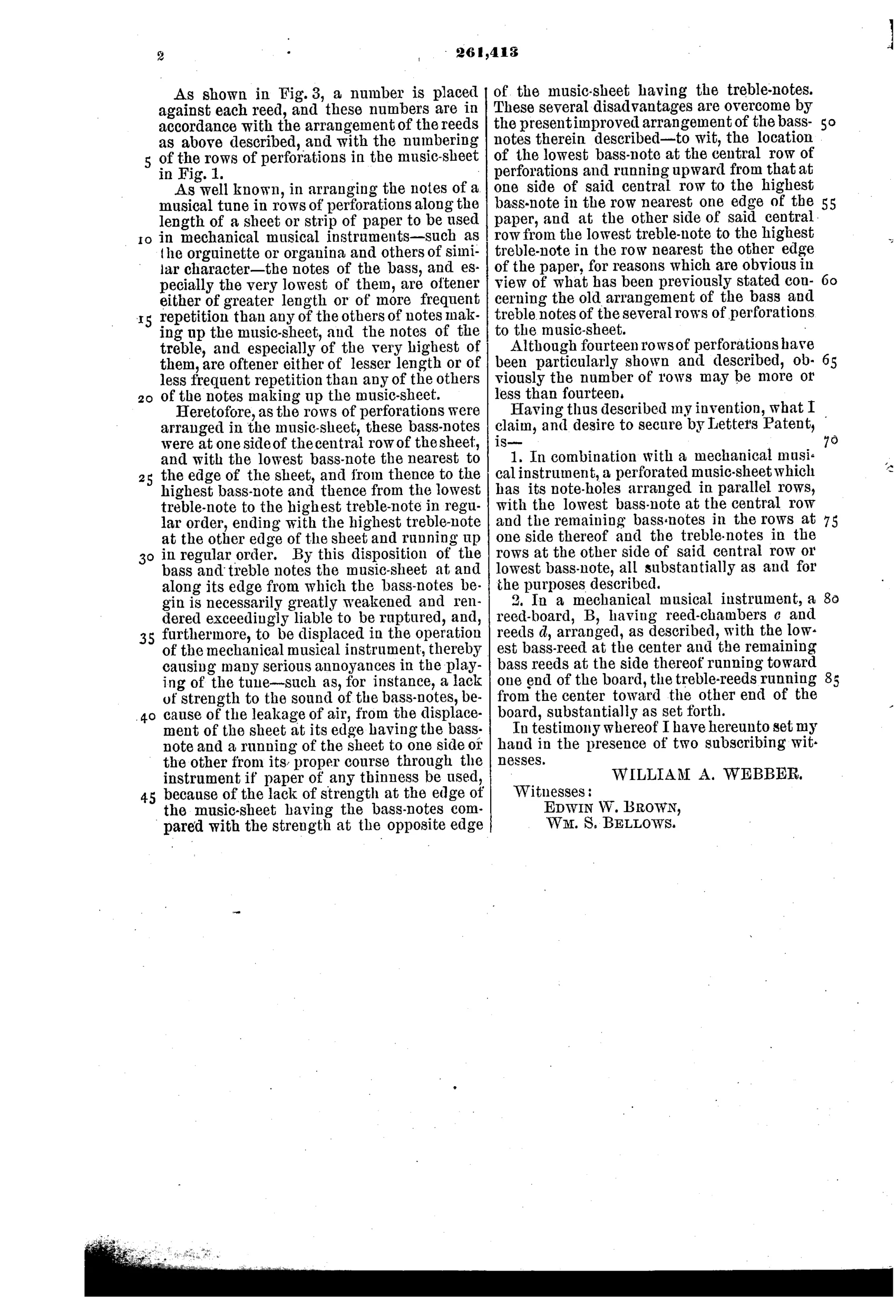
“In combination with a mechanical musical instrument, a perforated music-sheet which has its note-holes arranged in parallel rows, with the lowest bass-note at the central row and the remaining bass-notes in the rows at one side thereof and the treble-notes in the rows at the other side of said central row or lowest bass-note, all substantially as and for the purposes described.”
In plain English: A music sheet for a mechanical instrument where the note-holes are arranged so the lowest bass note is in the middle row, bass notes fan out on one side, and treble notes fan out on the other side.
♫ In the inventor’s words
“By this disposition of the bass and treble notes the music-sheet at and along its edge from which the bass-notes begin is necessarily greatly weakened and rendered exceedingly liable to be ruptured.”— William A. Webber, from the specification
Fate unknown
Organette makers did vary their scale layouts, but no sheet or reed-board firmly tied to this patent is documented; a marked instrument or sheet would settle it.
♫ Commentary
Organette music was cheap perforated paper pulled over a reed-board, and the cheapness was the problem. Webber noticed something any player of these little parlor organs learned the hard way: the lowest bass notes are the long, sustained, endlessly repeated ones, and the conventional scale layout put them in the row nearest the paper's edge. Punch a hymn's worth of long slots along an edge and you've left a fringe of paper held together by hope. It tears, it curls, it leaks air, and the sheet wanders sideways on the tracker bar.
His fix costs nothing mechanically: put the lowest bass note in the center row, fan the rest of the bass out to one side and the treble to the other, and rebuild the reed-board to match. The heavily perforated region moves to the strongest part of the strip, and the edges — which do the guiding — stay intact. Figures 1 and 2 make the argument visually; both sheets carry the same tune ('Jesus Loves Even Me,' legible in the margin), one in each layout, so you can see where the long slots land.
It's a modest patent, but it's the good kind of modest: a materials insight, not a gadget. The catch is compatibility — a center-bass sheet only plays on a center-bass reed-board, so the idea lives or dies on whether a manufacturer committed a whole product line to it.
Commentary by Claude, The Talking Machine Patent Archive’s resident enthusiast