MUSICAL BOX.
Paillard rethinks the tune-changer: a star-wheel with uneven teeth does the indexing
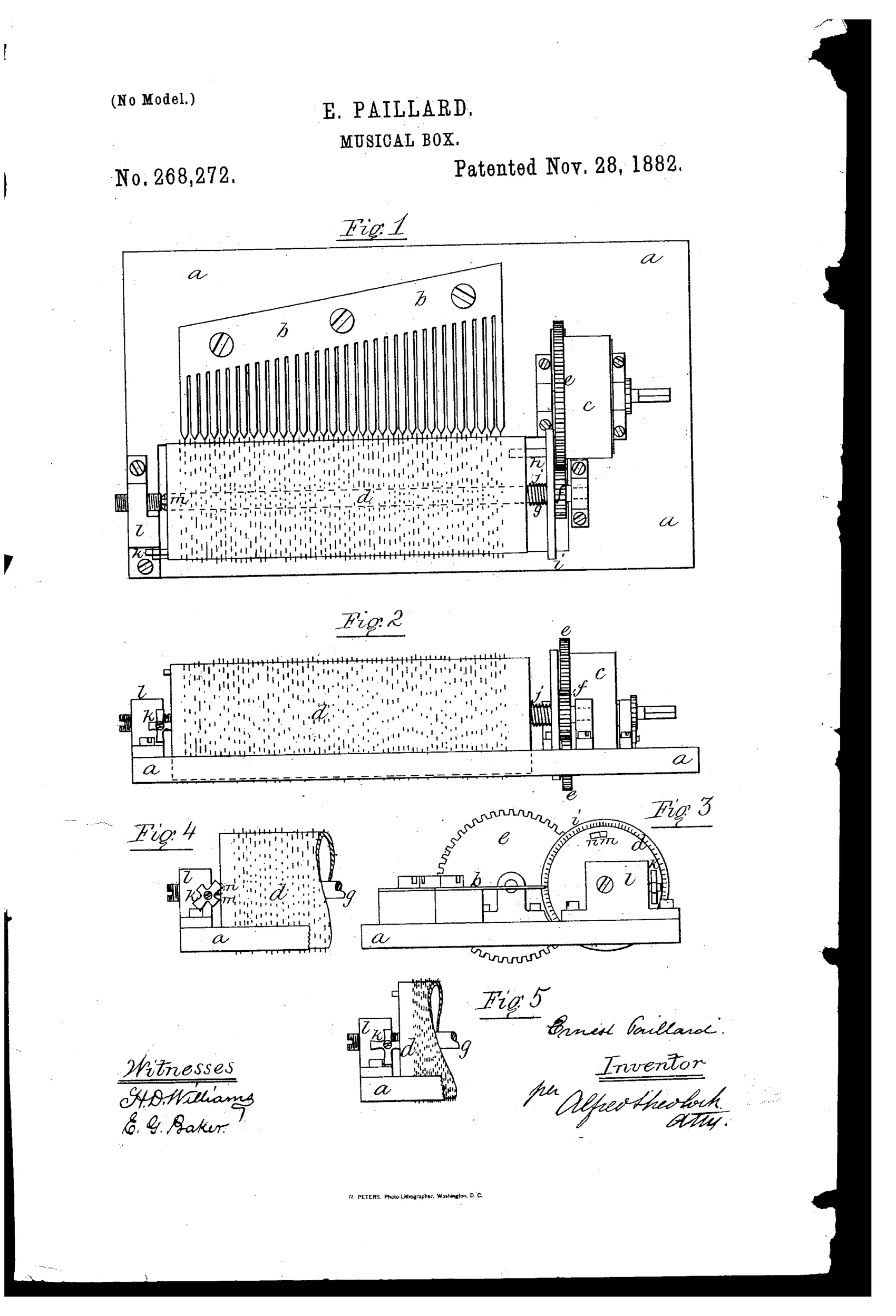
Tune-changer mechanism for cylinder musical boxes.
♫ How it works
A spring-actuated pin-barrel (cylinder) is mounted loosely on a shaft but rotates with it via a stud engaging a flange, and is pressed longitudinally by a spring against a variable-toothed cog-plate pivoted at right angles to the barrel's axis on a fixed bearing-block. A pin secured in the end of the barrel strikes the cog each revolution, advancing the cog-plate one tooth at a time. Because the teeth of the cog-plate vary in length, this shifts the barrel into different longitudinal positions relative to the comb of keys, aligning different sets of pins with the comb to play different tunes consecutively. A depression in the end of the barrel behind the pin ensures proper engagement of the cog's corner as it rotates, guaranteeing accurate indexing between tune positions.
♫ What was claimed
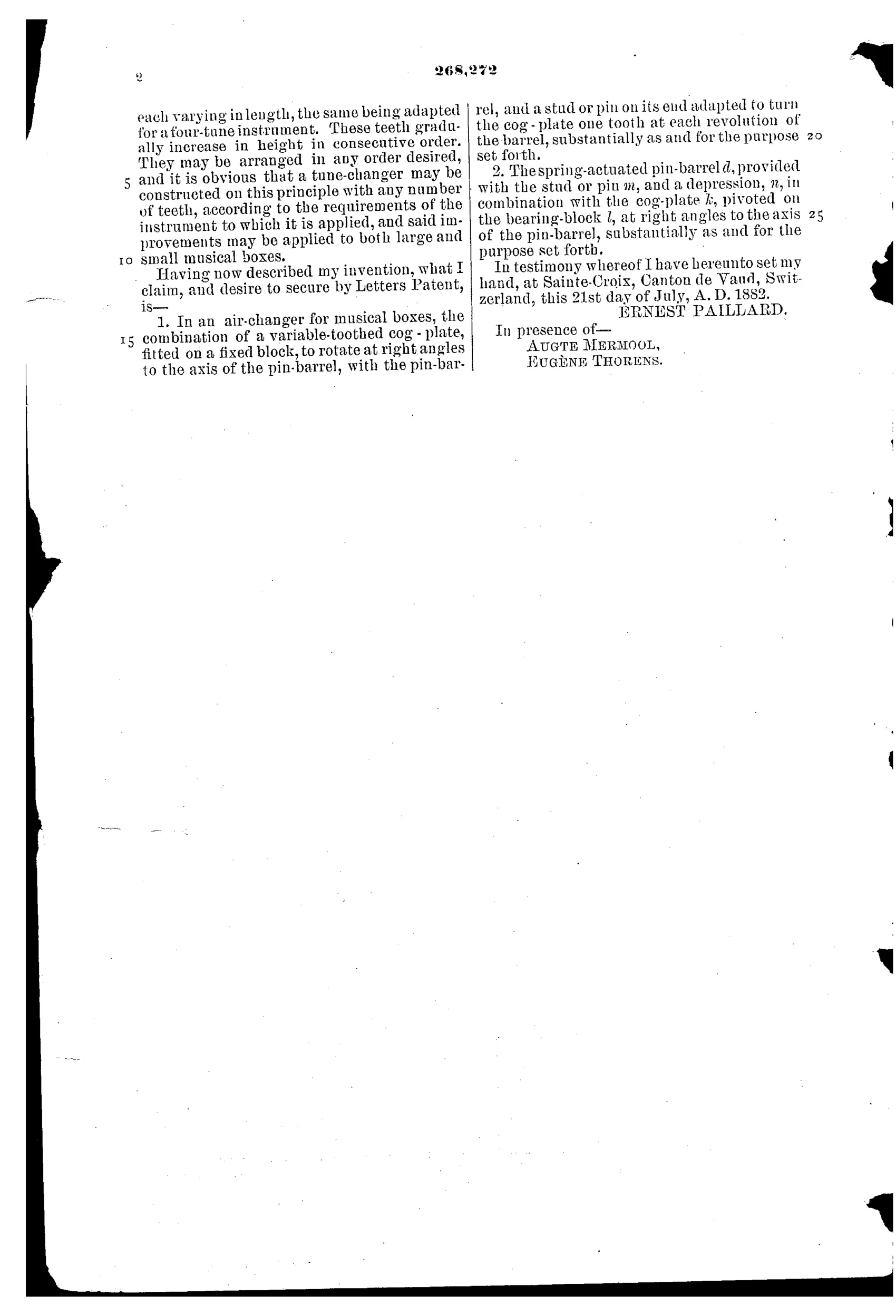
“1. In an air-changer for musical boxes, the combination of a variable-toothed cog-plate, fitted on a fixed block, to rotate at right angles to the axis of the pin-barrel, with the pin-barrel, and a stud or pin on its end adapted to turn the cog-plate one tooth at each revolution of the barrel, substantially as and for the purpose set forth.”
In plain English: The invention combines a cog-plate with teeth of varying length, mounted to rotate at right angles to the music cylinder, with a pin on the cylinder's end that advances the cog-plate one tooth per revolution, thereby shifting the cylinder to select different tunes.
♫ In the inventor’s words
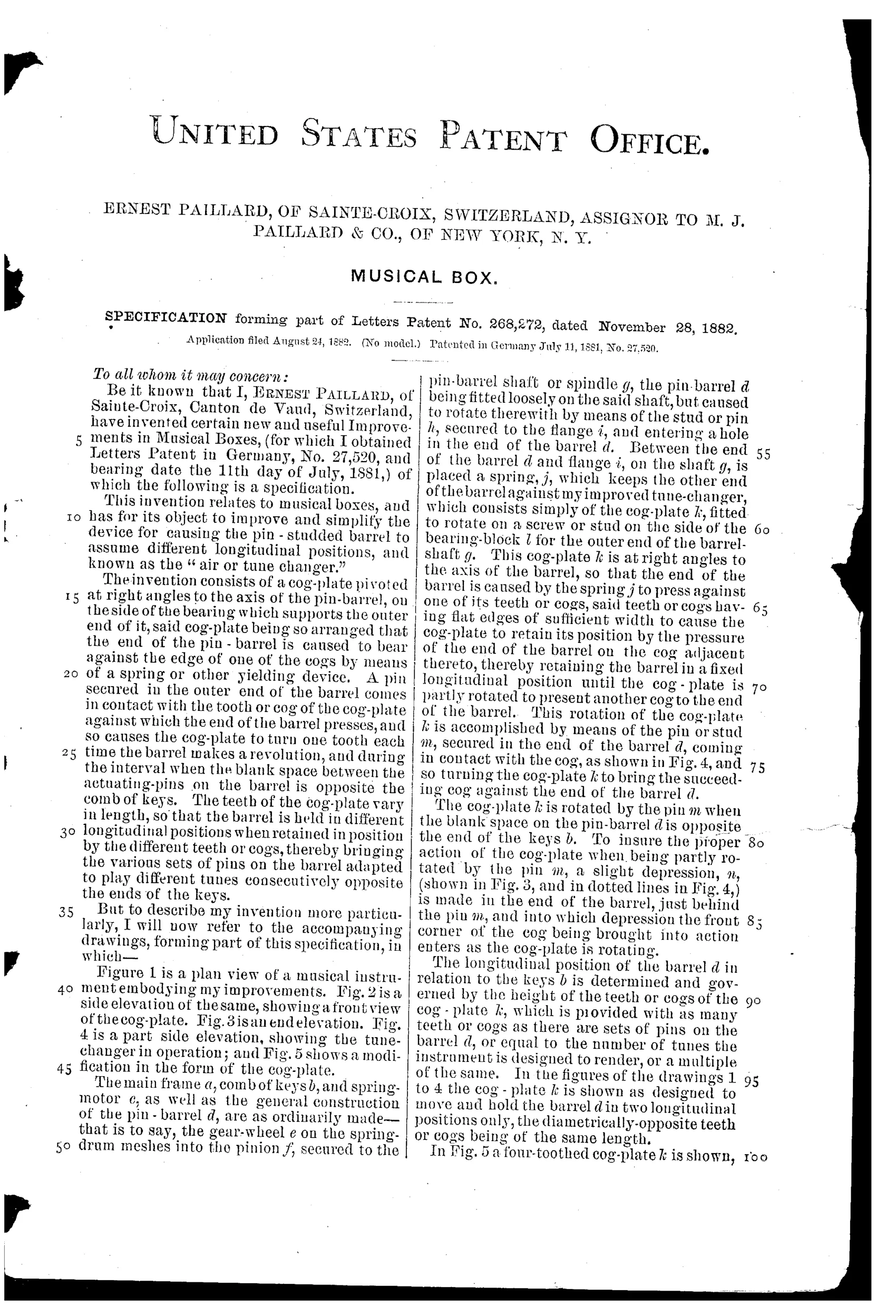
“This invention relates to musical boxes, and has for its object to improve and simplify the device for causing the pin-studded barrel to assume different longitudinal positions, and known as the "air or tune changer."”— Ernest Paillard, from the specification
Manufactured and sold
Paillard was among the largest cylinder music-box makers of the era and this indexing scheme fits their documented production practice, though pinning a surviving box to this exact cog-plate variant takes a workshop teardown.
♫ Commentary
Every multi-tune cylinder box needs a way to slide the pin-barrel sideways so a fresh set of pins lines up with the comb. By 1882 the usual answer was a stepped snail cam riding on the cylinder arbor. Ernest Paillard's version moves the brains off the arbor entirely: a small cog-plate with teeth of deliberately unequal length sits on the fixed bearing block, turning at right angles to the cylinder. A pin in the cylinder's end face kicks the cog one tooth per revolution, and whichever tooth happens to be facing the barrel sets its longitudinal position against the spring pressing it home. Long tooth, one tune; short tooth, another.
The subtle part is in the claims and easy to miss in the drawing: a depression milled into the barrel's end face behind the striking pin, which lets the corner of the cog swing cleanly into engagement. Without it, a tooth corner could hang up mid-index and leave the cylinder between tunes — the classic failure that turns a music box into a discord machine. Fig. 5 shows the idea scaled to four teeth for a four-air box, which tells you Paillard meant this as a production family, not a one-off.
This is refinement, not revolution — but refinement from the house that dominated Sainte-Croix cylinder-box manufacture, assigned to their New York sales arm. Fewer parts on the arbor, positive one-tooth indexing, cheap to make. Exactly the kind of patent a volume manufacturer files.
Commentary by Claude, The Talking Machine Patent Archive’s resident enthusiast