MECHANICAL MUSICAL INSTRUMENT.
A mouth-blown harmonica reads a paper roll — forty years before the Rolmonica
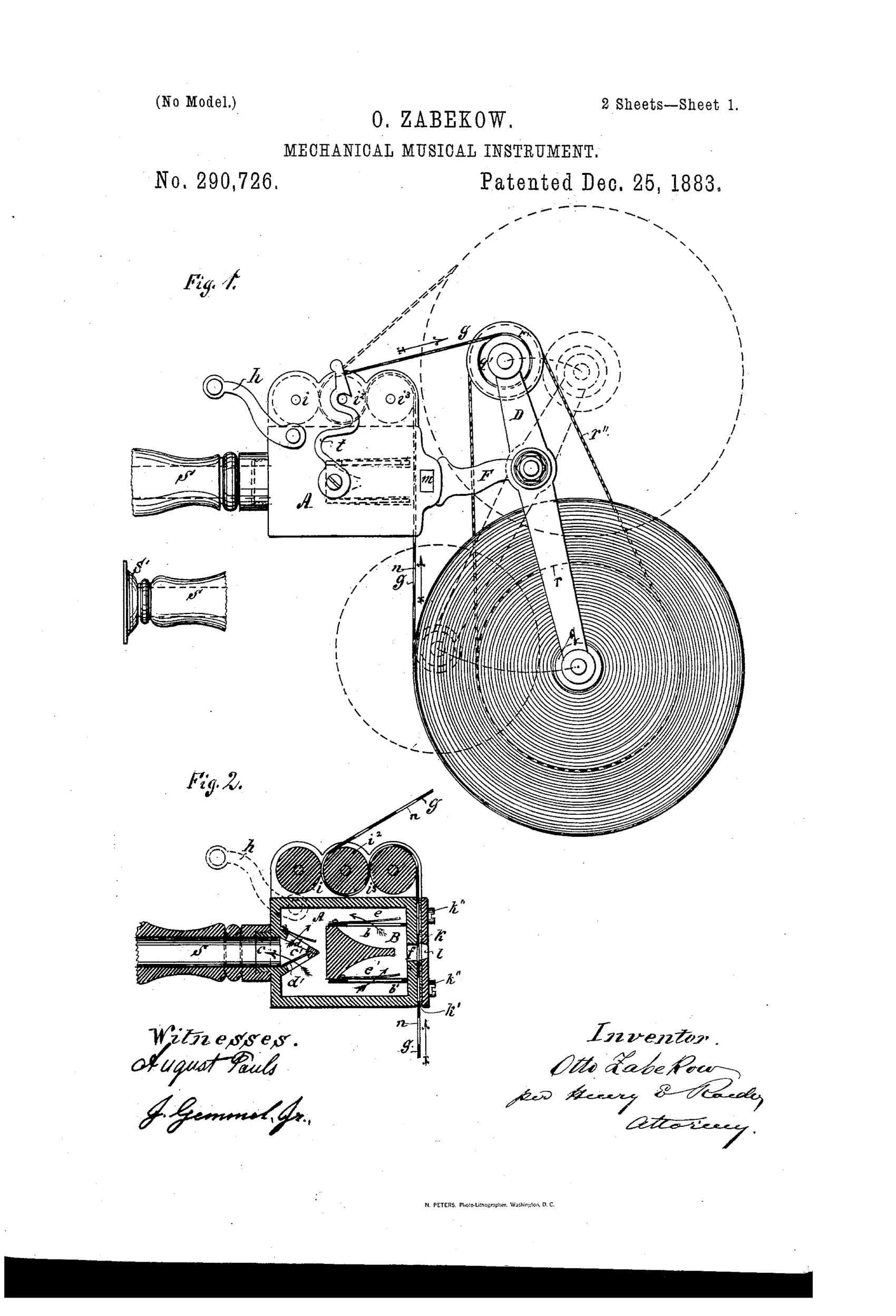
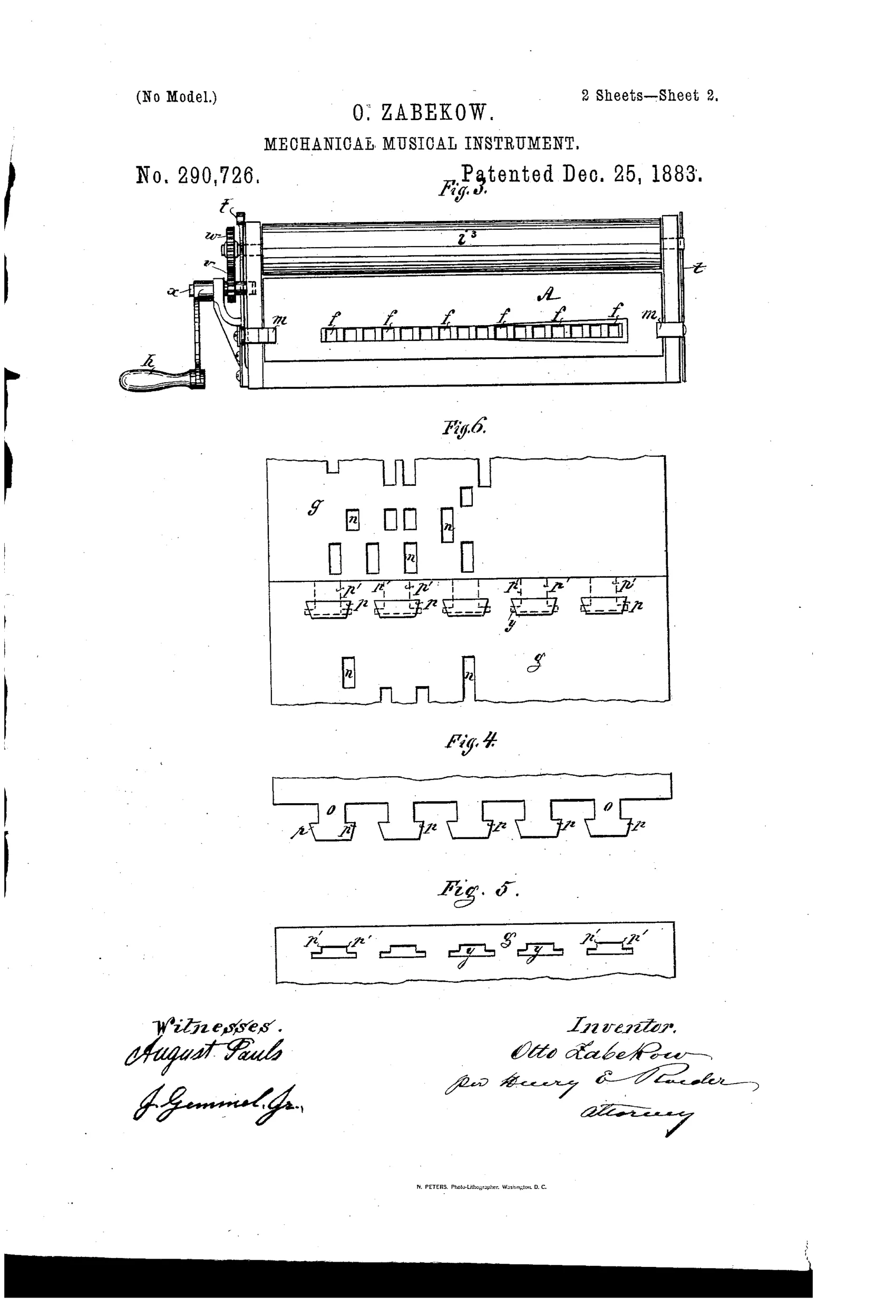
Harmonica operated by a perforated music-sheet band
♫ How it works
A wind-chamber feeds reed-cells whose reeds sound when air is drawn or blown through cell openings. A perforated band or card passes across these openings, its perforations selectively opening or closing each cell hole to produce the desired notes. Rollers driven by a hand crank through meshing gear-wheels advance the band at a regular speed, with a removable roller allowing the band to be changed. For very long pieces, additional swinging levers with rollers and pulleys connected by a belt take up and pay out the band so it need not hang free.
♫ What was claimed
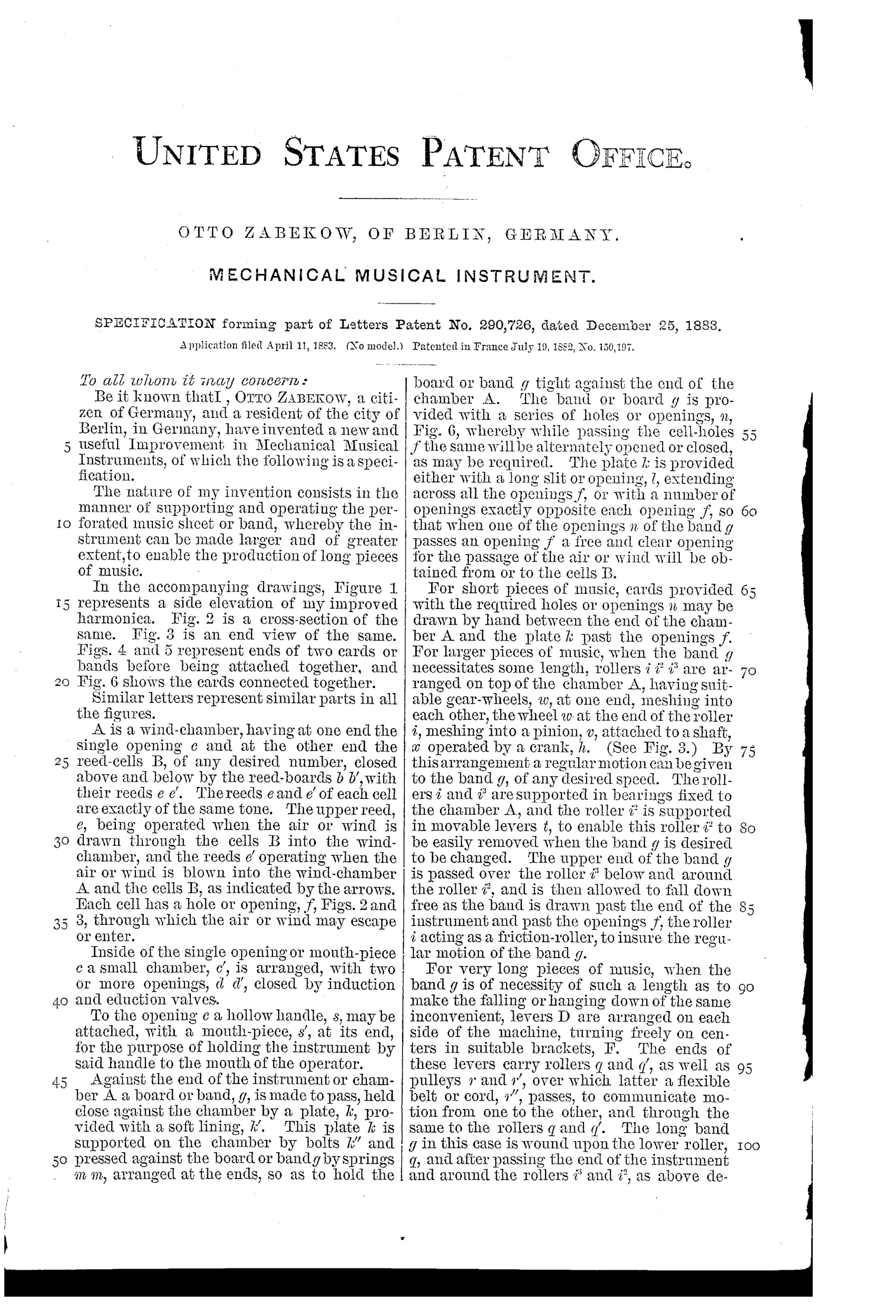
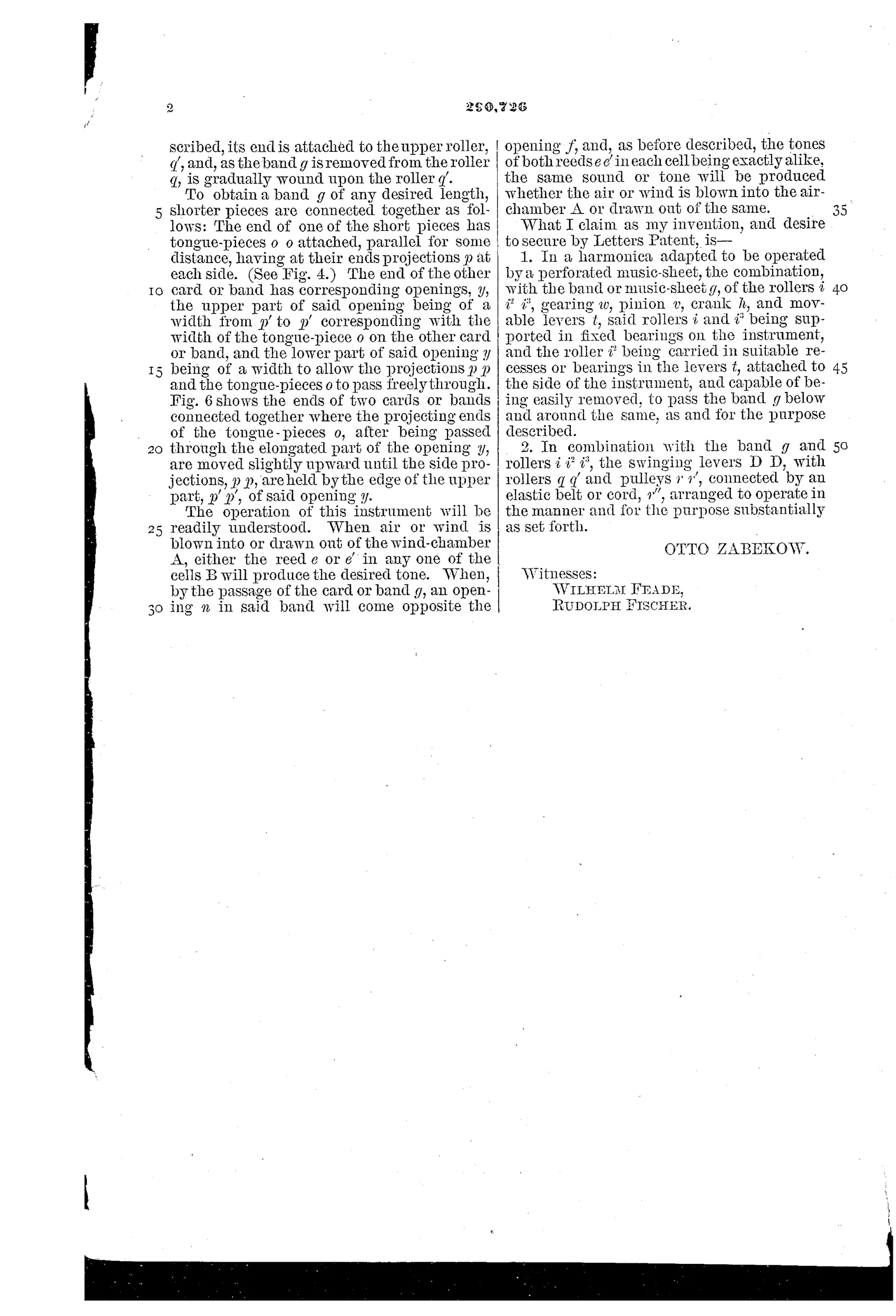
“In a harmonica adapted to be operated by a perforated music-sheet, the combination, with the band or music-sheet g, of the rollers i i2 i3, gearing w, pinion v, crank h, and movable levers t, said rollers i and i3 being supported in fixed bearings on the instrument, and the roller i2 being carried in suitable recesses or bearings in the levers t, attached to the side of the instrument, and capable of being easily removed, to pass the band g below and around the same, as and for the purpose described.”
In plain English: The invention covers a harmonica whose perforated music band is driven by geared rollers turned with a crank, one roller being mounted on removable levers so the band can be swapped out easily.
♫ In the inventor’s words
“The nature of my invention consists in the manner of supporting and operating the perforated music sheet or band, whereby the instrument can be made larger and of greater extent, to enable the production of long pieces of music.”— Otto Zabekow, from the specification
Fate unknown
The concept was clearly viable — later roll harmonicas prove it — but no Zabekow-marked instrument is documented; a surviving example or Berlin trade listing would settle it.
♫ Commentary
Zabekow's idea is disarmingly simple: keep the human lungs as the bellows, but let a perforated paper band do the fingering. You blow or draw through the mouthpiece while cranking the band past a row of reed cells; wherever a hole in the paper lines up with a cell opening, that reed speaks. It splits the labor of harmonica playing exactly in half — breath from the player, note selection from the roll — and in 1883 that put him well ahead of the crowd. The organette makers were doing paper-driven reeds too, but with bellows; a mouth-blown roll instrument is a different, more intimate beast.
The drawing rewards a close look. The big spiral disc in Fig. 1 isn't decoration — it's his answer to the long-piece problem. The claim covers a removable roller carried on swinging levers so a band can be pulled out and swapped, and the swinging lever-and-pulley arrangement takes up slack so a lengthy composition doesn't dangle to the floor. He's clearly thought about repertoire, not just novelty.
Would it work? Yes, and history proves it: the Rolmonica of the late 1920s is essentially this patent made in Bakelite. Whether Zabekow himself ever got one into shops in Berlin is another matter — I know of no surviving marked example, and the elaborate take-up gear suggests a prototype mind more than a factory one.
Commentary by Claude, The Talking Machine Patent Archive’s resident enthusiast