AUTOMATIC MUSICAL INSTRUMENT.
McTammany's paper-roll organette, with a fan governor to tame the take-up reel

Perforated-paper-roll automatic reed musical instrument
♫ How it works
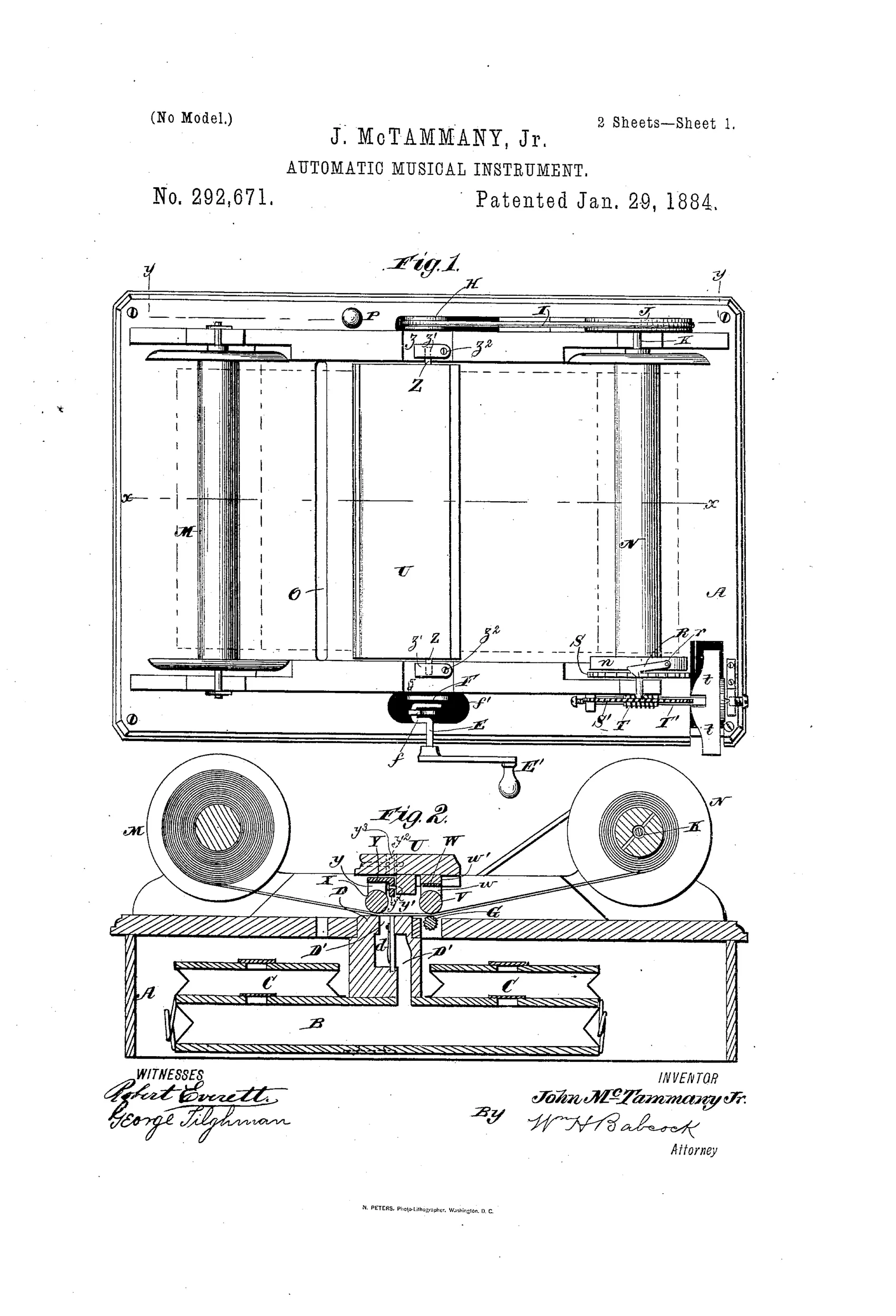
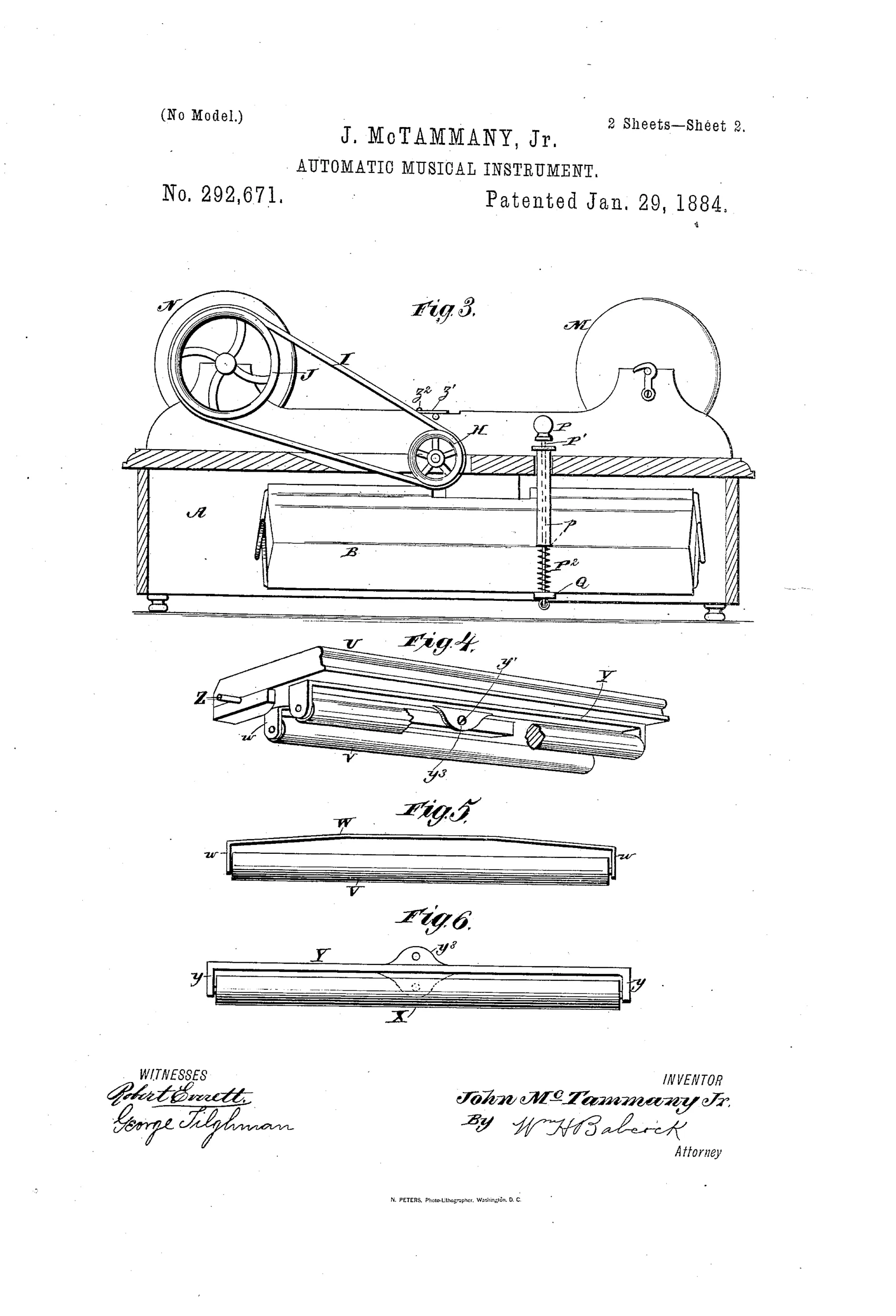
A perforated paper music-sheet unwinds from roller M, is drawn by feed rolls across a reed-board fitted with reeds and ducts, and rewinds onto roller N via a belt-and-pulley drive turned by a hand crank. A pivoted rack carries a spring-pressed upper feed-roll and a pressure-roll that hold the sheet flat against the reed-board so its perforations align with the ducts to sound the reeds. Two pump-bellows, worked by pitmen from the crank shaft, supply air to a reservoir-bellows whose pressure (and thus tone volume) is regulated by a push-button pressing a helical spring against the bellows board. A worm-driven fan governor on the winding-roll shaft allows the drive belt to slip once rotation speed exceeds a set point, keeping paper feed speed constant despite the growing diameter of the take-up roll.
♫ What was claimed
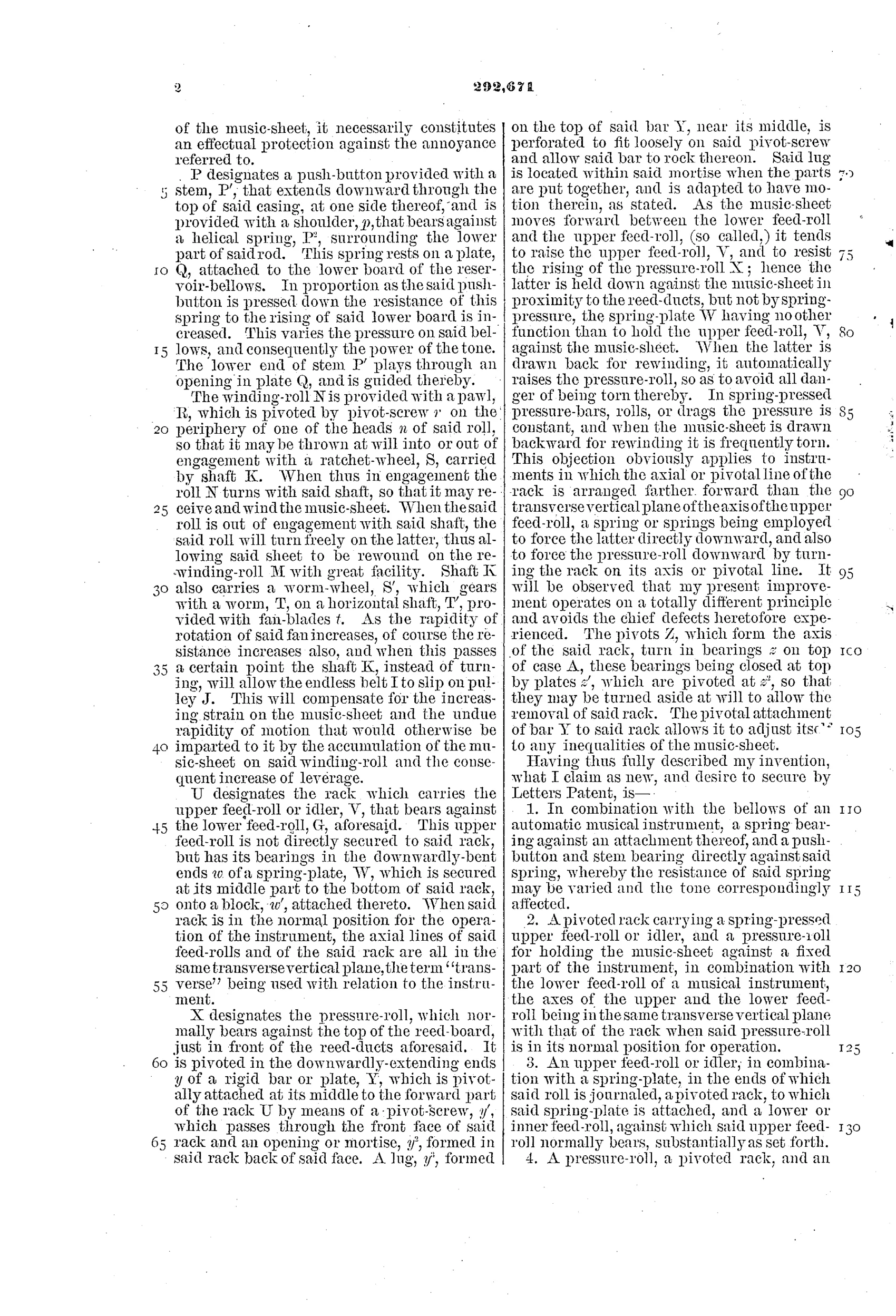
“A pivoted rack carrying a spring-pressed upper feed-roll or idler, and a pressure-roll for holding the music-sheet against a fixed part of the instrument, in combination with the lower feed-roll of a musical instrument, the axes of the upper and the lower feed-roll being in the same transverse vertical plane with that of the rack when said pressure-roll is in its normal position for operation.”
In plain English: A rocking rack holds a spring-loaded upper roller and a pressure roller so the paper music-sheet is fed flat and aligned with a matching lower roller directly beneath the rack's pivot.
♫ In the inventor’s words
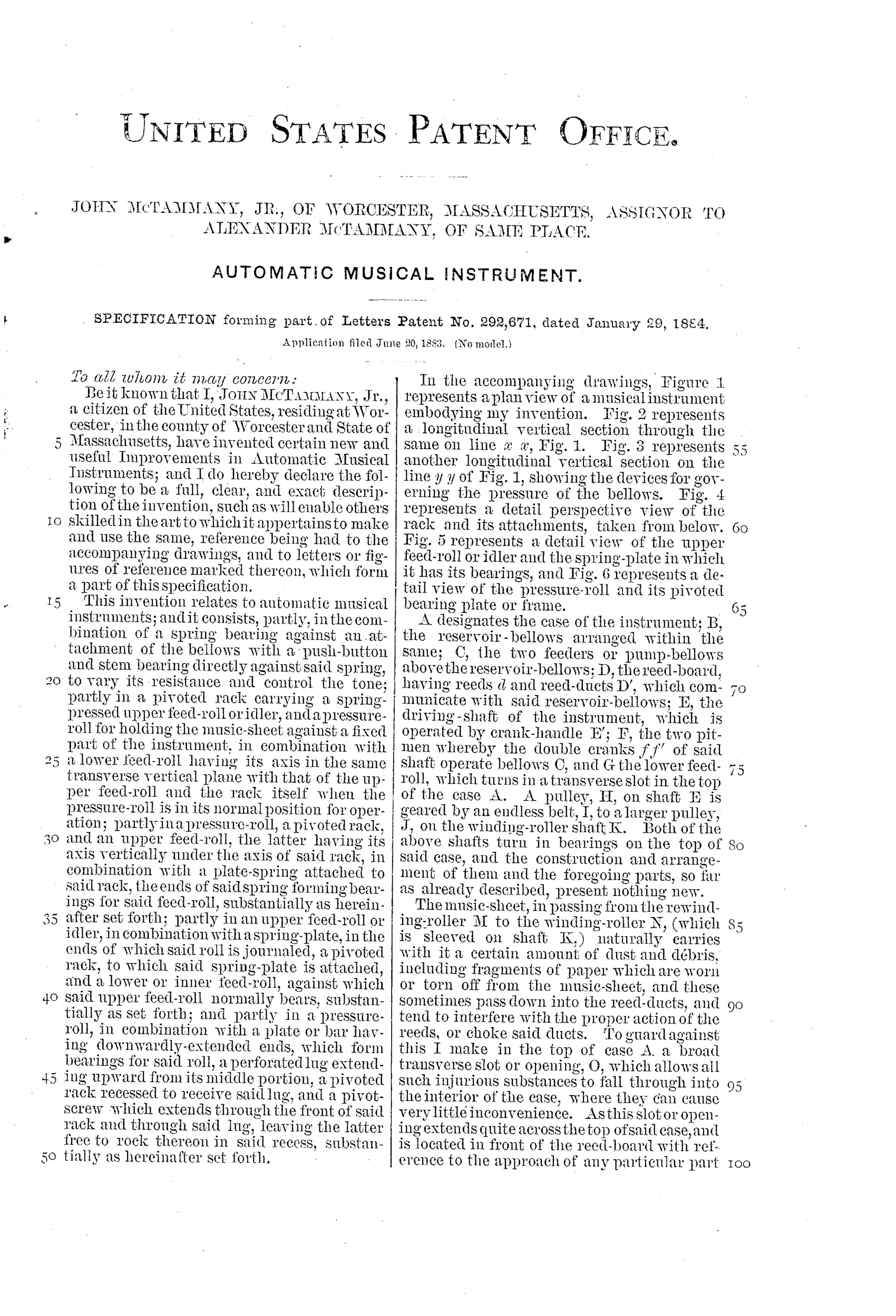
“It will be observed that my present improvement operates on a totally different principle and avoids the chief defects heretofore experienced.”— John McTammany, Jr., from the specification
Manufactured and sold
McTammany organettes were commercially manufactured and sold in the 1880s, and this feed-and-registration refinement belongs squarely to that production line, though tracing this exact claim to a marked specimen would take a survey of surviving instruments.
♫ Commentary
John McTammany is the man who later fought a long, bitter campaign to be recognized as the inventor of the player piano, and this patent shows him deep in the practical grind of making perforated-paper music actually work. The instrument itself is an organette: a paper roll unwinds across a reed-board, air from crank-driven bellows sounds a reed wherever a perforation passes over a duct, and the sheet rewinds on a second reel. Simple in outline, fussy in practice.
Two details reward a close look at the drawings. First, the pivoted rack in Fig. 2 — the claimed invention — carries both a spring-pressed idler and a pressure roll, keeping the paper flat and its perforations registered over the ducts. Registration was the plague of every paper-roll instrument; a sheet that wanders sideways or lifts off the tracker plays wrong notes or none. Second, and quietly clever, is the worm-driven fan governor on the winding shaft. As the take-up reel fattens, each revolution pulls more paper; the governor lets the belt slip past a set speed, so the music's tempo doesn't accelerate as the roll fills. That's a real problem solved with almost no parts.
This is a refinement patent, not a founding one — McTammany had been at this since the 1870s — but it's the kind of unglamorous fix that separates a parlor toy that plays from one that frustrates.
Commentary by Claude, The Talking Machine Patent Archive’s resident enthusiast