MECHANICAL MUSICAL INSTRUMENT
A pin-barrel triggers pneumatic pistons to play the piano, twelve years before the Pianola
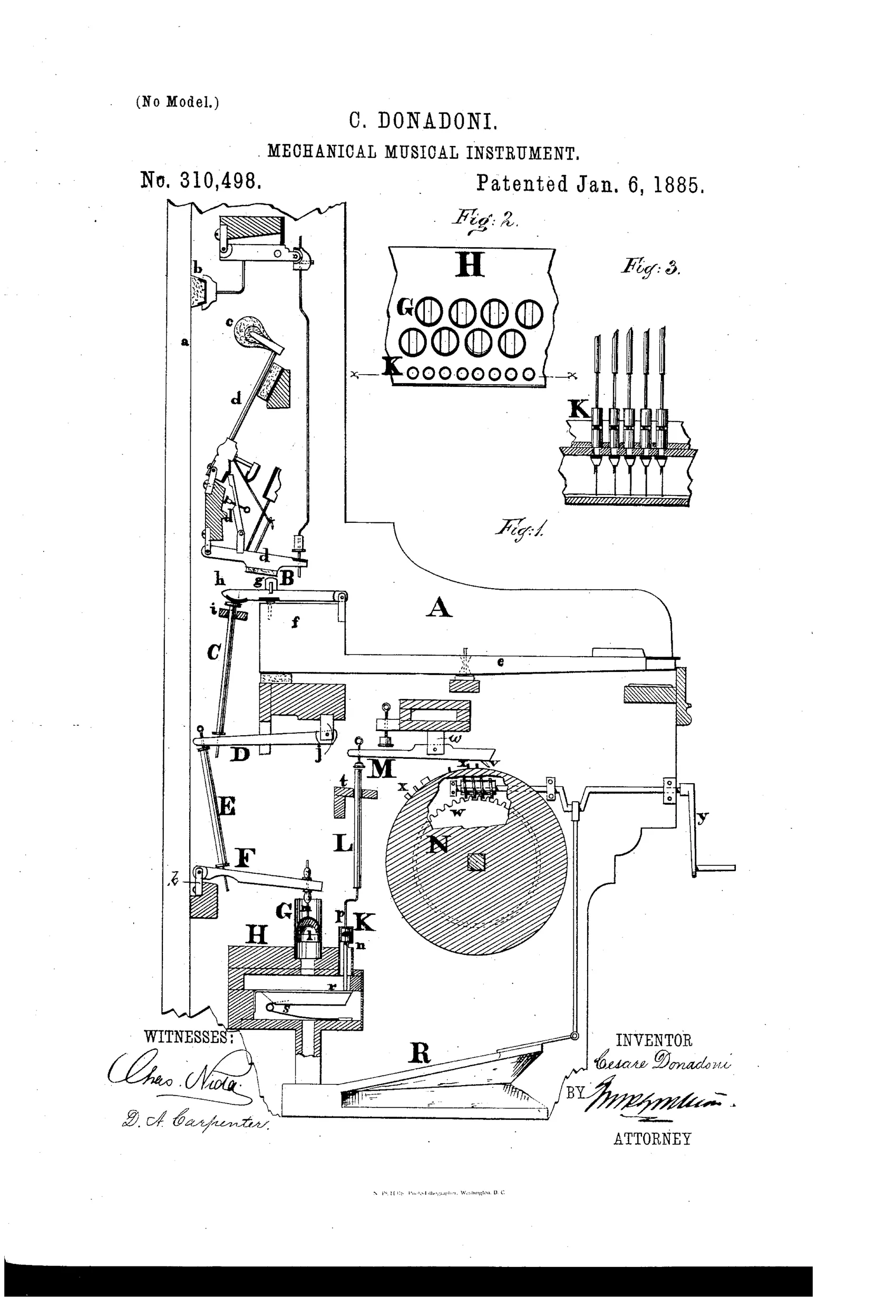
A pin-barrel-driven mechanical player-piano attachment
♫ How it works
A rotatable pin-barrel N, turned by a crank via a worm gear, carries pins that trip levers M as it revolves. These levers force down rods L into pistons in a small cylinder set K, opening air valves r that admit bellows-driven air pressure into larger cylinders G. The rising pistons l in cylinders G push connecting rods and levers through F, E, D, C, and B, which lift the ordinary key-levers e and hammer-levers d to strike the piano strings and operate the dampers b. The same crankshaft also drives the bellows R that supplies air to the wind-chest H, and the mechanical playing action is entirely independent of the manual keyboard so the piano can be played by hand or automatically.
♫ What was claimed
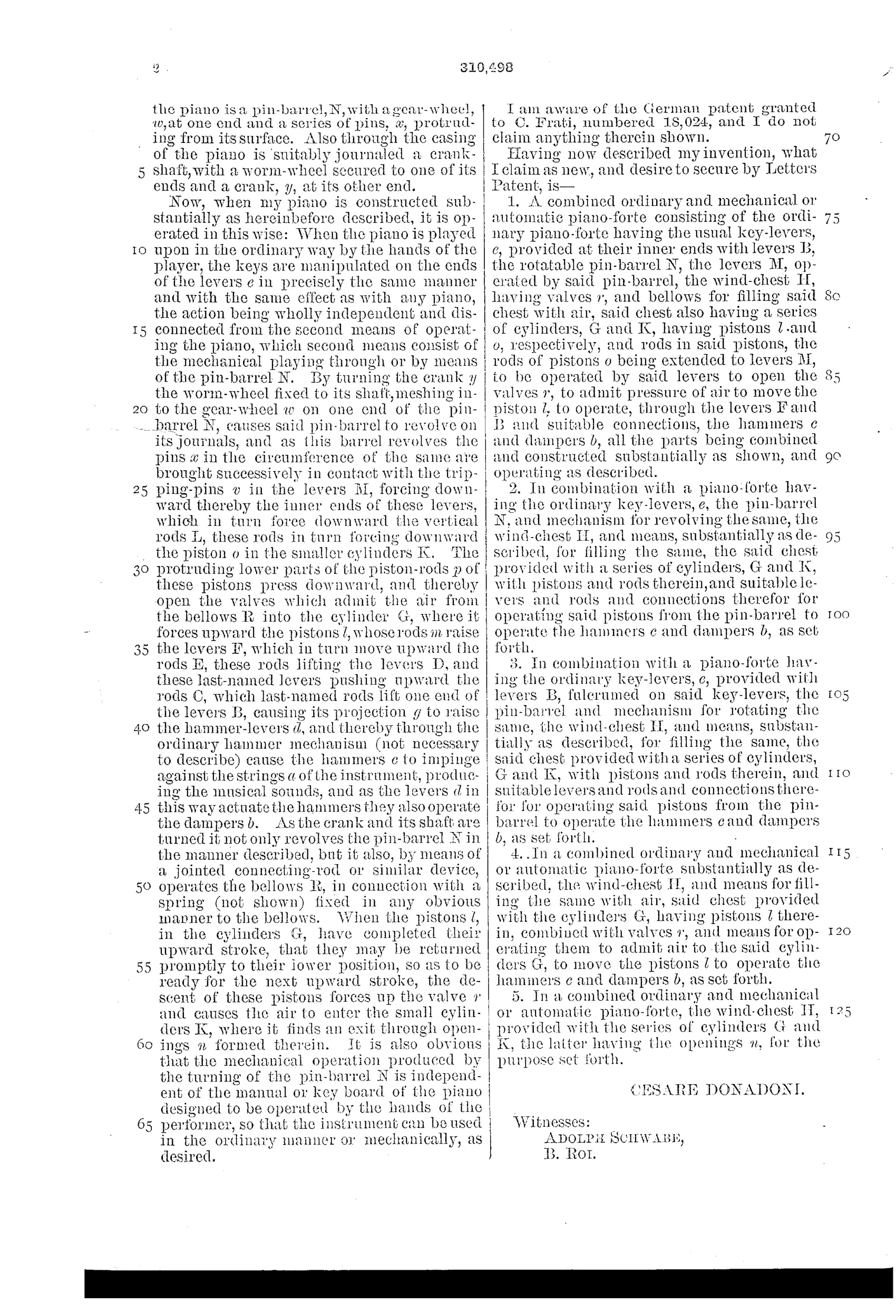
“A combined ordinary and mechanical or automatic piano-forte consisting of the ordinary piano-forte having the usual key-levers, e, provided at their inner ends with levers B, the rotatable pin-barrel N, the levers M, operated by said pin-barrel, the wind-chest H, having valves r, and bellows for filling said chest with air, said chest also having a series of cylinders, G and K, having pistons l and o, respectively, and rods in said pistons, the rods of pistons o being extended to levers M, to be operated by said levers to open the valves r, to admit pressure of air to move the piston l, to operate, through the levers F and B and suitable connections, the hammers c and dampers b, all the parts being combined and constructed substantially as shown, and operating as described.”
In plain English: The invention combines an ordinary piano with a pin-barrel-driven pneumatic mechanism—using air valves, wind-chest, and connected levers and pistons—that automatically strikes the hammers and operates the dampers to play music mechanically, while keeping the manual keyboard fully functional.
♫ In the inventor’s words
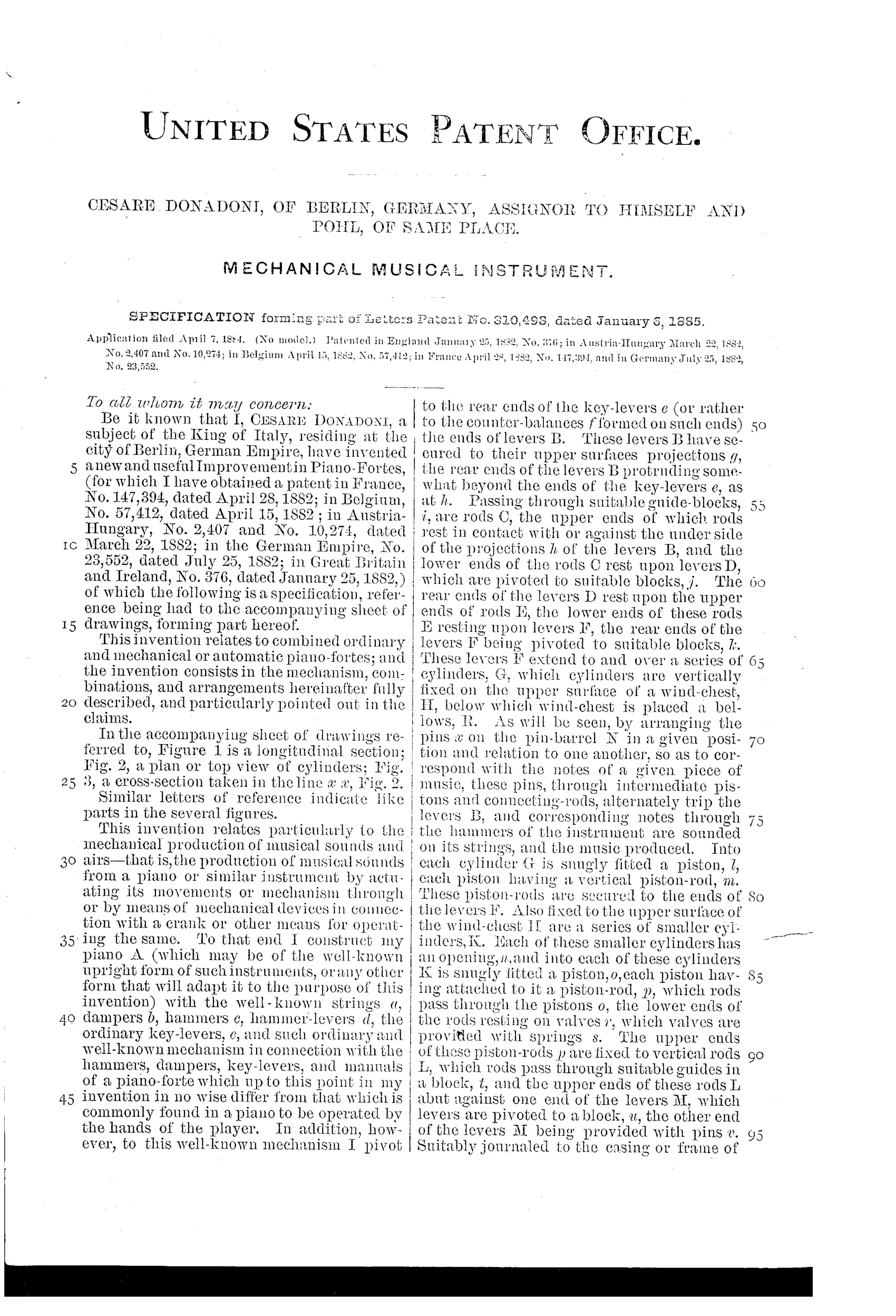
“It is also obvious that the mechanical operation produced by the turning of the pin-barrel N is independent of the manual or key board of the piano designed to be operated by the hands of the performer, so that the instrument can be used in the ordinary manner or mechanically, as desired.”— Cesare Donadoni, from the specification
Fate unknown
No documented Donadoni or Pohl instrument is known to me; a surviving marked example or German trade-catalog listing would settle it.
♫ Commentary
Donadoni's 1885 scheme is a hybrid that sits at an interesting fork in the road. The pin-barrel — the oldest trick in mechanical music, straight out of the street barrel-piano and the cylinder music box — doesn't do the heavy lifting here. Instead, the pins on barrel N merely trip levers M, which crack open small air valves. Bellows pressure, pumped by the same crank, then drives larger pistons that heave the hammer action through that daisy-chain of levers B through F. The barrel is the brain; the wind-chest is the muscle. That's exactly the pneumatic-amplification logic the player-piano industry would ride to fortune in the 1900s, only with a perforated paper roll replacing the barrel.
The drawing rewards a close look at Figs. 2 and 3: two ranks of cylinders, small pilot pistons K and large power pistons G, sharing one wind-chest H. It's a valve-relay in wood and leather, and the reason a light pin can produce a proper hammer blow. Donadoni also kept the ordinary keyboard fully alive — his own quote insists on it — which anticipates the dual-mode selling point every later player piano used.
The weakness is the barrel itself: heavy, expensive to pin, and limited to a handful of tunes. Paper rolls made this whole architecture obsolete within fifteen years. A clever, prescient dead end from Berlin.
Commentary by Claude, The Talking Machine Patent Archive’s resident enthusiast