KEY-BOARD ATTACHMENT FOR MUSICAL INSTRUMENTS.
A vacuum-powered piano player twelve years before the Pianola, from Islington
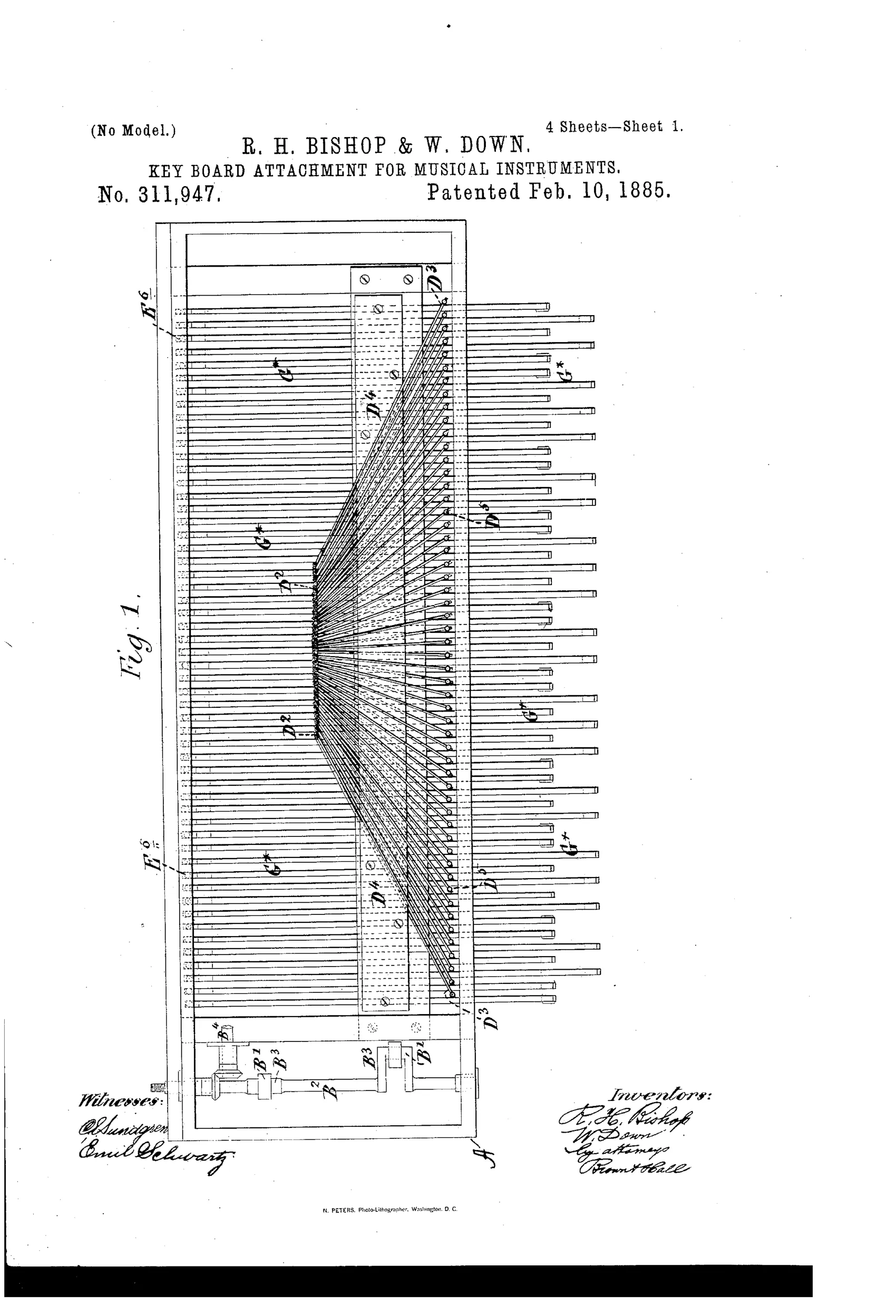
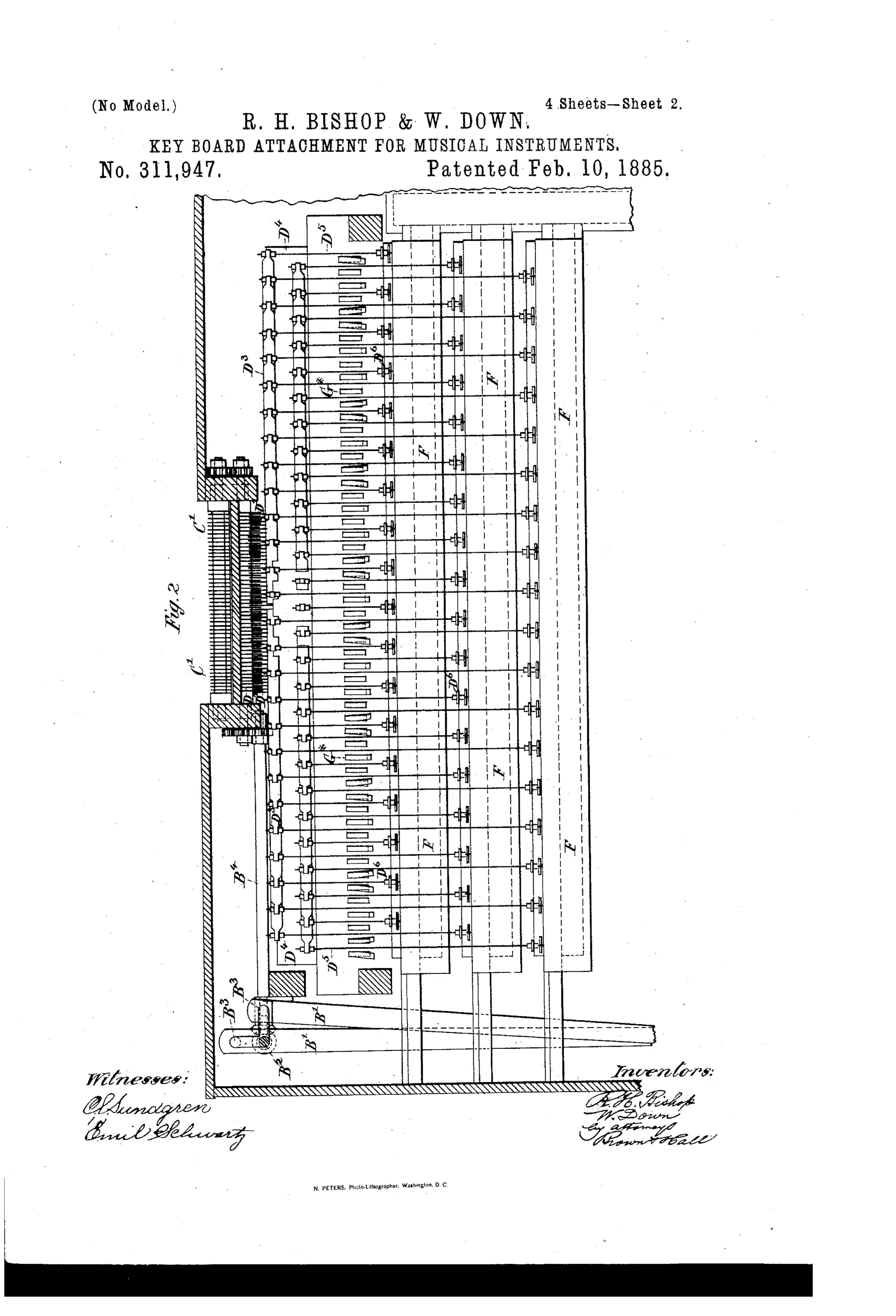
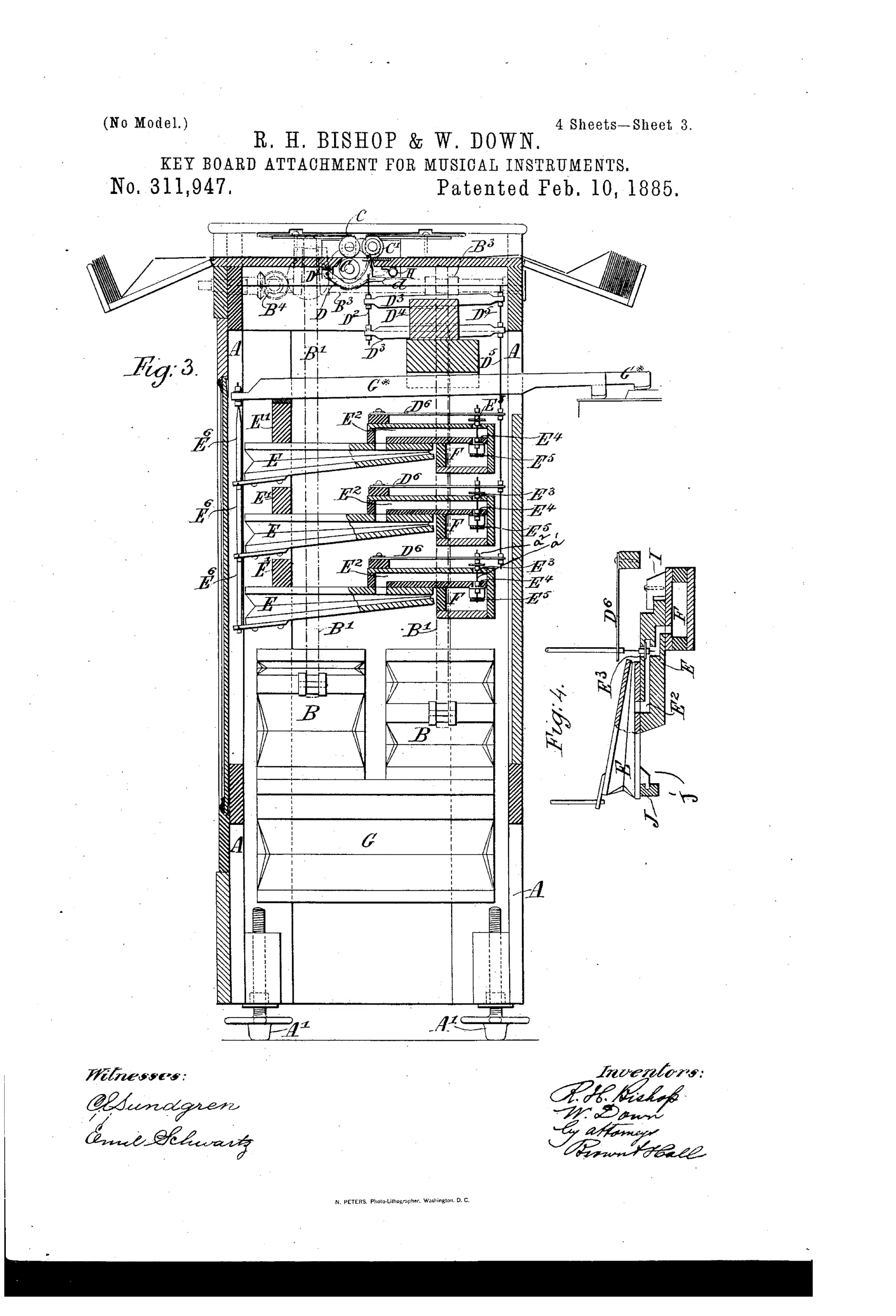
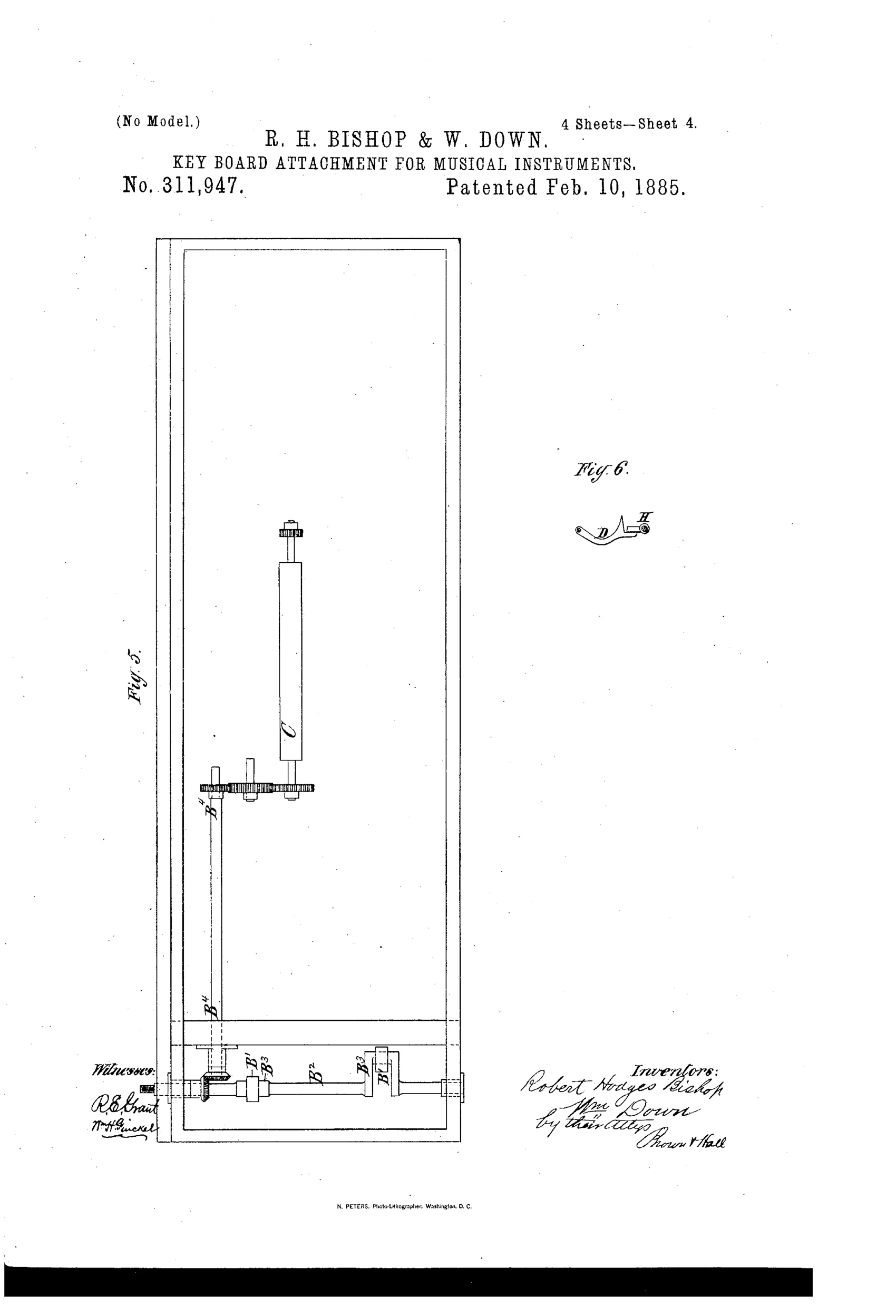
Pneumatic mechanical player attachment for pianos and organs
♫ How it works
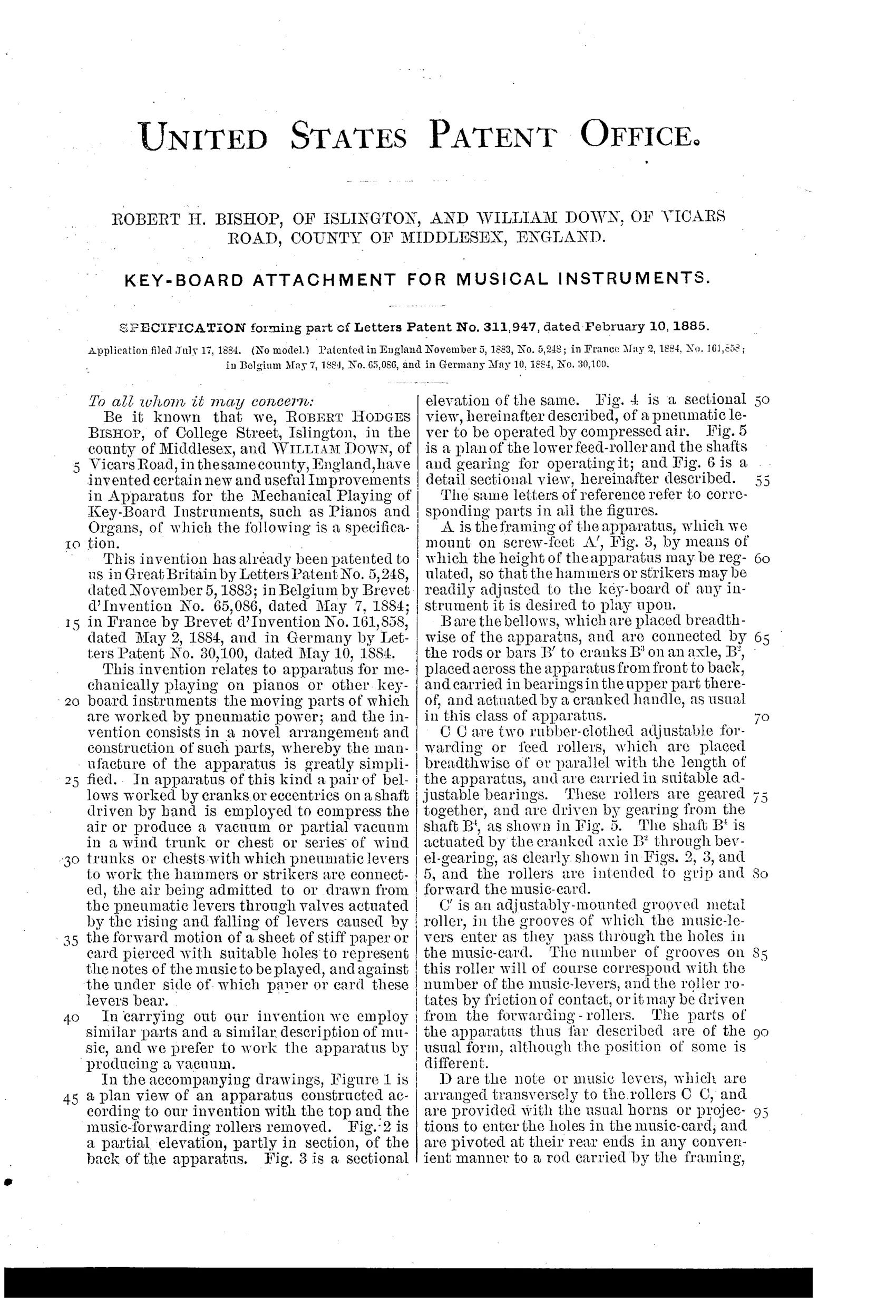
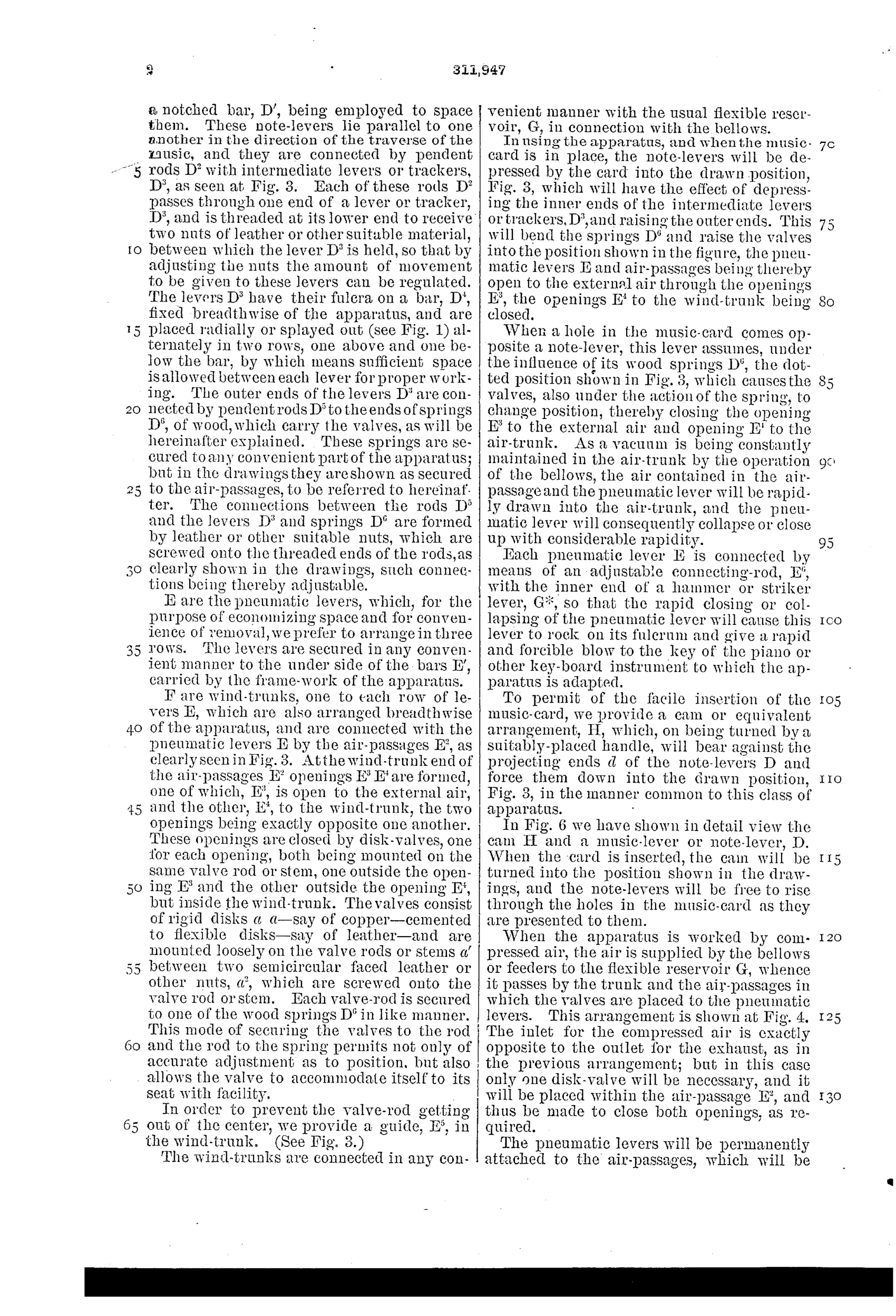
A perforated music-card is drawn front-to-back across the apparatus by a pair of geared, rubber-clothed feed rollers turned from a hand-cranked bellows shaft. Note-levers with horn-like projections ride against the underside of the card and are pushed up through its perforations, rocking splayed intermediate 'tracker' levers whose motion bends wood springs carrying disk-valves at the ends of pneumatic levers. As the bellows maintain a vacuum in the wind-trunk, opening a valve lets air rush from the pneumatic lever into the trunk, causing the lever to collapse rapidly; this motion is transmitted by adjustable connecting rods to striker-levers that strike the keys of the instrument. A rotating cam can be turned to depress all note-levers at once, allowing the music-card to be inserted freely.
♫ What was claimed
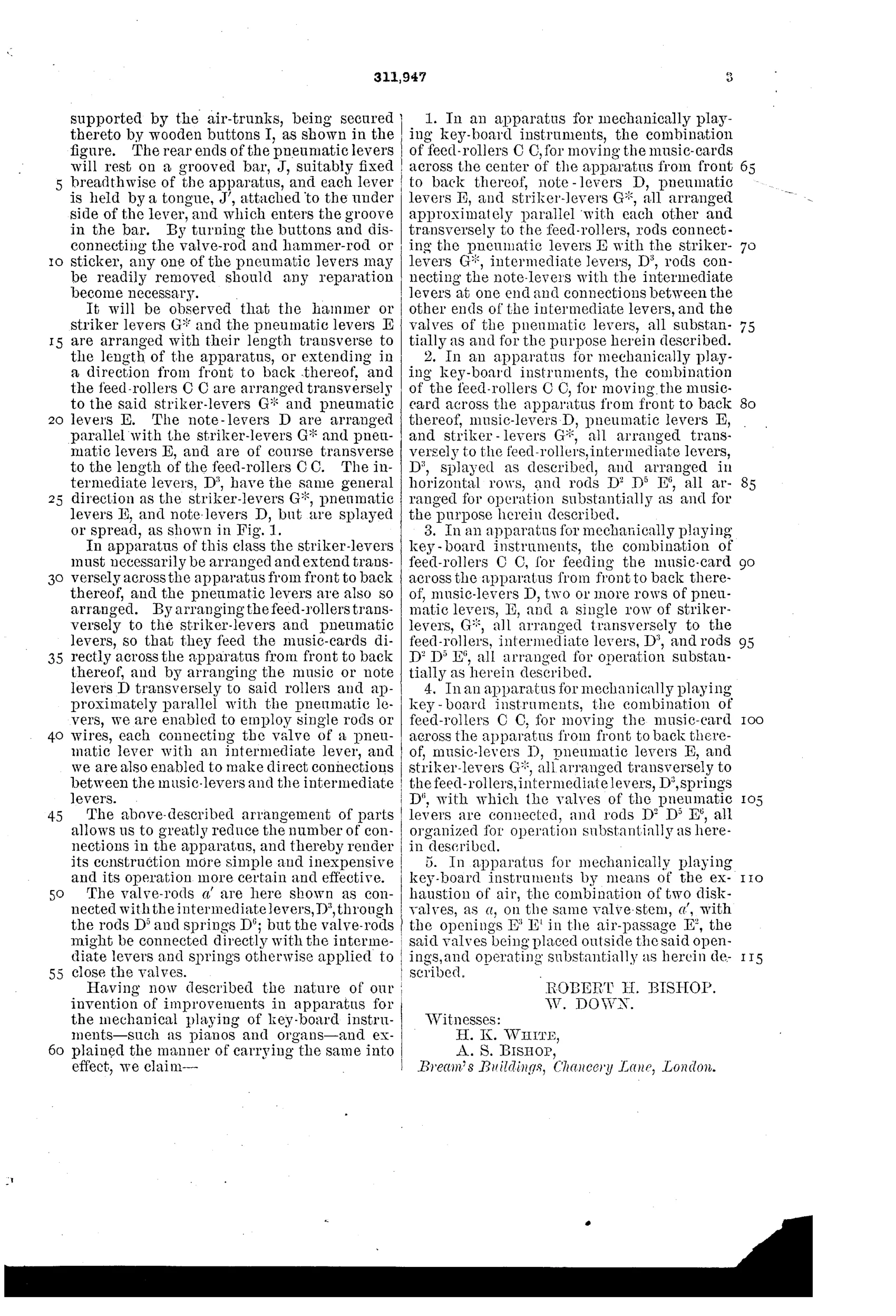
“In an apparatus for mechanically playing key-board instruments, the combination of feed-rollers C C, for moving the music-cards across the center of the apparatus from front to back thereof, note-levers D, pneumatic levers E, and striker-levers G*, all arranged approximately parallel with each other and transversely to the feed-rollers, rods connecting the pneumatic levers E with the striker-levers G*, intermediate levers, D3, rods connecting the note-levers with the intermediate levers at one end and connections between the other ends of the intermediate levers, and the valves of the pneumatic levers, all substantially as and for the purpose herein described.”
In plain English: The patent covers the overall arrangement of feed rollers pulling a perforated music card across the machine, with note-levers, intermediate tracker levers, pneumatic levers, and hammer-striking levers all connected together to mechanically play a keyboard instrument's keys.
♫ In the inventor’s words
“As a vacuum is being constantly maintained in the air-trunk by the operation of the bellows, the air contained in the air-passage and the pneumatic lever will be rapidly drawn into the air-trunk, and the pneumatic lever will consequently collapse or close up with considerable rapidity.”— Robert Hodges Bishop and William Down, from the specification
Fate unknown
No surviving Bishop & Down player or trade record is documented to me; a marked instrument or an English trade-catalog listing would settle it.
♫ Commentary
Bishop and Down filed this in 1884, which puts them well ahead of the wave. The Pianola and the Angelus push-up players that made pneumatic piano playing a household idea didn't arrive until the late 1890s. Here, already, are the essential ingredients: a perforated music card fed by rollers, a vacuum maintained by bellows, and small pneumatic motors that collapse 'with considerable rapidity' when a valve opens, snapping a striker down onto a piano key. The core insight — use the perforation only to trip a valve, and let suction do the actual work of hitting the key — is exactly what the whole player-piano industry would later be built on.
The drawing rewards a close look. That dramatic fan of levers in Fig. 1 isn't decoration: the music card is narrow, so the note-levers converge from full keyboard width down to card width, splaying like a river delta. Compare that with the later tracker-bar solution, where tiny tube spacing did the same job with air instead of wood. Bishop and Down are solving a pneumatic problem with a great deal of mechanism — dozens of rocking intermediate levers, wood springs, and adjustable rods, all of which would need individual regulation and would drift with humidity.
A thoughtful touch: a cam that lifts every note-lever at once so the card can be slipped in without snagging. Someone here had actually tried threading a fragile perforated card past a forest of spring-loaded fingers.
Commentary by Claude, The Talking Machine Patent Archive’s resident enthusiast