MECHANICAL MUSICAL INSTRUMENT.
A flat metal tune sheet with struck-up bumps, seven years before the Regina
Self-playing music box with tuned comb
♫ How it works
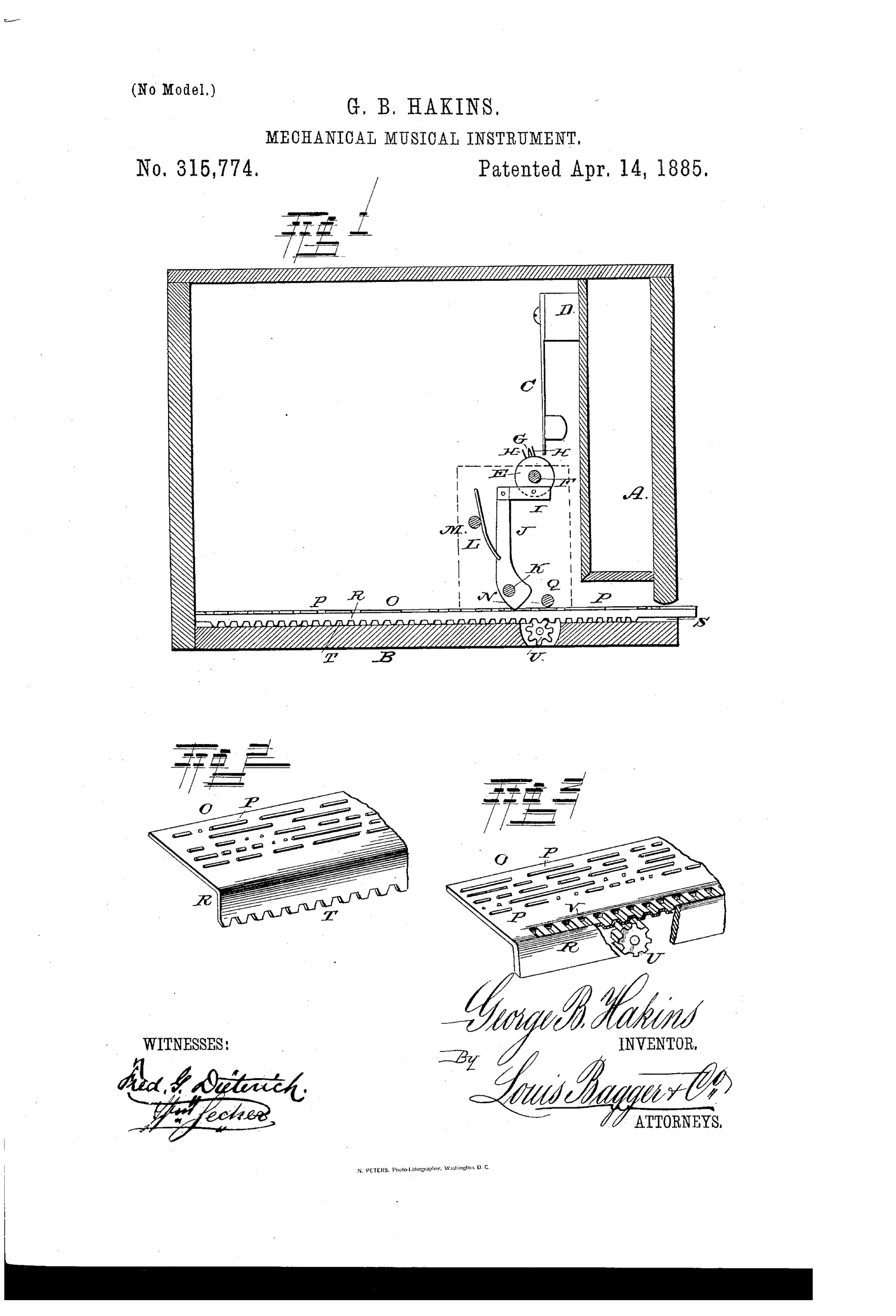
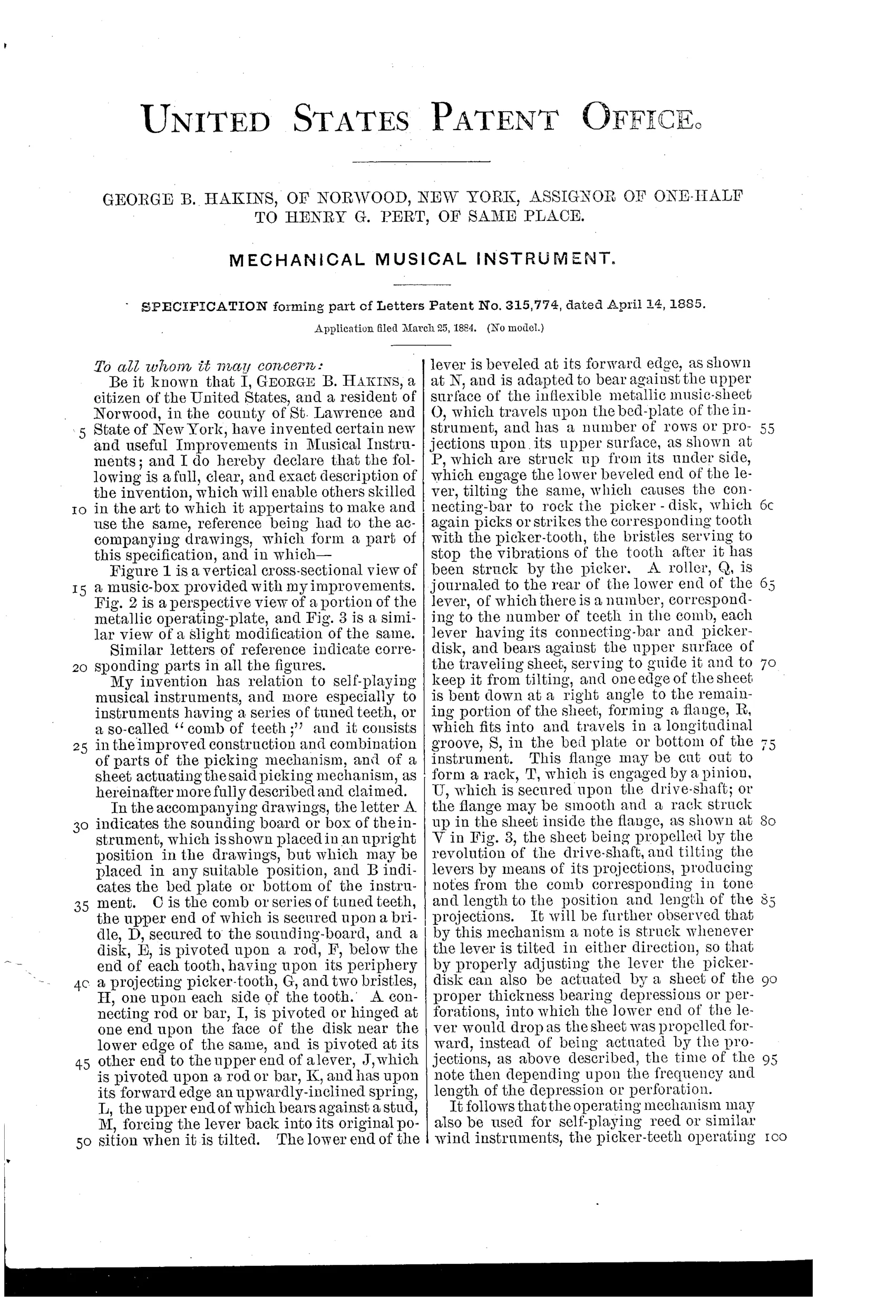
A picker-disk pivoted near each tuned tooth carries a picker-tooth flanked by two bristles that damp vibration after striking. A connecting-rod links the disk to a spring-loaded lever whose beveled lower end rests on projections struck up from a traveling metallic sheet. As the sheet is drawn forward by a drive-shaft pinion engaging a rack in the sheet's flange, its projections tilt the levers, rocking the picker-disks so the picker-tooth plucks the corresponding comb tooth. A spring returns each lever to its original position after each tilt, and the same sheet's projections (or, alternatively, depressions/perforations) can trigger notes in either direction of tilt, allowing timing to be set by projection or perforation length.
♫ What was claimed
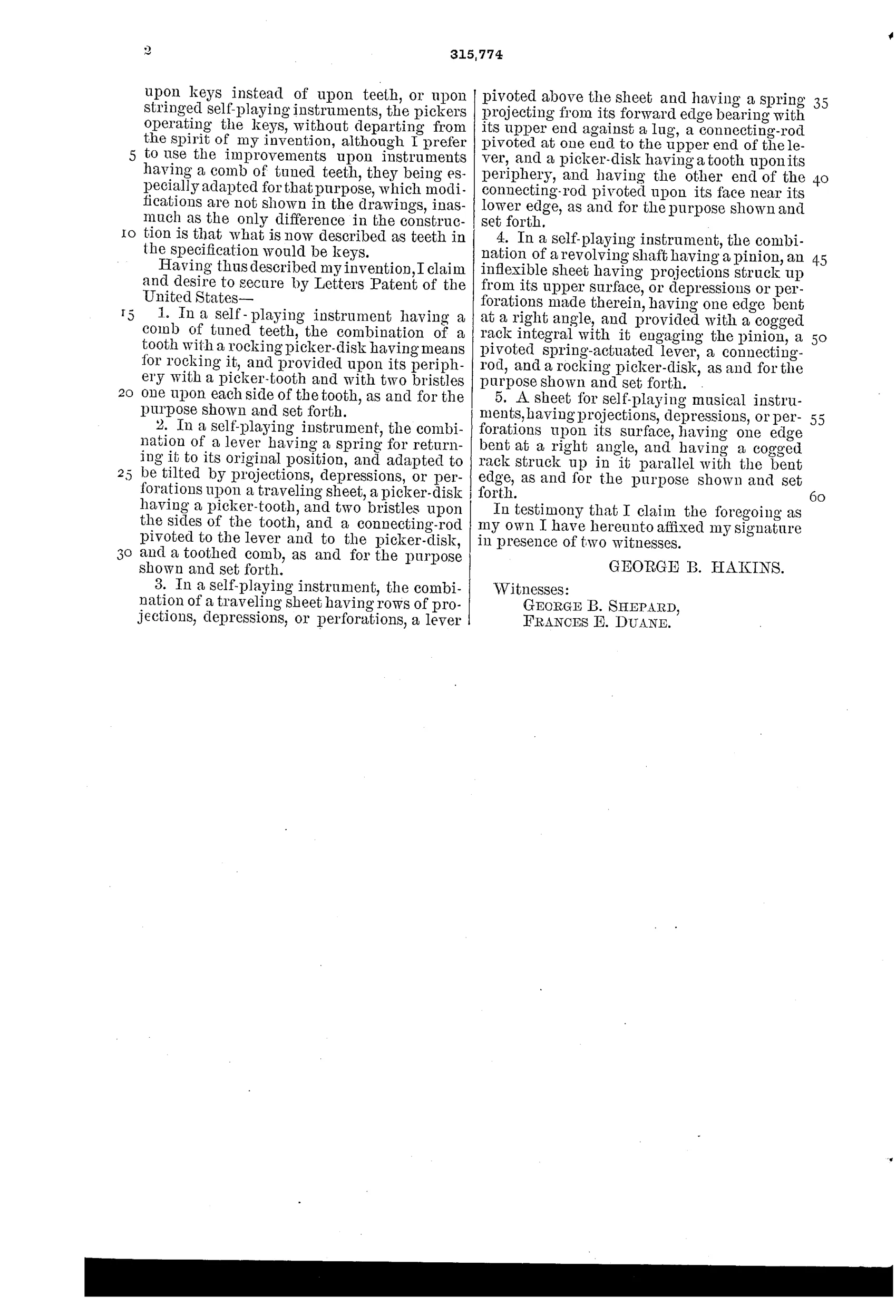
“1. In a self-playing instrument having a comb of tuned teeth, the combination of a tooth with a rocking picker-disk having means for rocking it, and provided upon its periphery with a picker-tooth and with two bristles one upon each side of the tooth, as and for the purpose shown and set forth.”
In plain English: The invention covers a tuned comb tooth paired with a rocking disk that has a small pick and two bristles (one on each side) to pluck the tooth and quickly damp its vibration.
♫ In the inventor’s words
“It follows that the operating mechanism may also be used for self-playing reed or similar wind instruments, the picker-teeth operating upon keys instead of upon teeth, or upon stringed self-playing instruments, the pickers operating the keys, without departing from the spirit of my invention.”— George B. Hakins, from the specification
Paper patent — likely never produced
The per-note disk, rod, lever, and spring assembly would have been costly to build at scale, and no manufactured example or Norwood-area production is documented.
♫ Commentary
In 1885 the standard music box was still Swiss: a pinned brass cylinder turning under a fixed comb, playing the handful of tunes it was born with. Hakins, working from the small town of Norwood, New York, went at the interchangeability problem from a direction that history would soon validate — a flat, traveling metal sheet carrying the tune as projections struck up from its surface, drawn along by a pinion engaging a rack in its own flange. That is recognizably the same instinct behind the Polyphon and Regina disc boxes that swept the market in the following decade, except Hakins's sheet slides linearly rather than rotating.
The payload mechanism is where it gets heavy. Every note gets its own pivoted picker-disk, connecting-rod, spring-loaded lever, and beveled foot riding the sheet. The genuinely thoughtful touch — and the one the first claim protects — is the pair of bristles flanking each picker-tooth, so the same rocking motion that plucks the comb tooth also damps it. That's the dampering problem every comb instrument fights, solved in one part.
But multiply that linkage by fifty-odd notes and you have a machine far costlier to build than a pinned cylinder, without the elegance of the star-wheel-and-disc answer Lochmann found. A clever anticipation, mechanically overbuilt, and a dead end in execution.
Commentary by Claude, The Talking Machine Patent Archive’s resident enthusiast