MECHANICAL MUSICAL INSTRUMENT.
McTammany makes the pedals do double duty: pump the wind, wind the spring.
Automatic reed organ played by perforated paper roll
♫ How it works
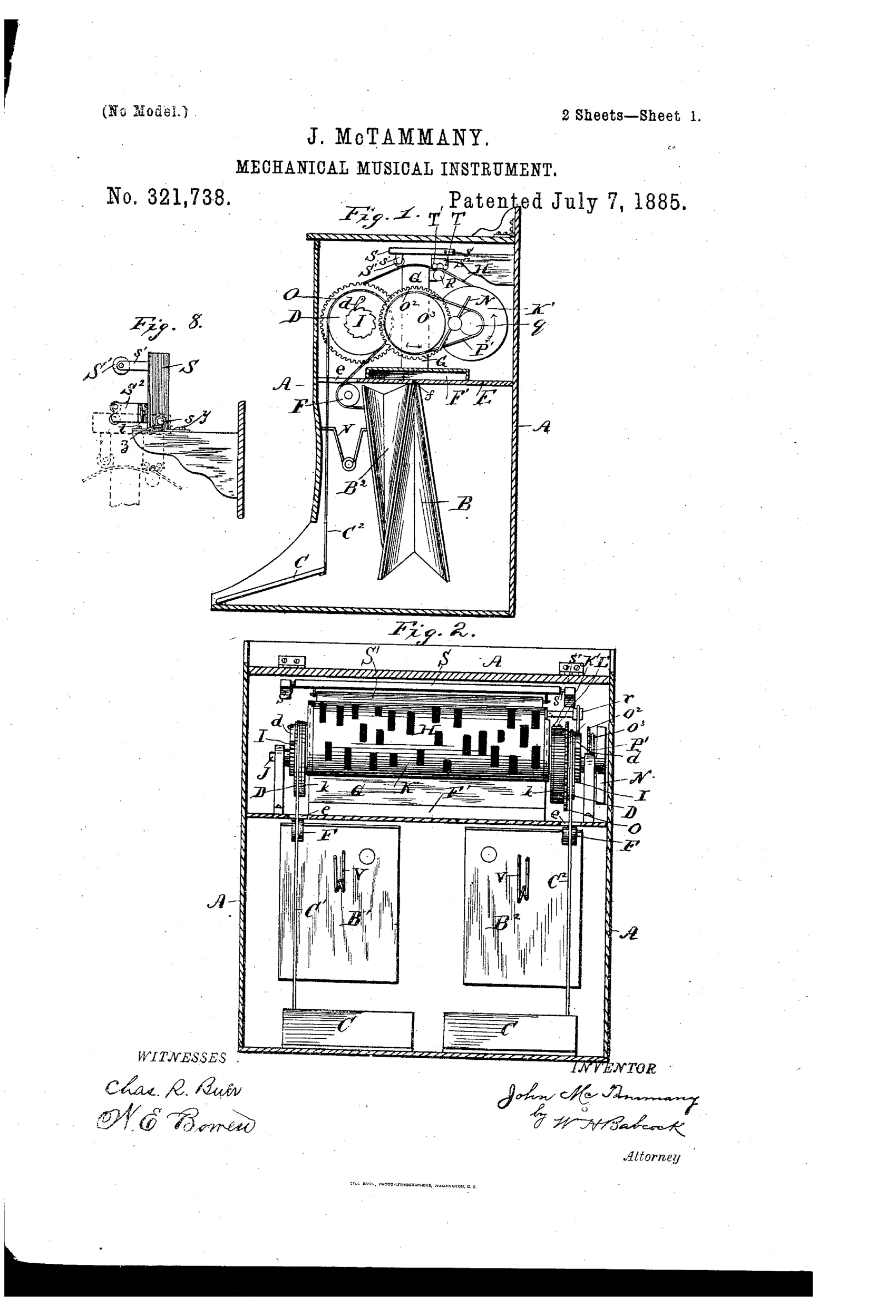
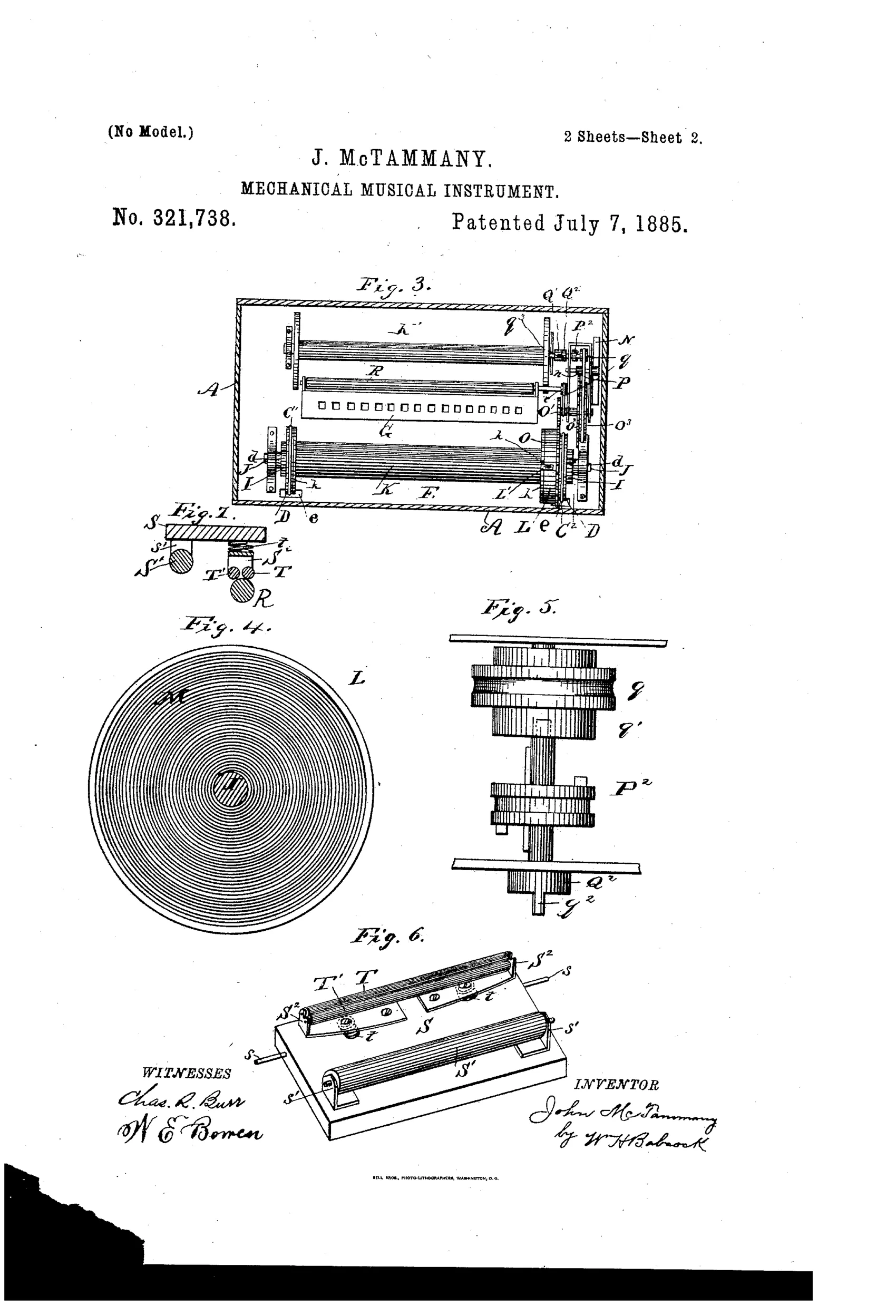
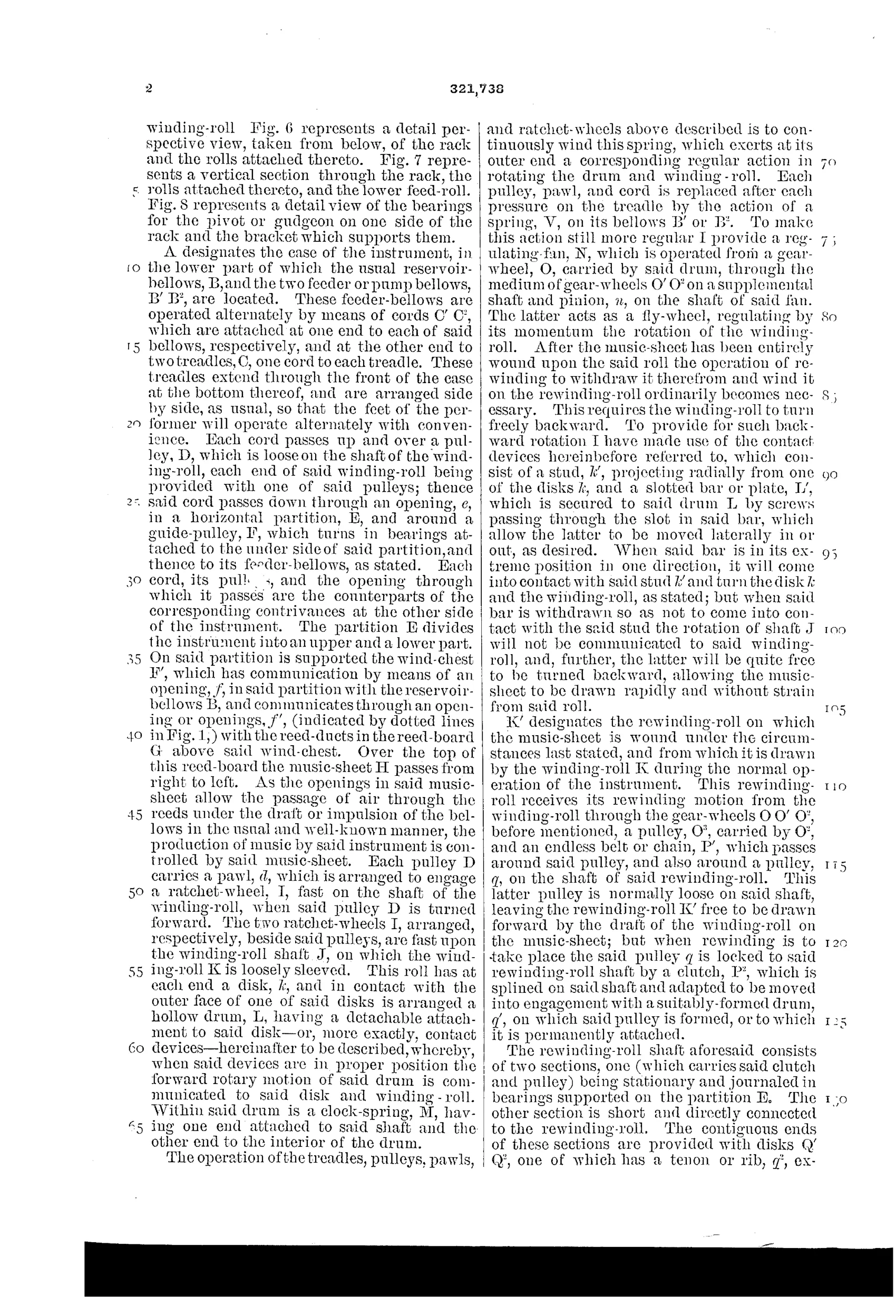
Two foot treadles alternately drive feeder bellows that supply the wind-chest and, via cords over pulleys and pawl-and-ratchet disks, wind a clock-spring housed in a drum. This spring continuously rotates the winding-roll, drawing a perforated music-sheet across the reed-board so air passes through the perforations into the reed-ducts to sound the reeds. A pivoted rack with upper feed-rolls and a pressure-roll holds the sheet against the lower feed-roll and reed-board, while a regulating fan geared to the drum acts as a governor to smooth rotation. When rewinding, a stud-and-slotted-bar clutch on the winding-roll disks disengages so the roll turns freely backward, and a separate rewinding-roll driven through gear-wheels, a pulley, and an endless belt with a splined clutch winds the sheet back for reuse or removal.
♫ What was claimed
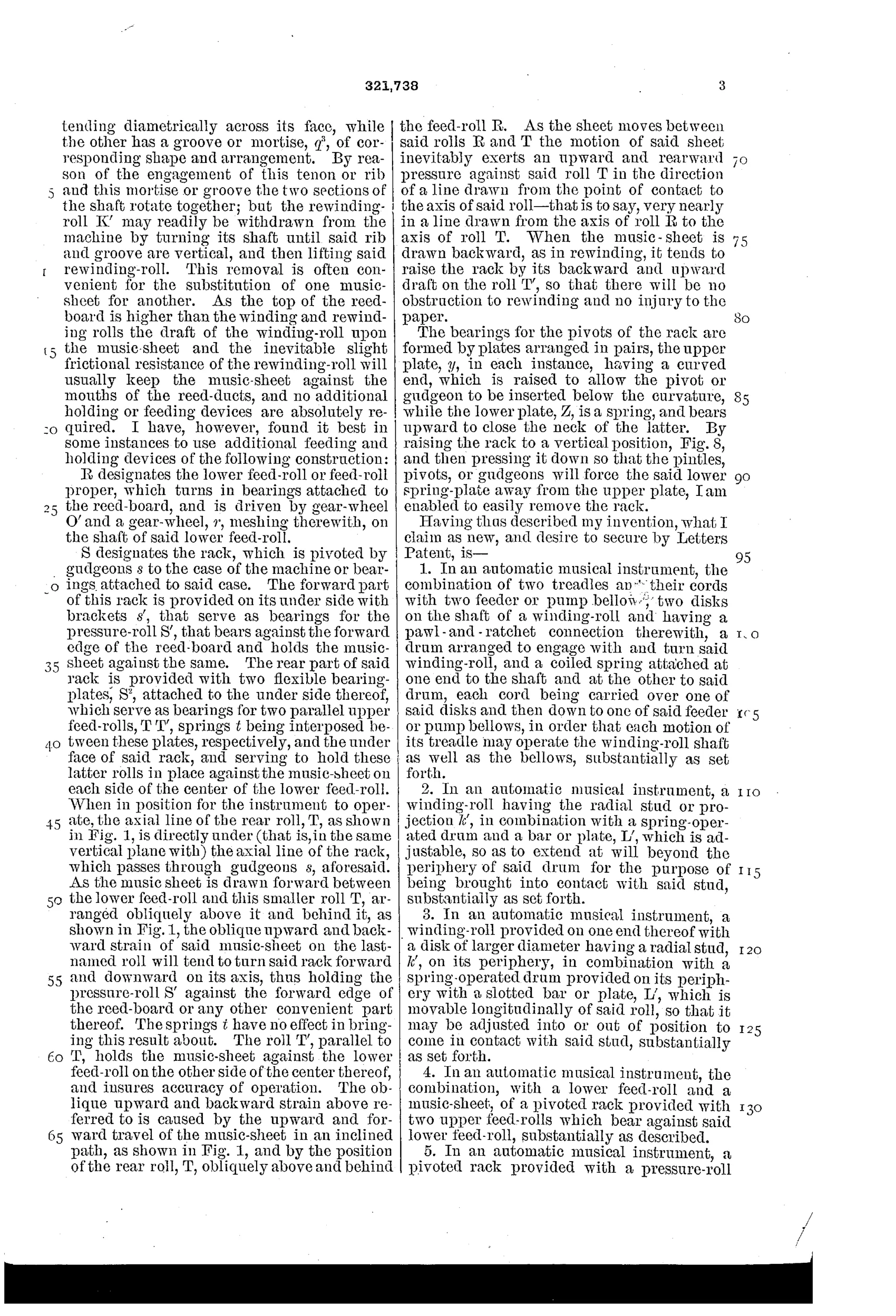
“1. In an automatic musical instrument, the combination of two treadles and their cords with two feeder or pump bellows, two disks on the shaft of a winding-roll and having a pawl-and-ratchet connection therewith, a drum arranged to engage with and turn said winding-roll, and a coiled spring attached at one end to the shaft and at the other to said drum, each cord being carried over one of said disks and then down to one of said feeder or pump bellows, in order that each motion of its treadle may operate the winding-roll shaft as well as the bellows, substantially as set forth.”
In plain English: The claim covers a system where two foot treadles, working through cords and disks with pawl-and-ratchet gearing, both pump the bellows and wind a spring-driven drum that turns the music-roll, so every push of either pedal both supplies air and advances the roll.
♫ In the inventor’s words
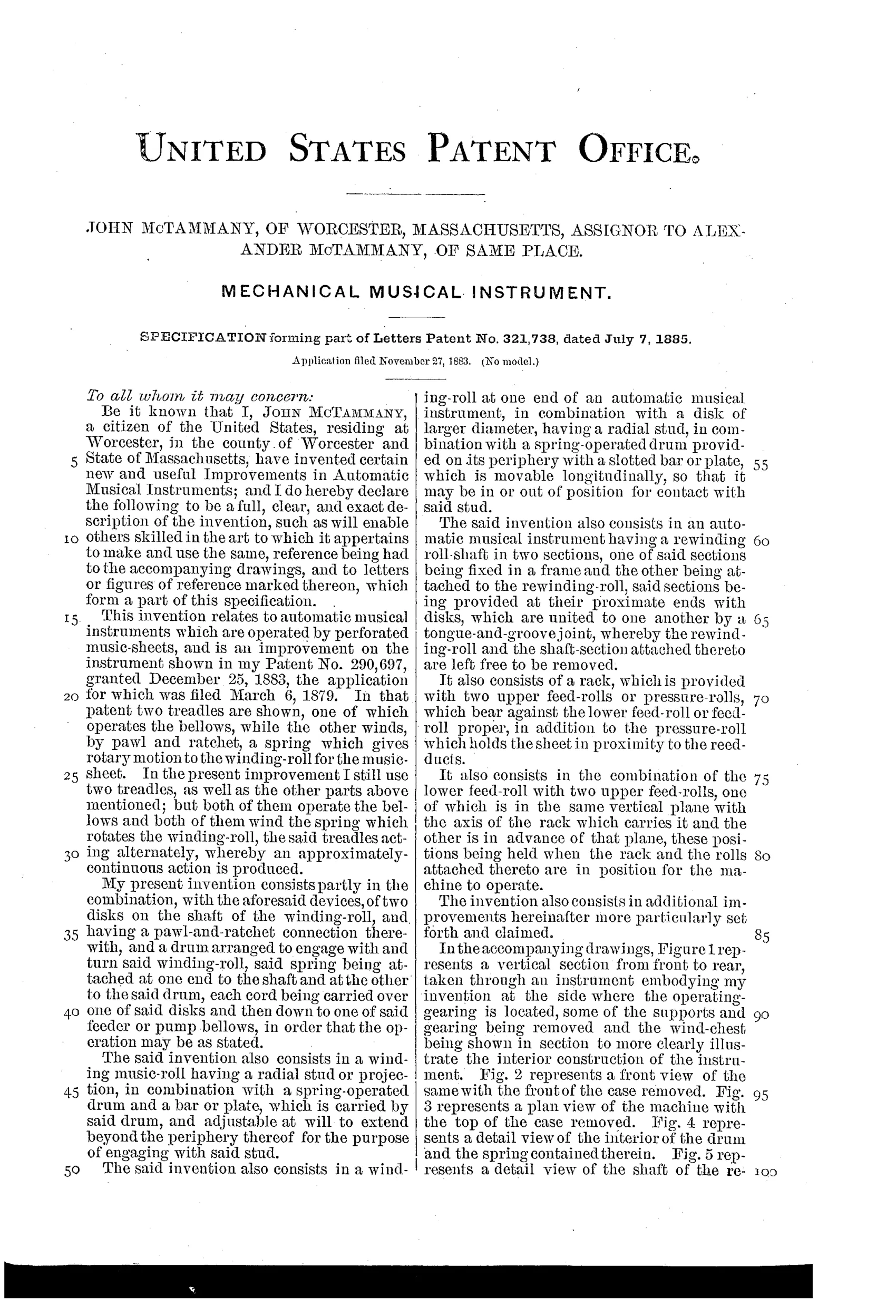
“This invention relates to automatic musical instruments which are operated by perforated music-sheets, and is an improvement on the instrument shown in my Patent No. 290,697, granted December 25, 1883, the application for which was filed March 6, 1879.”— John McTammany, from the specification
Fate unknown
McTammany organettes were built in Worcester, but confirming this specific spring-drive treadle configuration would take a surviving marked instrument.
♫ Commentary
John McTammany spent decades arguing he invented the player piano, and patents like this one are why the argument was never silly. The problem he attacks here is real and subtle: if the same treadles that pump the bellows also drag the paper roll, the music speeds up and slows down with every stroke of the player's feet. His answer is to insert a clock-spring between the two jobs. Each pedal stroke pulls a cord over a pawl-and-ratchet disk, storing energy in a coiled spring inside a drum; the drum then turns the winding-roll continuously, smoothed further by a geared fan governor. Foot pressure becomes lumpy input, the spring and fan turn it into steady output — the same governor logic that spring-motor phonographs would lean on a decade later.
The drawing rewards a close look. Fig. 1 shows the gear train and fan crowded above the wind-chest, and Fig. 2 lays out the perforated sheet stretched across the reed-board between feed-rolls — every hole a valve. The splined-clutch rewind arrangement, letting the roll spin free backward, is a genuinely practical touch for a sheet meant to be replayed.
This is a refinement of his 1883 patent, not a first, but it sits squarely in the pre-Edison mechanical-music lineage: perforated paper as the recording medium before wax ever held a groove.
Commentary by Claude, The Talking Machine Patent Archive’s resident enthusiast