AUTOMATIC MUSICAL INSTRUMENT.
Ellis Parr, later of Symphonion fame, tries interchangeable discs with air instead of pins
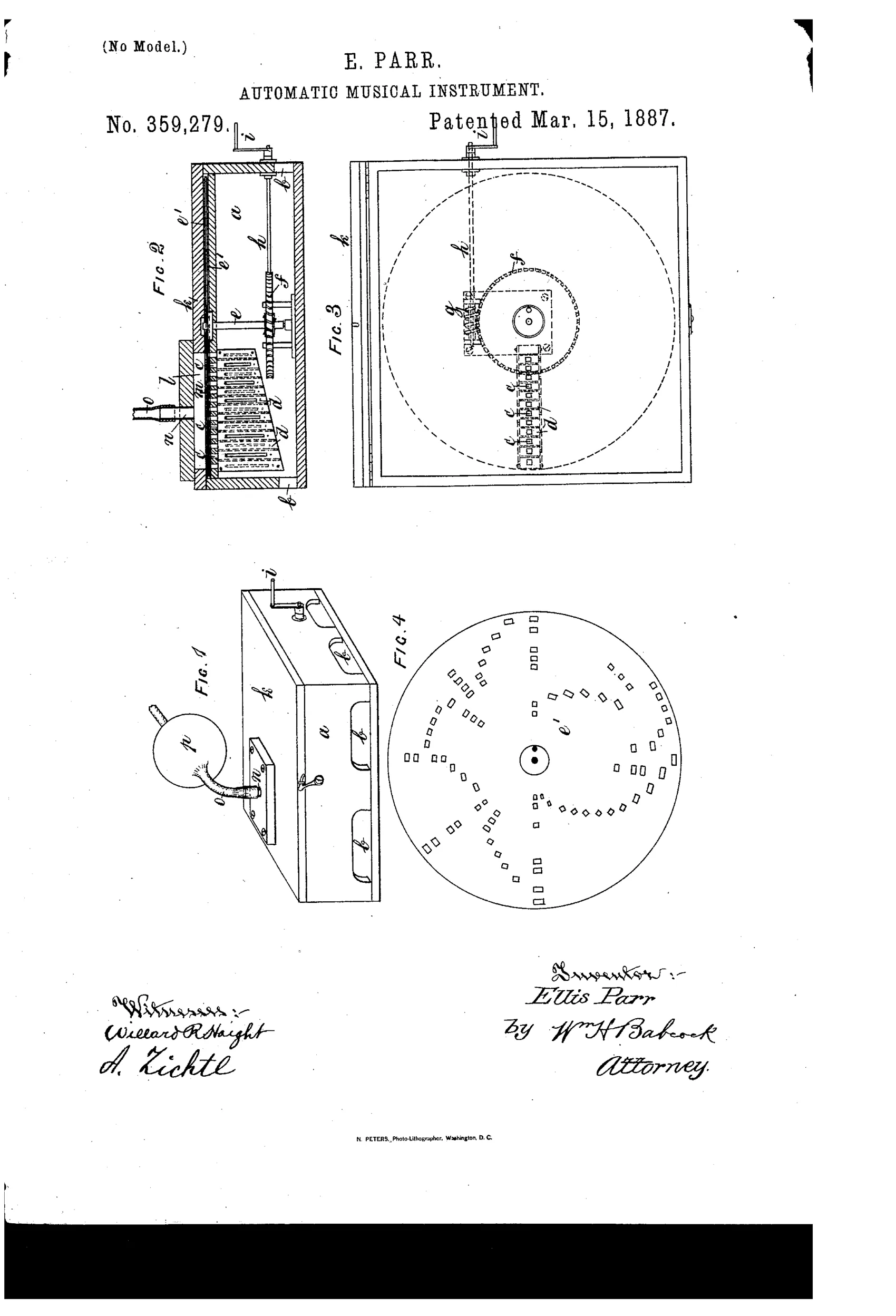
Disc-driven pneumatic organ using perforated paper discs
♫ How it works
A box contains a series of radiating tone chambers, each with a vibrating reed or tongue that sounds a note when air passes into it. A perforated disc rotates above the row of chambers, driven by a spindle turned via a worm gear and hand crank. Air is fed through a flexible tube with an elastic expanding bulb into a channel on the underside of a lid, so that as disc perforations align with the fixed openings, puffs of air reach the correct chambers to sound the tune. The disc can be lifted off the spindle and replaced with another differently-perforated disc to change tunes instantly.
♫ What was claimed
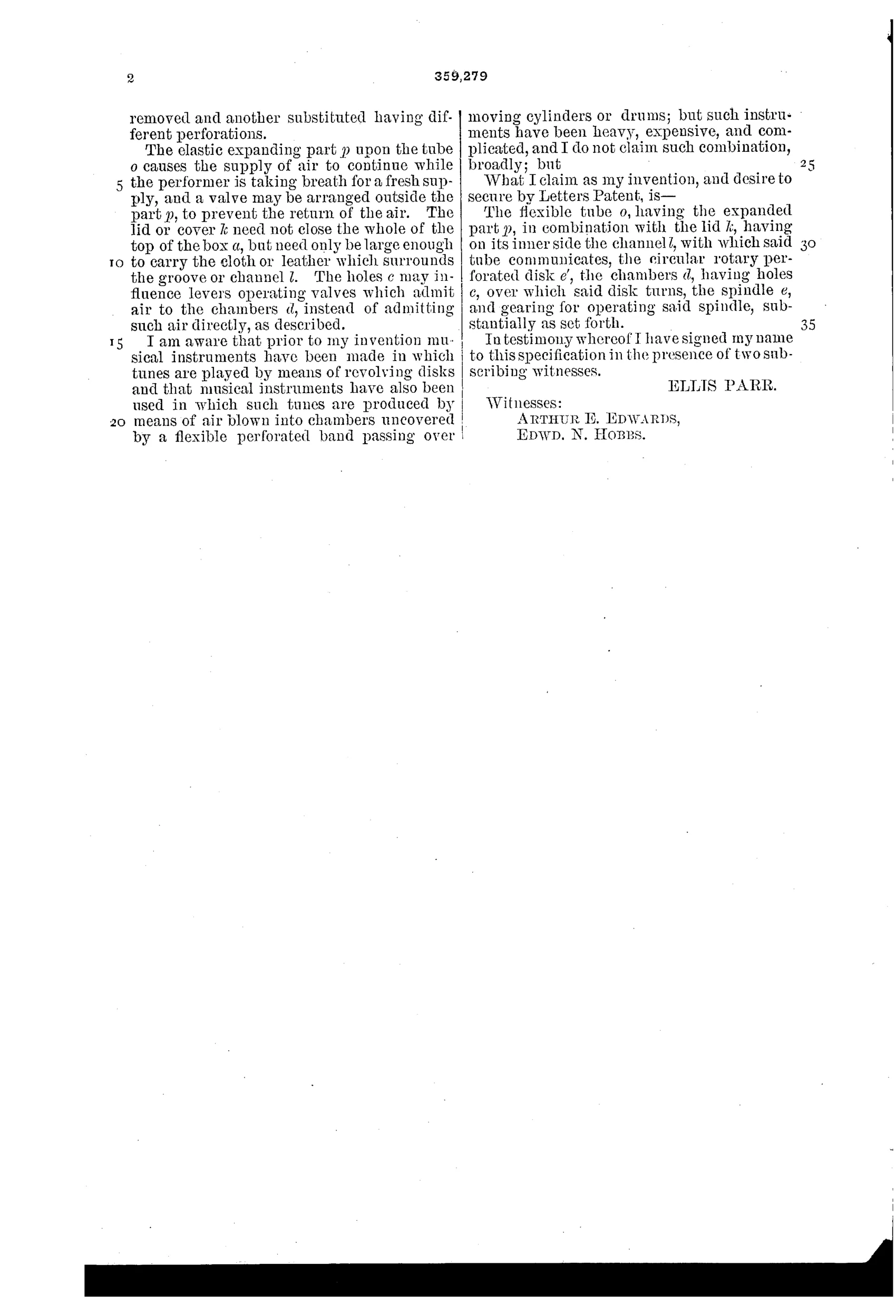
“The flexible tube o, having the expanded part p, in combination with the lid k, having on its inner side the channel l, with which said tube communicates, the circular rotary perforated disk e', the chambers d, having holes c, over which said disk turns, the spindle e, and gearing for operating said spindle, substantially as set forth.”
In plain English: The claim covers the combination of a flexible air tube with an expanding bulb, a lid with an internal air channel, a rotating perforated tune disc, a set of reed chambers with holes under the disc, and the spindle and gears that turn the disc.
♫ In the inventor’s words
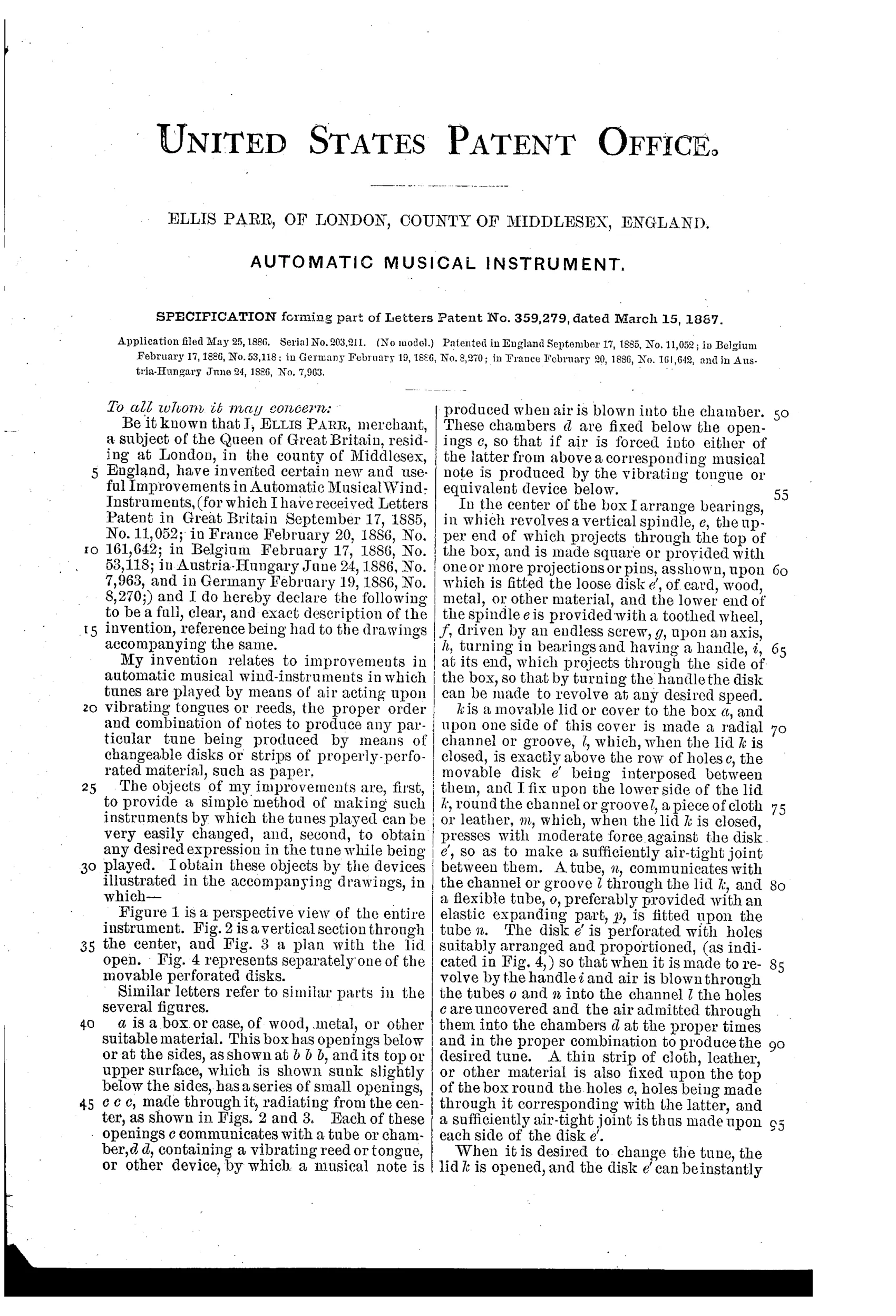
“The objects of my improvements are, first, to provide a simple method of making such instruments by which the tunes played can be very easily changed, and, second, to obtain any desired expression in the tune while being played.”— Ellis Parr, from the specification
Fate unknown
Parr's disc music box work with Lochmann certainly reached production, but no surviving example of this specific bulb-fed pneumatic organette is documented; a marked specimen would settle it.
♫ Commentary
The name matters here. Ellis Parr is the London half of the Parr-Lochmann partnership that gave the world the Symphonion — the first commercially successful disc music box, and the direct ancestor of the Polyphon and Regina machines that dominate the 1890s. This 1886 filing catches him a few years earlier, chasing the same core idea (a cheap, instantly swappable tune disc) but with pneumatics rather than plucked steel teeth. The disc here is perforated paper; puffs of air pass through the holes into radiating reed chambers, and the reed sounds while the hole is open.
The clever detail is the second stated object: expression. The air comes in through a flexible tube with an elastic bulb — you can see it dangling off the box in Fig. 1 like a doctor's sphygmomanometer. Squeeze harder and the tune plays louder. That's a dynamic control almost no pinned-cylinder box could offer, and Parr claims it explicitly in combination with the channeled lid.
Mechanically, the design sits in the crowded organette field — Ehrlich's Ariston disc organette was already proving the round-perforated-disc format in Germany. Parr's pneumatic feed through the lid is fussier than the Ariston's bellows-and-valve approach, and hand-cranking the disc while hand-squeezing the bulb asks a lot of two hands. But as a stepping stone toward the disc-format revolution Parr helped launch, it's a genuinely interesting fossil.
Commentary by Claude, The Talking Machine Patent Archive’s resident enthusiast