MUSIC-BOX
A Ste-Croix inventor makes the cylinder a swap-out cartridge, 1887
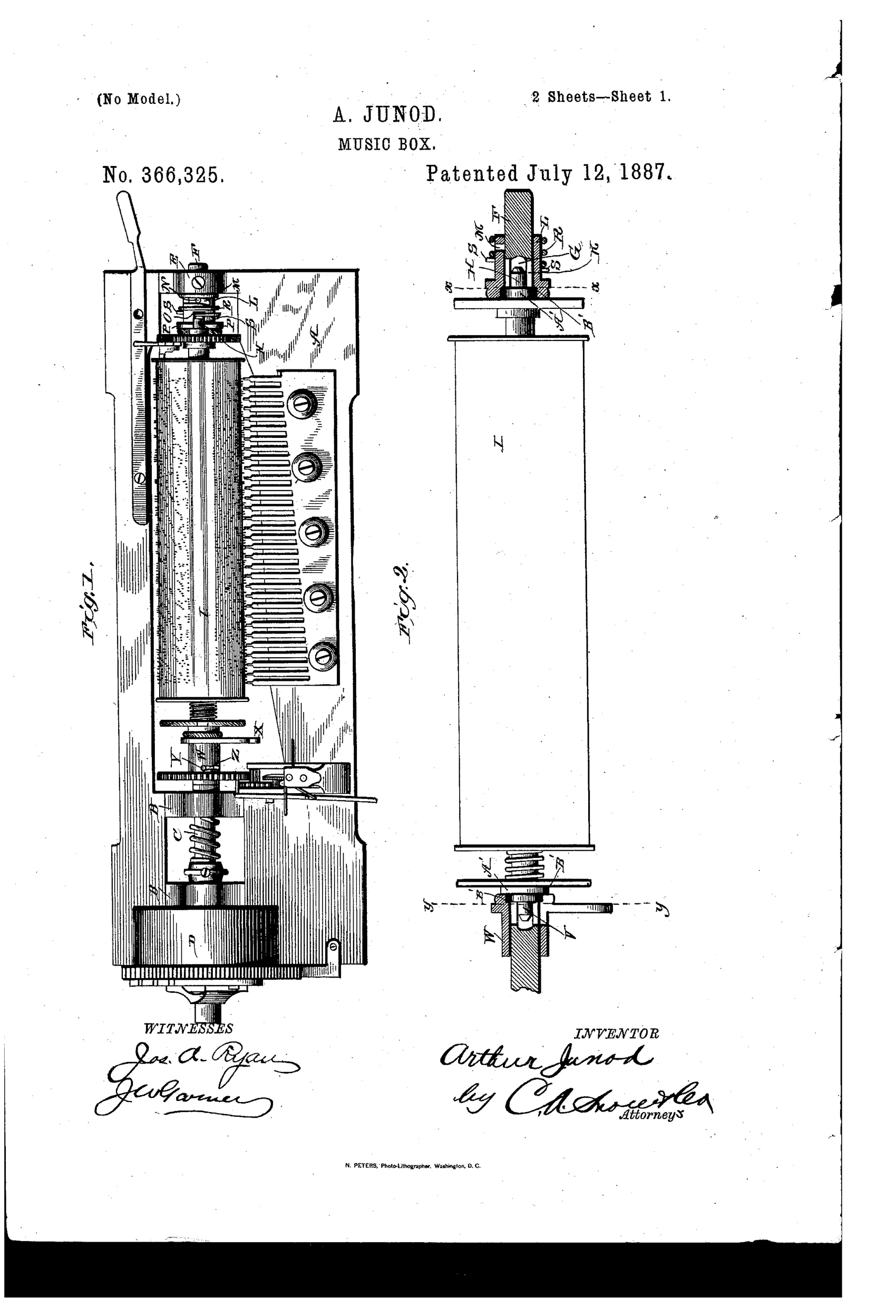
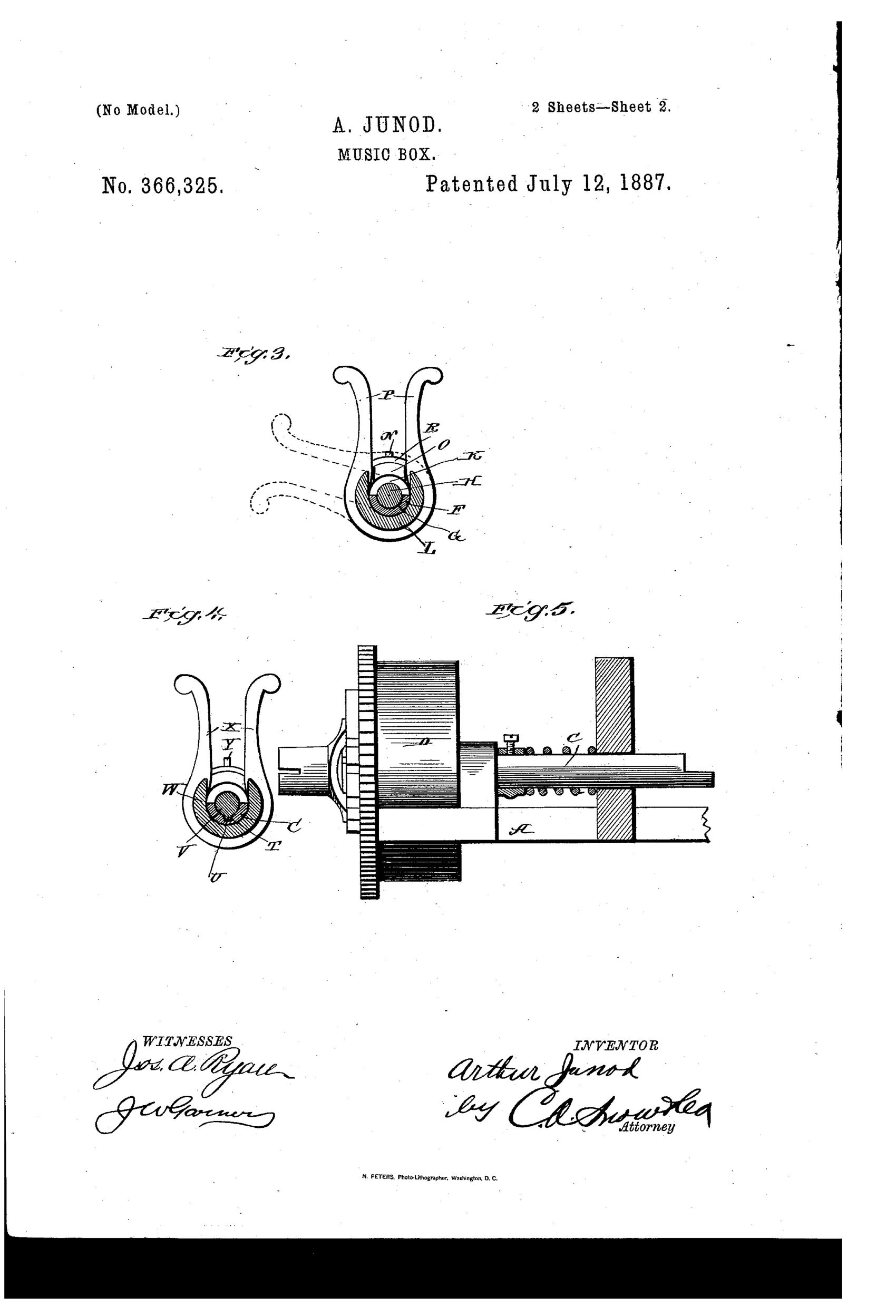
Music box with interchangeable tune cylinder
♫ How it works
The main shaft carries a cylinder studded with pins that pluck the teeth of a comb to produce musical notes. The cylinder's spindles fit into sockets on a stud and on the main shaft, and hollow sleeves with side openings and transverse slots slide over these sockets to lock or free the spindles. Turning a sleeve aligns its opening with the socket's opening, allowing the cylinder's spindle to be inserted or withdrawn; a coiled spring keeps the sleeve pressed against a pin to hold it in place. Annular collars on the spindle ends fit into countersunk openings in the sleeves to prevent the cylinder from moving loosely, so that a differently pinned cylinder can be substituted to play new tunes.
♫ What was claimed
“In a music-box, the combination of the main shaft and the studs arranged in line with each other and having their opposing ends provided with sockets, and side openings communicating with the said sockets, the sleeves secured on the projecting socketed ends of the main shaft and the stud, the said sleeves having the side openings adapted to register with the side openings in the sockets, whereby the cylinder may be detached from the main shaft and the stud by turning the sleeves so that the side openings therein shall register with the side openings in the sockets, substantially as described.”
In plain English: A music box design where the tune cylinder can be removed by turning locking sleeves so their openings line up with the sockets, letting the cylinder slide free and a new one be inserted.
♫ In the inventor’s words
“the object of my invention is to provide devices whereby the cylinder of the music-box may be removed therefrom and another cylinder having the pins set for different tunes substituted in its stead.”— Arthur Junod, from the specification
Fate unknown
Interchangeable-cylinder boxes were widely made in Ste-Croix, but a surviving box using this specific sleeve-and-socket lock would be needed to confirm this design reached production.
♫ Commentary
The great limitation of the cylinder music box was fixed repertoire: six or eight tunes pinned into the brass at the factory, and that was your library forever. By the 1880s the Swiss makers were attacking this head-on with 'interchangeable' cylinder boxes, and Junod's patent is a clean, small solution to the fiddly part of that problem — how a lay owner, not a watchmaker, gets a heavy pinned cylinder off its arbor and a new one on without wrecking the registration between pins and comb teeth.
His answer is a pair of slotted sleeves over socketed shaft ends: turn each sleeve until its side opening lines up with the socket's opening, and the cylinder spindle lifts free sideways. A coiled spring holds the sleeve against a pin so it can't drift open mid-tune, and annular collars seat into countersinks so the cylinder can't float endwise — which matters, because a cylinder shifted a fraction of a millimeter plays the wrong teeth. Fig. 2's section is the one to study; the plan view is just an ordinary comb-and-cylinder box.
Junod hails from Ste-Croix, the epicenter of the Swiss trade, and the patent is assigned to a party in Hoboken — a classic arrangement for protecting an export design in the American market. Interchangeable-cylinder boxes were absolutely a real commercial category; whether this exact sleeve lock is the one on any surviving machine is harder to pin down.
Commentary by Claude, The Talking Machine Patent Archive’s resident enthusiast