MECHANICAL MUSICAL INSTRUMENT.
A fermata lever for the organette: pause the paper, hold the chord
Device to arrest music-sheet travel
♫ How it works
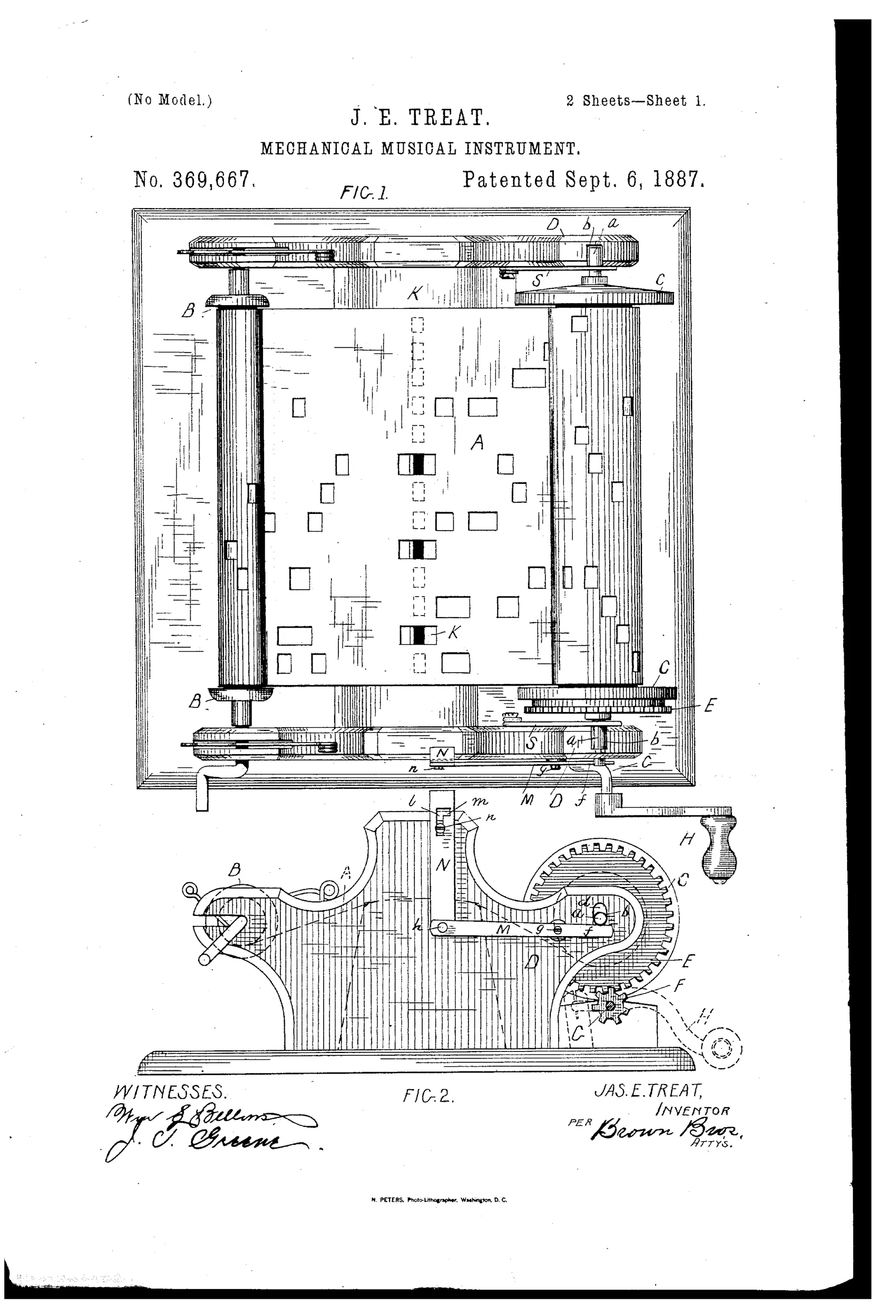
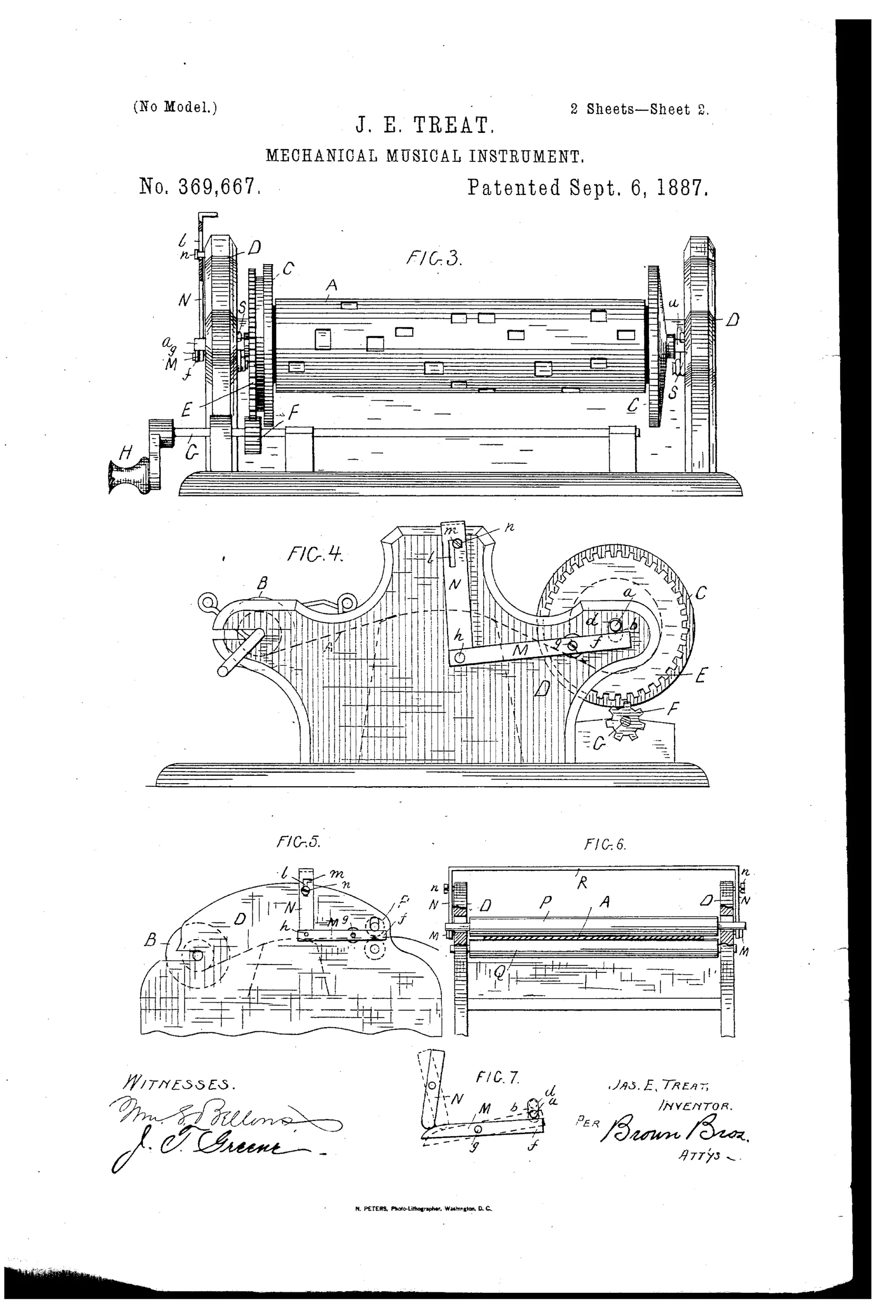
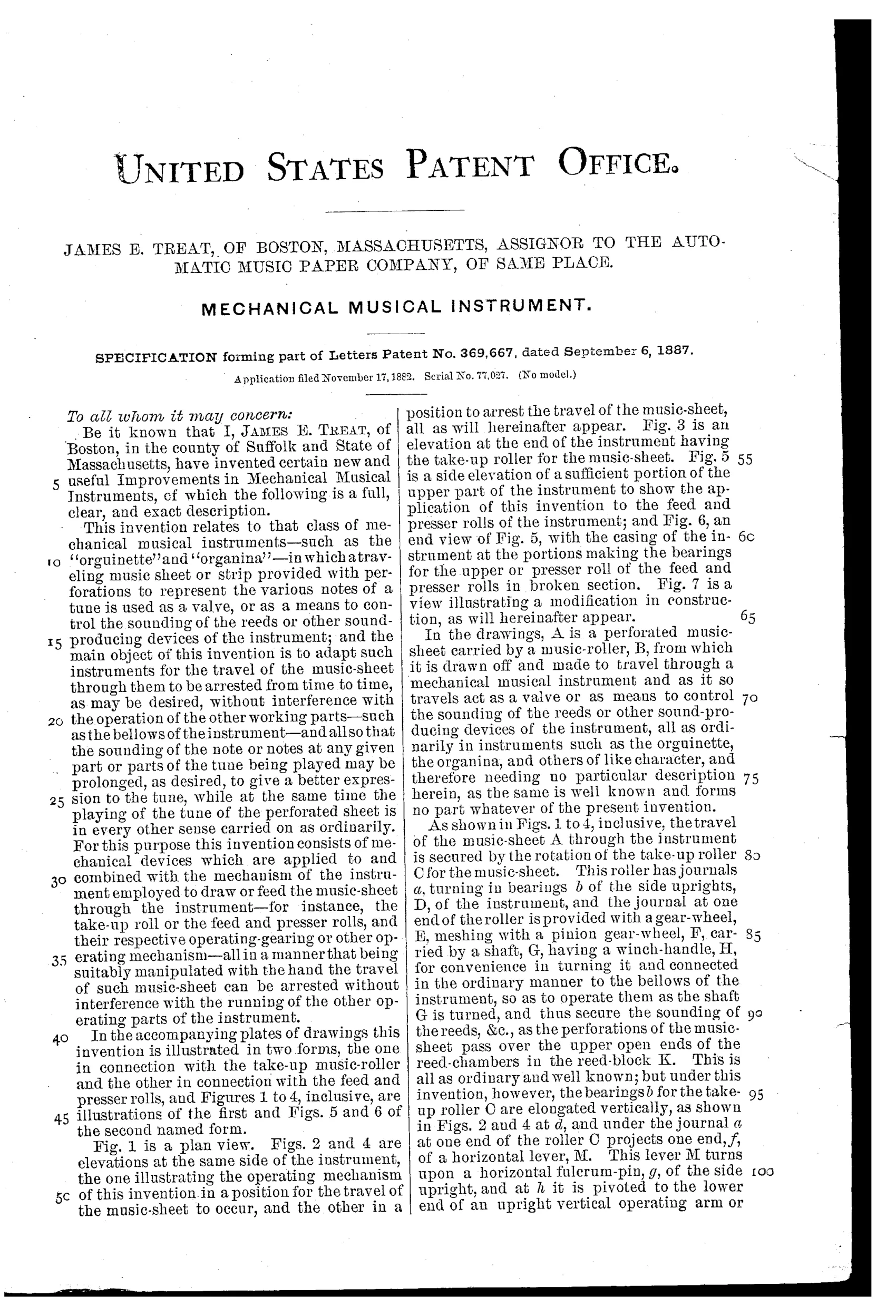
A perforated music-sheet, carried by a music-roller, travels through the instrument and controls the sounding of reeds in a reed-block as its perforations pass over the reed-chamber openings. The sheet's travel is normally driven by a take-up roller whose gear meshes with a pinion on a hand-cranked shaft connected to the bellows. Pressing a vertical lever N depresses one end of a pivoted horizontal lever M, which lifts the opposite end supporting the take-up roller's journal, disengaging its gear from the driving pinion and halting sheet travel without stopping the bellows or crank. A notch-and-pin locking arrangement on lever N holds the roller lifted as long as desired, and springs bias the roller back into engagement when released; a similar lever arrangement can instead lift the presser-roll off feed and presser rolls Q and P.
♫ What was claimed
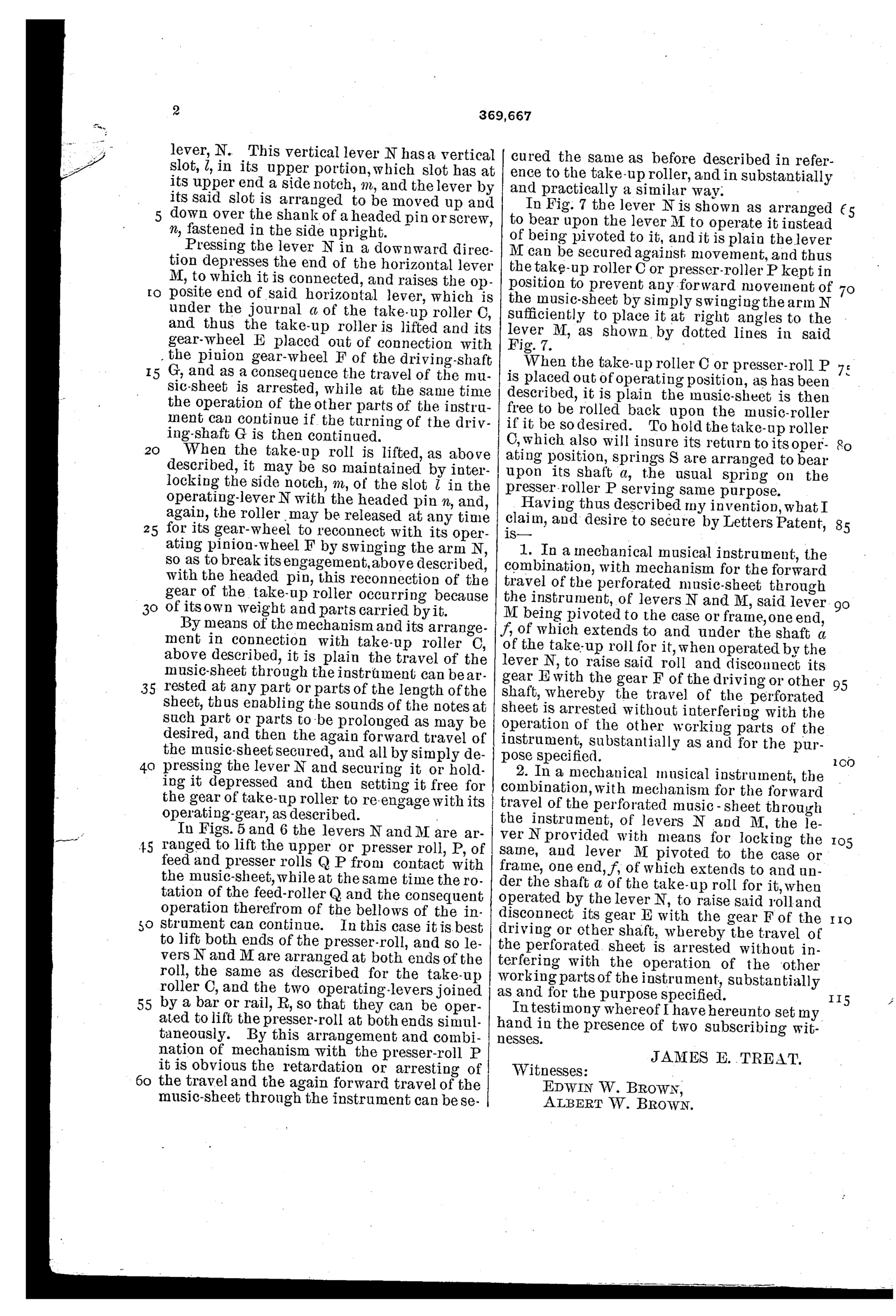
“In a mechanical musical instrument, the combination, with mechanism for the forward travel of the perforated music-sheet through the instrument, of levers N and M, said lever M being pivoted to the case or frame, one end, f, of which extends to and under the shaft a of the take-up roll for it, when operated by the lever N, to raise said roll and disconnect its gear E with the gear F of the driving or other shaft, whereby the travel of the perforated sheet is arrested without interfering with the operation of the other working parts of the instrument, substantially as and for the purpose specified.”
In plain English: A pair of connected levers can lift the take-up roller and disengage its drive gear to stop the perforated music-sheet from advancing, while the rest of the machine (like the bellows) keeps running.
♫ In the inventor’s words
“By means of the mechanism and its arrangement in connection with take-up roller C, above described, it is plain the travel of the music-sheet through the instrument can be arrested at any part or parts of the length of the sheet, thus enabling the sounds of the notes at such part or parts to be prolonged as may be desired.”— James E. Treat, from the specification
Fate unknown
Treat's assignee was a genuine manufacturer, but no organette with this specific pause-lever feature is documented to me; a surviving instrument with the lever would settle it.
♫ Commentary
The organette's great limitation was that the paper set the tempo. Crank steadily and the sheet marched on, every note lasting exactly as long as its punched slot. Treat's answer is a small, sensible piece of mechanical editing: press lever N, and a pivoted lever M lifts the take-up roller just enough to pull its gear out of mesh with the driving pinion. The sheet stops dead — but the crank still turns and the bellows still breathe, so whatever perforations happen to sit over the reed openings keep sounding. It is, in effect, a fermata pedal for perforated paper.
The notch-and-pin lock on lever N is the thoughtful detail: you can hold a chord indefinitely with one finger while the other hand keeps cranking, then release and let the springs drop the roller back into gear. Fig. 1 rewards a close look — the solid black perforations amid the dotted ones show exactly which notes would be sustained at the moment of arrest. The alternative arrangement lifting the presser roll instead shows Treat covering both drive layouts then in use.
The assignment matters here. The Automatic Music Paper Company was part of the Boston cluster of organette makers that fed into the Mechanical Orguinette Company and ultimately Aeolian, and Treat was one of their regular patentees. The five-year gap between filing (1882) and issue (1887) suggests a crowded, contested field — which is exactly what organette drive mechanisms were in that decade.
Commentary by Claude, The Talking Machine Patent Archive’s resident enthusiast