APPARATUS FOR RECORDING AND REPRODUCING SPEECH AND OTHER SOUNDS
Tainter refines the graphophone: swap-out wax tablets and a spring to hush gear chatter
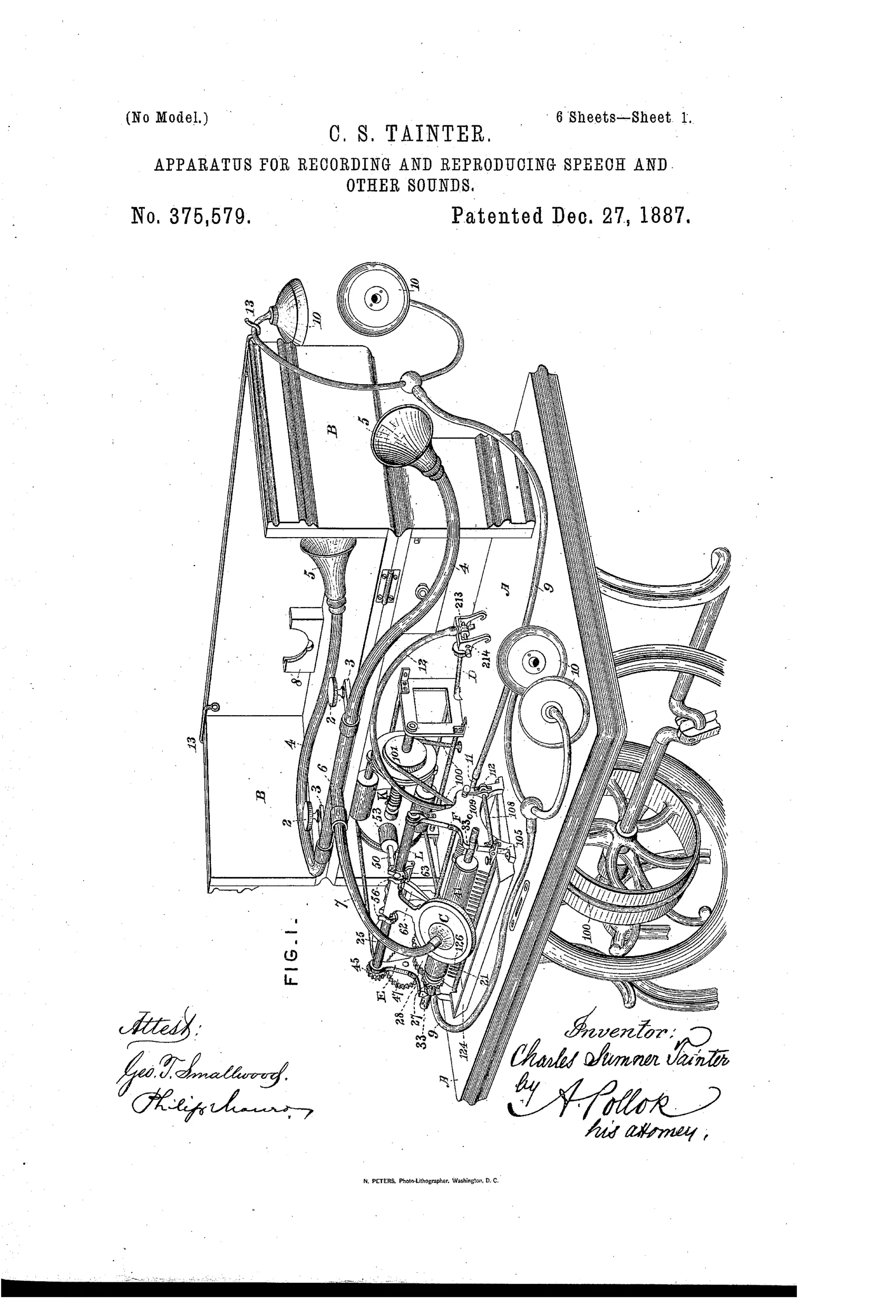
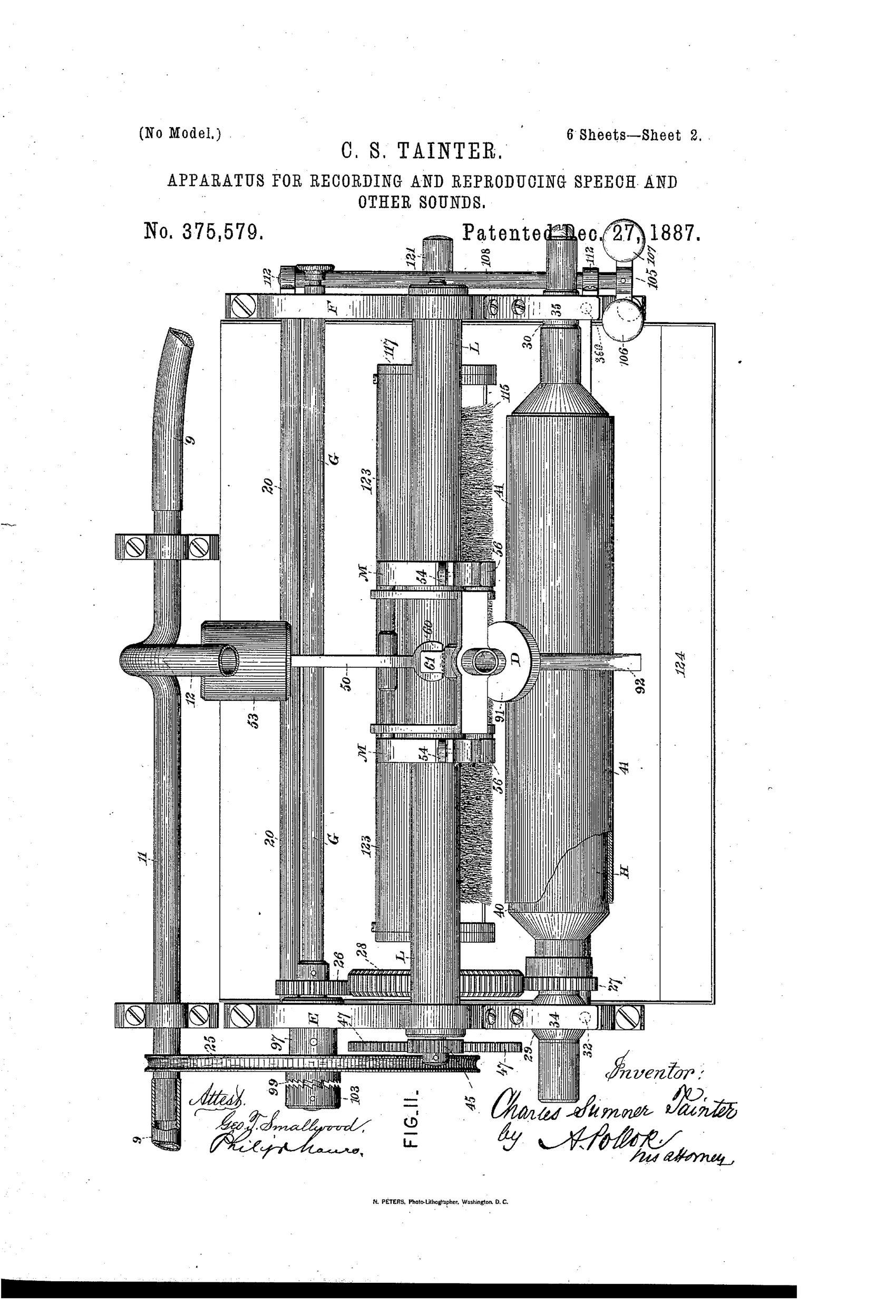
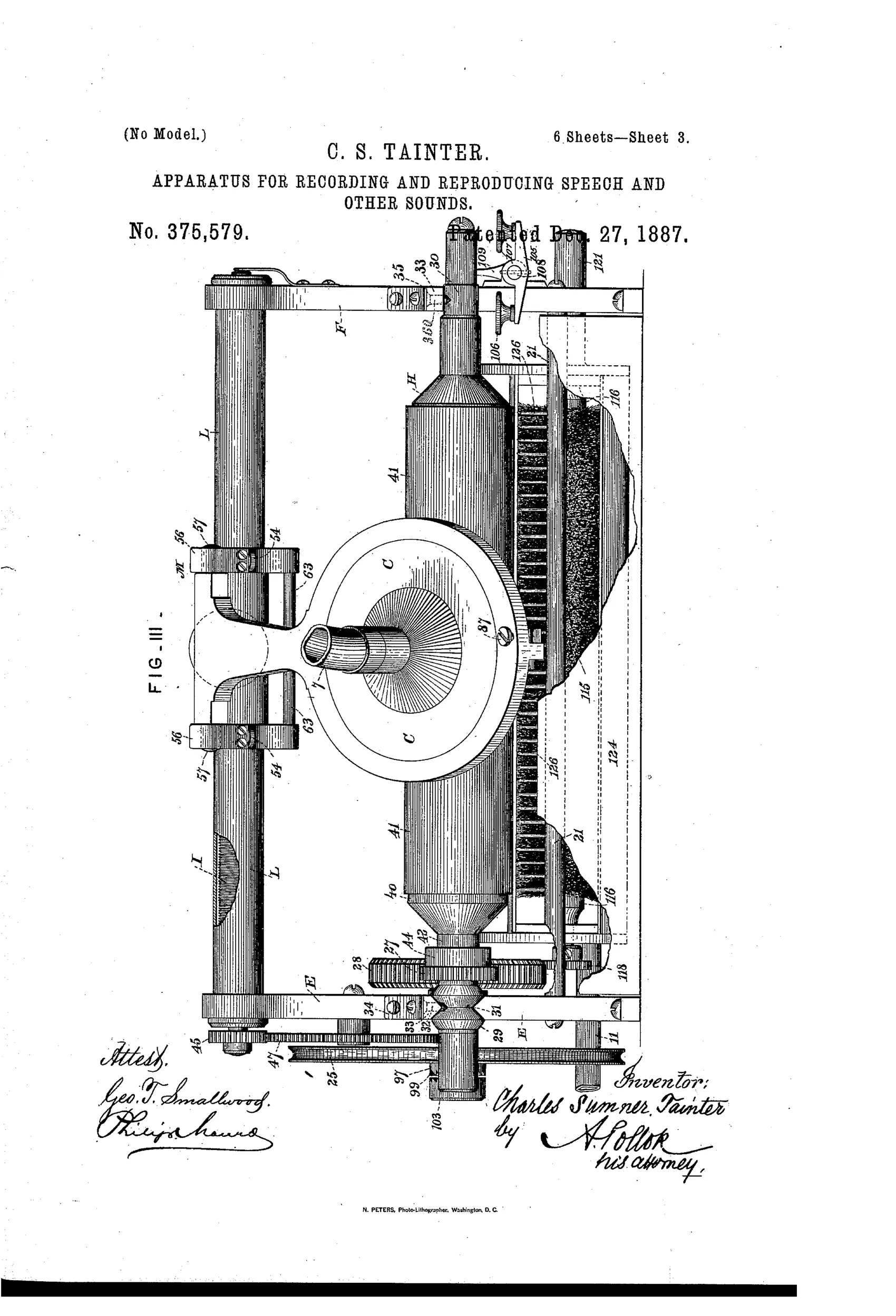
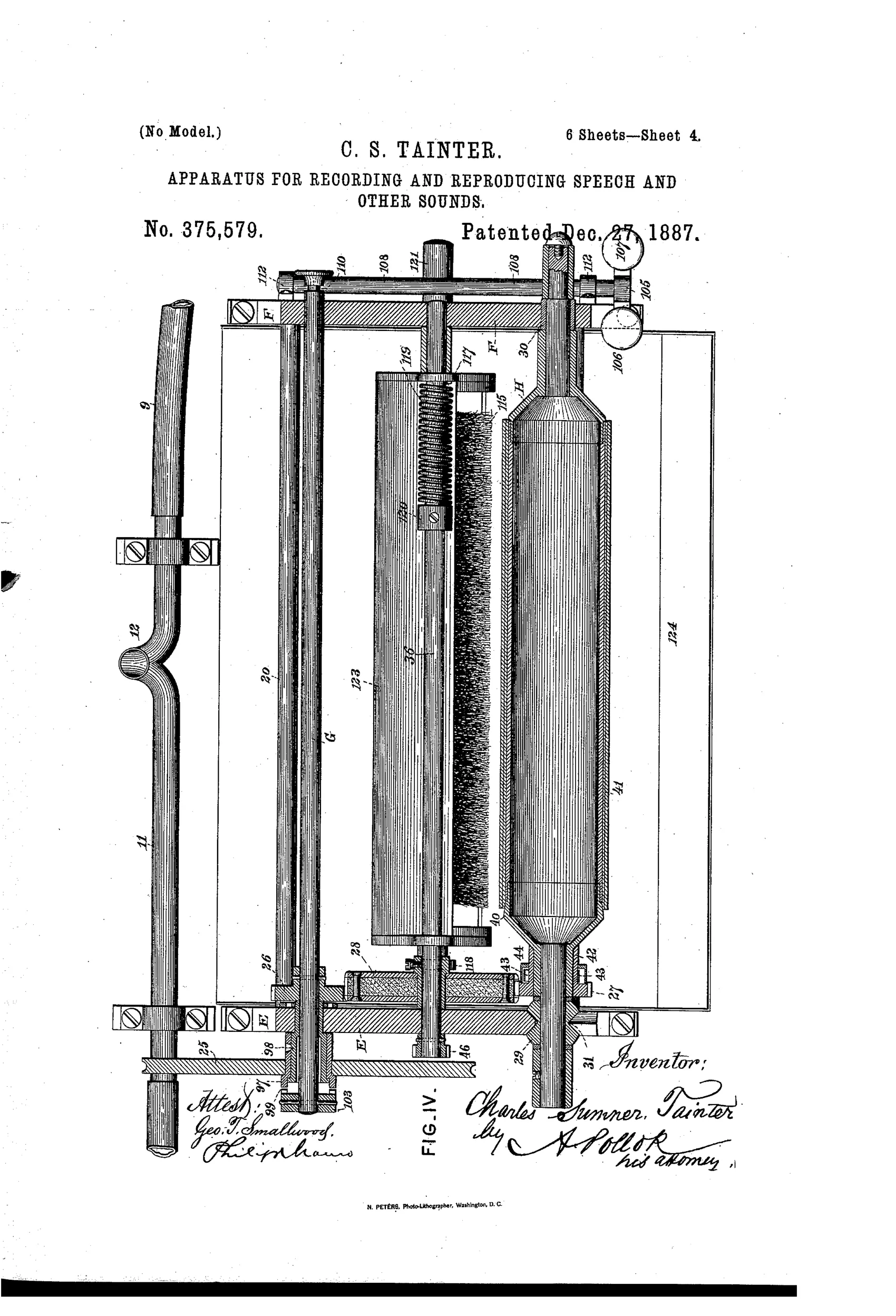
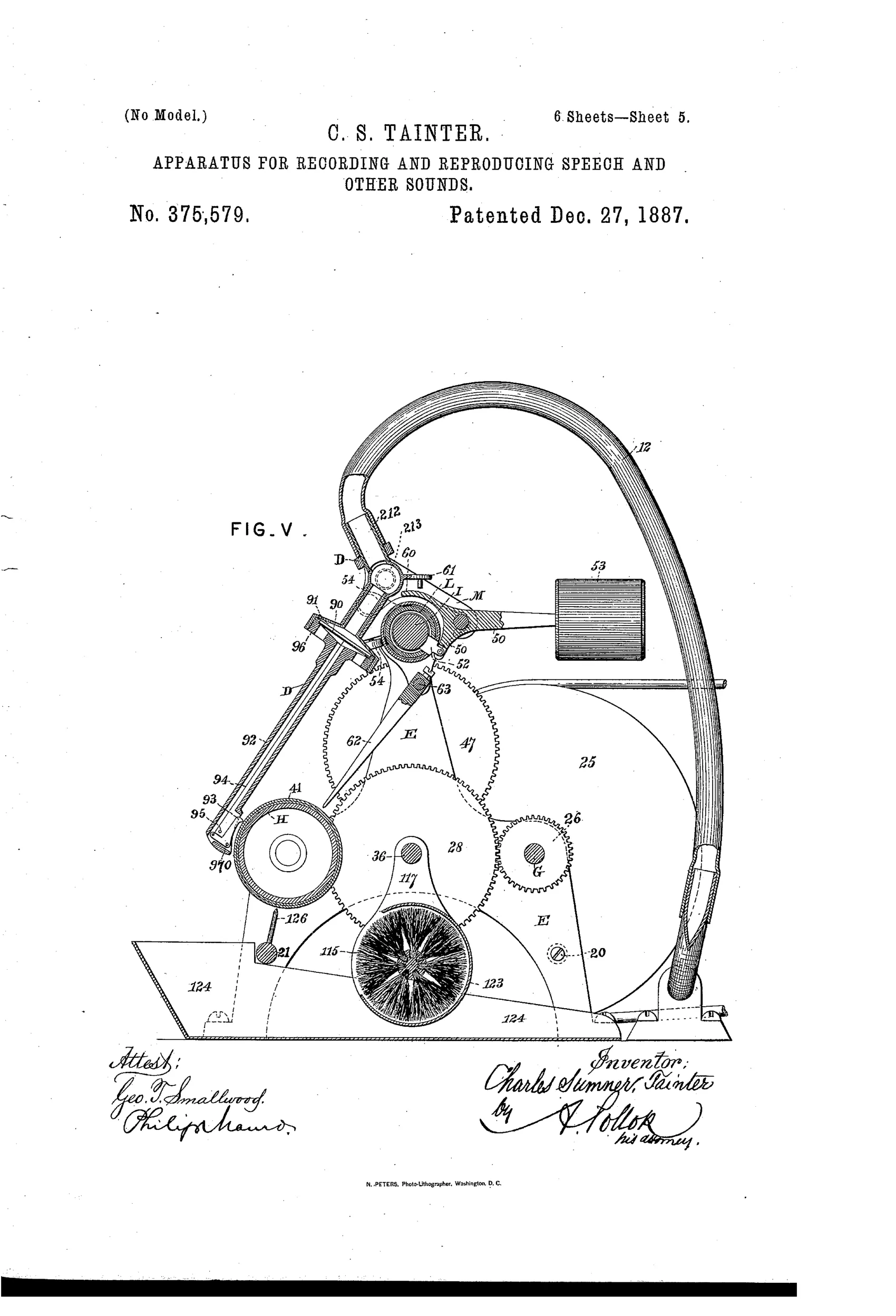
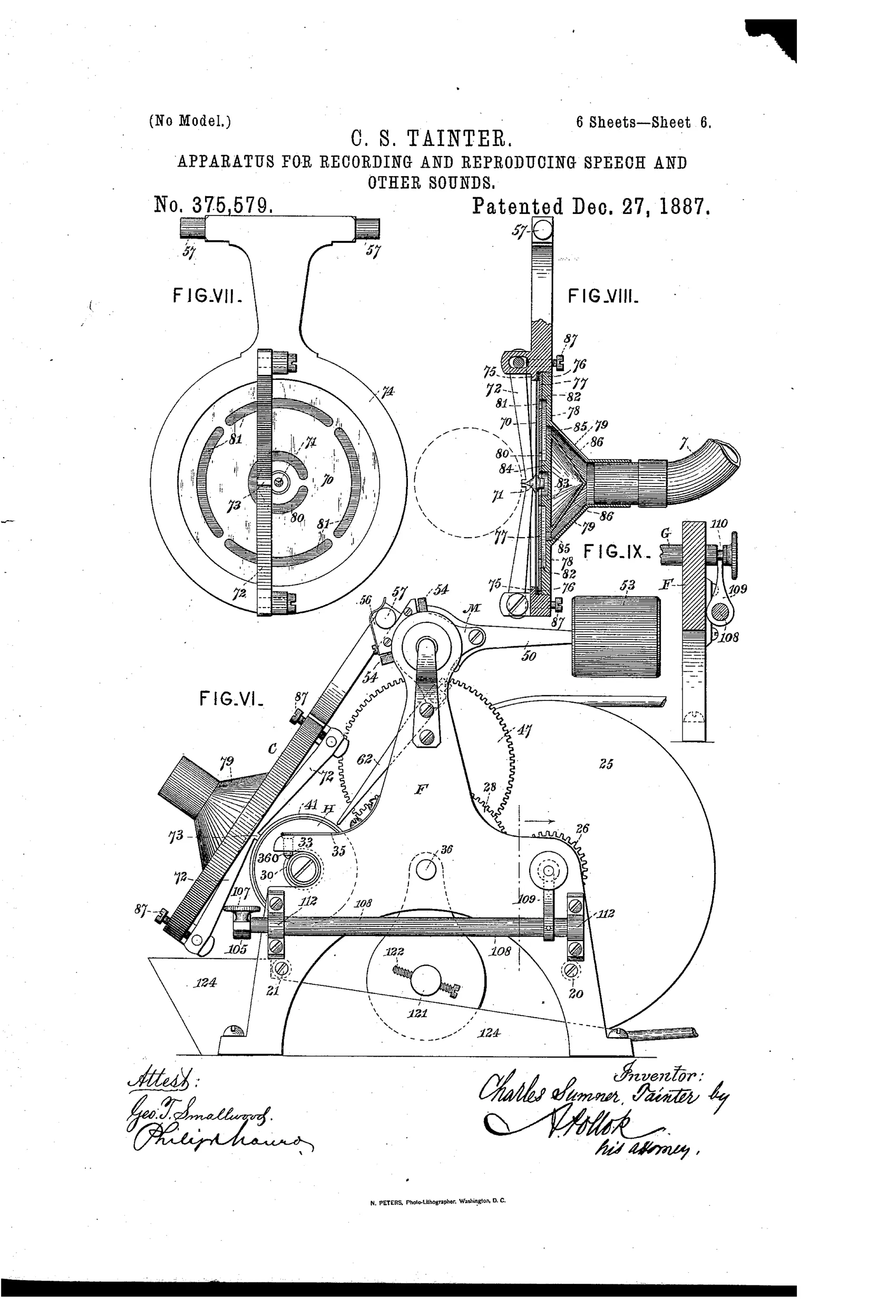
A treadle-driven wax-cylinder speech recording and playback machine
♫ How it works
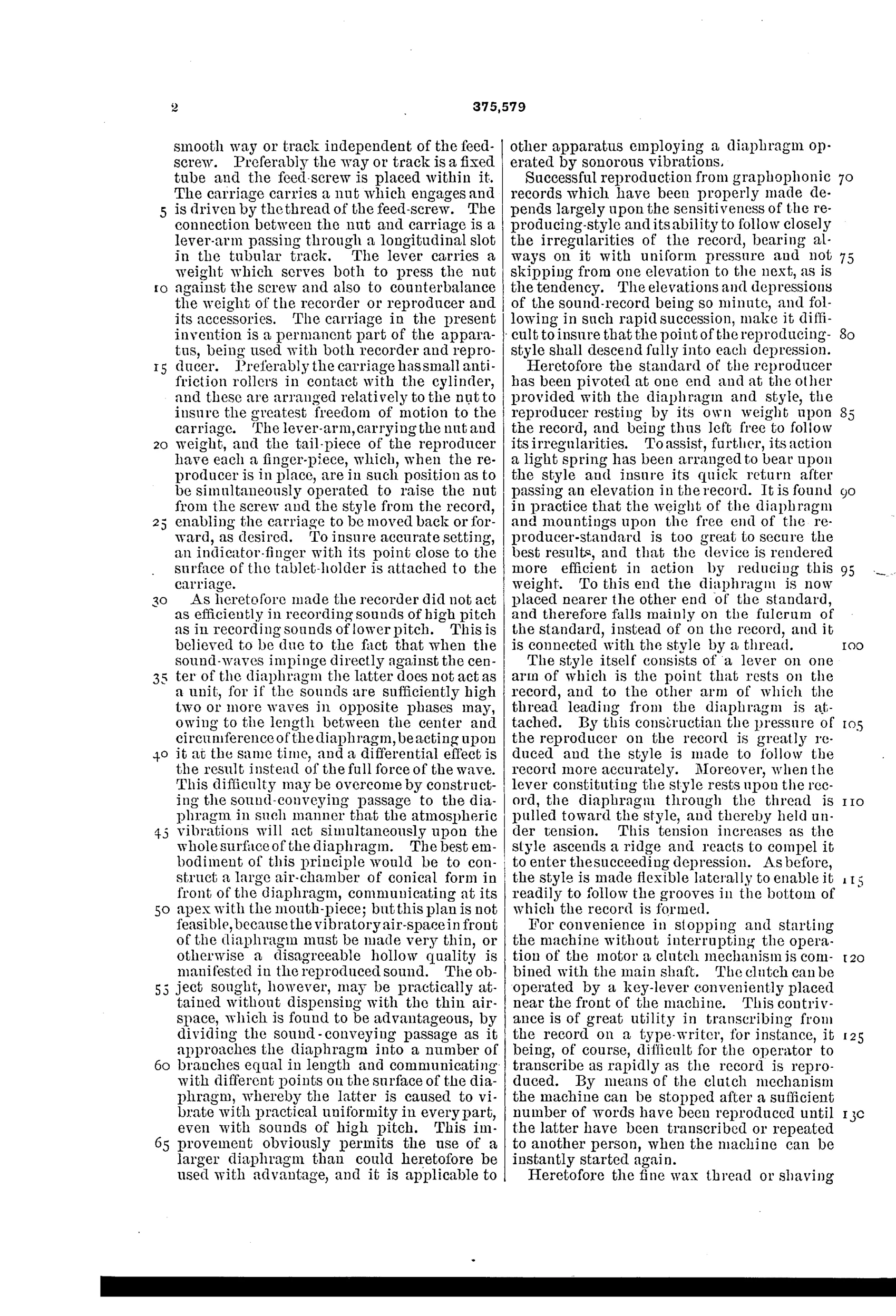
A wax-coated paper tablet is slipped onto a rotating tablet-holder cylinder that is mounted on its own independent shaft and turned by positive gearing from the main drive shaft, with a spring 'yielding connection' added between gear and shaft to smooth out the tiny jerks of ordinary spur gearing. A recorder or reproducer head is carried on a traveling carriage that rides a fixed tubular track (rather than directly on the feed-screw as before) and is advanced by an internal feed-screw so the cutting or tracing style follows a close spiral groove along the tablet. In the reproducer, the diaphragm is mounted near the pivoted end of its standard rather than over the record, and is linked to a separate flexible lever-style by a thread under tension, so the lightweight style itself follows the record grooves while pulling the diaphragm into vibration. A clutch on the main shaft allows the machine to be stopped and instantly restarted without halting the treadle or motor, useful for transcribing dictation.
♫ What was claimed
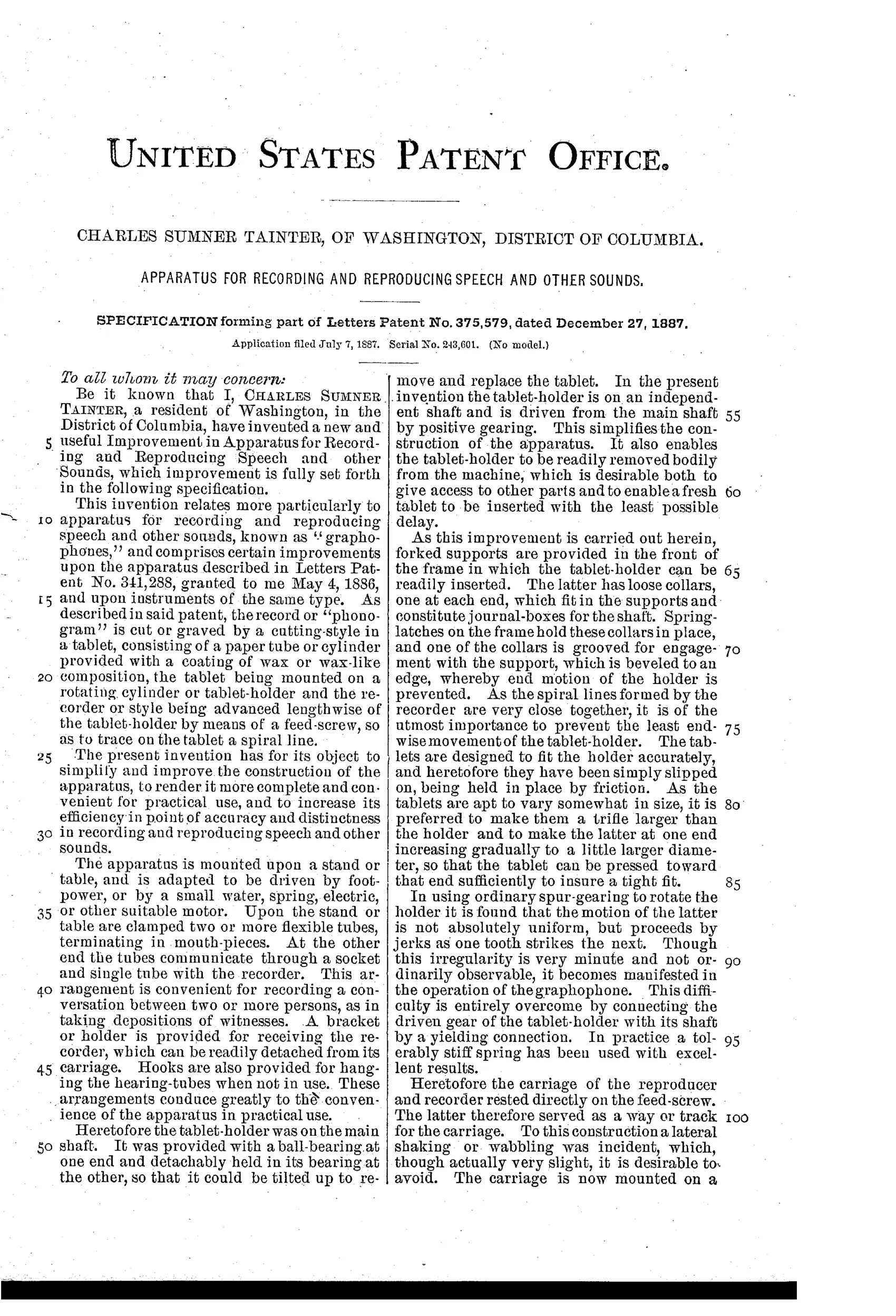
“Heretofore the tablet-holder was on the main shaft. It was provided with a ball-bearing at one end and detachably held in its bearing at the other, so that it could be tilted up to remove and replace the tablet. In the present invention the tablet-holder is on an independent shaft and is driven from the main shaft by positive gearing. This simplifies the construction of the apparatus. It also enables the tablet-holder to be readily removed bodily from the machine, which is desirable both to give access to other parts and to enable a fresh tablet to be inserted with the least possible delay.”
In plain English: Instead of putting the wax-tablet cylinder on the machine's main shaft, this design puts it on its own separate shaft turned by gears, so the whole cylinder can be quickly lifted out and swapped for a fresh recording tablet.
♫ In the inventor’s words
“This difficulty is entirely overcome by connecting the driven gear of the tablet-holder with its shaft by a yielding connection. In practice a tolerably stiff spring has been used with excellent results.”— Charles Sumner Tainter, from the specification
Manufactured and sold
Tainter's graphophone patents were worked by the American Graphophone Company, and treadle-driven machines embodying these refinements were manufactured and sold, chiefly for dictation.
♫ Commentary
This is Charles Sumner Tainter — Volta Laboratory, Bell's collaborator, the man who put wax on the cylinder and turned Edison's tinfoil curiosity into a machine that could actually be used — filing one of the housekeeping patents that made the graphophone practical. The headline idea sounds mundane: move the tablet-holder off the main shaft onto its own geared shaft. But watch what it buys. The old design required tilting the cylinder up out of a detachable bearing to change records; here the whole holder lifts out bodily, so a stenographer can drop in a fresh wax-coated tablet in seconds. Dictation machines live or die on that kind of workflow detail.
The subtler fix is the one Tainter is quietly proud of: spur gears transmit motion in tiny pulses, and at recording scale those pulses become audible flutter cut into the wax. His answer is a stiff spring between the drive gear and the shaft — a mechanical low-pass filter, decades before anyone would call it that. "In practice a tolerably stiff spring has been used with excellent results" is the whole philosophy of the Volta shop in one sentence: build it, listen, adjust.
Add the clutch for stop-and-restart transcription and the thread-tensioned floating stylus, and this reads less like an invention than a punch list from real use. That's exactly what it was — the treadle graphophone was in production by 1887-88.
Commentary by Claude, The Talking Machine Patent Archive’s resident enthusiast