STOP-MOTION FOR MUSIC-BOXES.
Splitting the stopping strain across two shafts, with wear adjustment built in
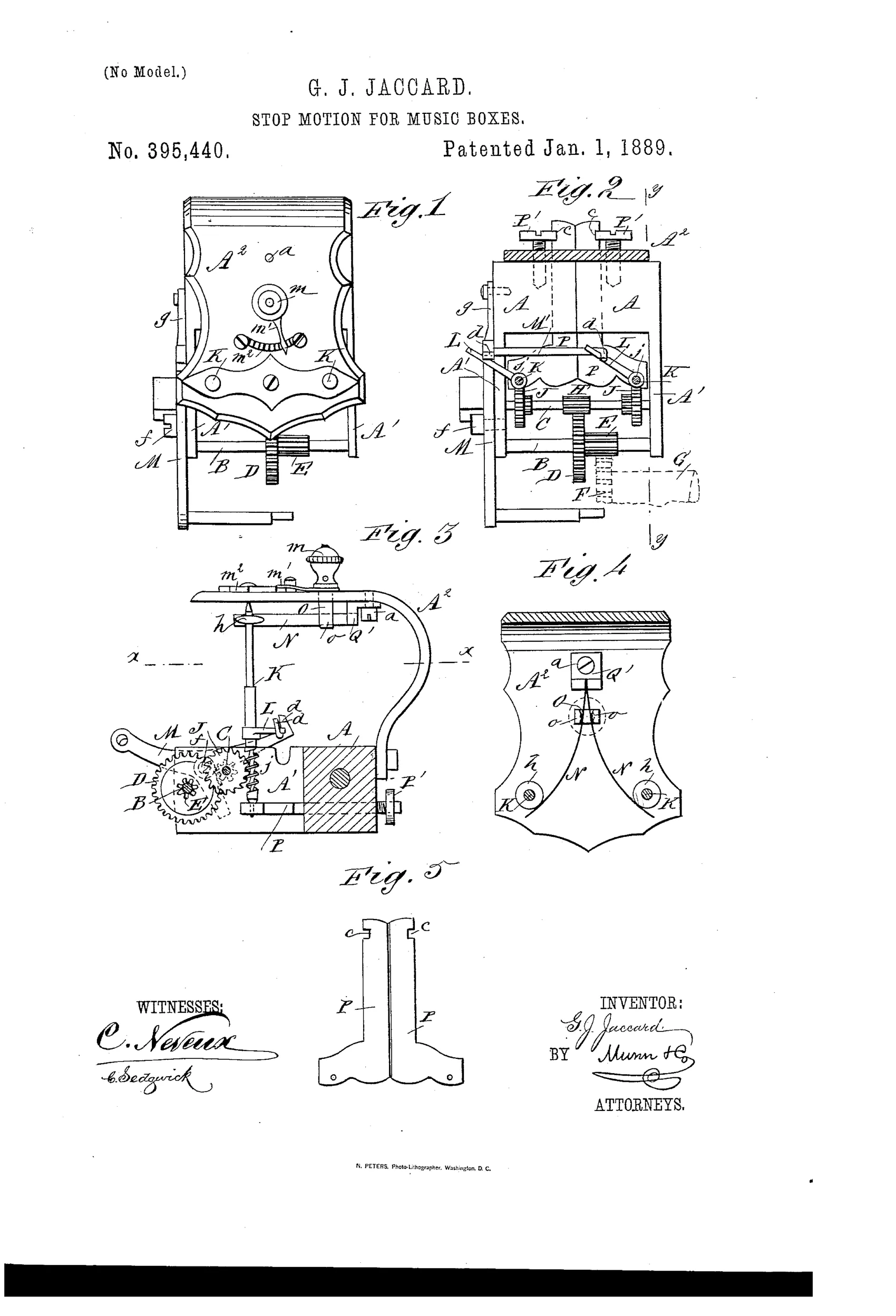
Duplex stop-motion mechanism for music boxes
♫ How it works
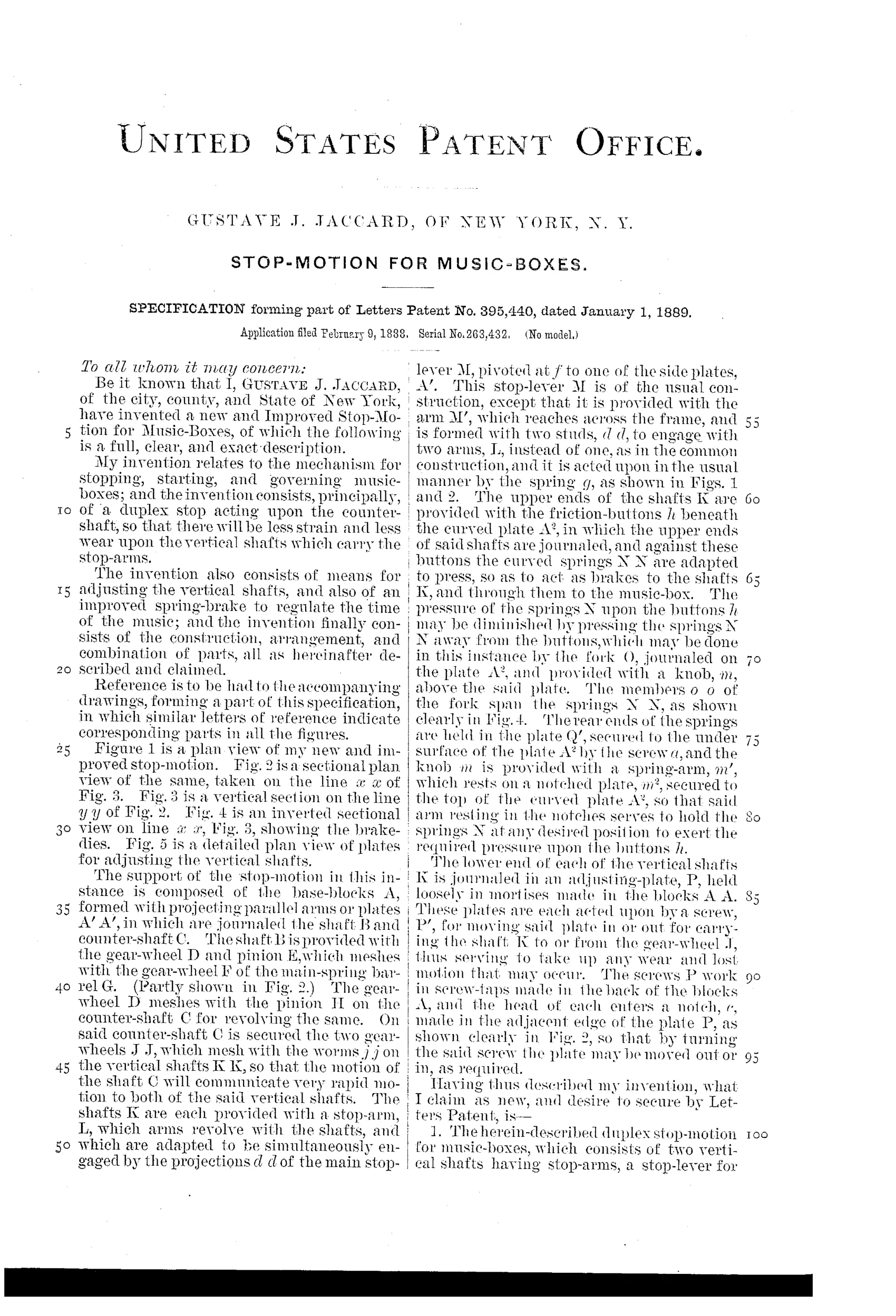
Two vertical shafts K, each carrying a stop-arm L, are driven from a counter-shaft C via gear-wheels J and worms j, which is itself driven from a shaft B through a pinion H, gear-wheel D, and pinion E meshing with the mainspring barrel's gear-wheel F. A stop-lever M, pivoted to a side plate, carries an arm M' with two studs d d that simultaneously engage the two stop-arms L to halt the mechanism, reducing wear on the vertical shafts. Friction-buttons h on the upper ends of the shafts K are pressed by curved brake springs N N to regulate the speed of the music, and the pressure of these springs is adjustable via a knob m and fork O that spans the springs. Adjusting-plates P, held loosely in mortises in the base-blocks A and moved by screws P', allow the lower ends of the shafts K to be shifted toward or away from the gear-wheels J to take up wear and lost motion.
♫ What was claimed
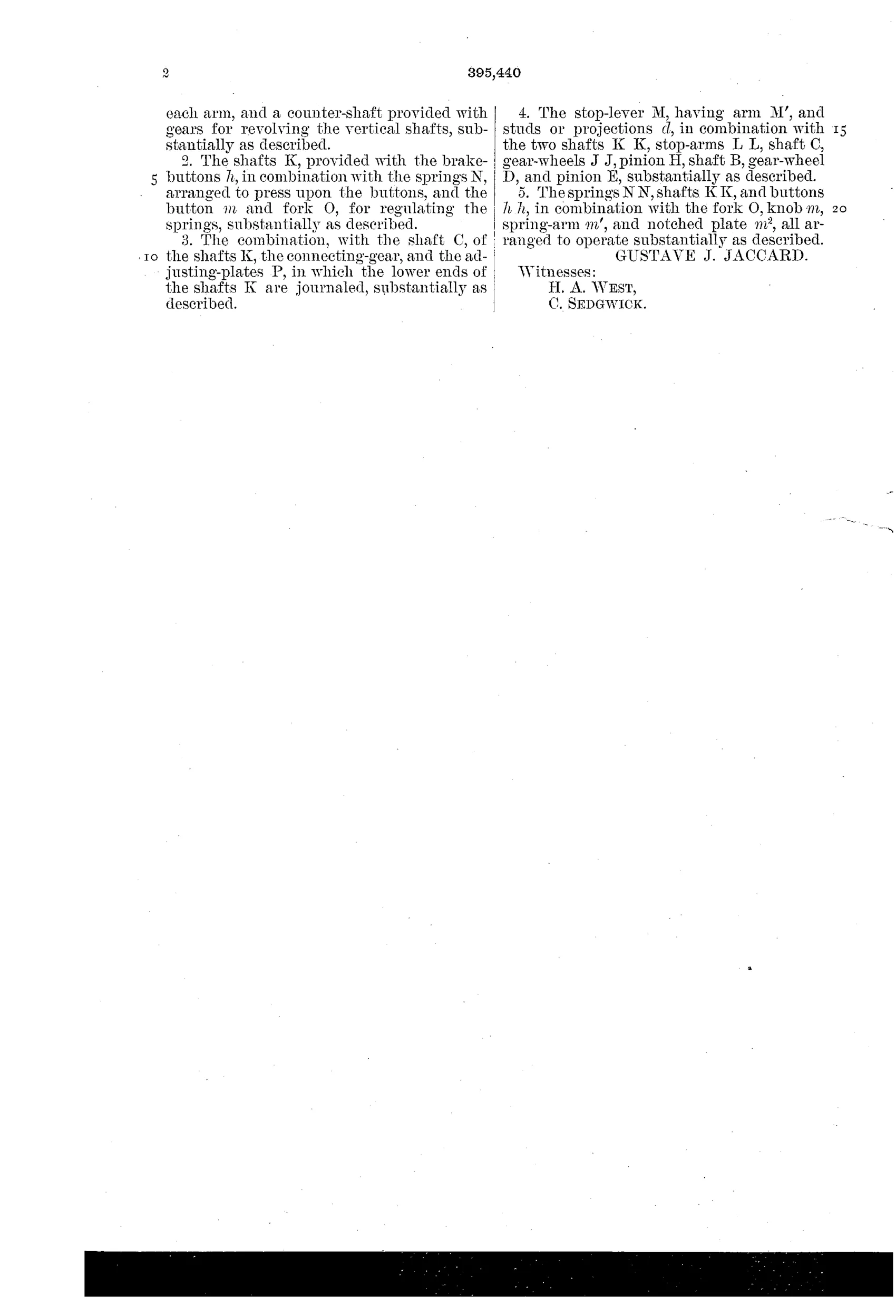
“The herein-described duplex stop-motion for music-boxes, which consists of two vertical shafts having stop-arms, a stop-lever for each arm, and a counter-shaft provided with gears for revolving the vertical shafts, substantially as described.”
In plain English: The invention is a stop mechanism using two vertical shafts with stop-arms, each controlled by its own stop-lever, driven by a geared counter-shaft.
♫ In the inventor’s words
“My invention relates to the mechanism for stopping, starting, and governing music-boxes; and the invention consists, principally, of a duplex stop acting upon the counter-shaft, so that there will be less strain and less wear upon the vertical shafts which carry the stop-arms.”— Gustave J. Jaccard, from the specification
Fate unknown
The Jaccard name is connected to the American music-box trade, but no box documented with this duplex stop-motion is known to me; a marked movement would settle it.
♫ Commentary
By 1888 the cylinder music box was a mature machine, and the patents of that decade read like maintenance reports: everyone was chasing the parts that wore out. Jaccard's target is the stop-motion — the little train that halts the cylinder at the end of a tune. In a conventional box a single vertical shaft with a stop-arm takes the full shock of arresting a wound mainspring, and over the years that shaft's bearings loosen and the box starts stopping sloppily, or not at all. His answer is blunt and sensible: use two vertical shafts, each with its own stop-arm, and a stop-lever carrying twin studs that engage both arms at once. Half the strain per shaft, twice the service life.
The detail worth lingering on is Fig. 5, the adjusting plates. Jaccard mounts the lower ends of the vertical shafts in plates held loosely in mortises, shifted by screws toward or away from the drive gears. That is a repairman's provision — an admission that gear mesh will open up with wear, and a way to close it without re-bushing anything. The friction-buttons under curved brake springs, with a knob-and-fork adjustment for spring pressure, double as a crude speed regulator.
Nothing here is revolutionary; it is a refinement in a crowded Swiss-dominated field. But it is honest engineering aimed at the actual failure mode, and the name Jaccard sits close to the American music-box trade of the period, which makes it more than idle speculation.
Commentary by Claude, The Talking Machine Patent Archive’s resident enthusiast