PHONOGRAPH.
Edison's right-hand man designs the talking doll's spring-return heart
Toy doll phonograph with repeating sound-record
♫ How it works
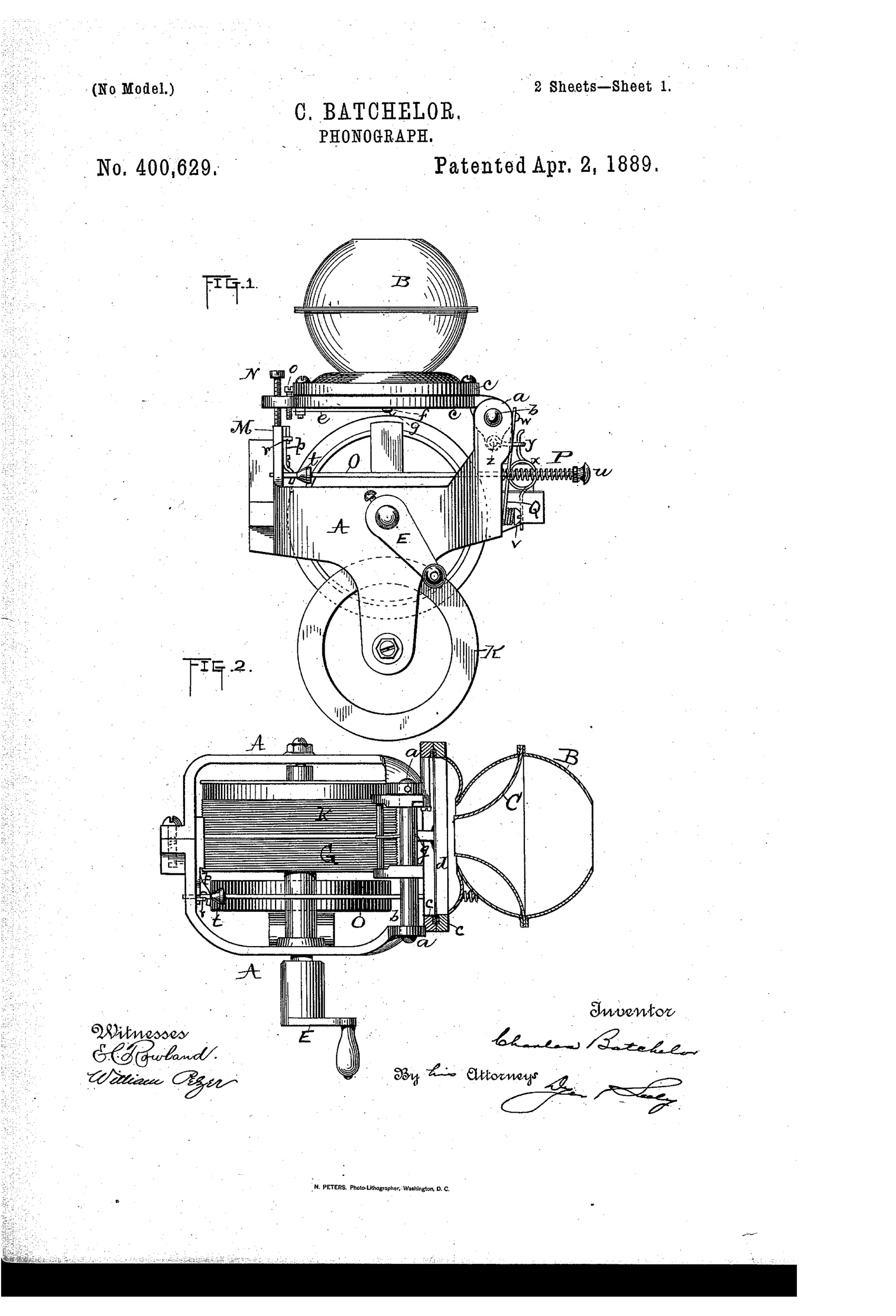
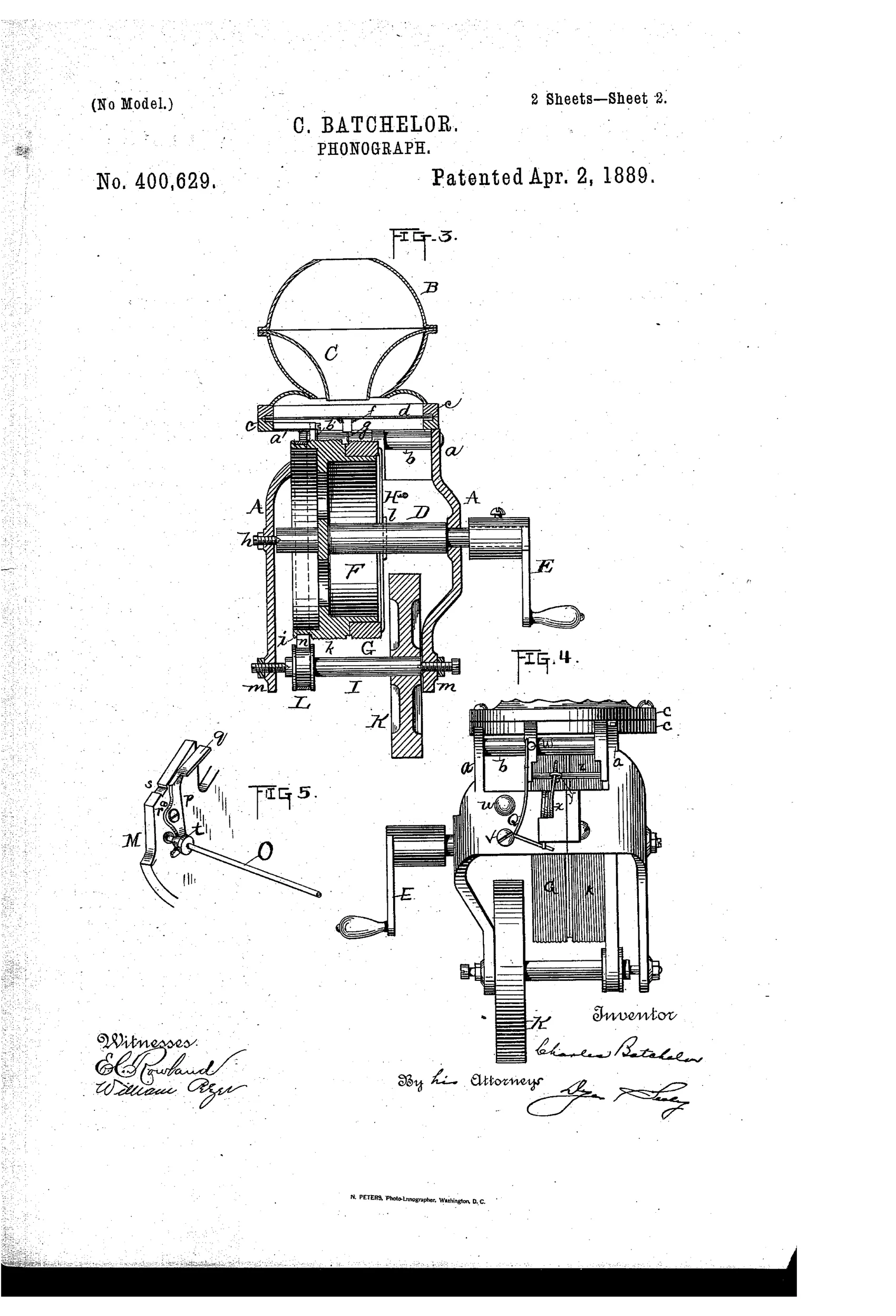
A hand-cranked shaft turns a metal shell bearing a spiral thread that feeds a hinged reproducer, whose diaphragm and hooked wire point ride against a permanent sound-record on a ring mounted on the shell. A fly-wheel and pulley connected by belt regulate the speed of rotation as the crank is turned. When the reproducing-point reaches the end of the record, a screw drops into a notch, engaging a catch that halts the reproducer's forward travel. Pressing a sliding rod trips a pivoted lever that lifts the reproducer off the record and releases the catch, letting springs snap the reproducer back to its starting position without damaging the record.
♫ What was claimed
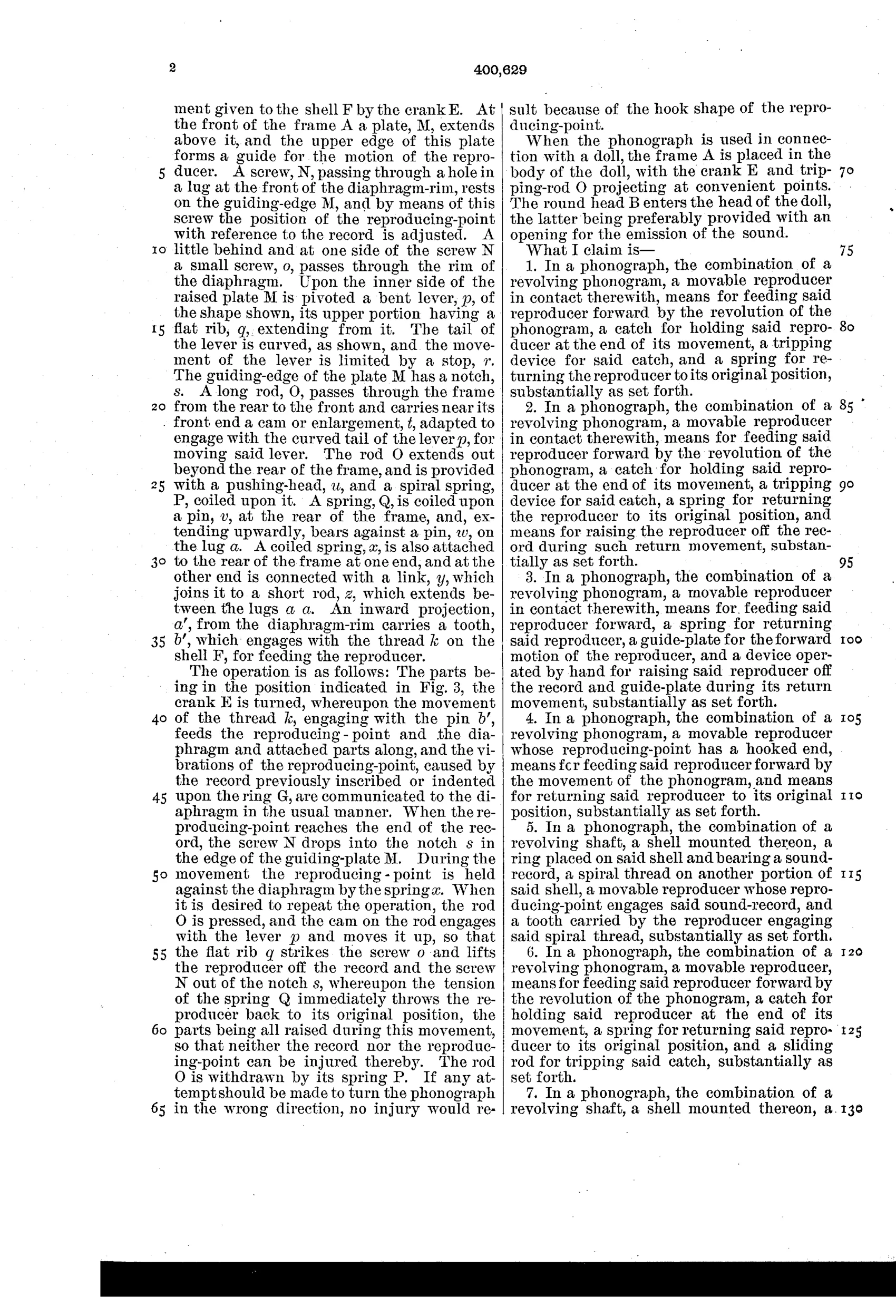
“1. In a phonograph, the combination of a revolving phonogram, a movable reproducer in contact therewith, means for feeding said reproducer forward by the revolution of the phonogram, a catch for holding said reproducer at the end of its movement, a tripping device for said catch, and a spring for returning the reproducer to its original position, substantially as set forth.”
In plain English: The patent covers a phonograph where a rotating cylinder feeds a movable sound-reproducer forward, and a catch-and-trip mechanism releases it so a spring snaps it back to the start.
♫ In the inventor’s words
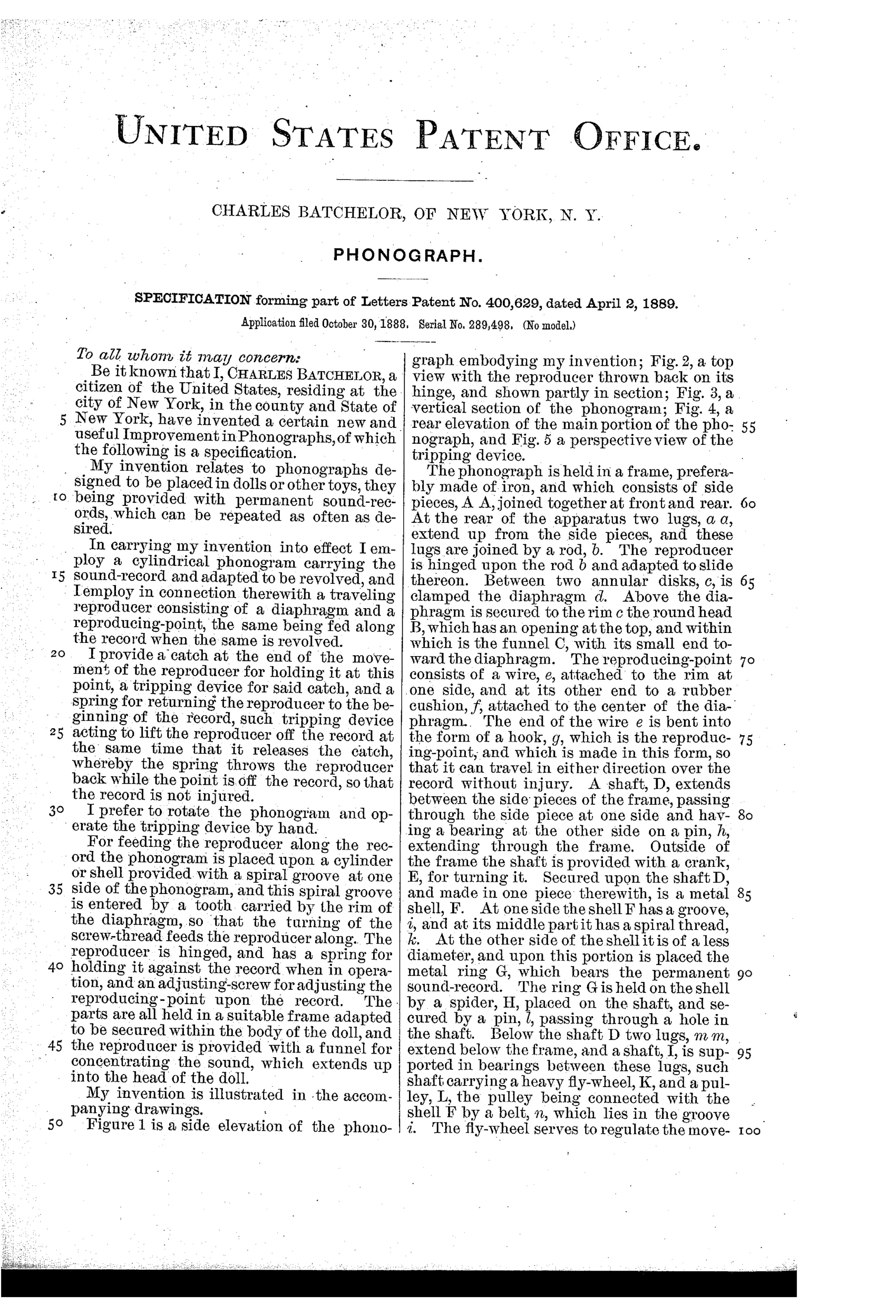
“My invention relates to phonographs designed to be placed in dolls or other toys, they being provided with permanent sound-records, which can be repeated as often as desired.”— Charles Batchelor, from the specification
Manufactured and sold
Batchelor's doll-phonograph work fed directly into the Edison Talking Doll of 1890, which was manufactured and sold — though famously withdrawn within weeks.
♫ Commentary
Charles Batchelor was Edison's chief experimental assistant — the man who was in the room for the tinfoil phonograph in 1877 — and this patent is his contribution to one of the lab's strangest commercial ventures: the talking doll. The core problem is stated plainly in the specification: a toy needs a permanent record that a child can play 'as often as desired.' A regular phonograph feeds its reproducer down a spiral and stops; a doll needs to say its piece and reset itself.
Batchelor's answer is the catch-and-trip return. The reproducer rides a threaded shell as the child cranks; at the end of the record a screw drops into a notch and a catch freezes the carriage. Push the sliding rod and a pivoted lever first lifts the stylus clear of the record, then releases the catch, letting springs snap the whole reproducer back to the start. The lift-before-release sequence is the clever bit — without it the return stroke would gouge the wax and the doll would be mute in a week.
History records that even with these precautions the Edison Talking Doll of 1890 was a fiasco: the records wore fast, the voices were shrill, and unsold dolls came back in crates. But as a mechanism, this is a genuinely thoughtful piece of miniaturization, and the fly-wheel governor shows Batchelor knew a child's cranking would be anything but steady.
Commentary by Claude, The Talking Machine Patent Archive’s resident enthusiast