MECHANICAL MUSICAL INSTRUMENT.
A player-piano roll rings distant church bells by wire, 1889
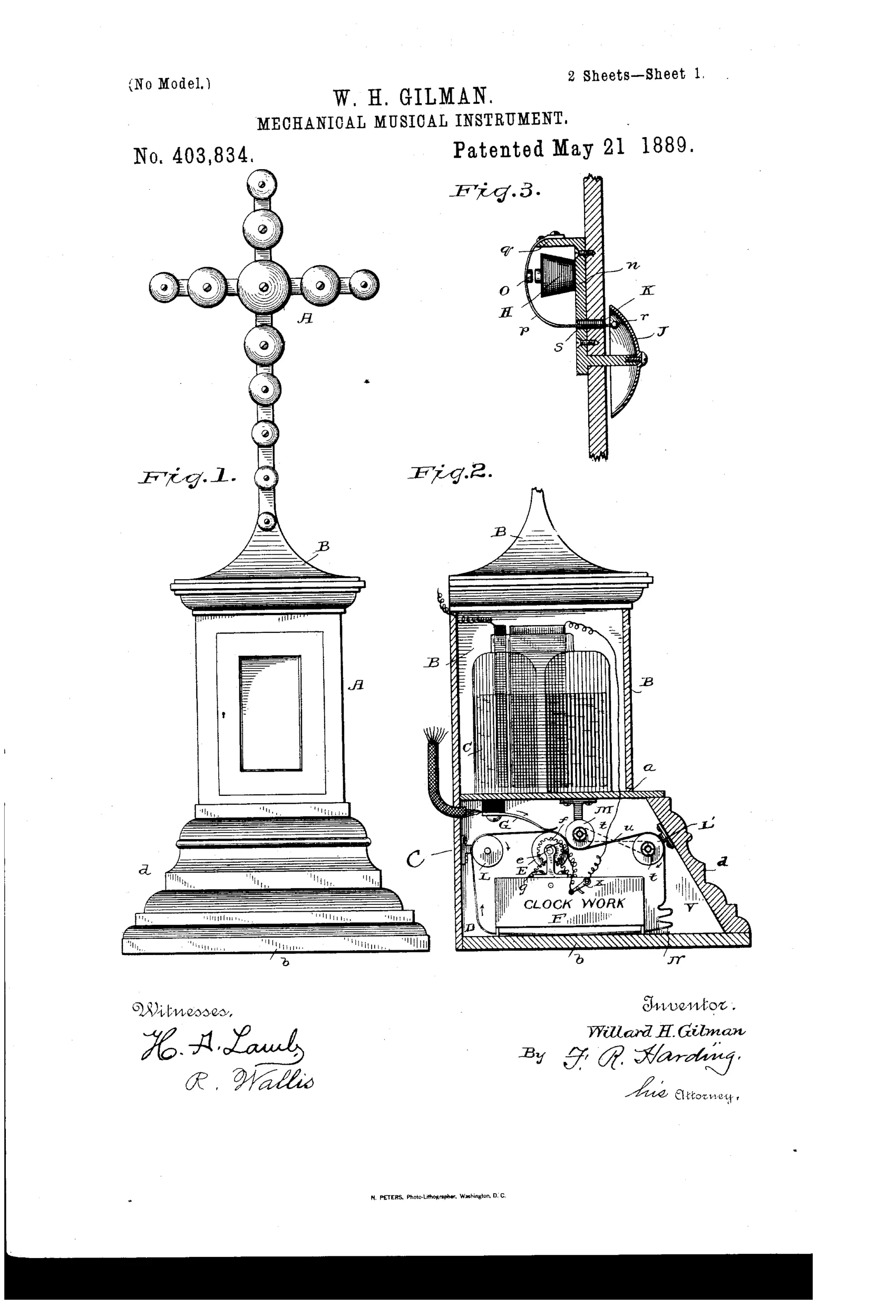
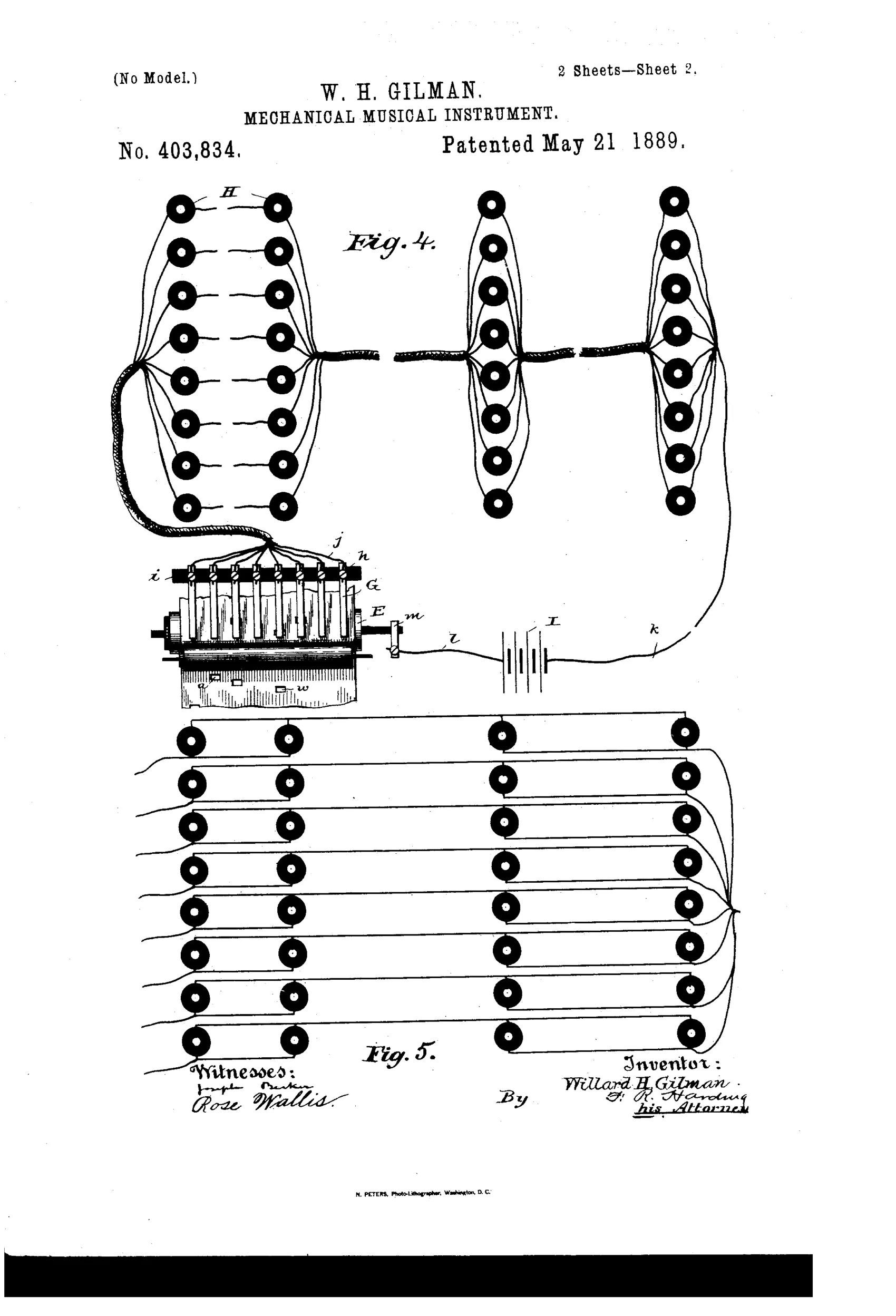
Electric chime-playing instrument using perforated paper roll
♫ How it works
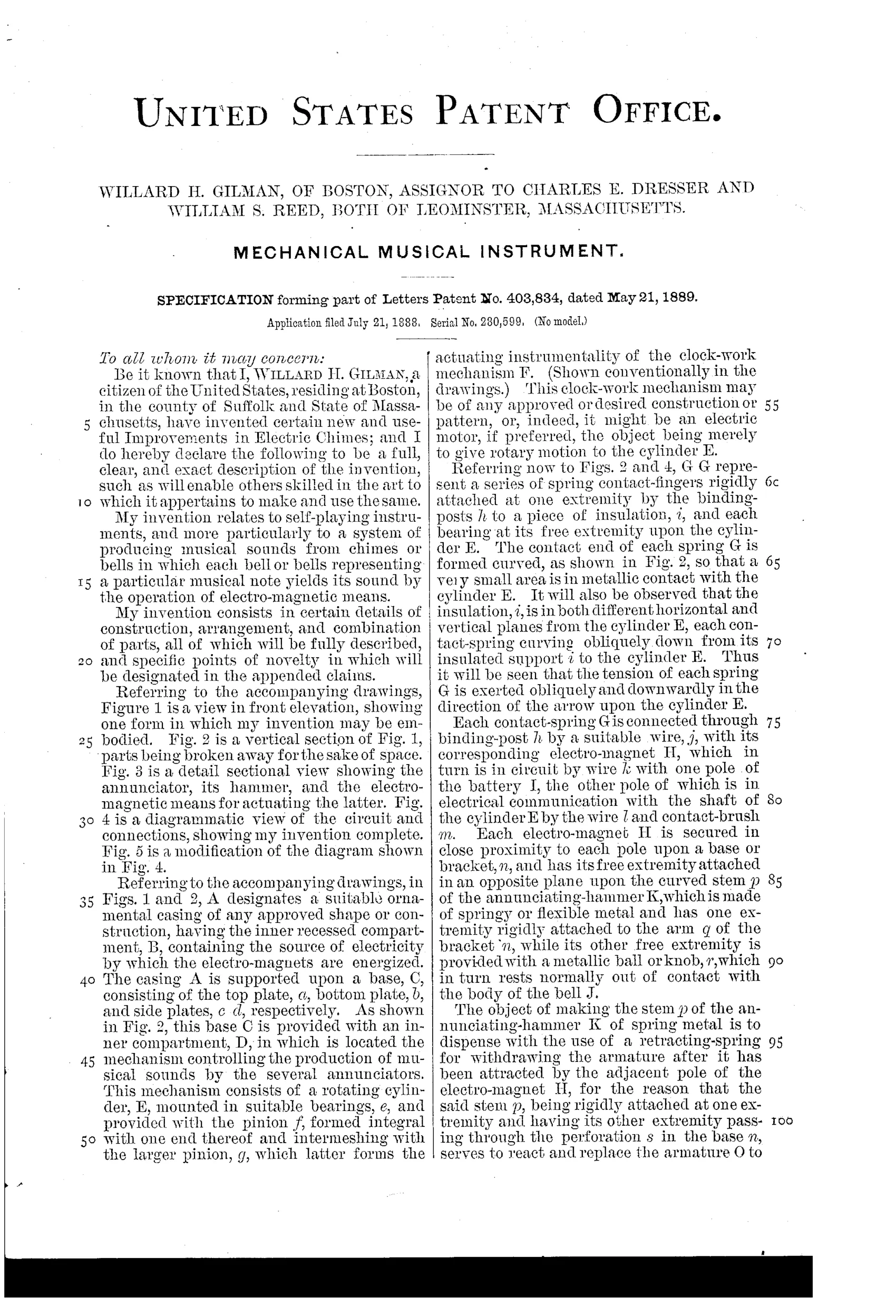
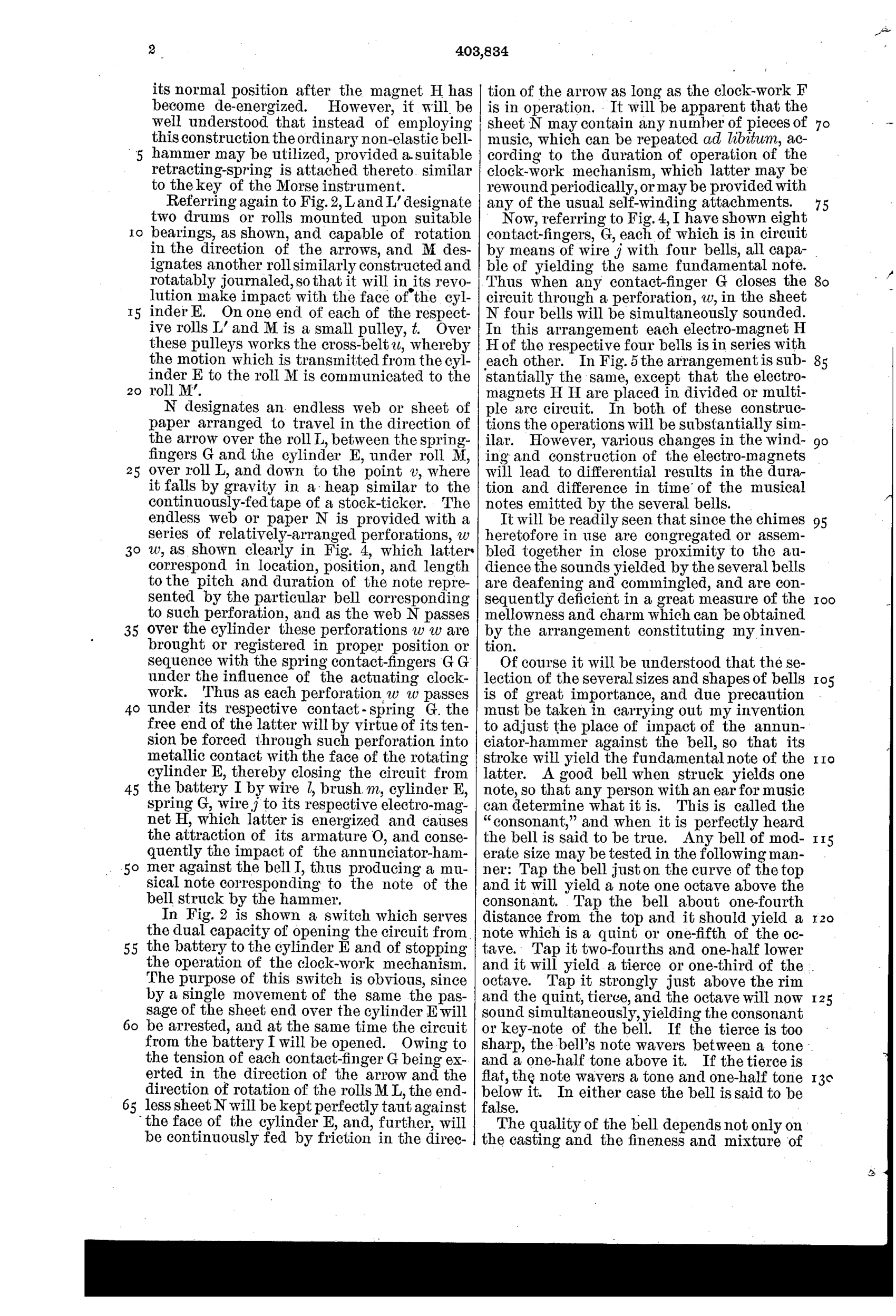
A clock-work mechanism rotates a metallic cylinder past a series of spring contact-fingers, each wired to its own electro-magnet. A perforated paper sheet is fed between the fingers and the cylinder, and wherever a perforation passes a finger, that finger springs through the hole into contact with the cylinder, closing the circuit. This energizes the corresponding electro-magnet, which attracts an armature and drives a spring-mounted annunciator-hammer against its bell, producing the bell's fundamental musical note. The paper's pattern of perforations, guided by rollers, thus times and selects which bells sound in sequence to play a tune.
♫ What was claimed
“The combination of a plurality of bells severally representing one or more musical notes, electro-magnetic means for severally actuating said bells, an electric circuit including said electro-magnetic means, a series of spring-fingers, G, controlling said electric circuit, the rotatable cylinder E, also included in said electric circuit, clock-work mechanism for rotating said cylinder, the perforated sheet N, passing between the fingers G and the cylinder E, and guiding-rollers M, L, and L' for said sheet, substantially as described.”
In plain English: A set of bells, each triggered by its own electromagnet, is controlled by spring contacts that close an electric circuit through a rotating cylinder whenever a perforation in a clockwork-driven paper roll passes beneath them, with rollers guiding the paper.
♫ In the inventor’s words
“It will be readily seen that since the chimes heretofore in use are congregated or assembled together in close proximity to the audience the sounds yielded by the several bells are deafening and commingled, and are consequently deficient in a great measure of the mellowness and charm which can be obtained by the arrangement constituting my invention.”— Willard H. Gilman, from the specification
Fate unknown
The assignment to Dresser and Reed suggests commercial intent, but no built example or marked chime is documented; a surviving instrument or trade advertisement would settle it.
♫ Commentary
Gilman's idea is a hybrid that sits between two worlds the site usually keeps apart: the perforated-paper tradition of organettes and roller organs, and something that looks forward to electric player actions. His paper roll doesn't admit air or trip a mechanical linkage — it lets a spring finger drop through a perforation to touch a rotating metal cylinder, closing an electric circuit. Each closed circuit fires an electromagnet, which flings an annunciator-style hammer against a bell. The roll is a tune; the bells are the pipes.
The reason he wants electricity is buried in the specification, and it's a good one: he complains that chimes clustered near the audience are 'deafening and commingled.' With wired circuits, the bells can be scattered — up a tower, across a building — while the clockwork and roll sit in the ornate cross-topped cabinet of Fig. 1. That separation of the 'program' from the sounding body is genuinely ahead of its time; it's the logic of the electric carillon decades early.
The weak points are practical. Paper as a circuit-breaker means the sheet must be a reliable insulator against a live cylinder, and 1889 batteries driving enough magnets to swing bell hammers with musical force is asking a lot. The contact-finger-through-perforation scheme was known from telegraph automation; applying it to chimes is the novelty. Assigned to two Leominster backers, so someone believed in it — but I know of no surviving instrument.
Commentary by Claude, The Talking Machine Patent Archive’s resident enthusiast