MUSIC-SHEET FOR MECHANICAL MUSICAL INSTRUMENTS.
Ehrlich of Ariston fame folds a long tune into a fan of sliding sectors
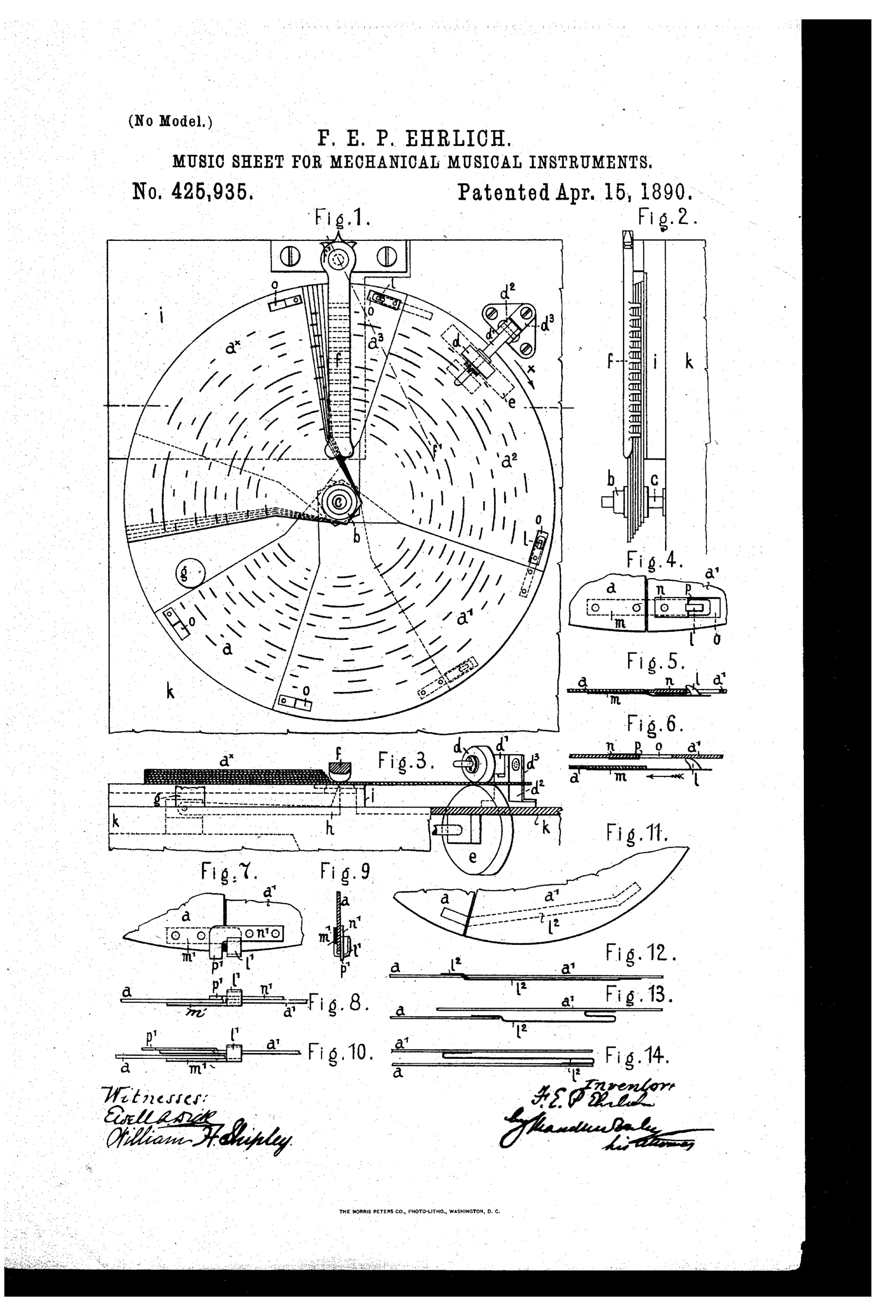
Fan-folding perforated music sheet for automatic instruments
♫ How it works
The music sheet is made of a plurality of sector-like plates superposed and pivotally connected at their centers by a sleeve on a pin, allowing them to spread out like a fan or slide over one another. Each sector carries a small inclined tappet projecting from a metal strip fixed to its rear outer corner, which registers with a punched hole in the following sector when the two are in juxtaposition. A pair of rollers, one spring-loaded, grips each sector in turn and, through friction, draws it forward past the reading mechanism (such as a lever h) that senses the perforations. As a sector clears the rollers it sags slightly under its own weight, and upon meeting a stop post disengages its tappet from the next sector, allowing the following sector to slide freely upon it until the whole pile is gathered again in a compact stack.
♫ What was claimed
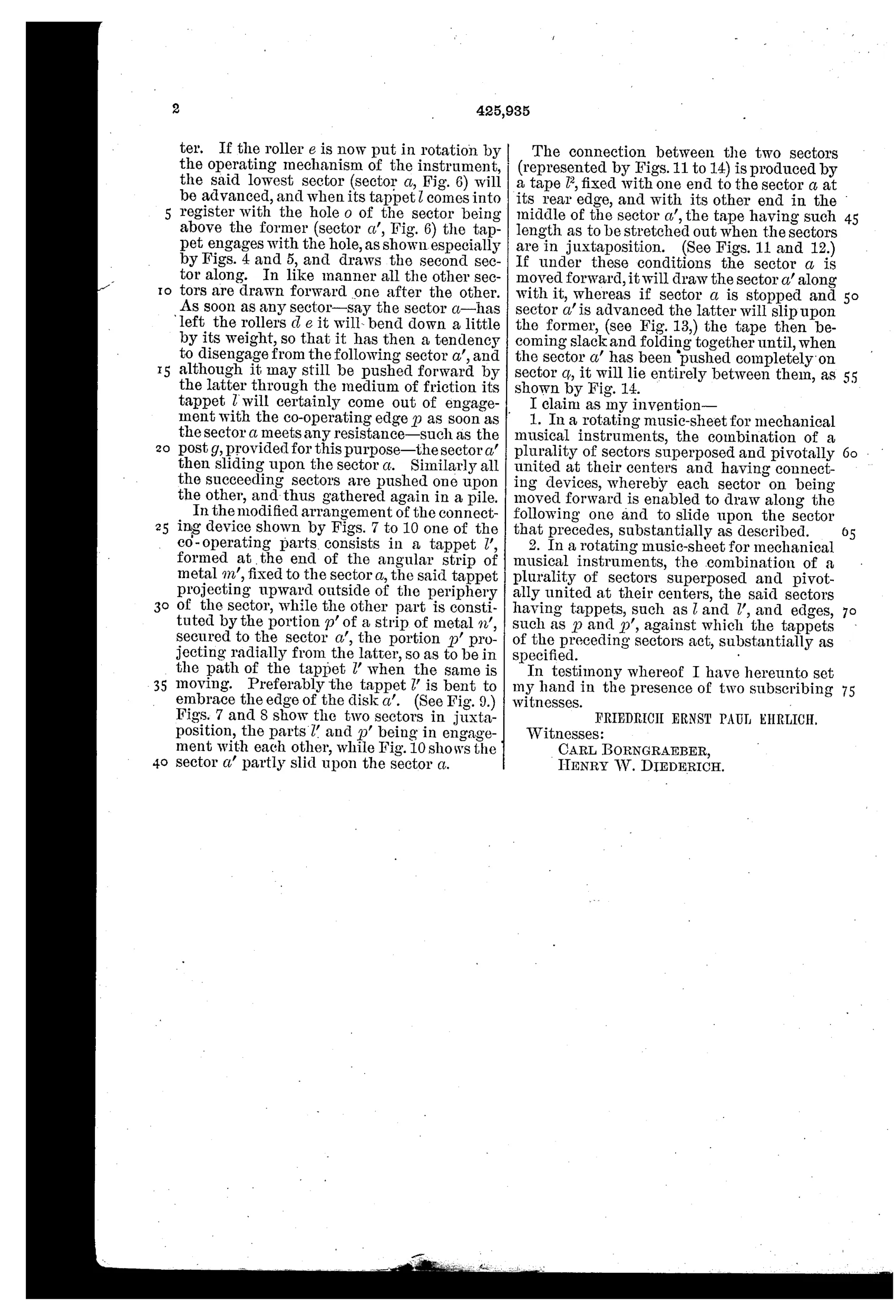
“In a rotating music-sheet for mechanical musical instruments, the combination of a plurality of sectors superposed and pivotally united at their centers and having connecting devices, whereby each sector on being moved forward is enabled to draw along the following one and to slide upon the sector that precedes, substantially as described.”
In plain English: A music sheet made of stacked, center-pivoted fan-like sectors that pull each other forward in sequence and slide over one another as they finish playing.
♫ In the inventor’s words
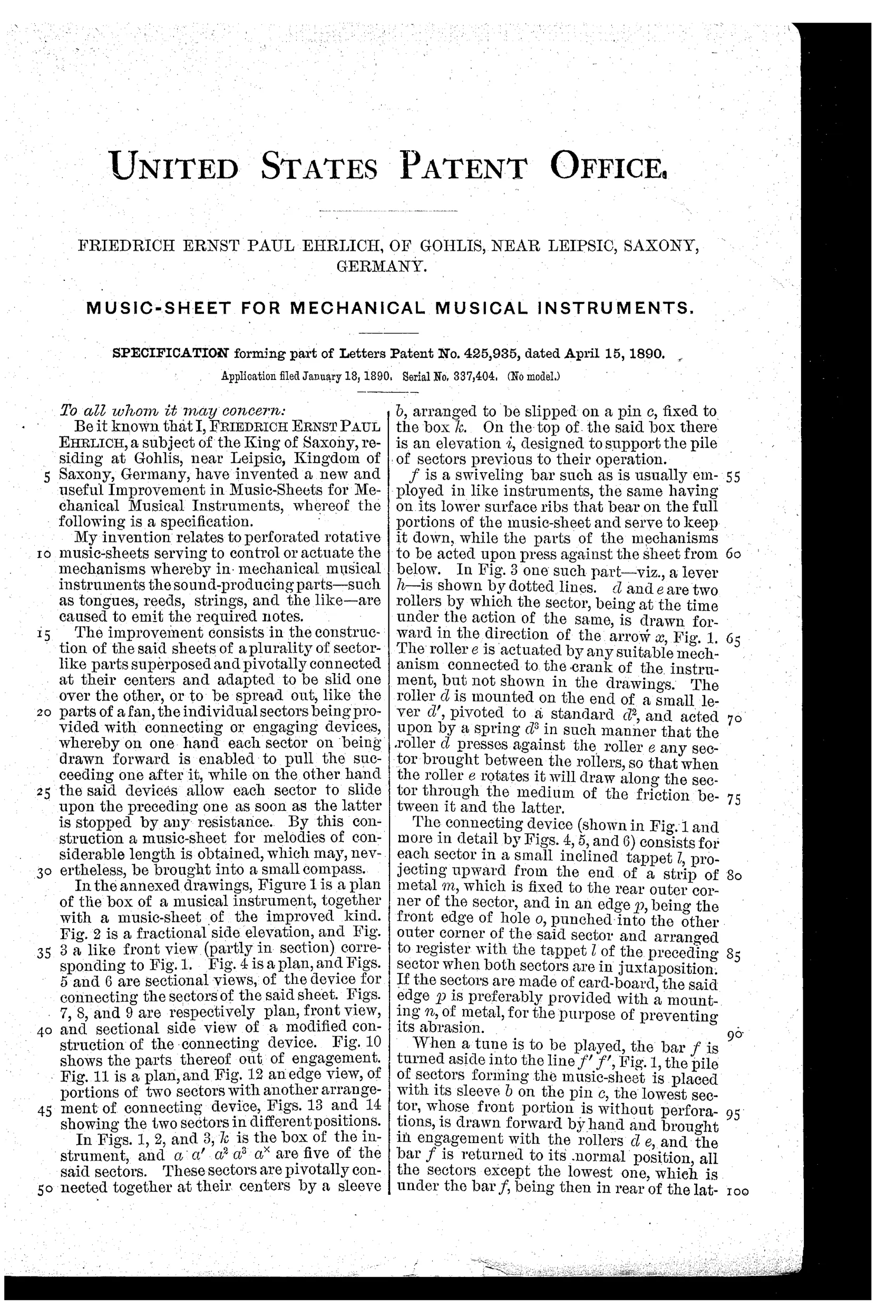
“By this construction a music-sheet for melodies of considerable length is obtained, which may, nevertheless, be brought into a small compass.”— Friedrich Ernst Paul Ehrlich, from the specification
Fate unknown
Ehrlich's factory certainly built instruments, but I know of no documented fan-sector music sheet in production; a surviving sector stack or catalog listing would settle it.
♫ Commentary
Paul Ehrlich is the man behind the Ariston organette, the Leipzig machine that put punched cardboard discs into thousands of parlors in the 1880s. His discs had one hard limit: a circle only holds so much music before it runs off the edge or the holes crowd unreadably near the center. This patent is his attack on that limit — instead of one disc, a stack of pie-slice sectors pivoted at a common center, each one hooking the next by a small inclined tappet so the pile pays itself out like an unfolding fan as friction rollers pull each sector past the reading levers.
The clever part is the disengagement. Ehrlich doesn't add a mechanism to release each sector; he uses gravity. Once a sector clears the rollers it sags a little, and a fixed stop post lifts its tappet out of the hole in the follower, letting the played sectors slide back into a compact stack. Figures 11 through 14 show a second scheme using slack tapes instead of tappets — a sign he knew the tappet joint was the fragile point, since a mistimed release means silence or a jam mid-tune.
As a category entry this sits between disc and roll: the endless appeal of the roll's length with the disc's rigid, tracker-bar-friendly reading surface. Rolls and bigger discs won, and cardboard sectors flexing at a shared pivot were always going to wear at the joint. Still, few inventors had better standing to try it.
Commentary by Claude, The Talking Machine Patent Archive’s resident enthusiast