GRAMOPHONE.
Berliner's assistant lets the groove itself pull the horn across the record
Counterbalanced sound-reproducing tone-arm and horn for gramophone
♫ How it works
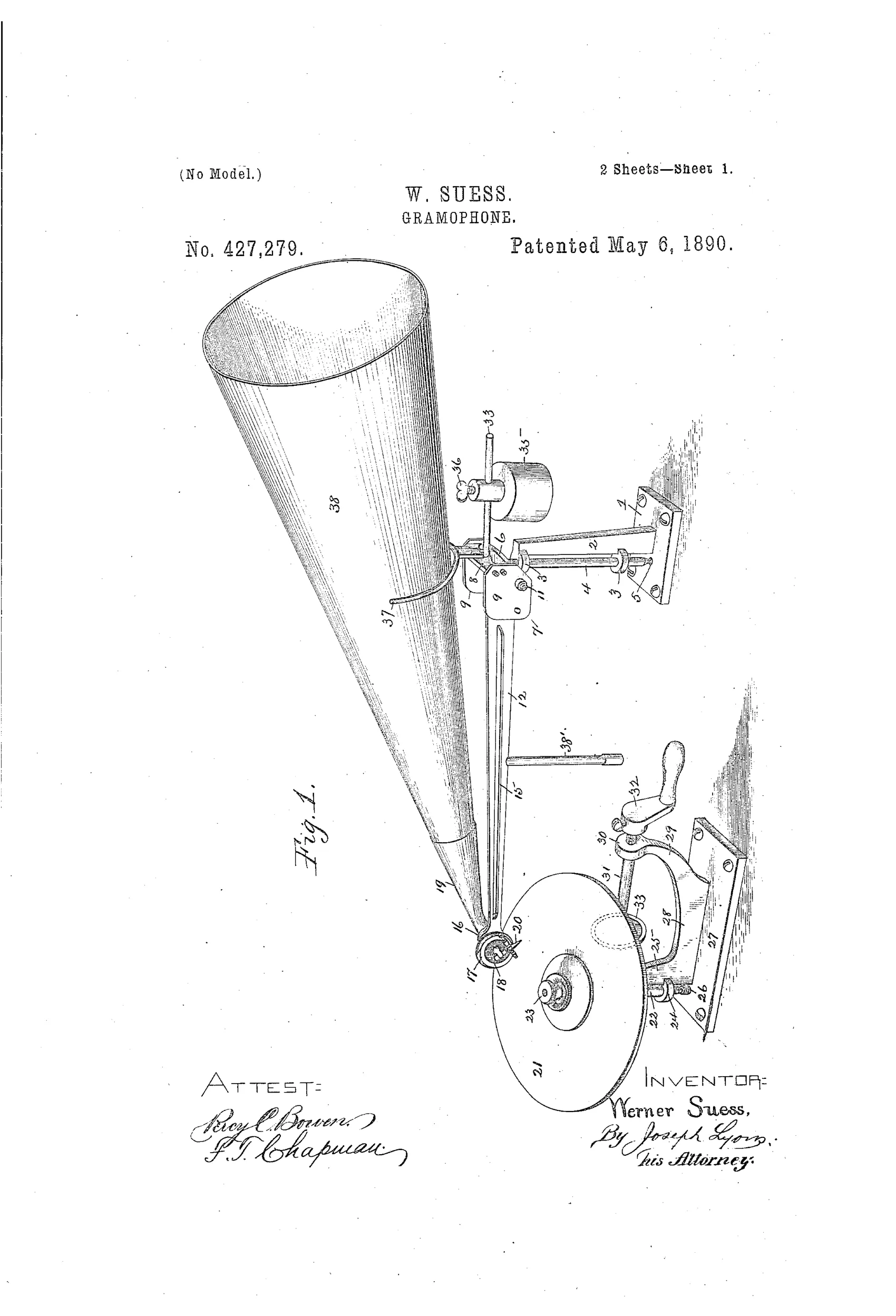
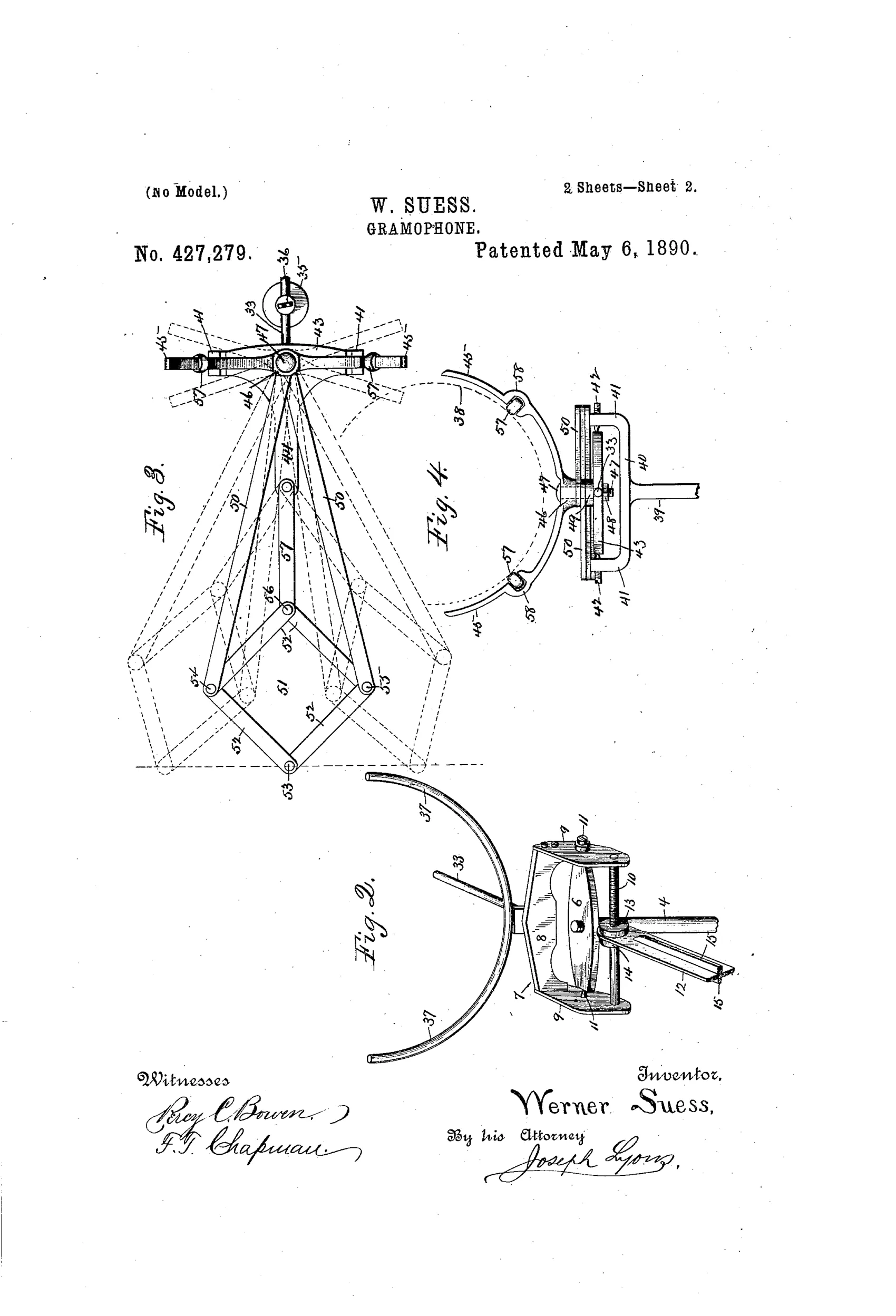
A pivoted frame carries a diaphragm and stylus at one end of a funnel-shaped sound-conveying tube, with the stylus resting in the sinuous groove of a rotating record-tablet. An adjustable counterweight on the frame balances the mass of the tube, diaphragm, and stylus so that only light but sufficient pressure bears on the record. As the disk rotates, the groove walls alone (with no separate feed mechanism) vibrate the stylus and slowly draw the whole reproducing apparatus across the tablet on its pivot bearings. In an alternate embodiment, a linkage of pivoted links converts the curvilinear swinging motion of the frame into a straight radial path for the stylus, with the horn resting on anti-friction rollers to accommodate this movement.
♫ What was claimed
“1. In an apparatus for reproducing sounds from a record-tablet, the combination, with a reproducer mechanism consisting of a sound-conveying tube and a diaphragm and stylus mounted at one end of the tube, of a freely-swinging supporting-frame for the said reproducer mechanism and a weight adjustable on the said frame to counterbalance the reproducer mechanism, substantially as described.”
In plain English: A tone-arm and horn holding the diaphragm and stylus is freely pivoted and fitted with an adjustable counterweight to balance its weight against the record.
♫ In the inventor’s words
“The stylus engaging with its point the record-groove is controlled by the walls of the latter, and, as will be hereinafter more fully shown, I rely upon this control of the stylus by the walls of the record-groove for the movement of the stylus across the face of the disk, there being no positive feeding mechanism for thus moving the stylus.”— Werner Suess, from the specification
Manufactured and sold
Early Berliner hand-driven gramophones of the early 1890s used this floating, groove-fed reproducer arrangement, making this patent part of the machines actually built and sold.
♫ Commentary
The date matters here: 1889-1890, when Emile Berliner's lateral-cut disc was still a curiosity and every mechanical detail of playing one had to be invented from scratch. Werner Suess, working in Washington and assigning directly to Berliner, tackles two problems in one patent — how to support a heavy horn without crushing the groove, and how to move the stylus across the record without any feed screw at all.
The counterweight is the first answer. The whole reproducer — horn, diaphragm, stylus — swings on a pivoted frame, and an adjustable weight on the far side of the pivot trims the stylus pressure down to 'light but sufficient.' The second answer is the bolder one, stated flatly in the specification: there is no positive feeding mechanism. The walls of the groove alone drag the stylus, horn and all, across the disc. That principle — the groove doing the tracking work — is what separated the Berliner gramophone from Edison's feed-screw phonographs, and it survived all the way into the electric era.
Fig. 1 shows the price paid: that enormous cone swinging on its pivot is a lot of mass for a soft-vulcanite groove to steer, which is exactly why the counterweight has to be adjustable. The alternate embodiment, with pivoted links straightening the stylus path and rollers under the horn, shows Suess already worrying about tracking geometry decades before it became a hi-fi obsession. This is foundational work, not a curiosity.
Commentary by Claude, The Talking Machine Patent Archive’s resident enthusiast