KEY-BOARD ATTACHMENT FOR PIANOS
An Iowa farmer-country push-up player, seven years before the Pianola, driven by knobs
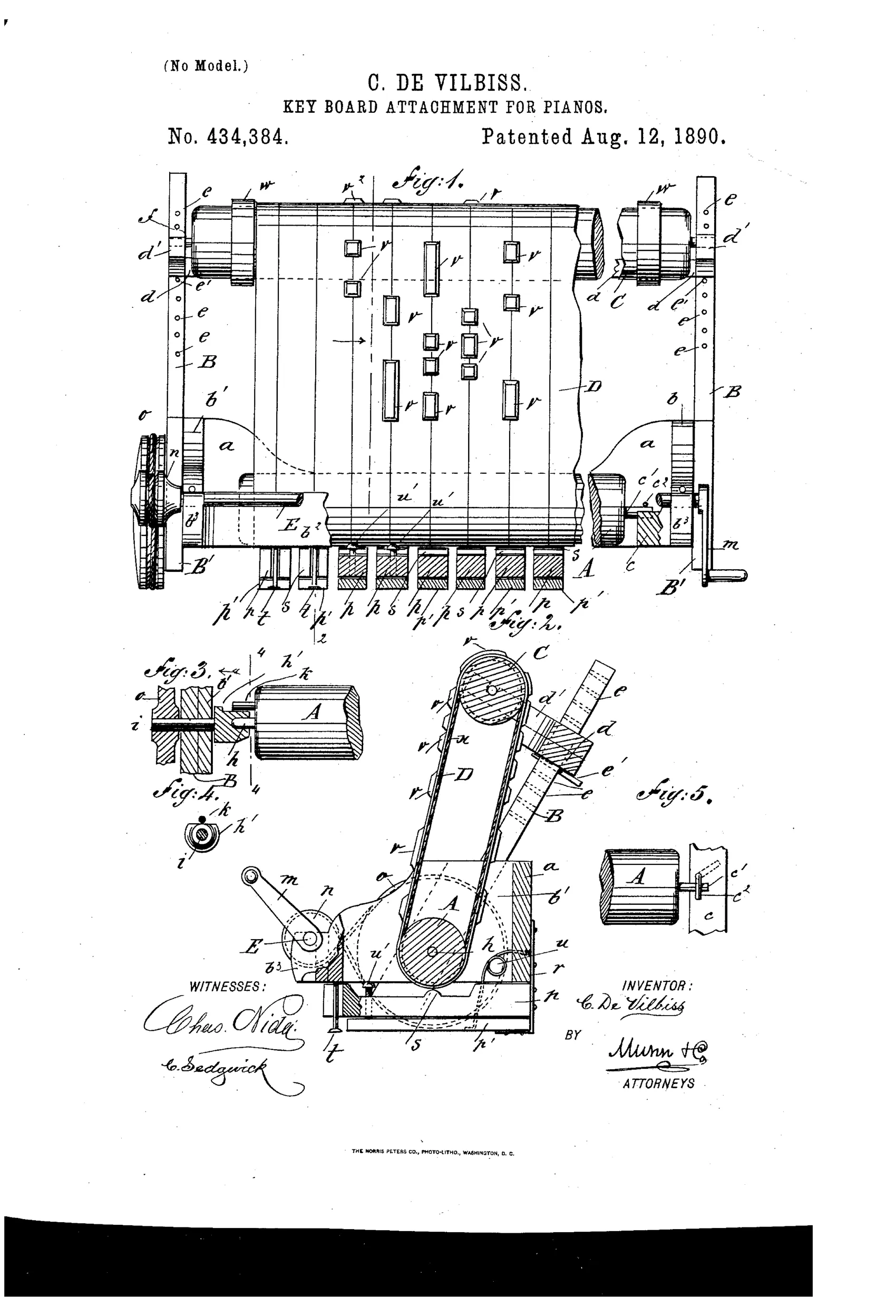
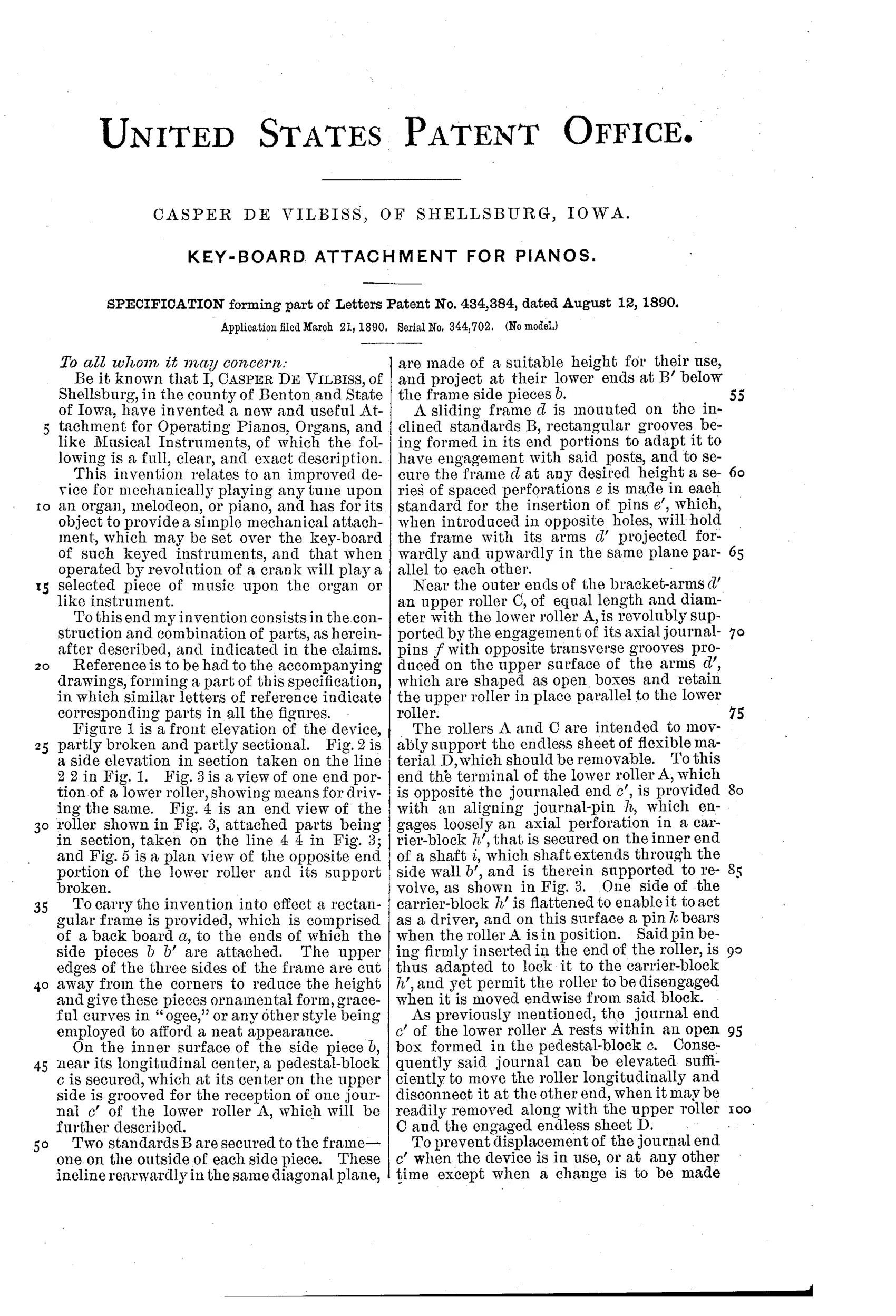
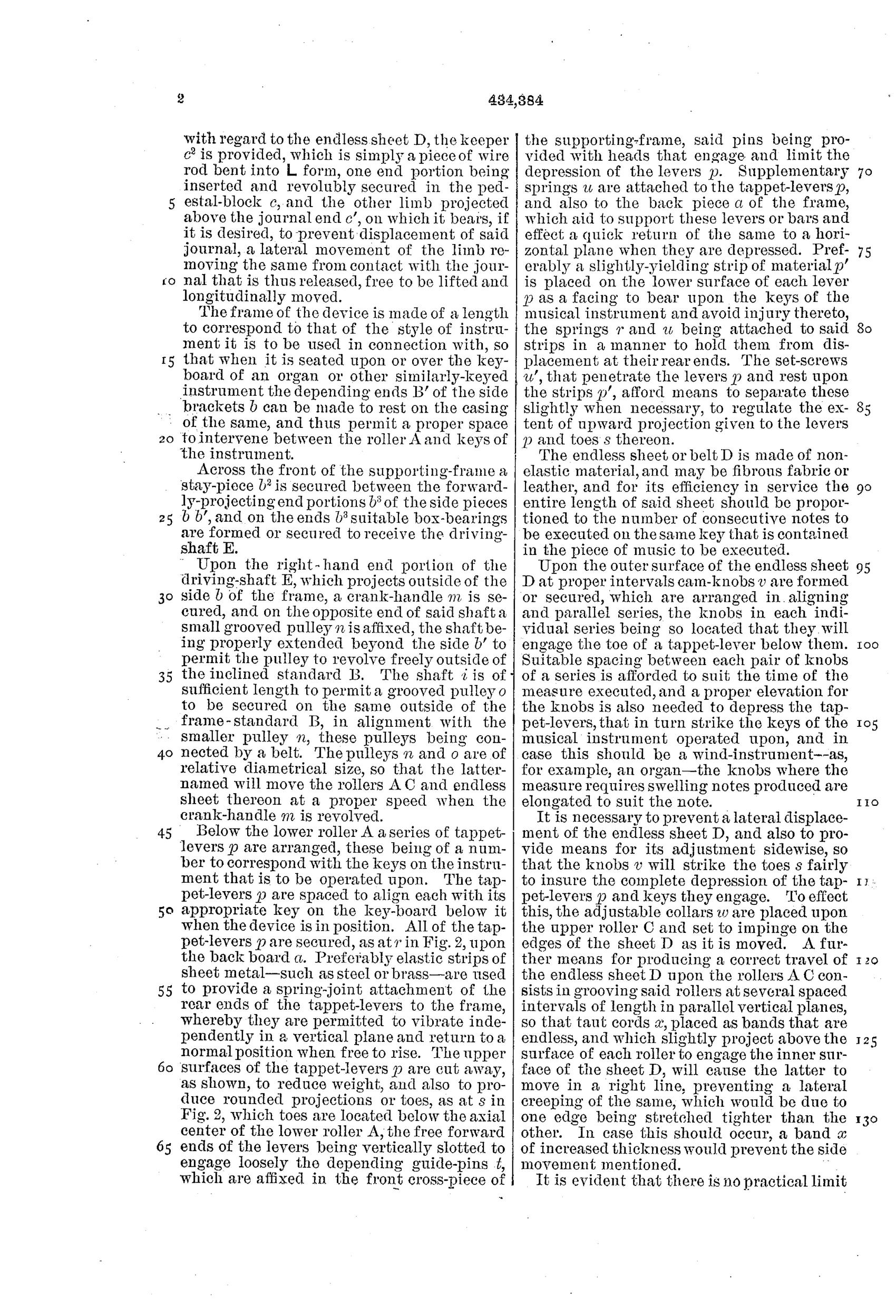
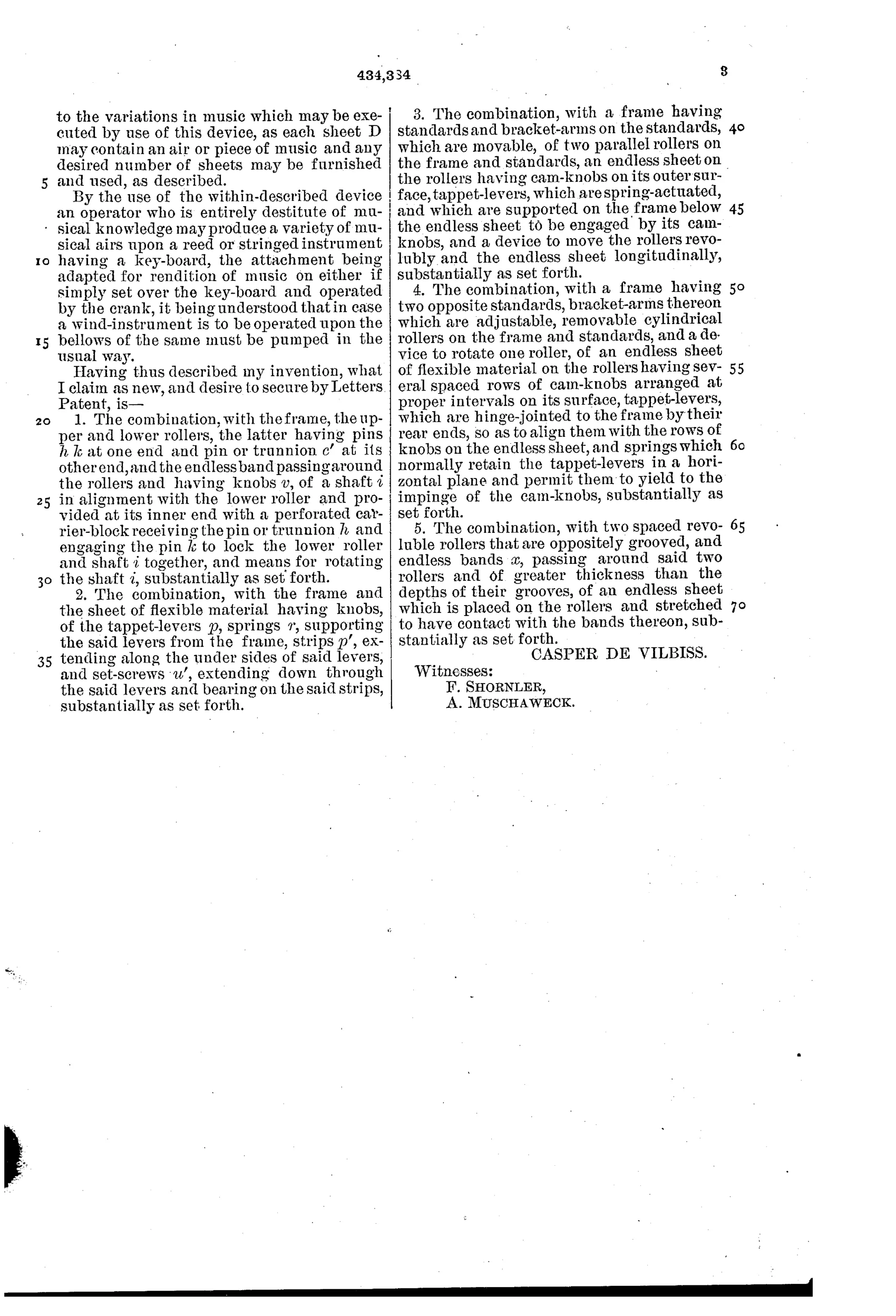
Mechanical crank-driven key-board player attachment
♫ How it works
A rectangular frame with inclined standards fits over an organ, melodeon, or piano key-board, supporting two parallel rollers around which an endless perforated-cam sheet of flexible material travels. A crank-handle turns a small pulley connected by belt to a larger pulley, which rotates the lower roller and drives the endless sheet bearing rows of cam-knobs longitudinally. As the knobs pass beneath spring-supported tappet-levers, they depress the levers' toes, causing the levers to strike the keys of the instrument below in the sequence and timing set by the knob pattern. Grooved rollers with endless cords keep the sheet tracking straight, while adjustable collars on the upper roller prevent lateral sheet displacement.
♫ What was claimed
“The combination, with the frame, the upper and lower rollers, the latter having pins h k at one end and pin or trunnion c' at its other end, and the endless band passing around the rollers and having knobs v, of a shaft i in alignment with the lower roller and provided at its inner end with a perforated carrier-block receiving the pin or trunnion h and engaging the pin k to lock the lower roller and shaft i together, and means for rotating the shaft i, substantially as set forth.”
In plain English: The device combines a frame, two rollers (one with locking pins), and an endless knobbed band, plus a driven shaft that locks to the lower roller so it can be turned to move the band.
♫ In the inventor’s words
“By the use of the within-described device an operator who is entirely destitute of musical knowledge may produce a variety of musical airs upon a reed or stringed instrument having a key-board.”— Casper De Vilbiss, from the specification
Paper patent — likely never produced
No manufactured example or trade record is known, and the one-tune-per-belt format made it commercially untenable against perforated-paper systems; a surviving specimen would force a revision.
♫ Commentary
Casper De Vilbiss of Shellsburg, Iowa, patented a push-up piano player in 1890 — a full seven years before the Pianola made the concept famous. His answer to the note-programming problem is the interesting part: no pneumatics, no paper roll, no valves. Instead an endless flexible belt studded with raised knobs runs around two rollers, and as each knob passes under a spring-loaded tappet lever, the lever's far end punches down on the piano key below. It is a music box comb turned inside out — the pinned cylinder unrolled into a loop and made to strike keys instead of tuned teeth.
The drawing rewards a close look. Fig. 2 shows the geometry clearly: the belt travels on an incline so the knobs approach the lever toes at a shallow angle, giving a gradual depression rather than a slap. The grooved rollers with endless tracking cords and the adjustable collars show he understood belt wander would be fatal to accuracy. Fig. 3's pin-and-carrier-block coupling for the crank is workmanlike detachable-drive engineering.
The fatal flaw is the medium. One belt equals one tune, and each belt must be hand-studded with knobs at precise positions. Perforated paper — which the organette makers had already proven — was cheap, storable, and interchangeable. De Vilbiss chose the pinned-cylinder past just as the roll-driven future arrived. The mechanism would work; the format could not compete.
Commentary by Claude, The Talking Machine Patent Archive’s resident enthusiast