ERASING ATTACHMENT FOR PHONOGRAPHS.
A delete key for 1890: erase single words from a wax cylinder mid-playback
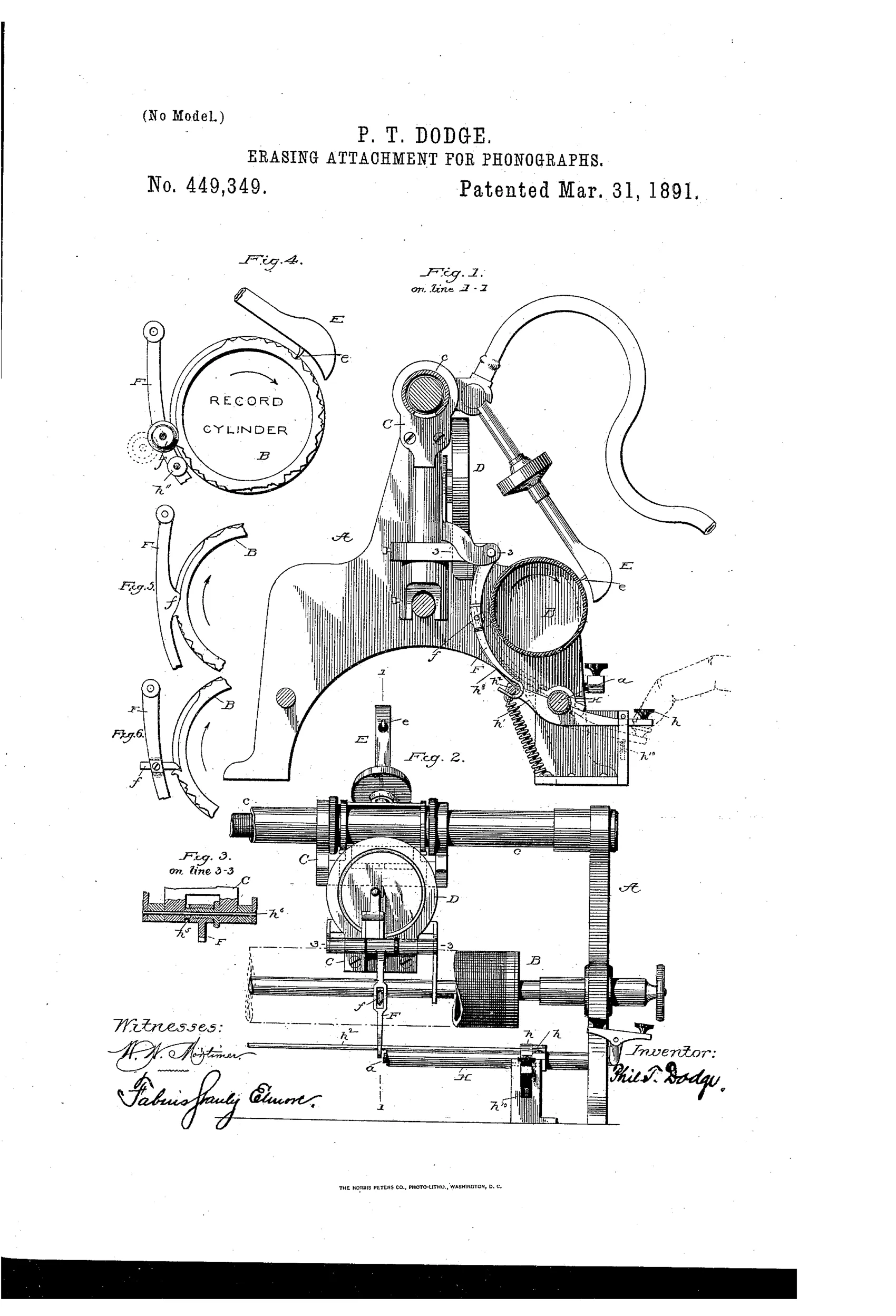
Device to erase phonograph cylinder recordings selectively
♫ How it works
A sharp-edged roller or wheel, mounted on an arm hinged to the recording carriage, travels in the record-groove immediately behind the reproducer or recorder style. When the operator depresses a finger-key, connecting rods raise a horizontal rod that swings the eraser arm forward, forcing the roller edge into the groove to smooth down and obliterate the recorded irregularities word by word. A sustaining spring holds the eraser to its work, while an adjustable stop-screw controls the depth of its action so as not to disturb adjacent grooves. The eraser arm is mounted on a laterally adjustable threaded sleeve so it can be aligned precisely with the reproducer stylus.
♫ What was claimed
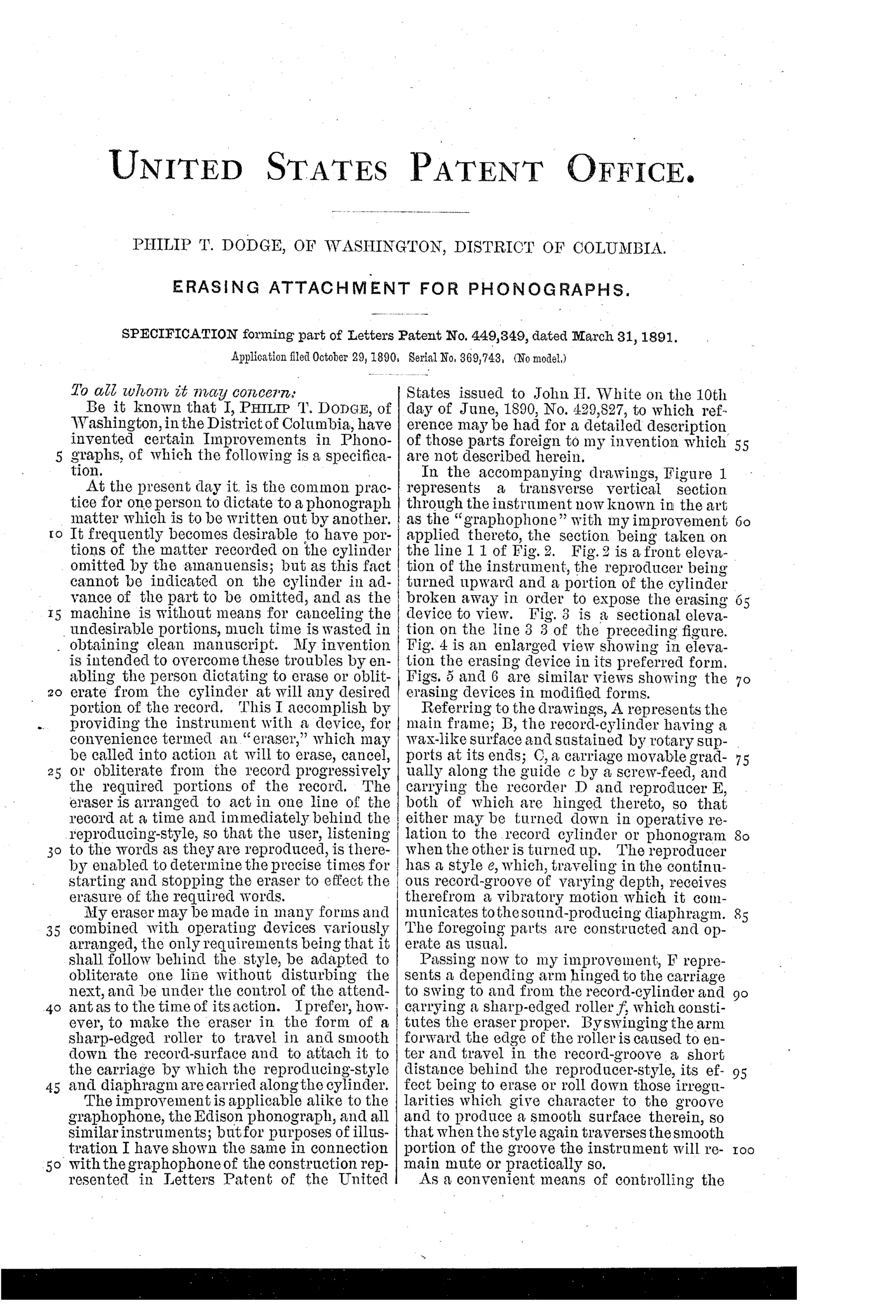
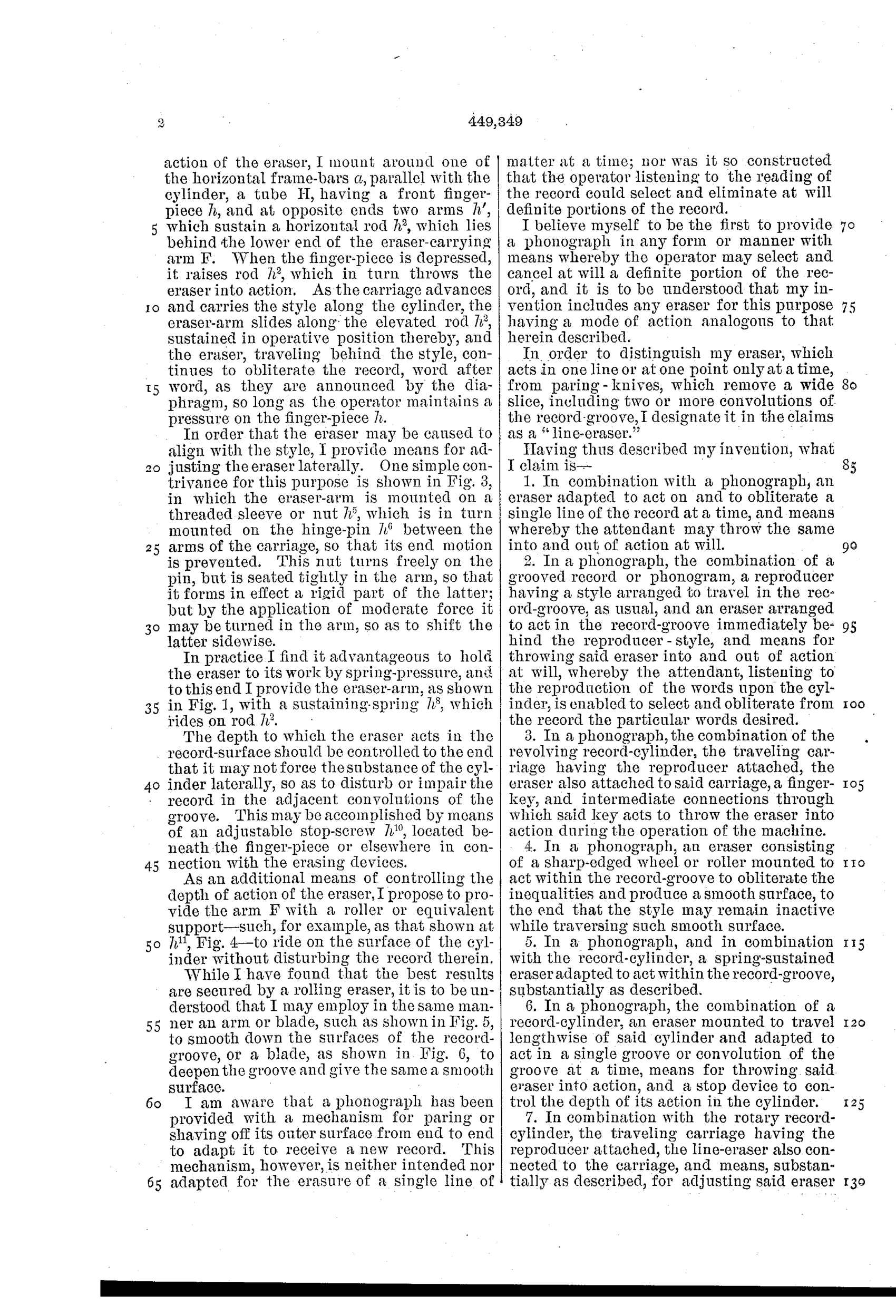
“In a phonograph, the combination of a grooved record or phonogram, a reproducer having a style arranged to travel in the record-groove, as usual, and an eraser arranged to act in the record-groove immediately behind the reproducer-style, and means for throwing said eraser into and out of action at will, whereby the attendant, listening to the reproduction of the words upon the cylinder, is enabled to select and obliterate from the record the particular words desired.”
In plain English: The patent claims a phonograph fitted with an eraser that trails just behind the playback stylus in the record groove, which the listener can switch on or off at will to erase specific unwanted words from the recording as they are heard.
♫ In the inventor’s words
“I believe myself to be the first to provide a phonograph in any form or manner with means whereby the operator may select and cancel at will a definite portion of the record.”— Philip T. Dodge, from the specification
Fate unknown
Business phonographs later carried erase/shave mechanisms, but no marked example of this specific behind-the-stylus keyed eraser is documented; a surviving attachment would settle it.
♫ Commentary
This is the phonograph as office dictation machine, and Dodge is solving the problem every stenographer's boss created: the botched sentence in the middle of an otherwise good letter. His answer is startlingly modern in spirit — a selective erase, controlled by a finger-key, that obliterates only the words you choose while you listen. The eraser is a sharp-edged roller riding in the groove just behind the reproducer stylus; press the key and connecting rods swing it down to iron the recorded undulations flat, word by word, as they pass under the playback point.
The mechanical care is in the details a casual reader skips. The roller sits on a laterally adjustable threaded sleeve so it tracks the exact groove the stylus just read, and a stop-screw limits its depth so it smooths one groove without gouging its neighbors. Figures 5 and 6 show alternate blade forms — one that scrapes, one that deepens — evidence Dodge was genuinely wrestling with how wax behaves under a burnishing edge rather than just sketching a wish.
The honest question is whether a burnished-over patch really vanished or just turned into a mushy thump on playback, and whether re-recording over the smoothed section worked cleanly. The industry's eventual answer was the shaver, which resurfaced the whole cylinder — cruder but reliable. Dodge's word-level precision was the more elegant idea; the wholesale approach won.
Commentary by Claude, The Talking Machine Patent Archive’s resident enthusiast