PHONOGRAPH.
Reel-to-reel in 1891: a wax ribbon phonograph with parallel tracks
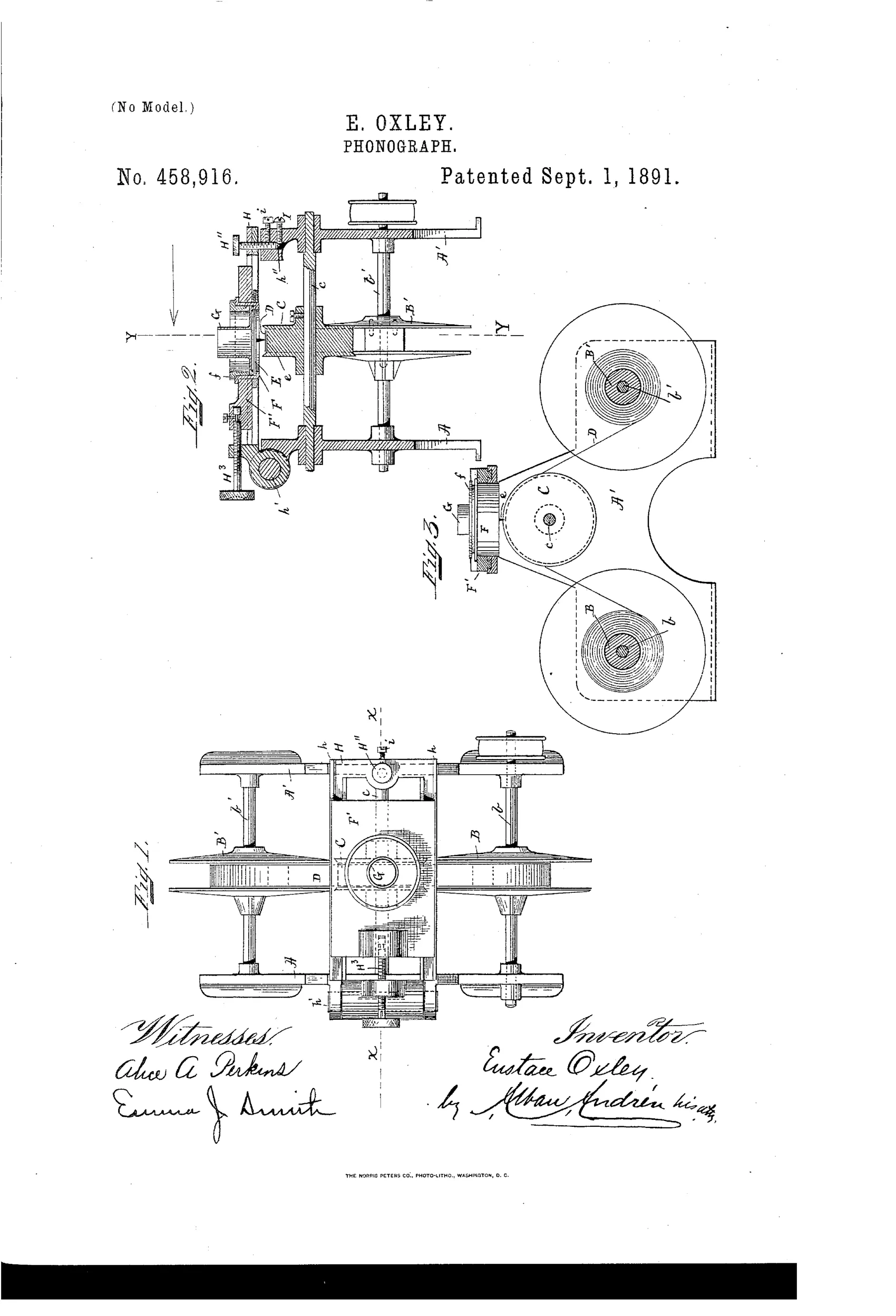
Tape-ribbon phonograph recorder-reproducer
♫ How it works
A flexible ribbon coated with wax or ductile material travels from one reel to another, passing over a rotating guide-roller. A vibratory diaphragm mounted above the roller carries a stylus that presses into the moving ribbon, recording indentures caused by sound waves striking the diaphragm through a speaking tube. The diaphragm case is adjustable laterally along the roller's shaft, allowing the stylus to be shifted after each pass so a series of parallel record tracks can be made across the width of the ribbon. Feed-screws and set-screws control the position of the case, its cover, and the sliding plate to properly align the stylus with the ribbon for recording or subsequent reproduction of the sound.
♫ What was claimed
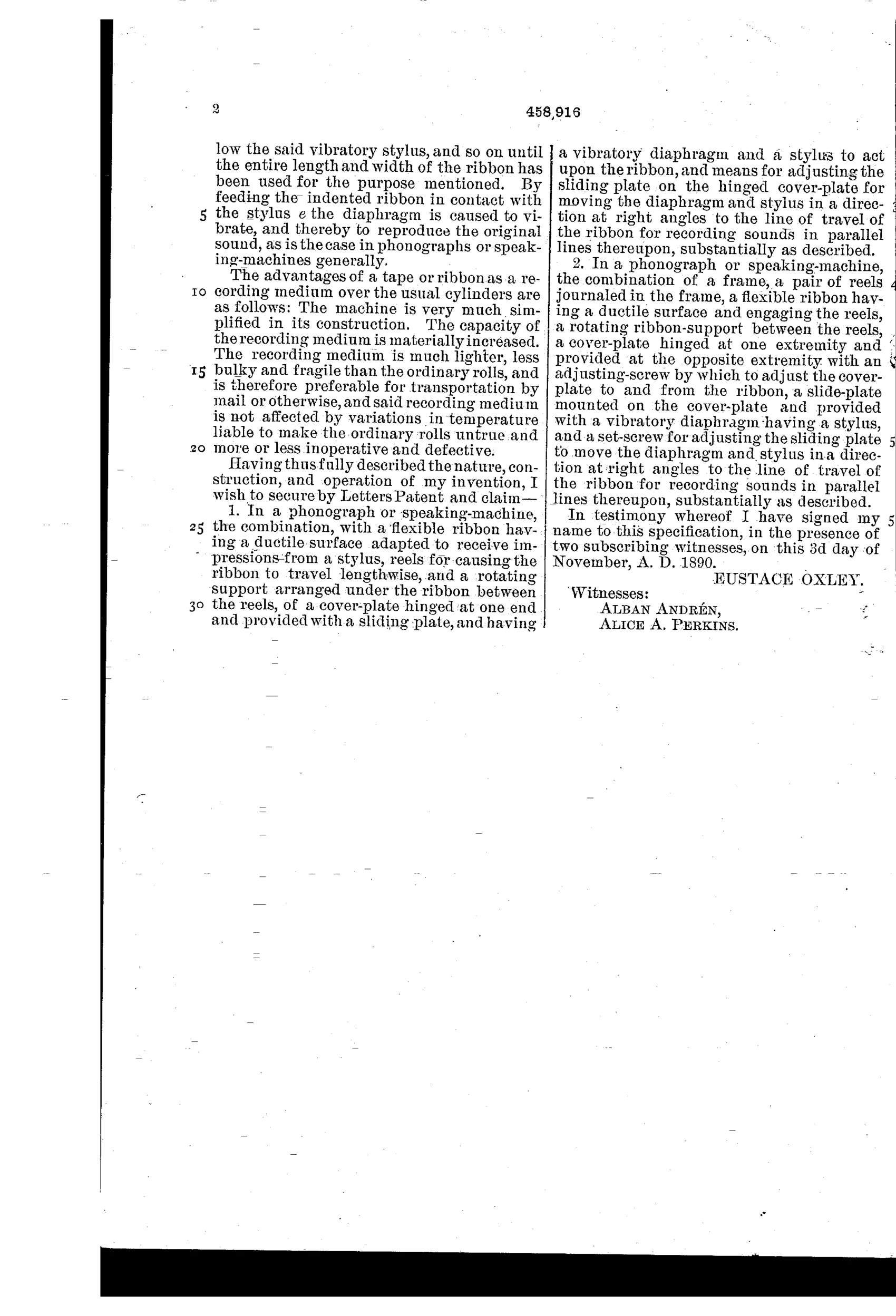
“In a phonograph or speaking-machine, the combination, with a flexible ribbon having a ductile surface adapted to receive impressions from a stylus, reels for causing the ribbon to travel lengthwise, and a rotating support arranged under the ribbon between the reels, of a cover-plate hinged at one end and provided with a sliding plate, and having a vibratory diaphragm and a stylus to act upon the ribbon, and means for adjusting the sliding plate on the hinged cover-plate for moving the diaphragm and stylus in a direction at right angles to the line of travel of the ribbon for recording sounds in parallel lines thereupon, substantially as described.”
In plain English: The invention combines a wax-coated ribbon fed lengthwise between two reels over a rotating support, with a hinged cover holding a sliding diaphragm-and-stylus assembly that can be shifted sideways to record multiple parallel sound tracks on the ribbon.
♫ In the inventor’s words
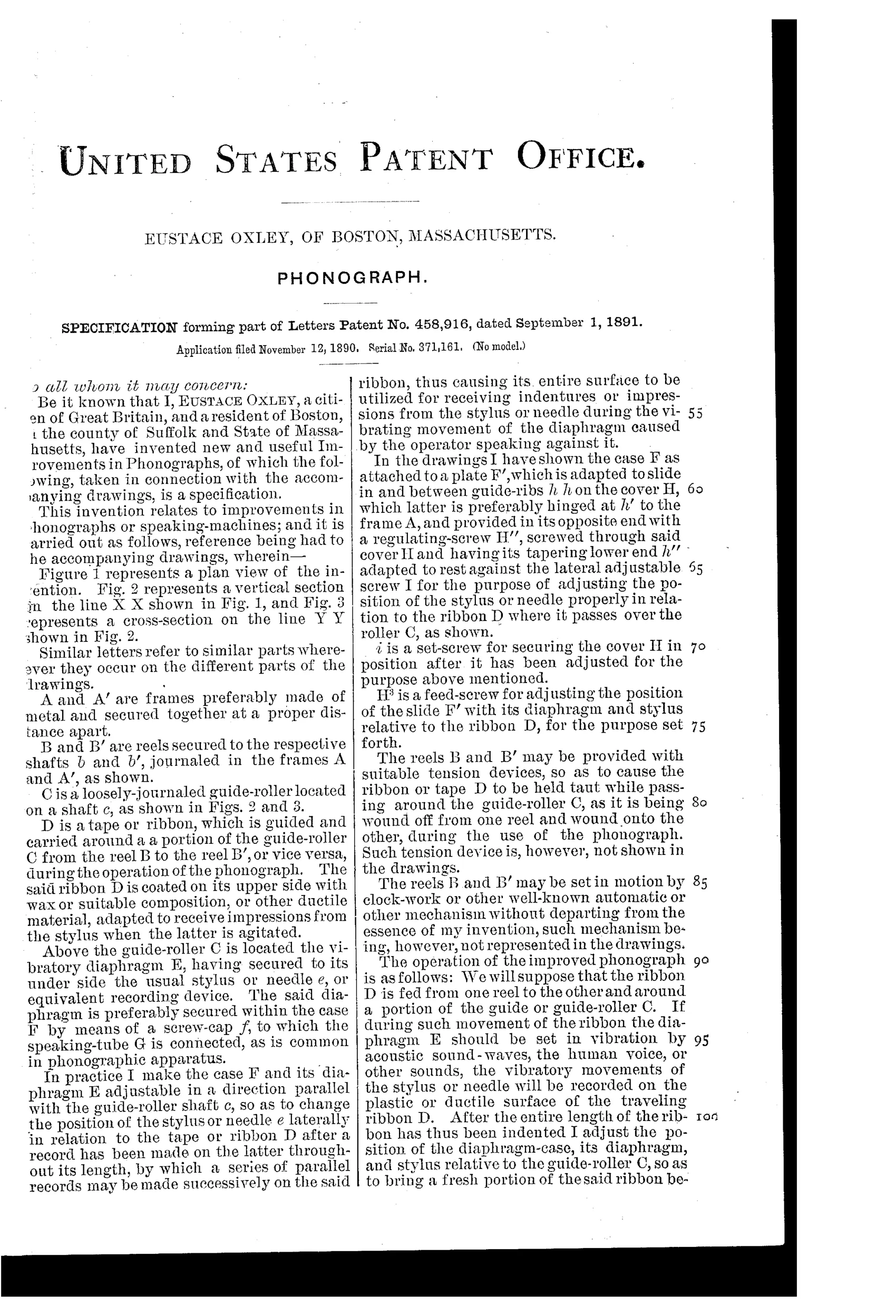
“The advantages of a tape or ribbon as a recording medium over the usual cylinders are as follows: The machine is very much simplified in its construction. The capacity of the recording medium is materially increased.”— Eustace Oxley, from the specification
Paper patent — likely never produced
No commercial ribbon phonograph from this era is known, and the wax-on-wax winding problem makes production implausible; no surviving example is documented.
♫ Commentary
Six decades before magnetic tape recorders became household objects, Eustace Oxley of Boston drew one out in wax. His machine runs a flexible ribbon coated with ductile material from one reel to another, past a stylus and diaphragm mounted over a guide roller. The stylus indents the moving ribbon; play it back and the indentations drive the diaphragm the other way. The architecture — supply reel, take-up reel, recording head between them — is unmistakably the reel-to-reel layout, arrived at from first principles.
The cleverest detail is easy to miss in Fig. 1: the diaphragm case rides on a sliding plate with a feed screw, so after each pass the whole head shifts sideways and records a fresh parallel track across the ribbon's width. That is multi-track thinking, and it answers the cylinder's real weakness — two minutes of capacity and no easy way to get more. Oxley says so plainly in the specification: simpler construction, materially increased capacity.
The trouble is the medium, not the layout. A wax-surfaced ribbon must wind onto a reel without the layers crushing each other's grooves, must run at dead-steady speed with no motor or governor shown worth the name, and must survive rewinding. Cylinders and discs won precisely because they kept the recorded surface off of itself. Oxley had the right diagram and the wrong material; the diagram had to wait for magnetism.
Commentary by Claude, The Talking Machine Patent Archive’s resident enthusiast