AUTOMATIC ORGAN-PLAYER.
A push-up player with no bellows: metal sheet, levers, and springs press keys
Attachable automatic player mechanism for organ or piano
♫ How it works
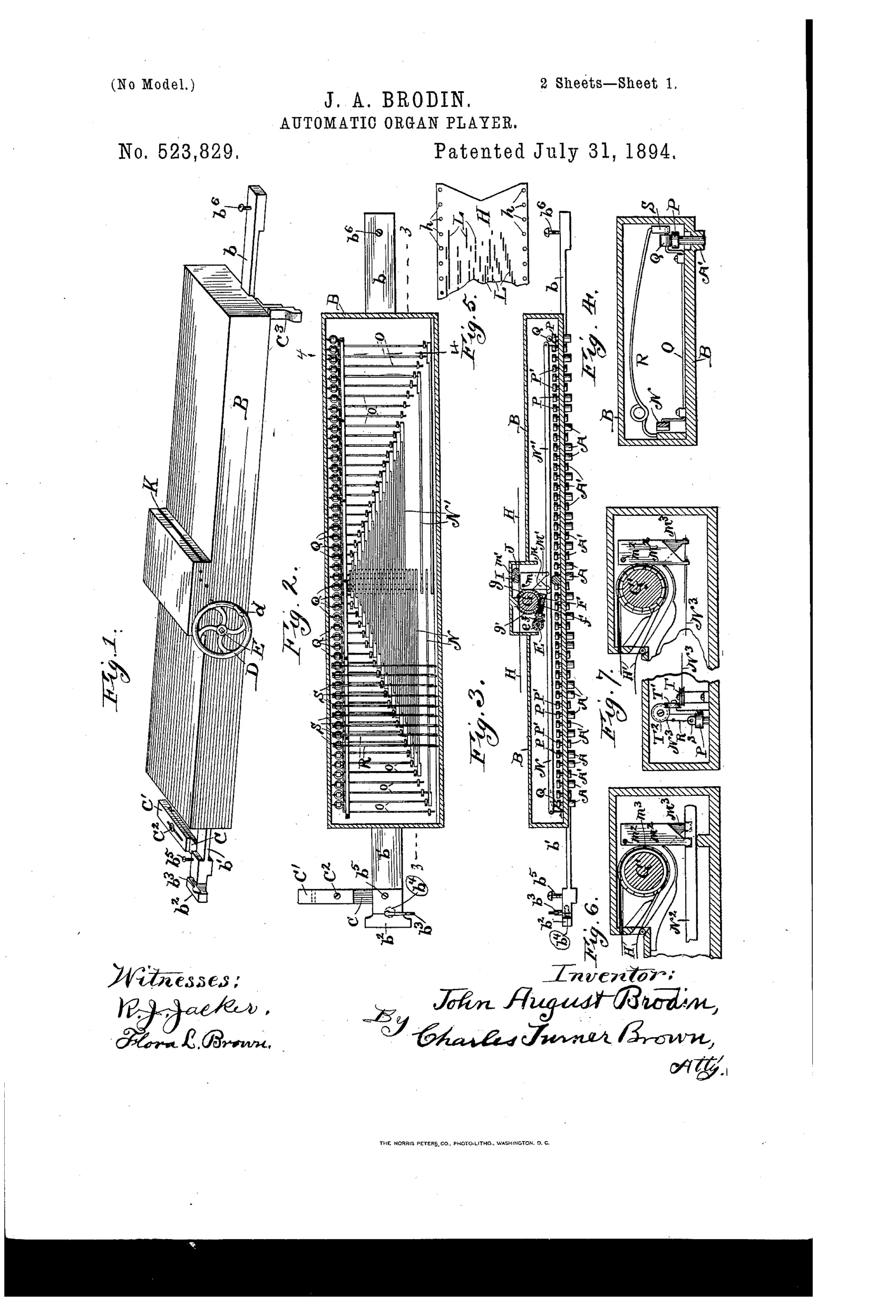
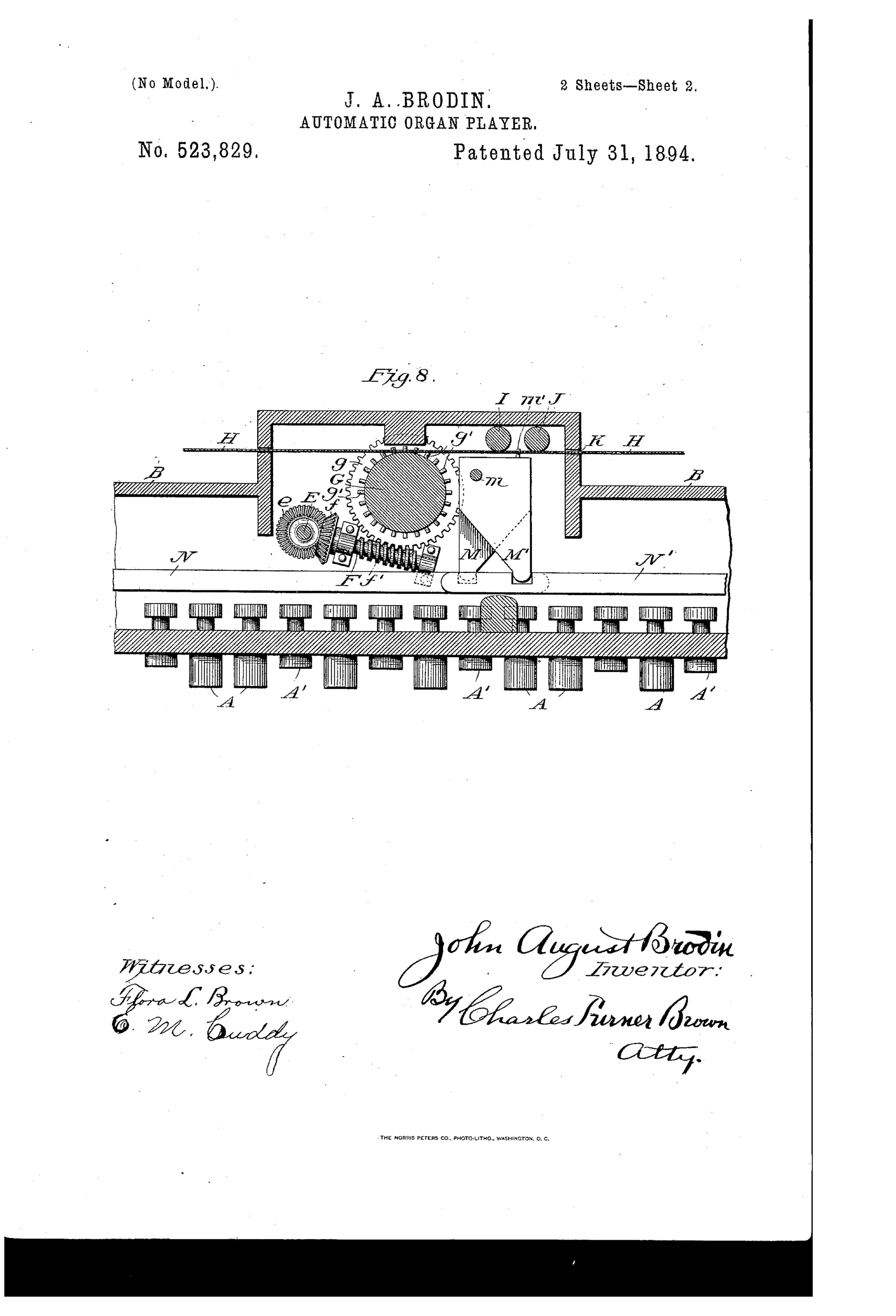
A case fitted with tubes is placed over an instrument's keyboard so the tubes align with the white and black keys. A crank-driven shaft turns a roller via worm gearing, and pins on the roller engage holes in a perforated metal sheet, drawing it through the device past guide rollers. Fulcrumed levers with pins ride against the sheet; when a perforation passes over a lever's pin, a spring presses down on a crank shaft connected to that lever by a longitudinally movable rod, forcing a pin down onto the corresponding key. When no perforation is present, the lever and its linked crank hold the pin lifted off the key, keeping it silent.
♫ What was claimed
“The combination of a rotatable cylinder, means for rotating the cylinder, a perforated sheet adapted to be connected to the rotatable cylinder and forced through the device by the rotation thereof, a series of levers fulcrumed in the device, abutments on such levers, respectively, adapted to intermesh with the perforations in the perforated sheet corresponding therewith, a series of longitudinally movable pins adapted to engage with respective keys of the instrument to which the device is attached, a series of crank shafts the crank at one end whereof is connected to the series of longitudinally movable pins, and a series of longitudinally movable connections attached at one end to the fulcrumed levers and at the other end to the crank at the other end of the crank shaft named; and a series of springs tending to yieldingly hold the series of longitudinally movable pins in an extended position; substantially as described.”
In plain English: The device combines a hand- or motor-turned cylinder that pulls a perforated sheet through the machine, with a set of pivoting levers whose pins fit into the sheet's holes; each lever is linked by a rod to a crank that, when released by a spring, pushes a pin down onto the corresponding piano or organ key, while a spring normally holds the pin lifted so the key stays silent.
♫ In the inventor’s words
“The object of the invention embodied in the device described, illustrated and claimed herein is to obtain an automatic organ player which may be attached to an ordinary organ or piano and by means of which the key board of the organ or piano can be actuated by the actuating of the crank of the device, (whether by the hand or by a motor)”— John August Brodin, from the specification
Paper patent — likely never produced
No manufactured example or trade record of a Brodin player is known, and the all-mechanical, expression-less design was quickly outclassed by pneumatic push-up players; a surviving marked specimen would overturn this.
♫ Commentary
Brodin's device is a keyboard-straddling player attachment — the same idea that would make the Angelus and Pianola famous a few years later — but built the hard way. Where the successful push-up players read a paper roll pneumatically and struck keys with air-driven fingers, Brodin does everything with hardware: a crank turns a pinned roller that drags a perforated metal sheet through the case, fulcrumed levers ride the sheet, and each lever works a little crank shaft that lets a spring drive a pin down onto its key. No wind, no bellows, no valves.
That all-mechanical scheme is the interesting part and also the problem. Every note is played at whatever force the spring supplies, so there is no dynamic shading at all, and the metal sheet is heavier and costlier than punched paper. Look at Fig. 2 and the friction becomes visible: dozens of lever pins bearing continuously against the sheet as it slides past, all of that drag fed back into the hand crank. Figs. 6 and 7 show Brodin already hedging with modified end mechanisms, a sign he knew the linkage was fussy.
Filed in 1893, this sits right at the moment the industry was deciding how to play a keyboard automatically. Pneumatics won decisively, and reading this patent you can see why. Still, it is an honest, fully worked-out attempt at the wrong answer, and those often teach more than the right one.
Commentary by Claude, The Talking Machine Patent Archive’s resident enthusiast