MUSICAL BOX.
The Otto works patents its answer to Regina: a spring drum around the spindle
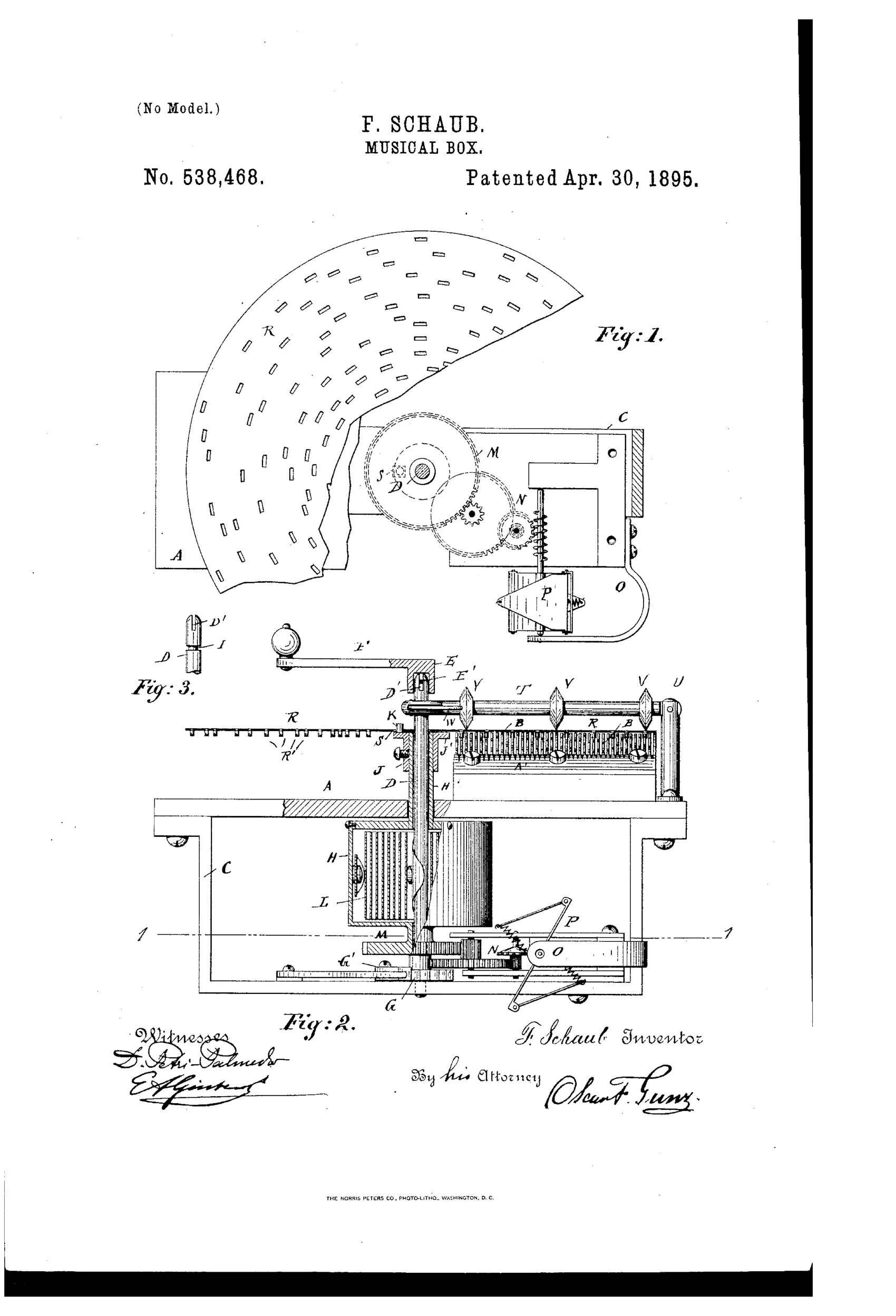
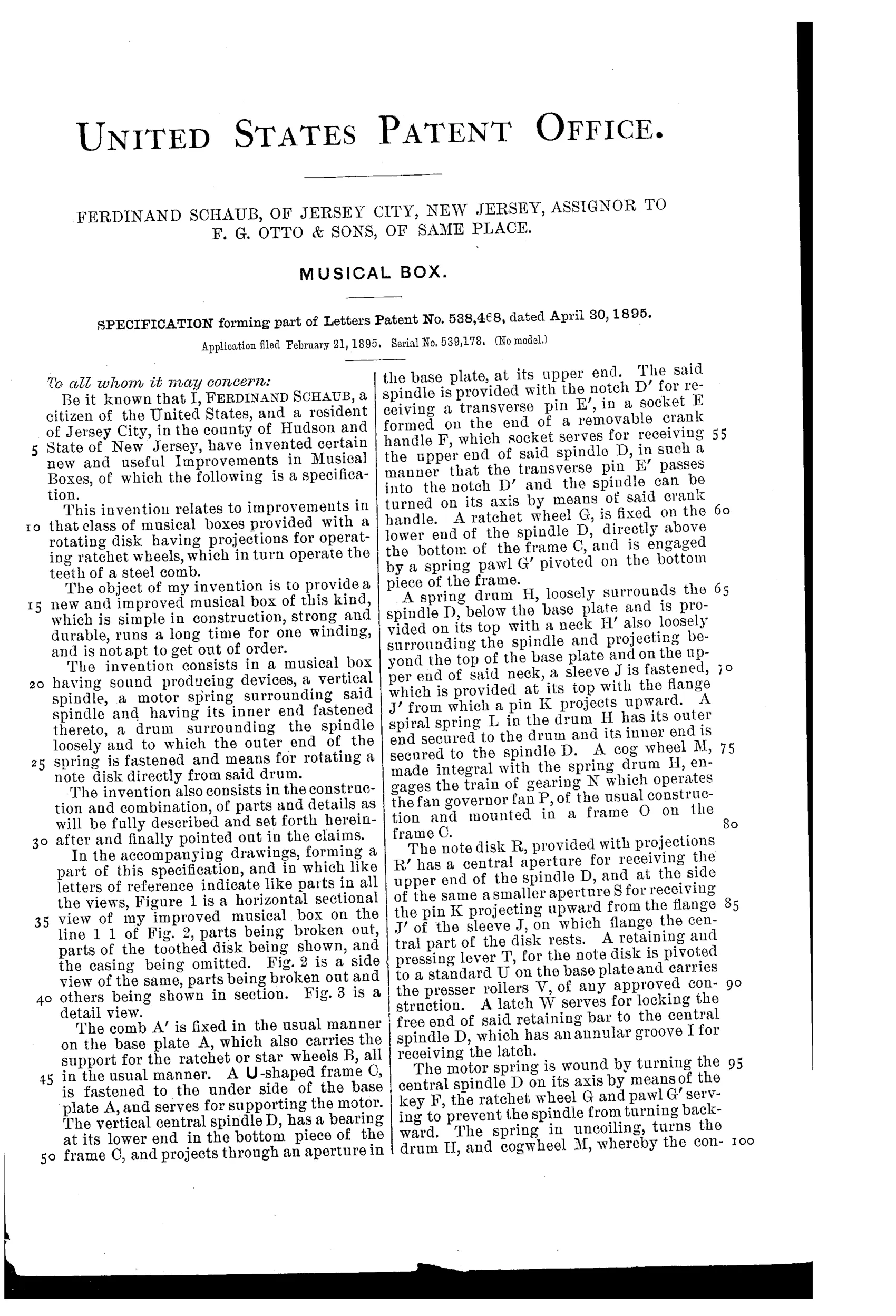
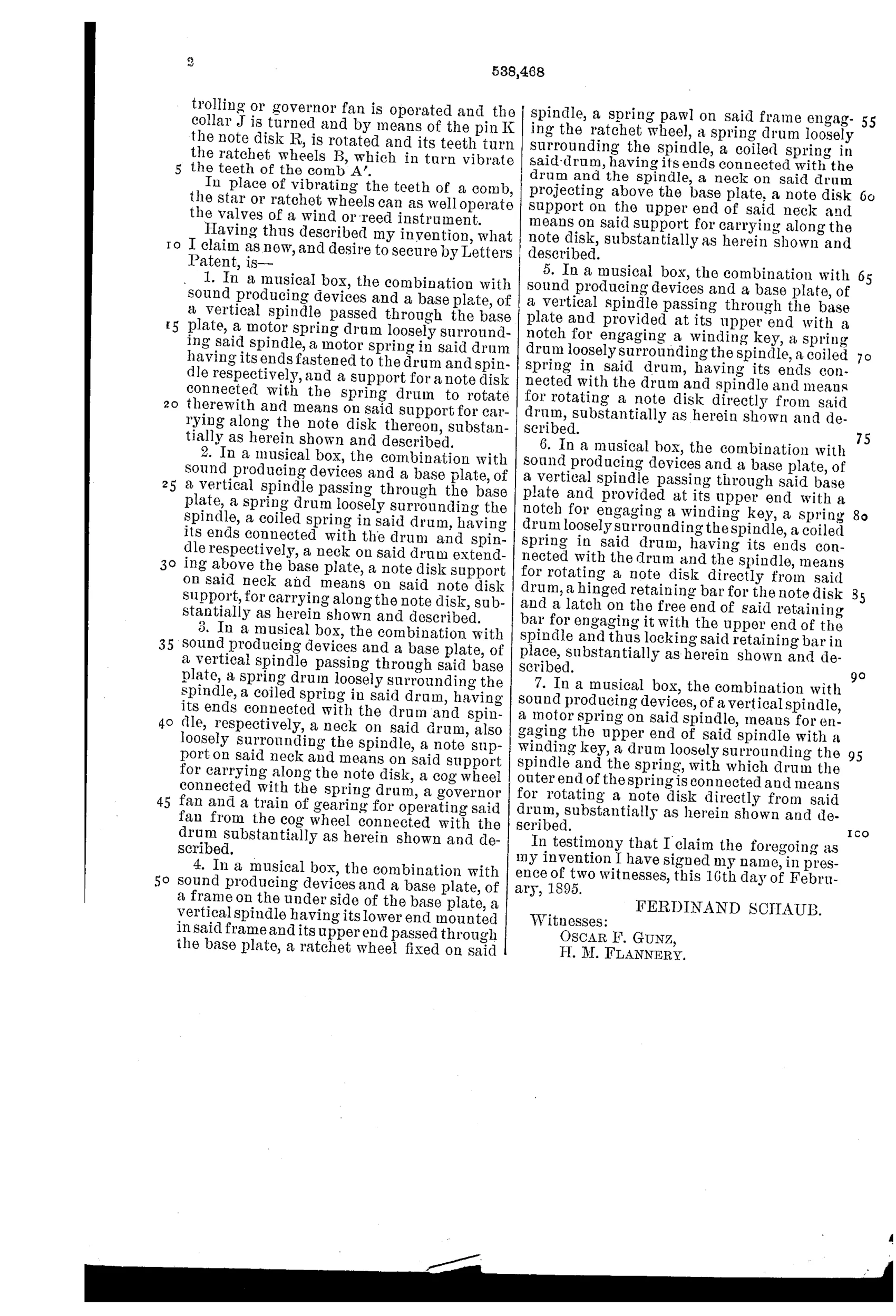
Spring-driven disc musical box mechanism
♫ How it works
A vertical spindle passes through the base plate and is turned by a removable crank handle to wind a coiled motor spring housed in a loosely surrounding drum. As the spring uncoils, it rotates the drum and an integral cog wheel, which drives a governor fan through a train of gearing to regulate speed. The drum's neck carries a pin that engages the note disc, causing the disc's projections to rotate and strike ratchet or star wheels, which in turn vibrate the teeth of a steel comb to produce music. A hinged retaining bar with presser rollers holds the disc in place, locked by a latch engaging a groove in the spindle.
♫ What was claimed
“1. In a musical box, the combination with sound producing devices and a base plate, of a vertical spindle passed through the base plate, a motor spring drum loosely surrounding said spindle, a motor spring in said drum having its ends fastened to the drum and spindle respectively, and a support for a note disk connected with the spring drum to rotate therewith and means on said support for carrying along the note disk thereon, substantially as herein shown and described.”
In plain English: The musical box combines a base plate, a vertical spindle, a spring-loaded drum around the spindle, and a rotating support that carries the note disc along with the drum.
♫ In the inventor’s words
“The object of my invention is to provide a new and improved musical box of this kind, which is simple in construction, strong and durable, runs a long time for one winding, and is not apt to get out of order.”— Ferdinand Schaub, from the specification
Manufactured and sold
F. G. Otto & Sons manufactured disc music boxes in this period, and Schaub was their house designer, so this assigned patent almost certainly reached production in some form — though matching it to a specific surviving model would take a bedplate comparison.
♫ Commentary
Ferdinand Schaub filed this on behalf of F. G. Otto & Sons of Jersey City, the firm best remembered for the Capital 'cuff' box and the Olympia disc machines — the most serious American challengers to Regina in the disc-box boom of the mid-1890s. That context matters: this is not a lone tinkerer's fantasy but a production engineer solving a production problem.
The clever bit is packaging. Instead of a separate spring barrel driving the disc through a gear train, Schaub coils the motor spring in a drum that loosely surrounds the central spindle itself — one end of the spring anchored to the spindle, the other to the drum. Wind the spindle with a removable crank, and the drum turns directly under the disc, carrying it along by a pin in the drum's neck. The gear train runs the other way, out to the governor fan, doing nothing but regulating speed. Fewer parts between spring and disc means less lost motion and less to wear.
Fig. 2 rewards a close look: the whole drive stacks vertically on one axis under the disc, with the hinged retaining bar and presser rollers up top latching into a groove in the spindle — a neat, serviceable answer to keeping a floppy steel disc pressed against its star wheels. It is a refinement, not a first, but it is the kind of refinement that made disc boxes affordable parlor goods rather than watchmakers' curiosities.
Commentary by Claude, The Talking Machine Patent Archive’s resident enthusiast