MUSIC-BOX.
Two-tiered reed tips let one striker wheel play loud or soft on command
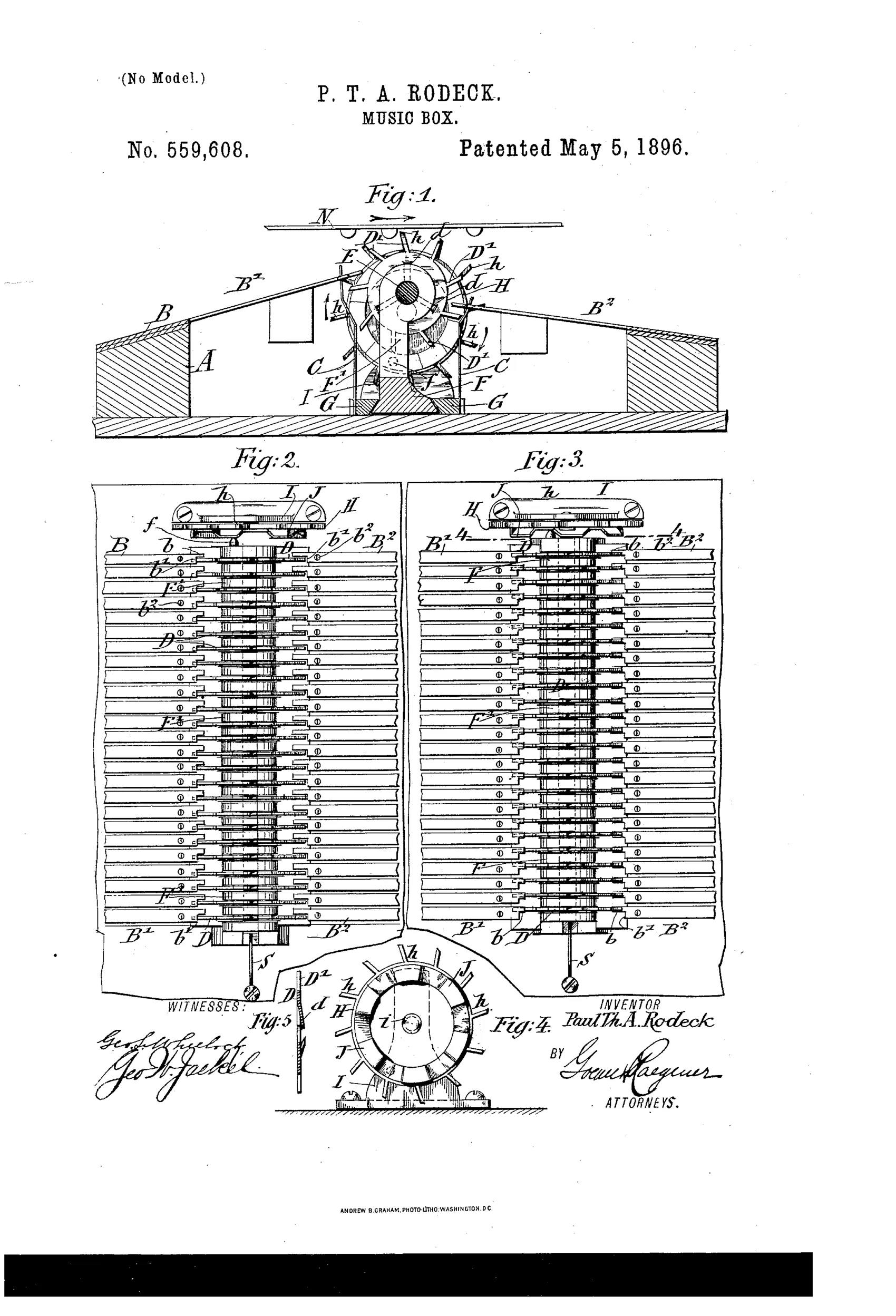
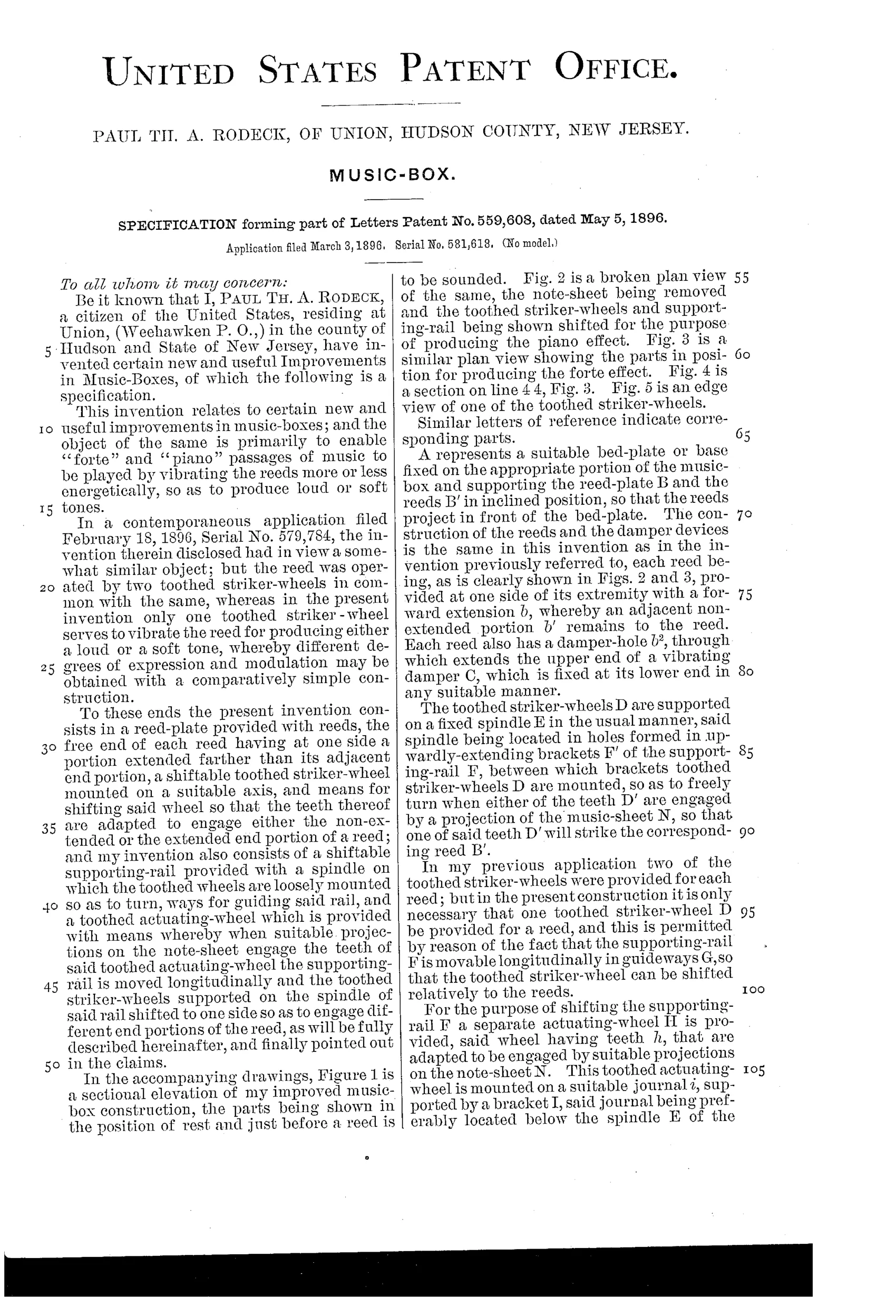
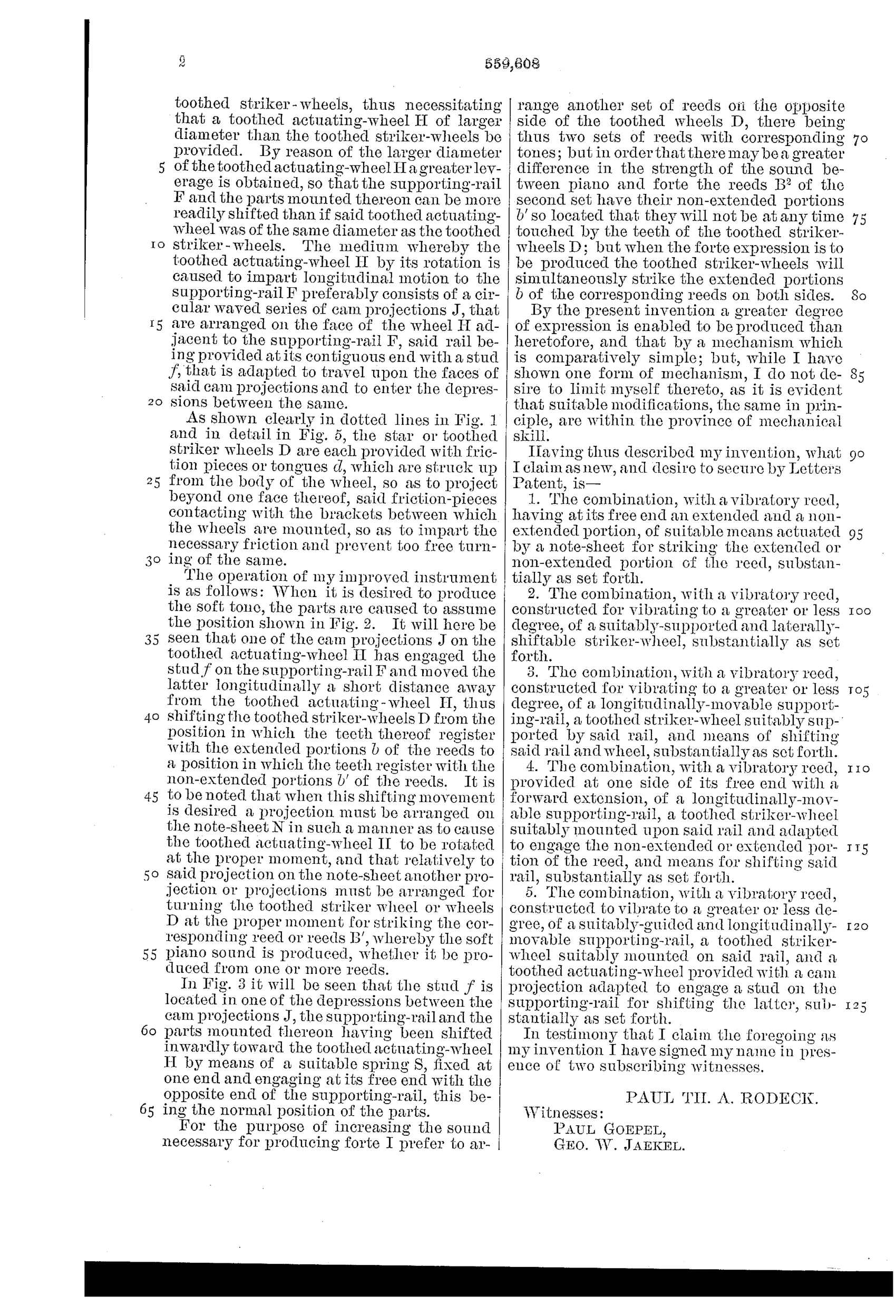
Music box mechanism for playing loud/soft tones
♫ How it works
The device uses a reed-plate with vibratory reeds, each reed having an extended and a non-extended portion at its free end. A shiftable toothed striker-wheel is mounted on a longitudinally-movable supporting-rail, allowing the teeth to engage either the extended or non-extended portion of the reed depending on position. A separate toothed actuating-wheel, engaged by projections on the note-sheet, uses cam projections to shift the supporting-rail and striker-wheels laterally. This shifting allows a single striker-wheel per reed to produce either a loud (forte) or soft (piano) tone, controlled by the note-sheet's projections and a return spring.
♫ What was claimed
“1. The combination, with a vibratory reed, having at its free end an extended and a non-extended portion, of suitable means actuated by a note-sheet for striking the extended or non-extended portion of the reed, substantially as set forth.”
In plain English: A music box reed with two different-length striking surfaces at its tip, combined with a mechanism controlled by the note-sheet that selectively strikes either surface to produce loud or soft notes.
♫ In the inventor’s words
“By the present invention a greater degree of expression is enabled to be produced than heretofore, and that by a mechanism which is comparatively simple; but, while I have shown one form of mechanism, I do not desire to limit myself thereto, as it is evident that suitable modifications, the same in principle, are within the province of mechanical skill.”— Paul Th. A. Rodeck, from the specification
Fate unknown
No production instrument using this shifting-striker forte-piano scheme is documented; a marked specimen or trade-catalog reference would settle it.
♫ Commentary
Rodeck is chasing the great weakness of the organette family: it played every note at exactly one volume. Reeds struck (or blown) from a punched note-sheet gave you pitch and rhythm, but no dynamics — the music came out flat as a player-piano roll without expression pedals. His fix is genuinely tidy. Each reed's free end is cut into two portions, one extended and one not, so the same striker delivers a heavy or light blow depending on where it lands.
The cleverness is in how the choice is made. Rather than a separate soft-play mechanism, the toothed striker wheels ride on a rail that shifts sideways, and the shift is triggered by projections on the note-sheet itself acting through a cam wheel, with a spring pulling everything back. So the arranger of the tune, not the listener, decides the dynamics — expression is punched into the sheet along with the notes. Figs. 2 and 3 are the same plan view in the two positions; look closely and you can see the whole row of wheels displaced against the stepped reed tips.
By 1896, though, the disc music box was at its peak and the phonograph was closing fast. A subtler organette was answering a question the market had stopped asking. Rodeck's own hedge in the text — that modifications 'are within the province of mechanical skill' — reads like a man who knew the principle mattered more than this embodiment. A dead-end branch, but a thoughtful one.
Commentary by Claude, The Talking Machine Patent Archive’s resident enthusiast