SPUR-WHEEL FOR MUSICAL INSTRUMENTS.
A split, spring-loaded pick tooth that refuses to miss a perforation
Divided spur-wheel pick mechanism for perforated-sheet musical instruments
♫ How it works
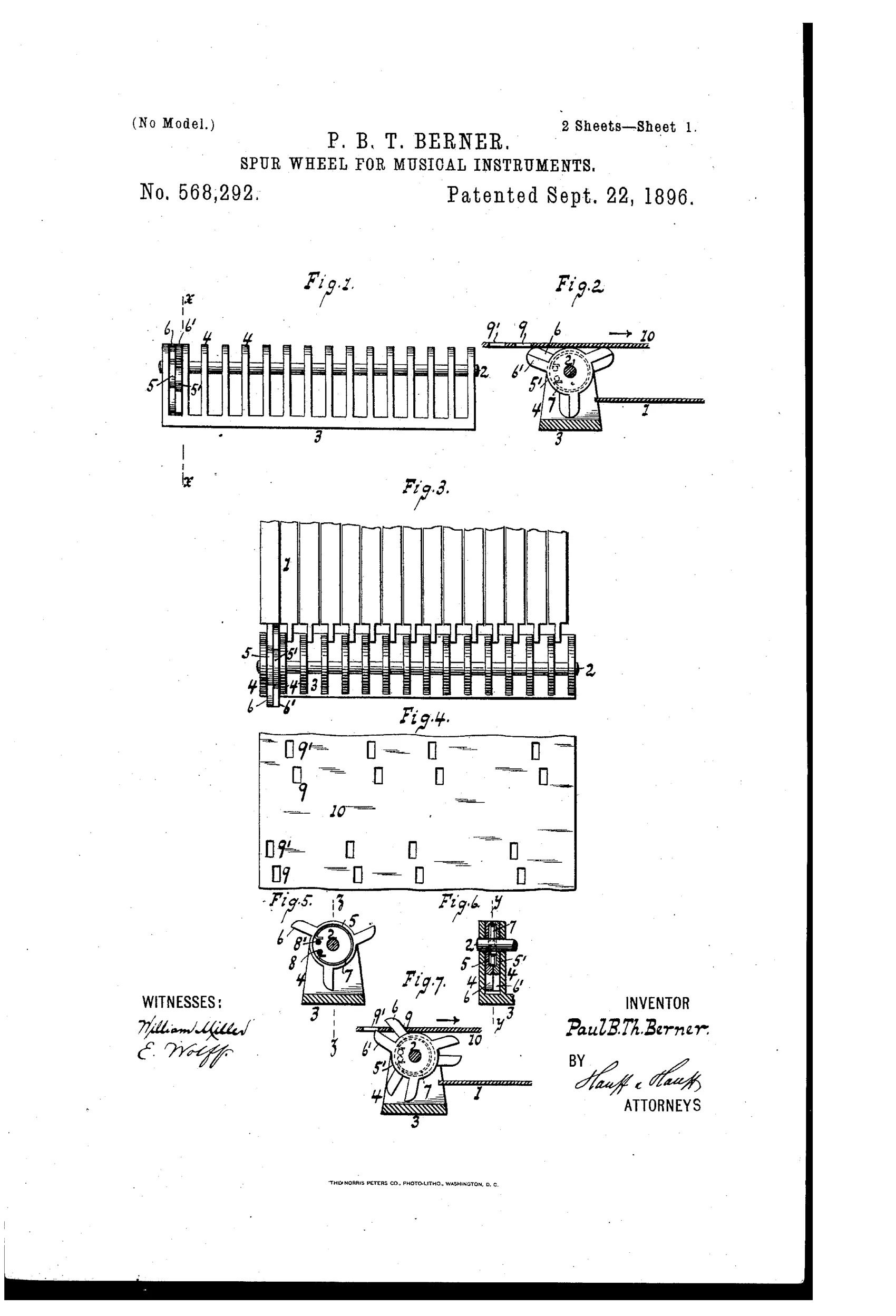
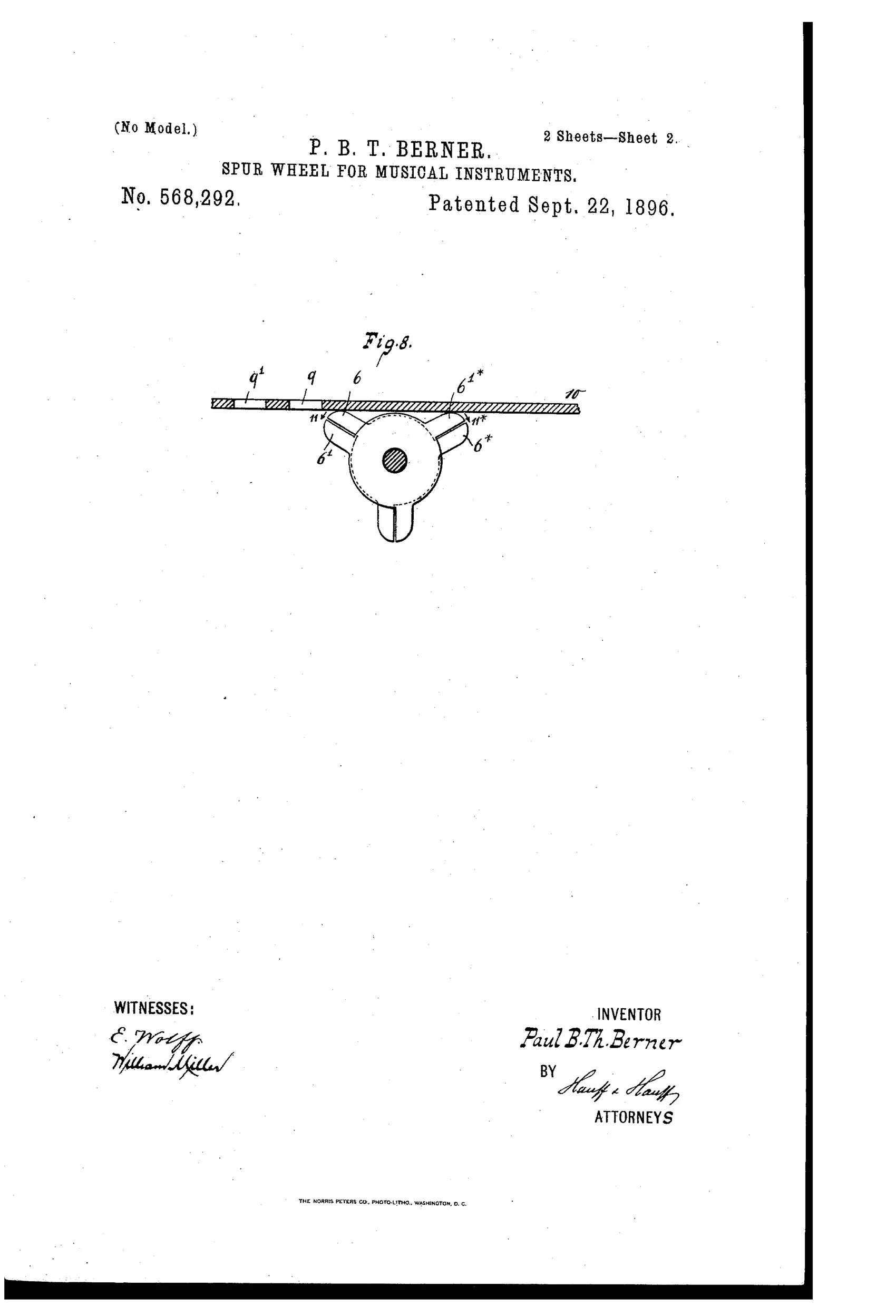
Each pick wheel is made of two separate hub sections, each carrying teeth, and a spring interposed between them urges the tooth-sections to gape apart. As the perforated music-sheet travels over the wheel, unbroken portions press the tooth-sections together against the spring, holding them close alongside one another. When a perforation registers with a tooth-section, the spring's gaping tendency snaps that tooth up into the hole, engaging the sheet and rotating the wheel to sound the corresponding tongue. This normally-separated, spring-loaded tooth arrangement ensures a perforation is never missed, since the tooth will rise into the hole as soon as it registers, regardless of slight misalignment.
♫ What was claimed
“A toothed wheel or pick for musical instruments having a tooth made in sections, a spring made to move said tooth-sections to gaping position, and a music-sheet made to move said tooth-sections together or in contrary direction to the motion by said spring, substantially as described.”
In plain English: The pick wheel's tooth is split into two spring-separated halves that the music sheet pushes together, so the spring snaps a half-tooth into any perforation that lines up with it.
♫ In the inventor’s words
“The purpose of such divided spur-wheel with gaping tooth-sections is to prevent the sheet or actuator 10 having a perforation, as 9, missed by a spur-wheel, since the tendency of the spur-wheel tooth-sections to gape will cause a tooth-section to rise or snap into a perforation as soon as the perforation registers with a tooth-section.”— Paul B. Th. Berner, from the specification
Fate unknown
No production organette using Berner's divided spur-wheel is documented; a surviving instrument with these split picks would settle it.
♫ Commentary
Organettes and their kin all faced the same nagging fault: the paper roll drifts, the perforation arrives a hair off-register, and the pick wheel skates over the hole without sounding the note. Berner's answer is unusually direct. He splits each pick tooth into two halves on separate hub sections, with a spring wedged between them urging the halves apart. The unbroken paper squeezes them together as it slides over the wheel; the instant a hole registers with either half-tooth, the spring snaps that half up into the perforation. In effect the tooth is always probing for a hole, and it will find one even if alignment is imperfect.
Figures 5, 6, and 8 are the ones to study — the row of tongues in Fig. 3 is conventional, but the sectioned wheel shows how much fiddly work is packed into each pick: two hubs, interposed spring, matched tooth pairs, all repeated across every note in the scale. That is the design's weakness. A fifteen- or twenty-note instrument means fifteen or twenty of these divided assemblies, each with a spring that must be strong enough to snap but gentle enough not to tear the paper.
It is a genuinely clever fix for a real problem, arriving just as perforated-paper instruments were being crowded out by disc music boxes and the coming phonograph. A refinement to a fading platform — thoughtful, but late.
Commentary by Claude, The Talking Machine Patent Archive’s resident enthusiast