CHIMING MECHANISM.
A pinned cylinder scaled up to tubular bells, with a self-shifting tune changer
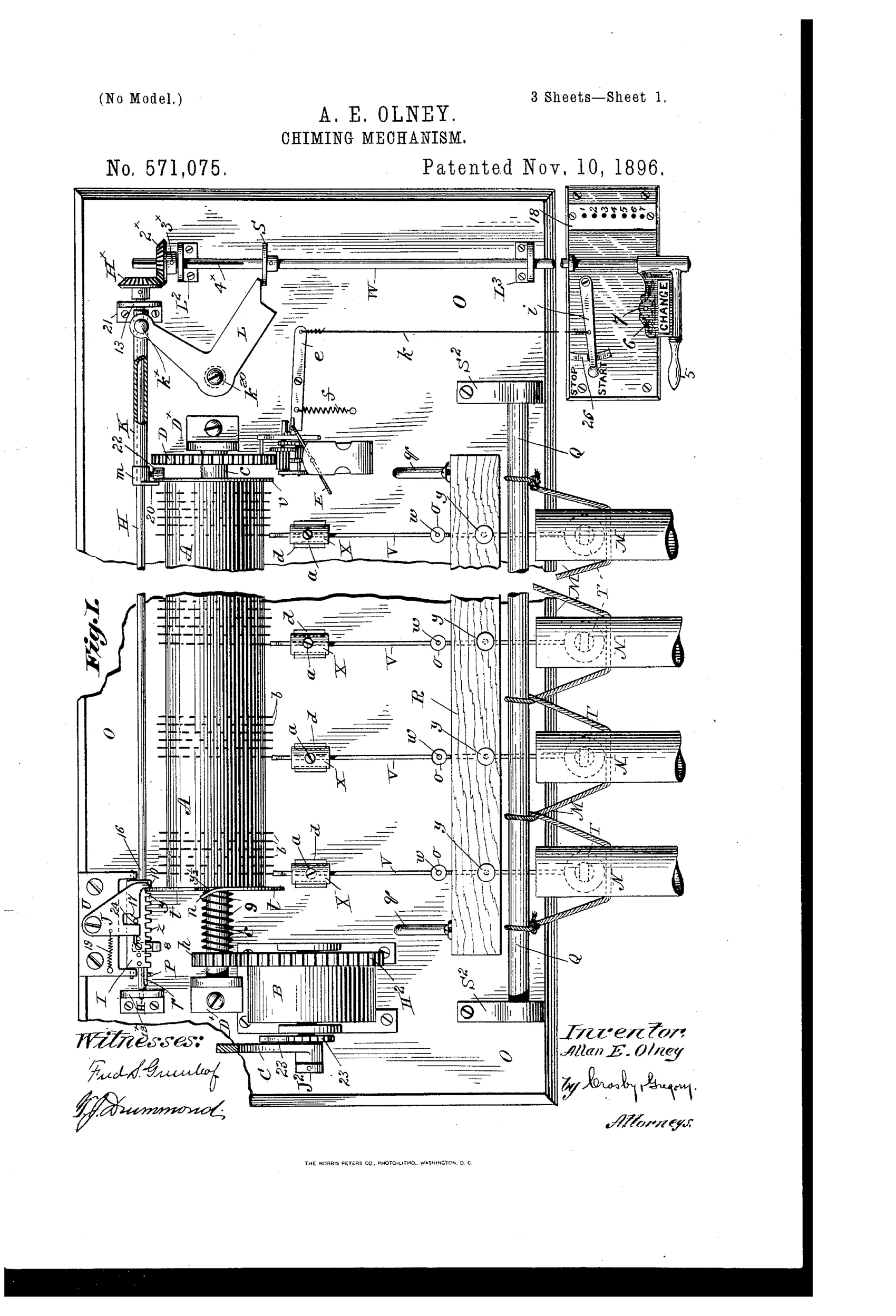
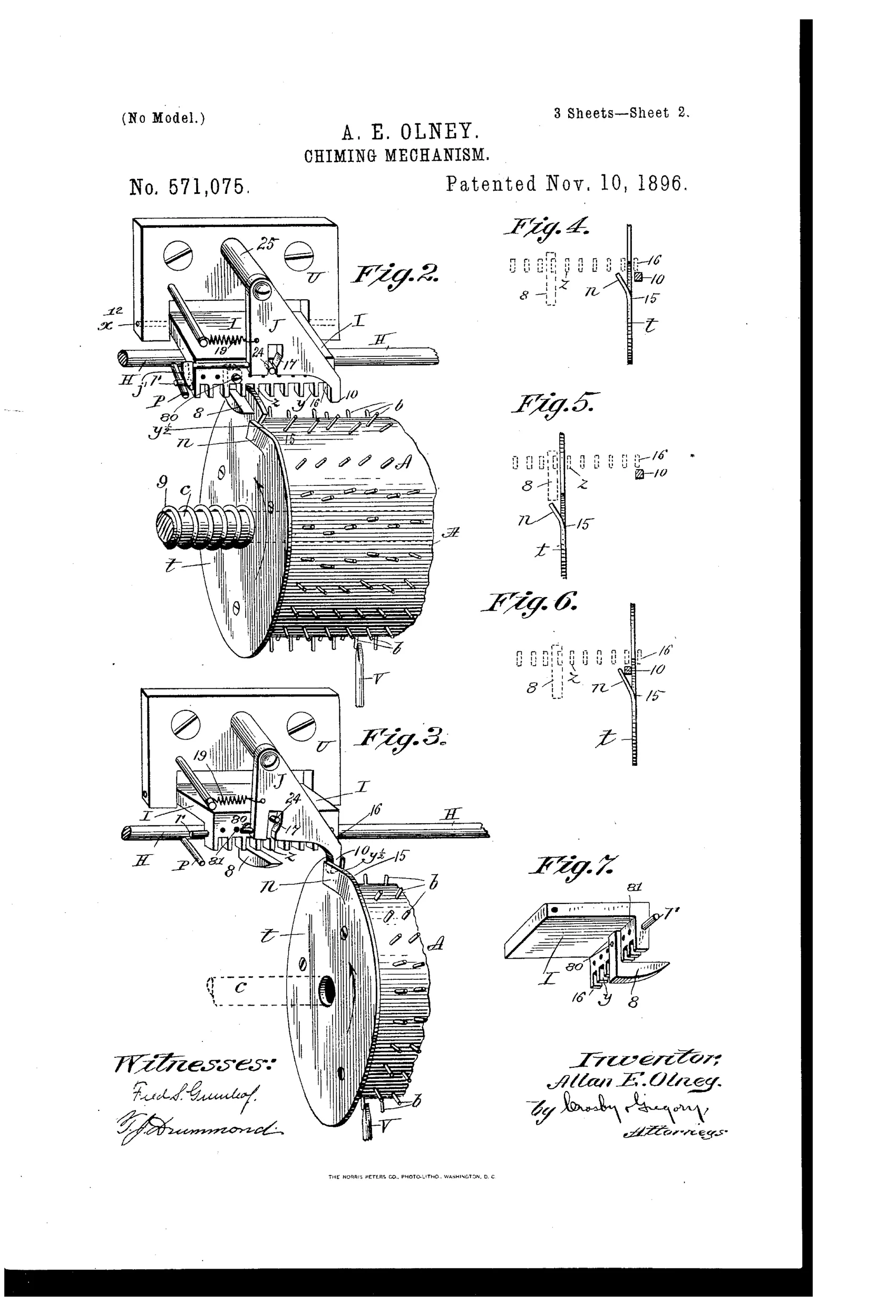
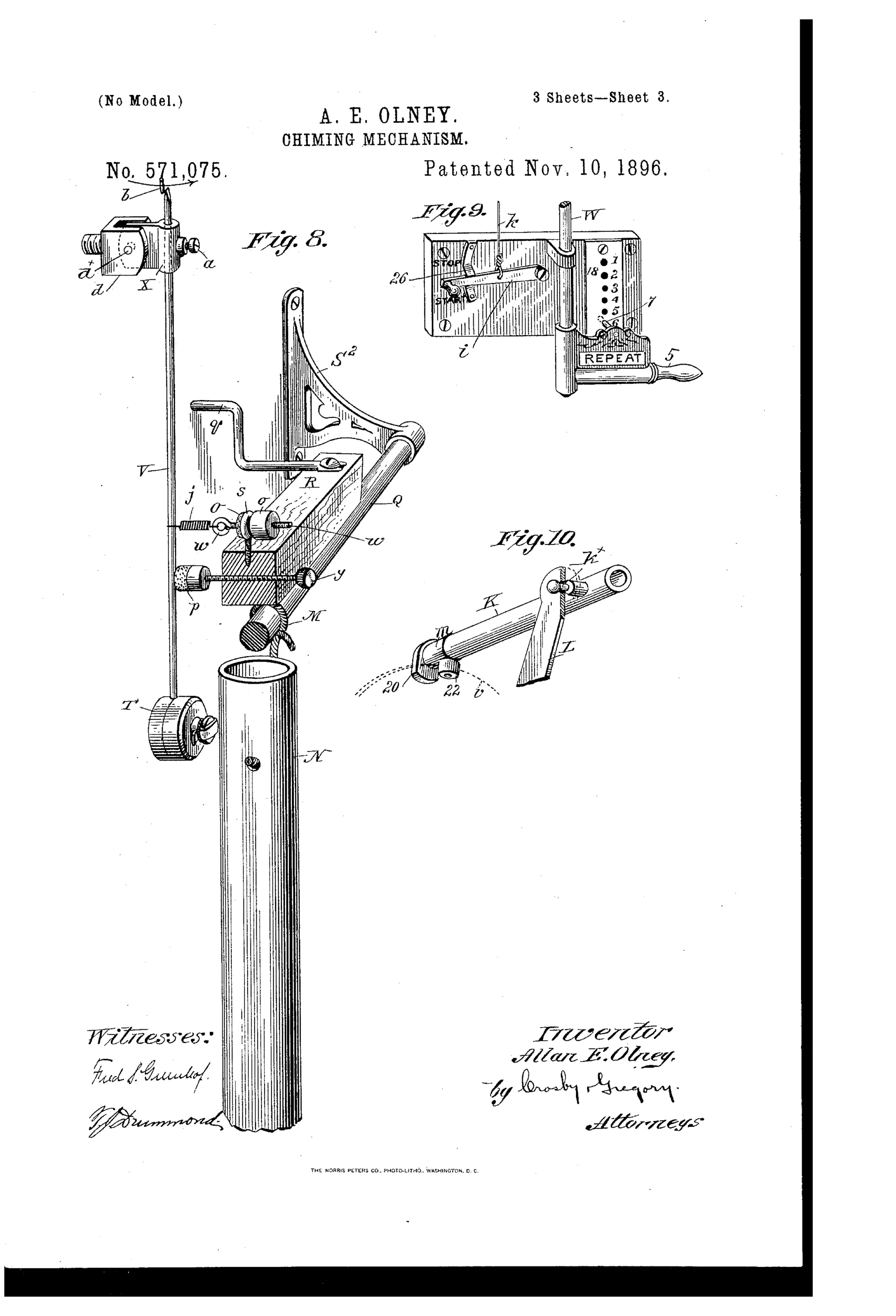
Automatic tune-changing pinned-barrel chime-playing mechanism
♫ How it works
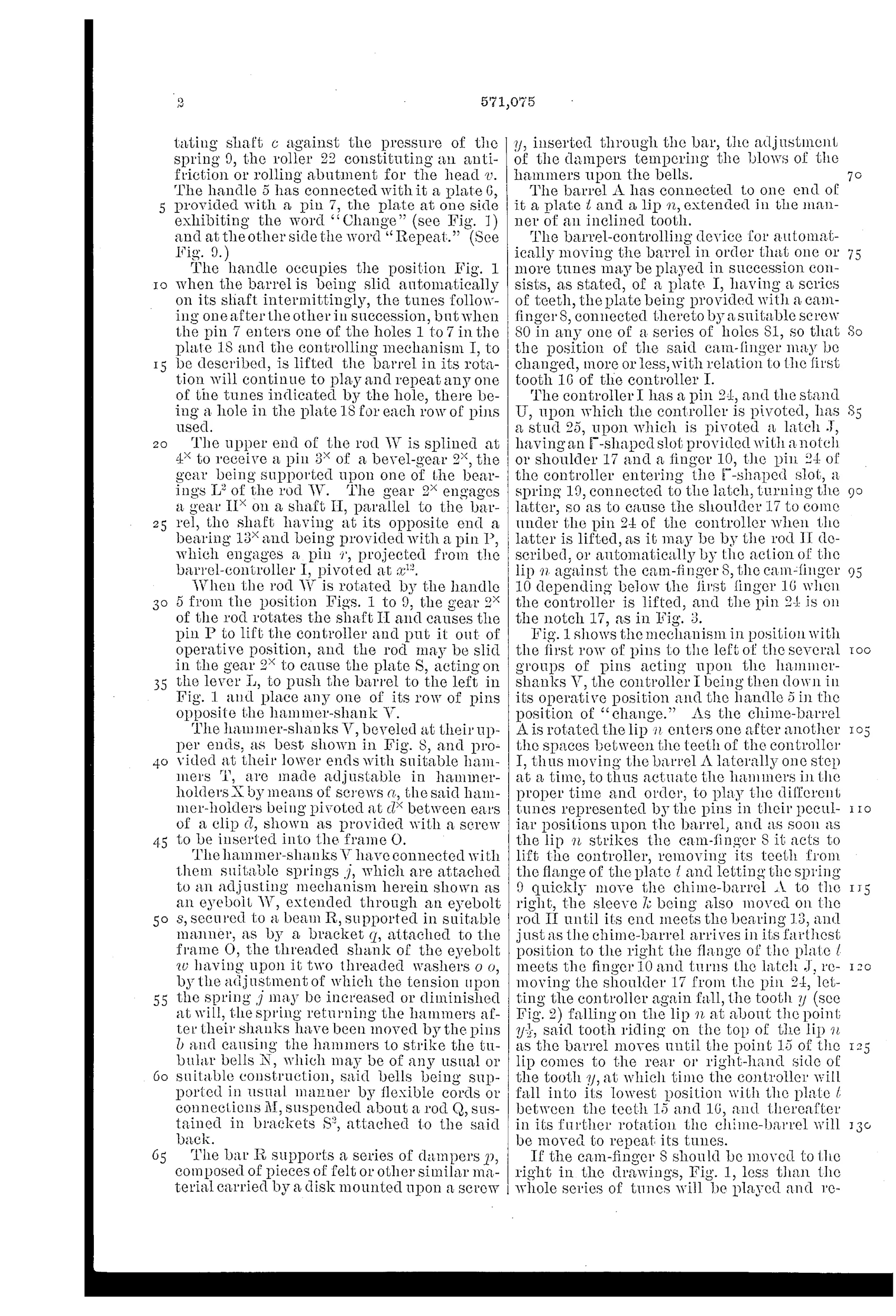
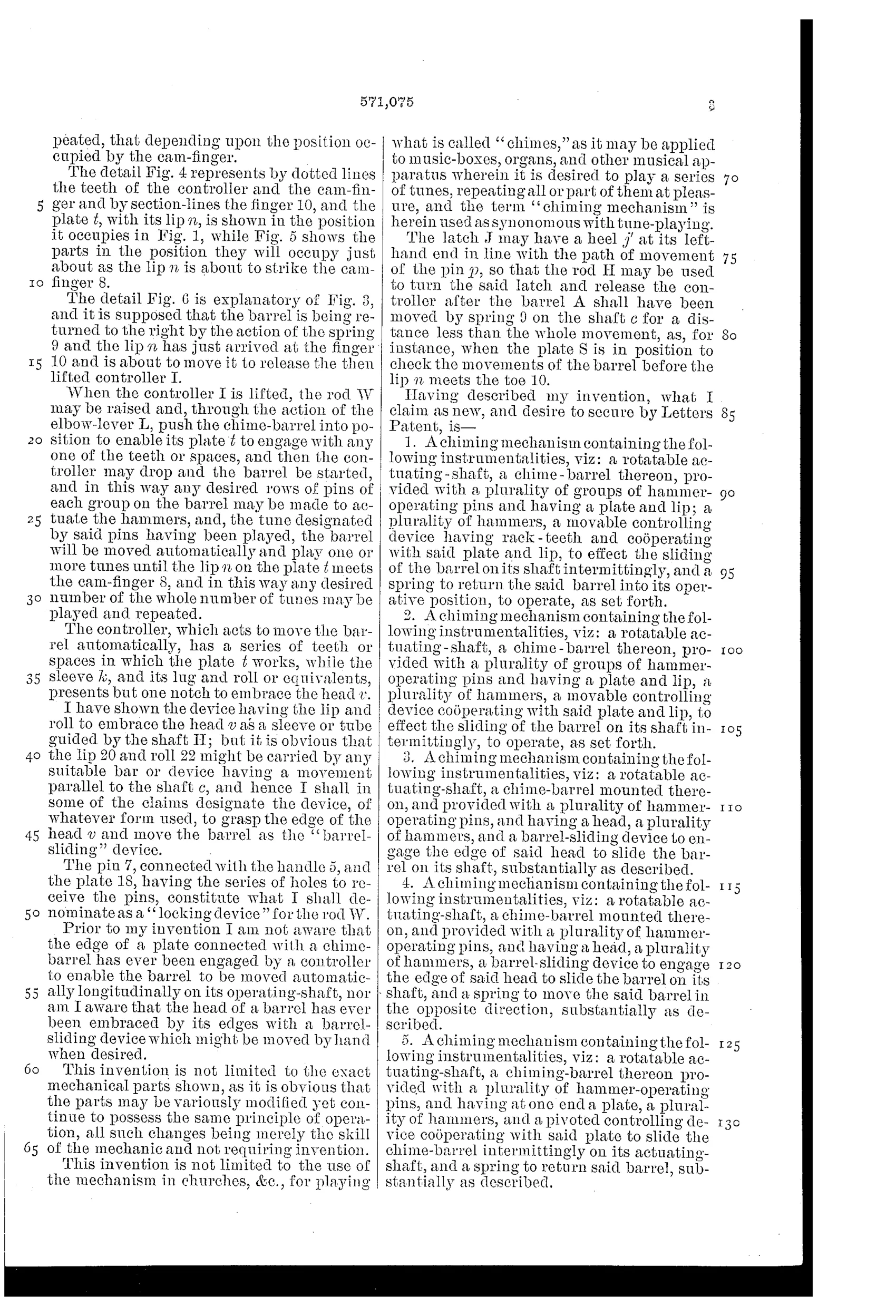
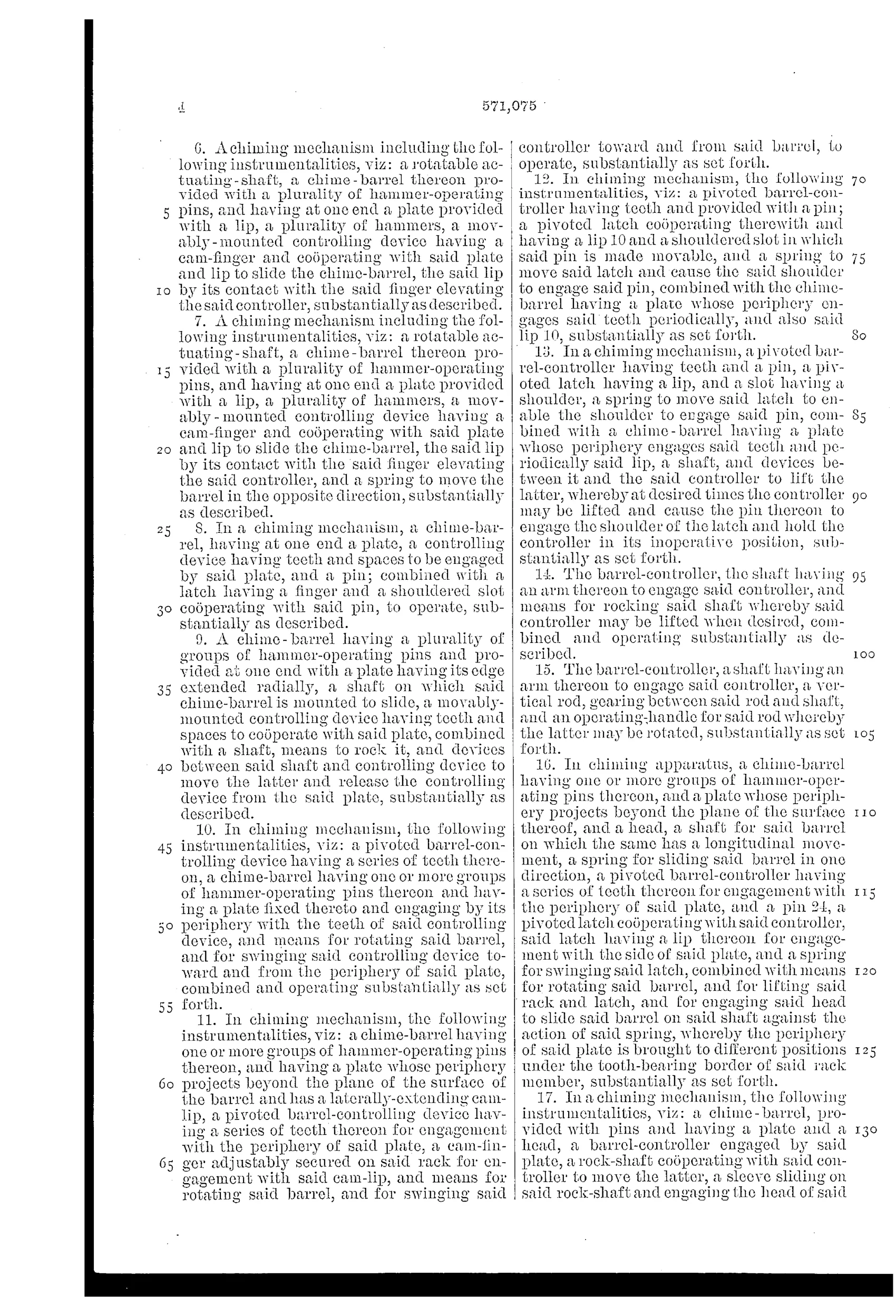
A rotatable chime-barrel splined on a shaft carries multiple groups of hammer-operating pins arranged in rows for different tunes; a clock-spring (wound via a crank and ratchet) rotates the barrel through gearing, with a fan-regulator governing speed and a start/stop switch controlling a lever that engages the fan. As the barrel turns, its pins strike hammer-shanks whose spring tension is adjustable, causing hammers to strike a series of tubular bells suspended on a rod. A pivoted, toothed barrel-controller engages a plate and cam-lip on the end of the barrel to shift it laterally step by step so successive rows of pins play different tunes in sequence; a latch and shouldered slot can lock the controller up so a single tune repeats, and a spring returns the barrel to its starting position when the controller disengages. A hand-operated rod, handle, and sleeve mechanism also allow the operator to manually slide the barrel to select any desired row of pins for a chosen tune.
♫ What was claimed
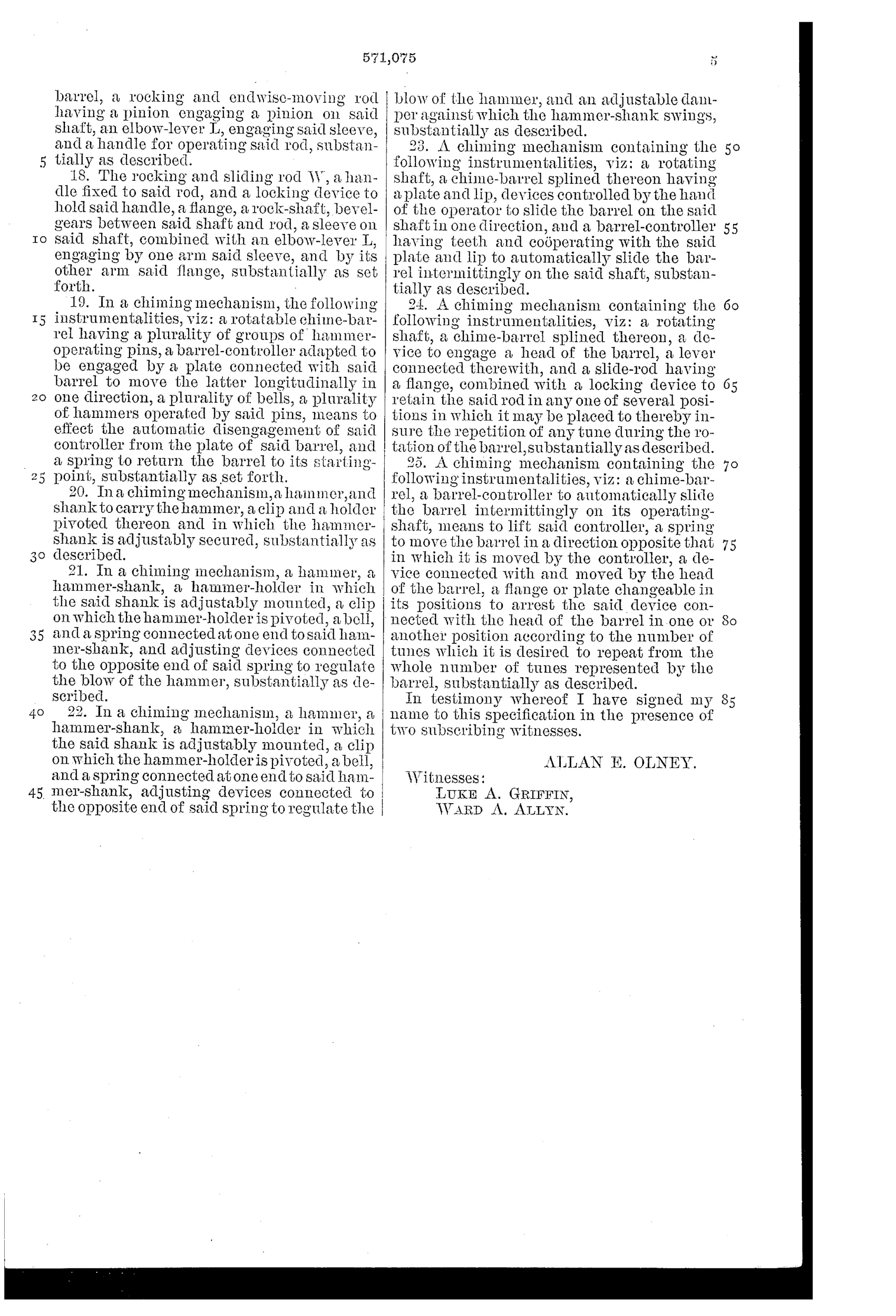
“A chiming mechanism containing the following instrumentalities, viz: a rotatable actuating-shaft, a chime-barrel thereon, provided with a plurality of groups of hammer-operating pins and having a plate and lip; a plurality of hammers, a movable controlling device having rack-teeth and cooperating with said plate and lip, to effect the sliding of the barrel on its shaft intermittingly, and a spring to return the said barrel into its operative position, to operate, as set forth.”
In plain English: The invention is a chime mechanism where a rotating shaft carries a pinned barrel with a plate and lip, and a toothed movable controller works with that plate and lip to shift the barrel step by step on its shaft while a spring resets the barrel to its starting position.
♫ In the inventor’s words
“This invention is not limited to the use of the mechanism in churches, &c., for playing what is called "chimes," as it may be applied to music-boxes, organs, and other musical apparatus wherein it is desired to play a series of tunes, repeating all or part of them at pleasure.”— Allan E. Olney, from the specification
Fate unknown
Assigned to a Holyoke party, suggesting commercial intent, but no manufactured example is documented; a surviving marked chime mechanism would settle it.
♫ Commentary
Olney takes the oldest idea in mechanical music — the pinned cylinder tripping tuned hammers — and applies it not to a comb but to a rank of tubular bells hanging off the frame like organ pipes. Everything around it is standard music-box practice circa 1896: clock-spring wound by crank, gear train, fan governor to hold tempo, a start/stop lever that simply grabs the fan. The interesting engineering is at the barrel's end.
That's what Figs. 2 through 7 dwell on. The barrel is splined on its shaft and carries a plate and cam-lip; a pivoted, rack-toothed controller engages these once per revolution and ratchets the barrel sideways one step, bringing the next row of pins under the hammers. It's the classic Swiss tune-change mechanism, but Olney adds a latch that holds the controller out of action so one tune repeats indefinitely, plus a manual rod-and-sleeve arrangement — note the numbered 'CHANGE' selector panel at upper right of Fig. 1 — so the operator can dial straight to any tune. A return spring snaps the barrel home when released.
He says outright the invention isn't limited to chimes and could serve music boxes and organs, which is honest: by 1896 the tune-changing barrel was well-trodden ground, and the disc machines from Regina and Polyphon had already made the whole approach look expensive. As a chime player for churches or halls, though, it's a coherent, buildable design — just one arriving late in the barrel's story.
Commentary by Claude, The Talking Machine Patent Archive’s resident enthusiast