DAMPING DEVICE FOR MECHANICAL MUSICAL INSTRUMENTS.
One stamped spring damps the tongue and drags the star-wheel at once
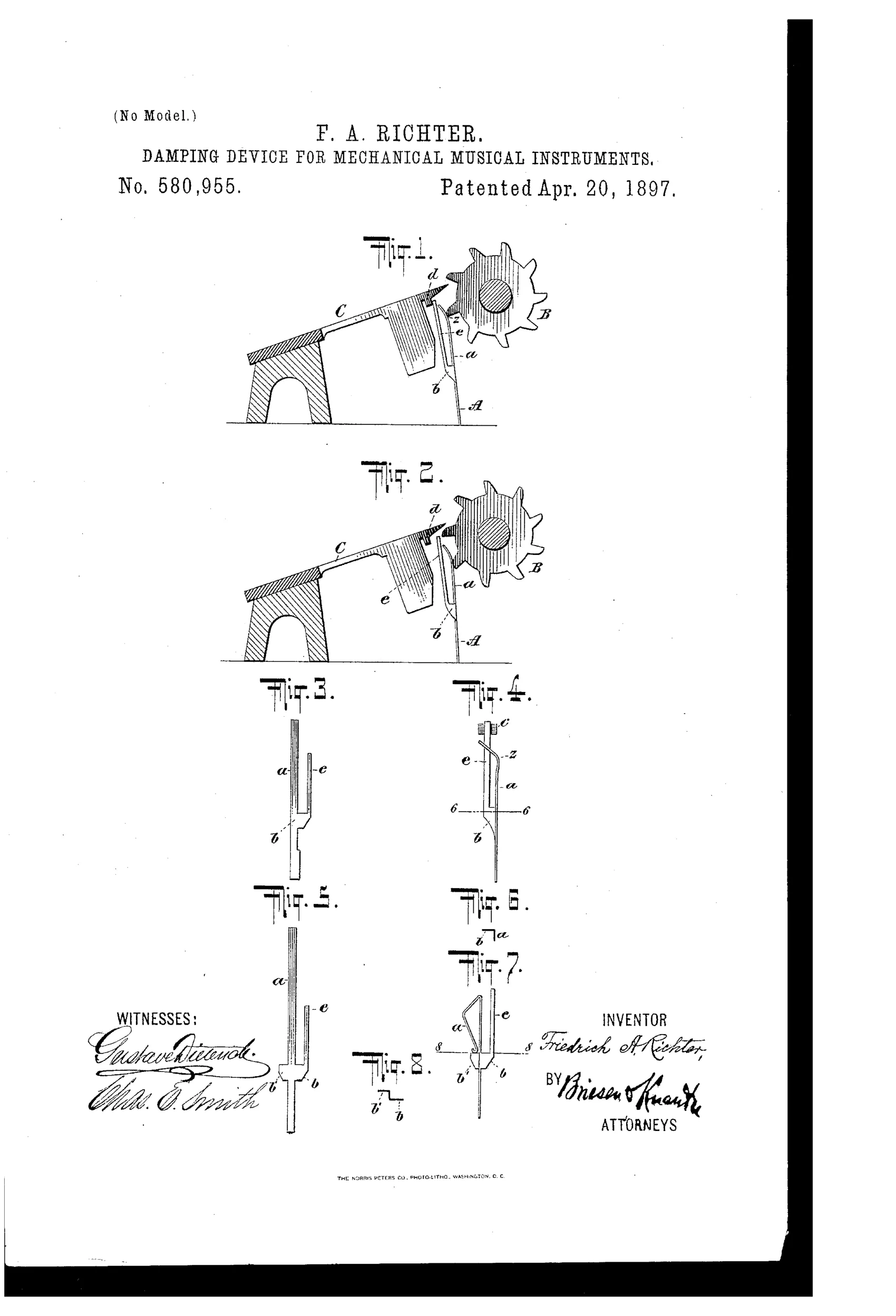
Spring damper for mechanical musical-instrument tongues
♫ How it works
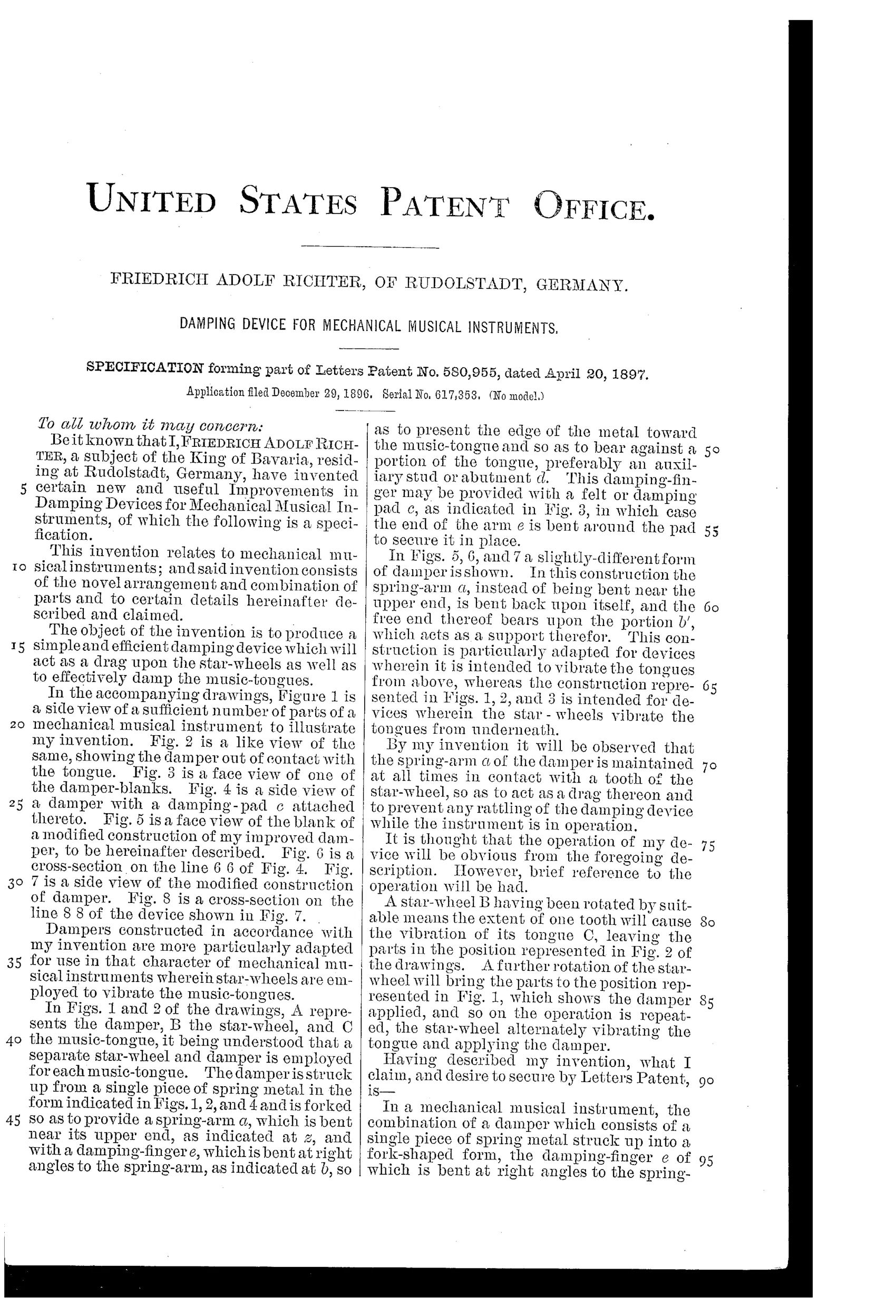
A single piece of spring metal is struck up into a fork shape, forming a spring-arm and a damping-finger bent at right angles. The spring-arm continually rides against a tooth of the rotating star-wheel, acting as a drag to prevent rattling. As the star-wheel turns, it deflects the music-tongue, and the damping-finger presses against a stud on the tongue to silence its vibration. A felt pad may be attached to the damping-finger to soften contact with the tongue.
♫ What was claimed
“In a mechanical musical instrument, the combination of a damper which consists of a single piece of spring metal struck up into a fork-shaped form, the damping-finger e of which is bent at right angles to the spring-arm a, a music-tongue having a bearing stud or abutment d against which the finger e of the damper is adapted to bear, a star-wheel adapted to operate the damper and against a tooth of which the spring-arm is adapted at all times to bear and to form a drag for said star-wheel, substantially as described.”
In plain English: The invention combines a single spring-metal damper, forked into a spring-arm and a right-angled damping-finger, with a music-tongue having a bearing stud that the finger presses against, and a star-wheel whose teeth the spring-arm continuously drags against to both operate the damper and prevent rattling.
♫ In the inventor’s words
“The object of the invention is to produce a simple and efficient damping device which will act as a drag upon the star-wheels as well as to effectively damp the music-tongues.”— Friedrich Adolf Richter, from the specification
Manufactured and sold
Richter's Rudolstadt works manufactured disc music boxes (the Imperator line) in this period, and this damper is plainly production engineering, though confirming this exact stamping means opening a surviving machine.
♫ Commentary
Every disc music box lives or dies by its dampers. A star-wheel tooth catches under a comb tooth, lifts it, and lets it snap free — but if the tooth is still ringing from the last note when the wheel touches it again, you get a squeal instead of music. Separate problem: the star-wheels themselves are loose on their arbors and will rattle and drift between plucks. Most makers solved these with two separate parts. Richter's whole idea here is to solve both with one piece of struck-up spring steel.
Look at Figs. 3 and 5, the flat blanks: a fork with a long spring-arm and a shorter finger bent at right angles. The long arm rides continuously on a star-wheel tooth, acting as a friction drag so the wheel never rattles or creeps. As the wheel rotates to pluck, the same motion swings the bent finger against a stud on the vibrating tongue — Figs. 1 and 2 show the engaged and clear positions — killing the ring just before the next pluck. Fig. 4 adds a felt pad where metal-on-metal contact would buzz.
Richter is worth knowing: this is the Rudolstadt toy magnate behind Anker stone building blocks, whose factory also built disc-playing musical instruments in the late 1890s. This patent is exactly the kind of parts-count economy a high-volume manufacturer files — not a new principle, but a cheaper, one-piece way to do what Polyphon and Regina did with assemblies.
Commentary by Claude, The Talking Machine Patent Archive’s resident enthusiast