MECHANICAL MUSICAL INSTRUMENT.
A Knoxville inventor puts music-box pins to work on real piano strings
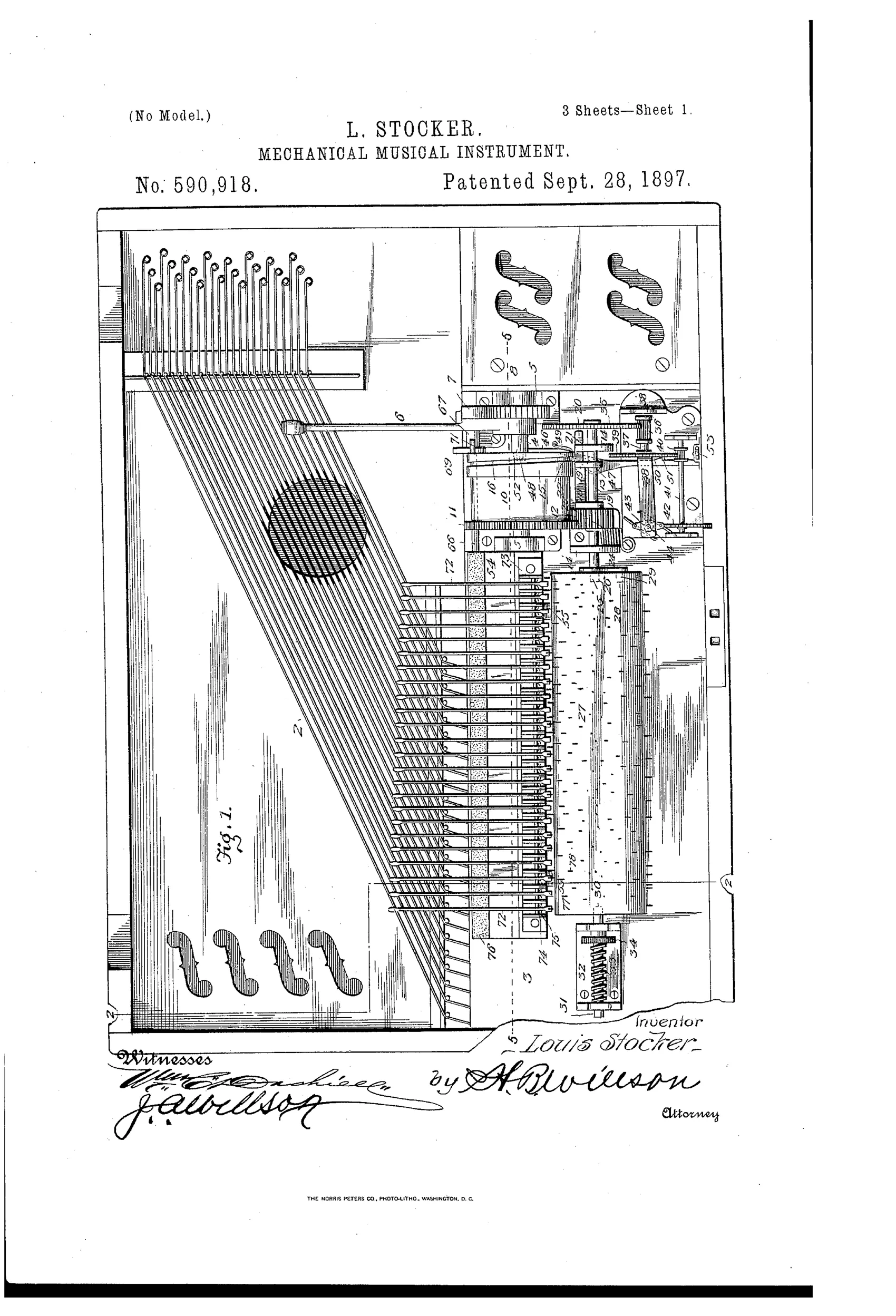
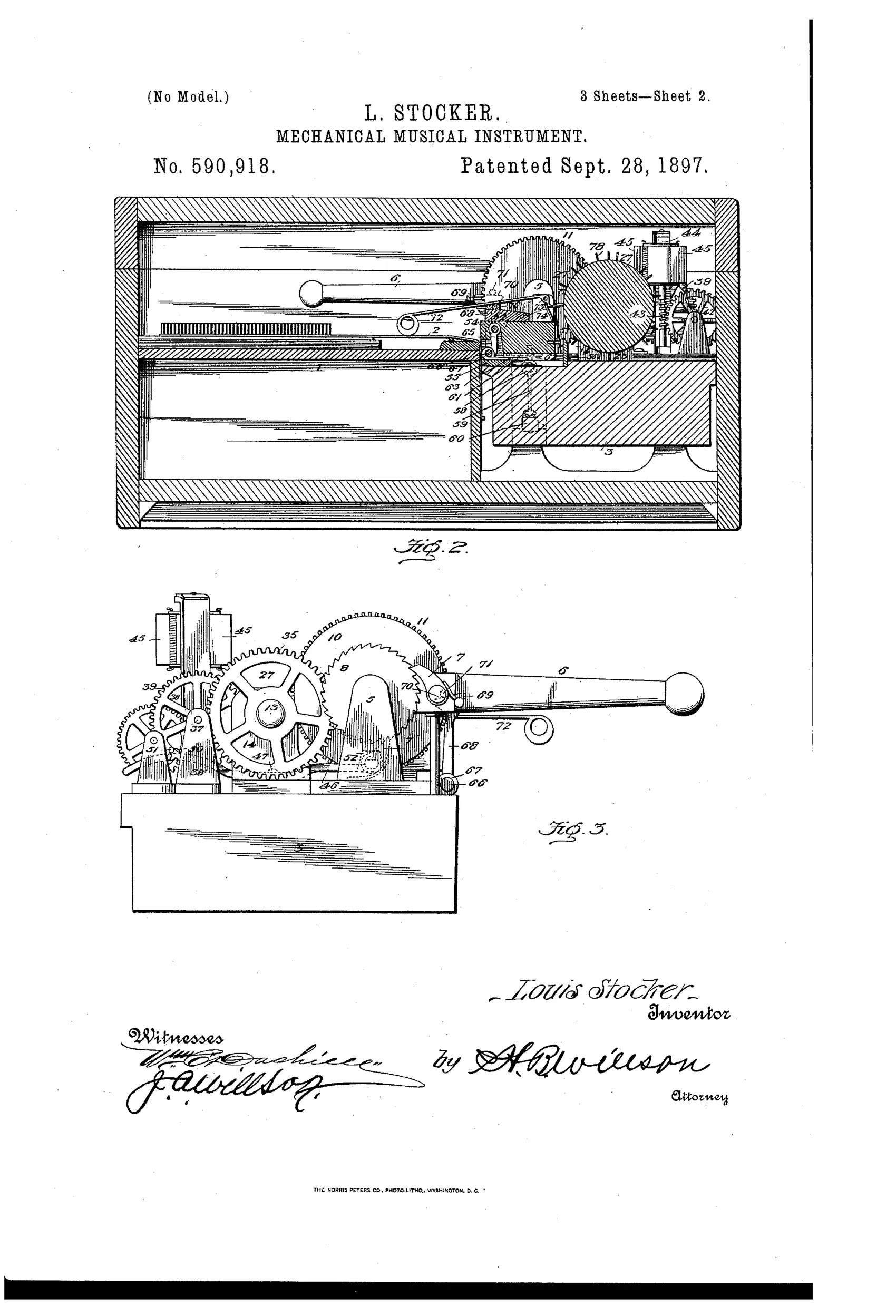
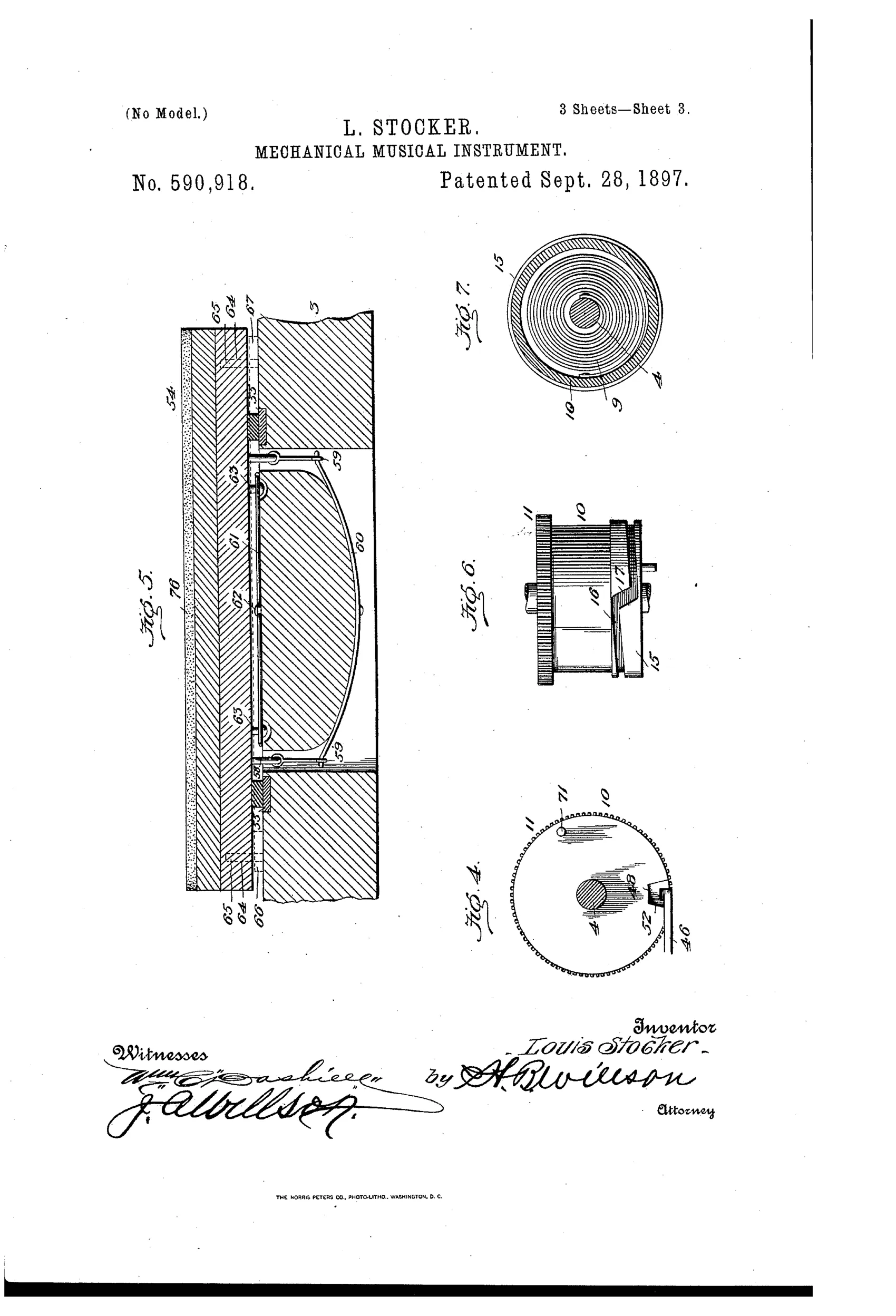
Spring-driven pinned-cylinder musical instrument with strings
♫ How it works
A mainspring housed in a barrel drives a gear train that rotates a pinned cylinder while also moving a hammer-carriage toward and away from the cylinder via a spiral and diagonal groove on the barrel acting on a shaft and bar. Radial pins on the rotating cylinder depress flattened fingers on independently pivoted hammers mounted on the traveling carriage, releasing them so spring-loaded hammers strike piano strings above. A worm and governor-fan assembly regulates the speed of the driving train, and a stop-lever with a dog engaging a notch in the barrel halts the cylinder after a set number of revolutions to end the tune, unless disabled by a thumb-lever to allow repeat play. Springs and rails guide and hold the hammer-carriage in alignment with the cylinder throughout its reciprocating travel.
♫ What was claimed
“1. A mechanical musical instrument, comprising a series of musical strings, a rotating cylinder provided with a series of arbitrarily-arranged radial pins, a carriage adapted to travel to and from said cylinder, and a series of hammer-arms fulcrumed on said carriage, and having their inner ends projecting into the path of said pins, and their outer hammer-heads arranged vertically above said strings, substantially as and for the purpose set forth.”
In plain English: The invention is a musical instrument with strings, a rotating pinned cylinder, and a movable carriage holding hammers whose inner ends are struck by the pins to make the outer hammer-heads strike the strings.
♫ In the inventor’s words
“the object is to provide a simple and inexpensive instrument of this class.”— Louis Stocker, from the specification
Fate unknown
No manufacturer or surviving example is documented; a marked specimen or a trade-catalog listing would settle it, though the unassigned patent suggests it likely stayed on paper.
♫ Commentary
Louis Stocker's idea is a hybrid: take the pinned cylinder of a Swiss music box, but instead of plucking a tuned steel comb, use the pins to trip spring-loaded hammers that strike genuine piano strings. The drawing makes the split obvious — the left two-thirds of the sheet is essentially a small zither or piano harp, strings fanned across a soundboard, while the right side is pure clockwork: spring barrel, worm, governor fans, and the pinned cylinder.
The interesting mechanical choice is the traveling hammer-carriage. In a conventional cylinder box the comb stays put and the cylinder shifts laterally to change tunes. Stocker reverses this: a spiral groove on the spring barrel walks the whole carriage of pivoted hammers toward and away from the cylinder. That lets one barrel serve double duty as both power source and tune-shifting cam — economical, which fits his stated goal of 'a simple and inexpensive instrument of this class.'
Would it work? Probably, at a modest musical level. Pin-tripped hammers on strings were proven technology — this is the same era Regina and Polyphon were selling disc boxes by the thousands, and string-playing automatics like the later Wurlitzer machines were coming. Stocker's version, with no assignee and a small-shop feel, reads as a workmanlike Southern entry into a field the big Northern factories were already dominating with steel discs rather than expensive pinned cylinders.
Commentary by Claude, The Talking Machine Patent Archive’s resident enthusiast