DEVICE FOR REPRODUCING SOUND
An Orange, New Jersey inventor tries to free the stylus from gravity in 1898
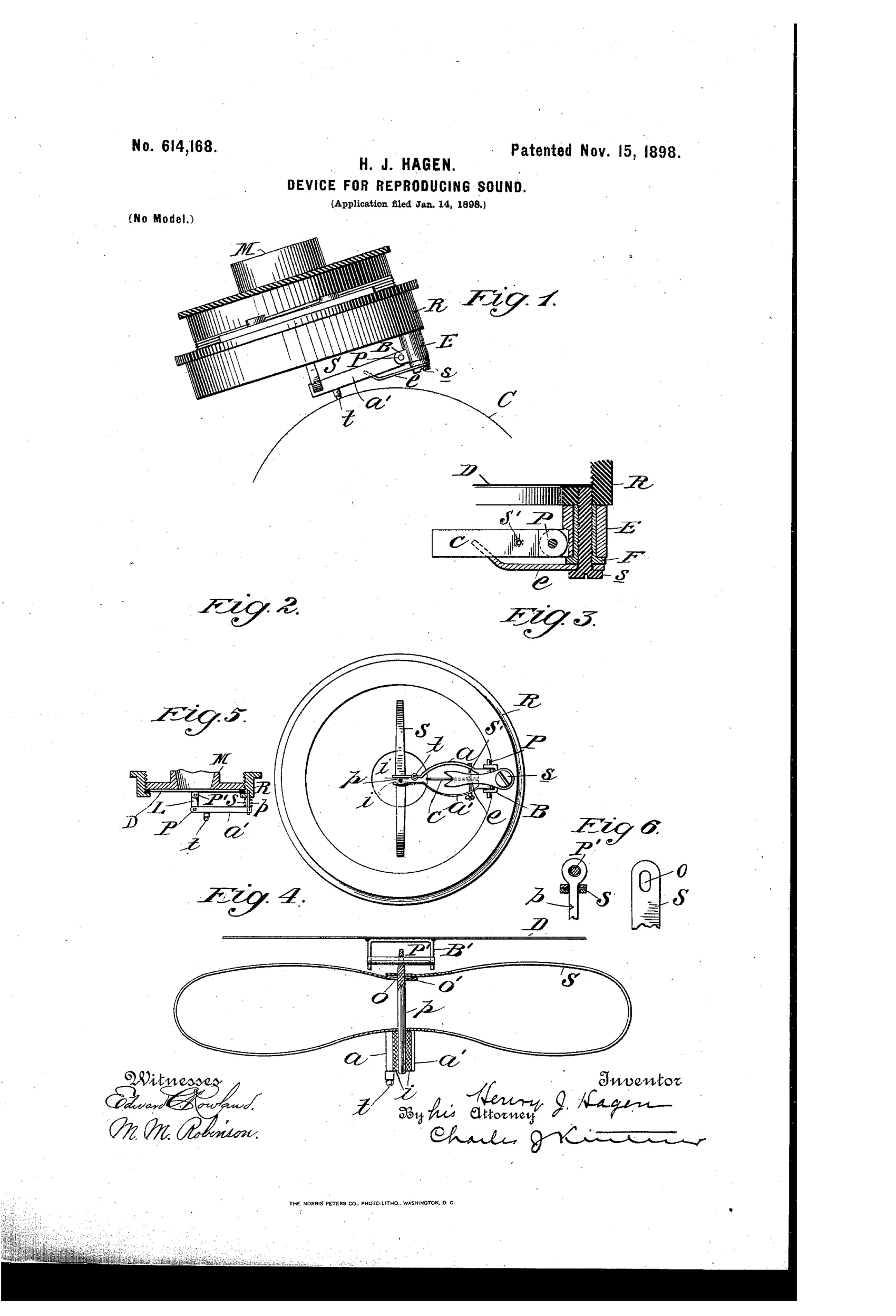
Yielding universal-joint stylus mount for sound reproducers
♫ How it works
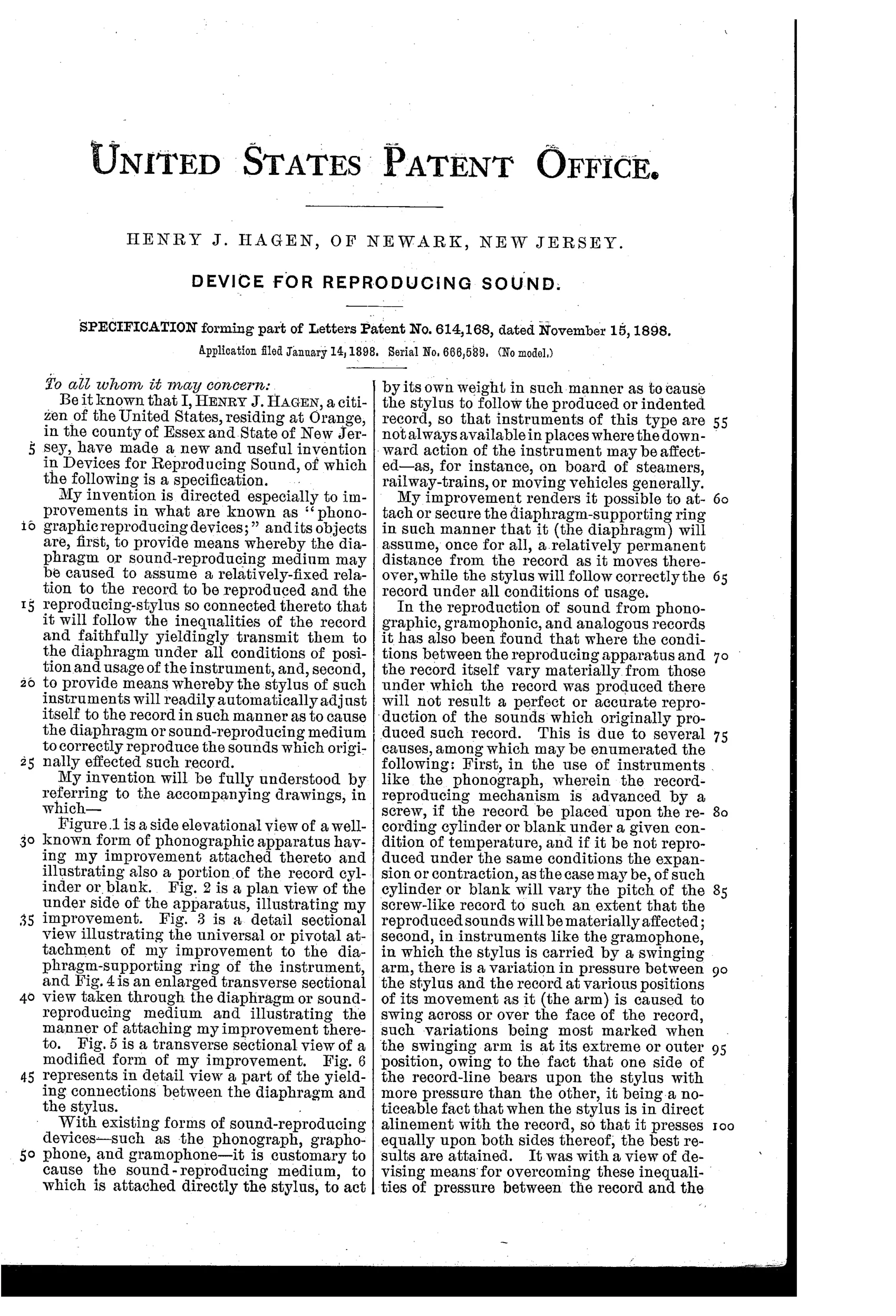
A pair of spring-arms are pivotally connected by a universal joint to the body of the phonographic instrument at one end, while their free ends grasp a pin depending from the diaphragm. A spring yieldingly connects the free ends of the arms to the diaphragm, allowing the pin to move laterally while the arms move vertically with delicate frictional bearing. A stylus carried by one of the arms follows the record grooves with minimal friction and without relying on gravity, transmitting the record's inequalities to the diaphragm. An adjusting screw between the arms varies the pressure against the pin, letting the user tune how firmly the stylus tracks the record.
♫ What was claimed
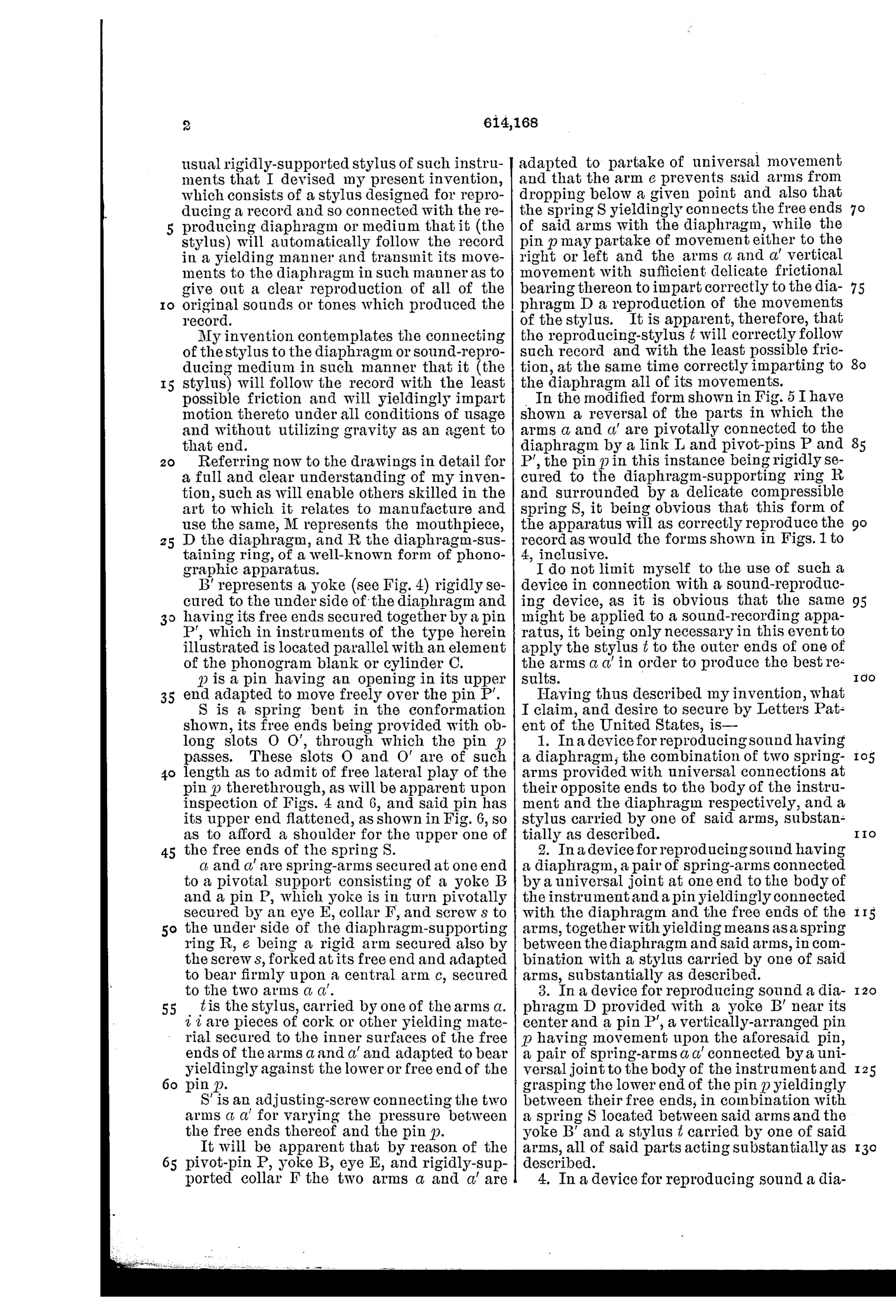
“In a device for reproducing sound having a diaphragm, the combination of two spring-arms provided with universal connections at their opposite ends to the body of the instrument and the diaphragm respectively, and a stylus carried by one of said arms, substantially as described.”
In plain English: The invention combines two spring-arms, each universally connected between the instrument body and the diaphragm, with a stylus mounted on one arm to transmit record vibrations.
♫ In the inventor’s words
“My improvement renders it possible to attach or secure the diaphragm-supporting ring in such manner that it (the diaphragm) will assume, once for all, a relatively permanent distance from the record as it moves thereover, while the stylus will follow correctly the record under all conditions of usage.”— Henry J. Hagen, from the specification
Fate unknown
No production reproducer bearing Hagen's name or this patent date is documented to me; a marked specimen or an assignment record to Edison or a rival would settle it.
♫ Commentary
The address is the first tell: Orange, New Jersey, 1898 — Edison's back yard, at the moment the wax-cylinder business was booming and everyone within walking distance of the Edison works had opinions about reproducers. Hagen's opinion is a good one. Early cylinder reproducers mostly relied on gravity and a rigid stylus lever to keep the point in the groove, which meant tracking pressure varied with how the machine sat and how worn the record was.
Hagen's answer is a pair of spring-arms hung on universal joints at the body end, gripping a pin that hangs from the diaphragm at the other, with a spring and an adjusting screw to tune how firmly the assembly presses. The stylus rides on one arm. The result is a compliant, two-axis suspension: the arms flex vertically to ride the groove's hill-and-dale cut, the pin can shift laterally to absorb eccentricity, and the diaphragm ring stays at a fixed height over the record. Fig. 4 is the one to study — the yoke straddling the pin under the diaphragm is essentially a crude tone-arm compliance problem being solved inside the soundbox.
This is the crowd that eventually produced the Edison Model C 'floating' reproducers and the automatic-weight designs. Hagen is a refinement in that stream, not the origin of it, but the adjustable tracking pressure is a genuinely thoughtful touch for its date.
Commentary by Claude, The Talking Machine Patent Archive’s resident enthusiast