DEVICE FOR TRIPPING VIBRATING TONGUES OF MECHANICAL MUSIC-BOXES
A Swiss maker's answer to plucking combs from smooth, projectionless paper sheets
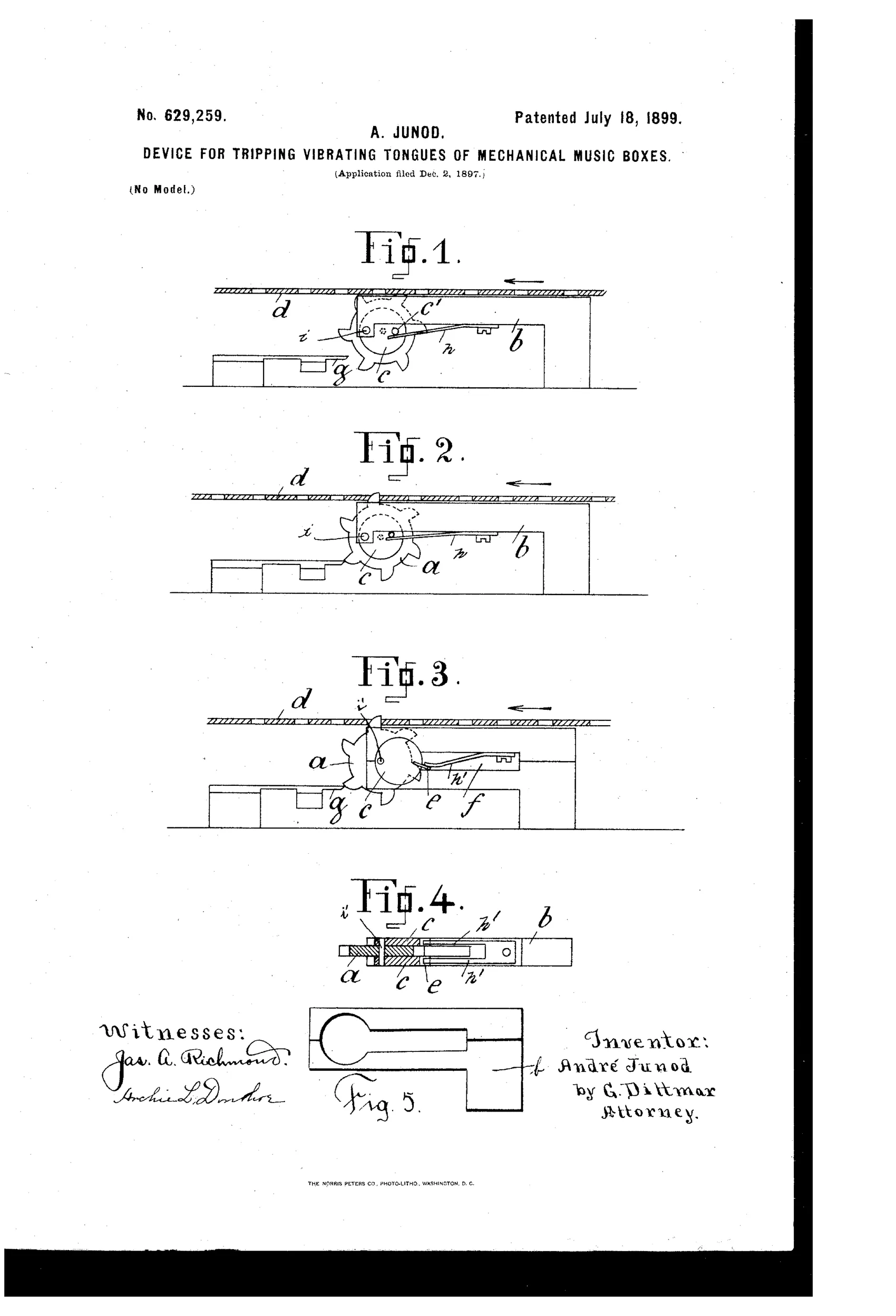
Tripping device for music-box tongues
♫ How it works
A toothed tripping-wheel is mounted eccentrically upon a pivoted disk that is pressed by a spring so the wheel's teeth constantly bear against a perforated music-sheet. When a hole in the music-sheet passes over the wheel, a tooth springs into the hole and the disk turns on its eccentric pivot until a projection strikes the frame, giving the wheel a momentarily fixed bearing that trips the vibrating steel tongue. In a modified form, the wheel is mounted between two spring-loaded disks turning in circular recesses of the frame, connected by a pin, so the wheel oscillates and advances as the music-sheet moves. This oscillation of the wheel about the disk pivots produces the tripping action that plucks the tongues to sound notes.
♫ What was claimed
“A tripping device for steel tongues in mechanical music-boxes consisting of a tripping-wheel a revolubly and concentrically mounted upon a disk c, which is eccentrically pivoted in the frame, and which receives the pressure of a spring in such a way as to keep the teeth of the tripping-wheel constantly pressed against the music-sheet d, said disk being provided with a projection c', adapted to limit the oscillation of the disk by striking against the frame b when a tooth of the tripping-wheel enters into an opening of the music-sheet.”
In plain English: The invention is a spring-loaded tripping wheel mounted off-center on a pivoted disk, so that the wheel's teeth press against a perforated music sheet and momentarily lock in place whenever a tooth drops into a hole, thereby plucking the music box's steel tongues.
♫ In the inventor’s words
“According to this device the center of the tripping-wheel revolves around a fixed point located outside of said center, so that thereby the tripping-wheel is vertically displaced against the music-sheet.”— André Junod, from the specification
Fate unknown
The Junods were working Auberson makers and projectionless tripping mechanisms did reach production, but no specific machine using this exact eccentric-disk design is documented; a surviving Junod sheet-playing box with this mechanism would settle it.
♫ Commentary
Most disc and strip music boxes of the 1890s worked from projections: punched teeth bent downward from the disc caught a star wheel, which plucked the comb. Junod's problem here is the opposite case — a plain perforated sheet with holes and no projections. Nothing sticks out to grab. His answer is to make the tripping wheel do the reaching: it rides spring-loaded against the underside of the moving sheet, its teeth skating along the paper until one drops into a hole. At that instant the eccentric disk carrying the wheel swings until its stop c' hits the frame, the wheel suddenly has a rigid bearing, and the advancing sheet forces it to rotate one step — plucking the tongue.
The eccentric mounting is the clever bit, and it's easy to miss in Figs. 1-3. The wheel's center orbits a fixed point off-center, so engaging a hole displaces the wheel vertically as well as rotationally. That gives a clean, positive pluck and then lets the wheel drop back to skating. Fig. 4's two-disk variant, with the wheel oscillating between spring-loaded disks in circular recesses, is the more manufacturable version.
Auberson, next to Sainte-Croix, was the heart of the Swiss music-box trade, and the Junod name belongs to established makers there. Projectionless-disc plucking of exactly this family later became the hallmark of Stella boxes from neighboring Mermod Frères, so this sits in a genuinely productive line of Swiss thinking, not a crank's corner.
Commentary by Claude, The Talking Machine Patent Archive’s resident enthusiast