LIFTING MECHANISM FOR GRAPHOPHONE-REPRODUCERS.
Macdonald teaches the Graphophone to set its needle down straight, every time
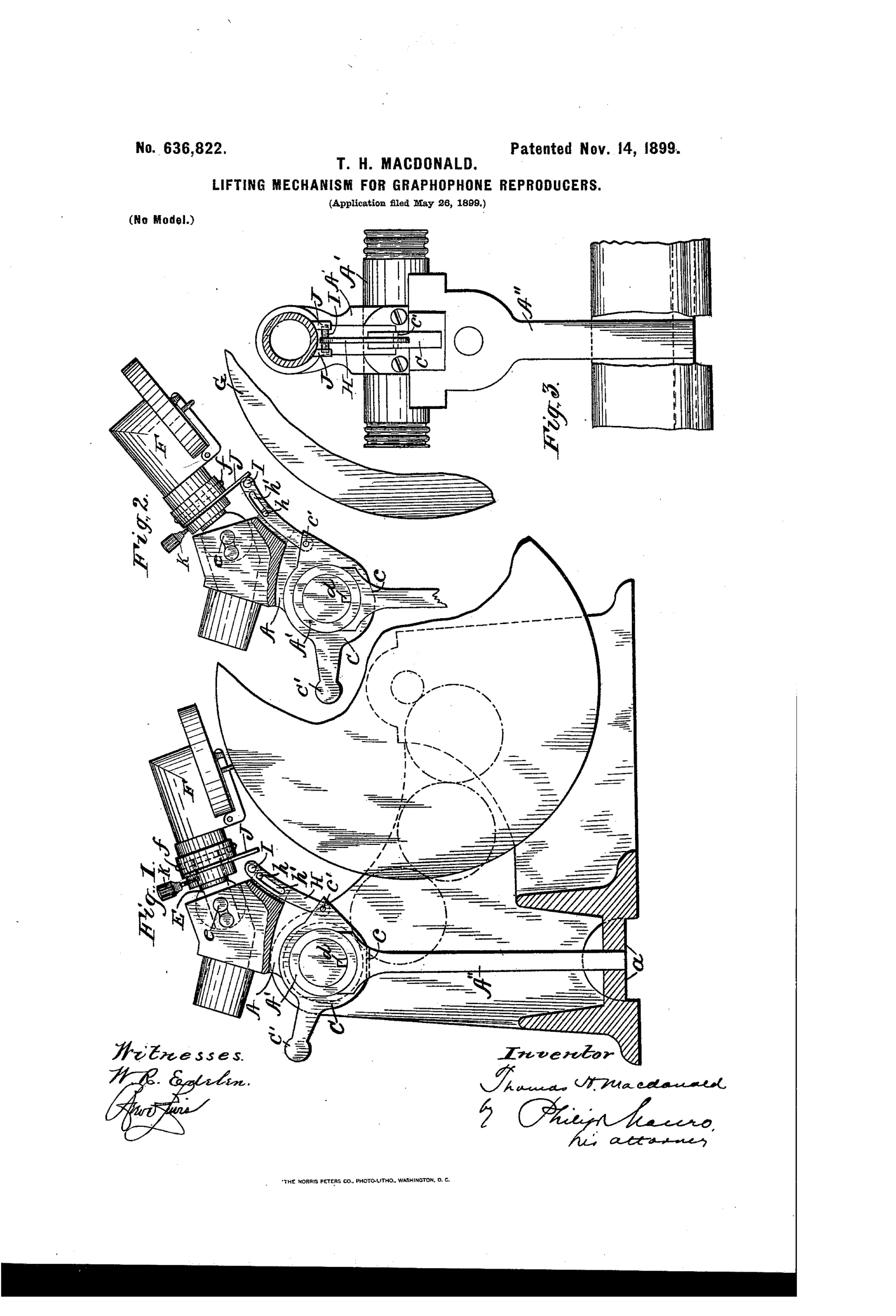
Lifting mechanism for graphophone sound reproducers.
♫ How it works
A stop-ring bearing a cam actuates a lifting plunger housed in the carriage. When the ring's handle is depressed, the cam forces the plunger upward so its transverse pin engages two parallel arms fastened to the reproducer-head. This raises the reproducer-head itself, rather than the intermediate tubular neck, supporting it directly at two points in the center of its lateral play. When the handle is released the reproducer-head is lowered truly and squarely back onto the sound-record without swinging to one side.
♫ What was claimed
“In a graphophone, the combination with the reproducer-carriage, the intermediate tubular neck secured thereto by a horizontal pivot, the reproducer-head engaging said neck by a substantially vertical pivot, and the stop-ring seated in the carriage, of a plunger actuated by said ring, two parallel arms depending from said reproducer-head, and a transverse pin in the end of said plunger adapted to engage with said arms to lift the reproducer-head and support it in the center of its lateral play, substantially as described.”
In plain English: The invention combines a carriage, pivoted neck, pivoted reproducer-head, and a ring-actuated plunger with pin-and-arm engagement so that lifting raises and centers the reproducer-head itself rather than just the neck.
♫ In the inventor’s words
“The reproducer-head being supported directly and at two points, there is no tendency for it to swing to either side, so that when handle C' is raised and the reverse of the operation just described takes place the reproducer is lowered truly and accurately upon the sound-record.”— Thomas H. Macdonald, from the specification
Manufactured and sold
Macdonald was American Graphophone's superintendent and his carriage and lifting patents fed directly into Columbia's production Graphophones of this period, which used cam-actuated reproducer lifts of this general design.
♫ Commentary
Thomas Macdonald was American Graphophone's chief mechanical mind, and this patent shows him sweating a detail most inventors of the era ignored: not how to lift the reproducer off the cylinder, but how to put it back down. The Graphophone reproducer hung from a double-pivoted joint — a horizontal pivot at the neck, a vertical pivot at the head — which gave it the floating compliance a wax cylinder demanded. The trouble is that a floating head, once lifted, swings. Lower it carelessly and the stylus lands off-center or skids across the groove.
His fix is quietly elegant. Instead of lifting at the neck, which leaves the head free to wander on its vertical pivot, a cam on the stop-ring drives a plunger whose transverse pin catches two parallel arms hanging from the reproducer-head itself. Two-point support, taken directly on the head, at the center of its lateral play — the swing is captured, not fought. Release the handle and the head descends 'truly and accurately upon the sound-record,' as the specification says without exaggeration.
Figures 1 and 2 show the same carriage lowered and lifted; compare the plunger position and you can read the whole geometry. This is refinement work, not invention from scratch — but it's exactly the kind of refinement that separated machines people could actually use from laboratory curiosities.
Commentary by Claude, The Talking Machine Patent Archive’s resident enthusiast