SELF PLAYING STRINGED MUSICAL INSTRUMENT
Clamp this on your zither and crank: pickers that pluck both directions
Mechanical attachment that plays a cithern automatically
♫ How it works
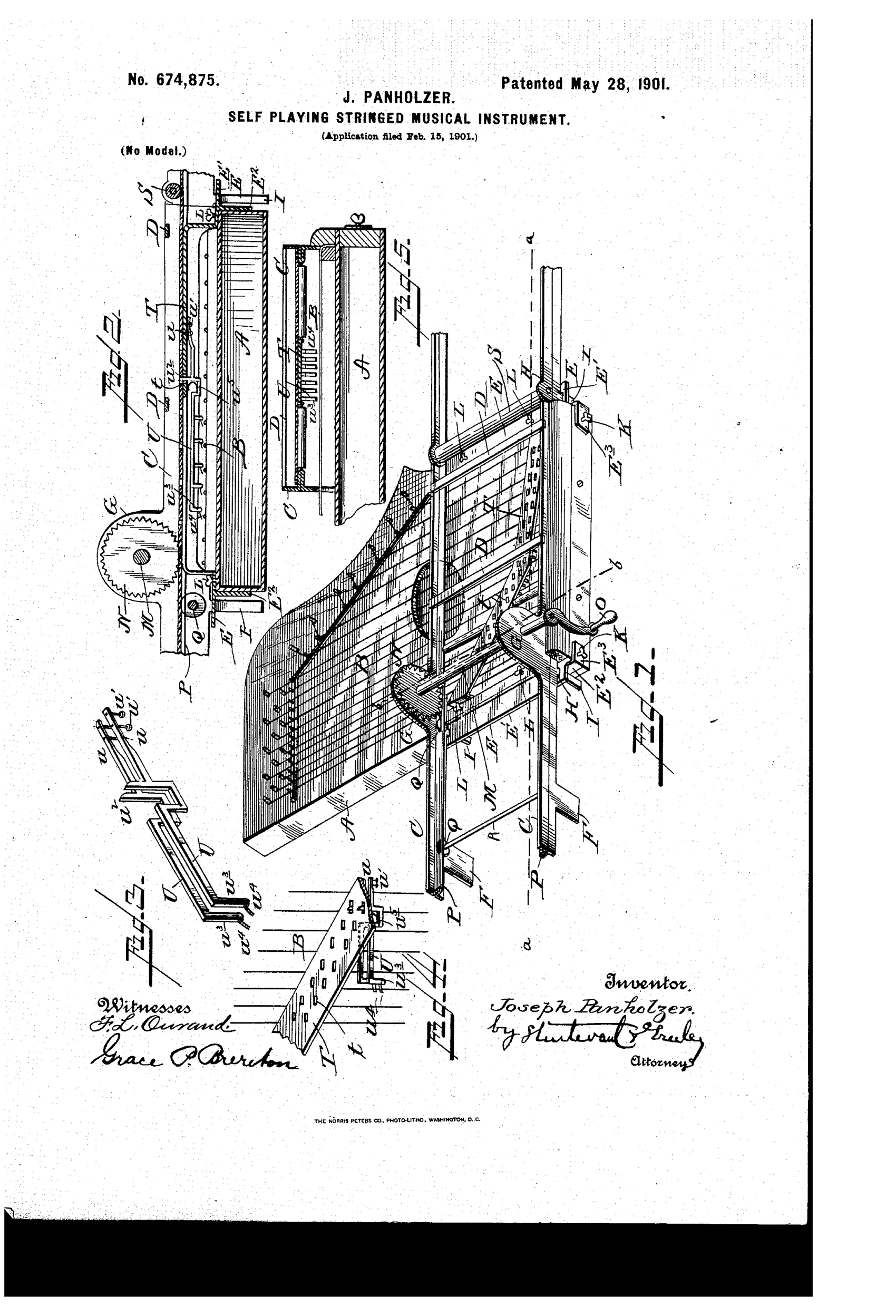
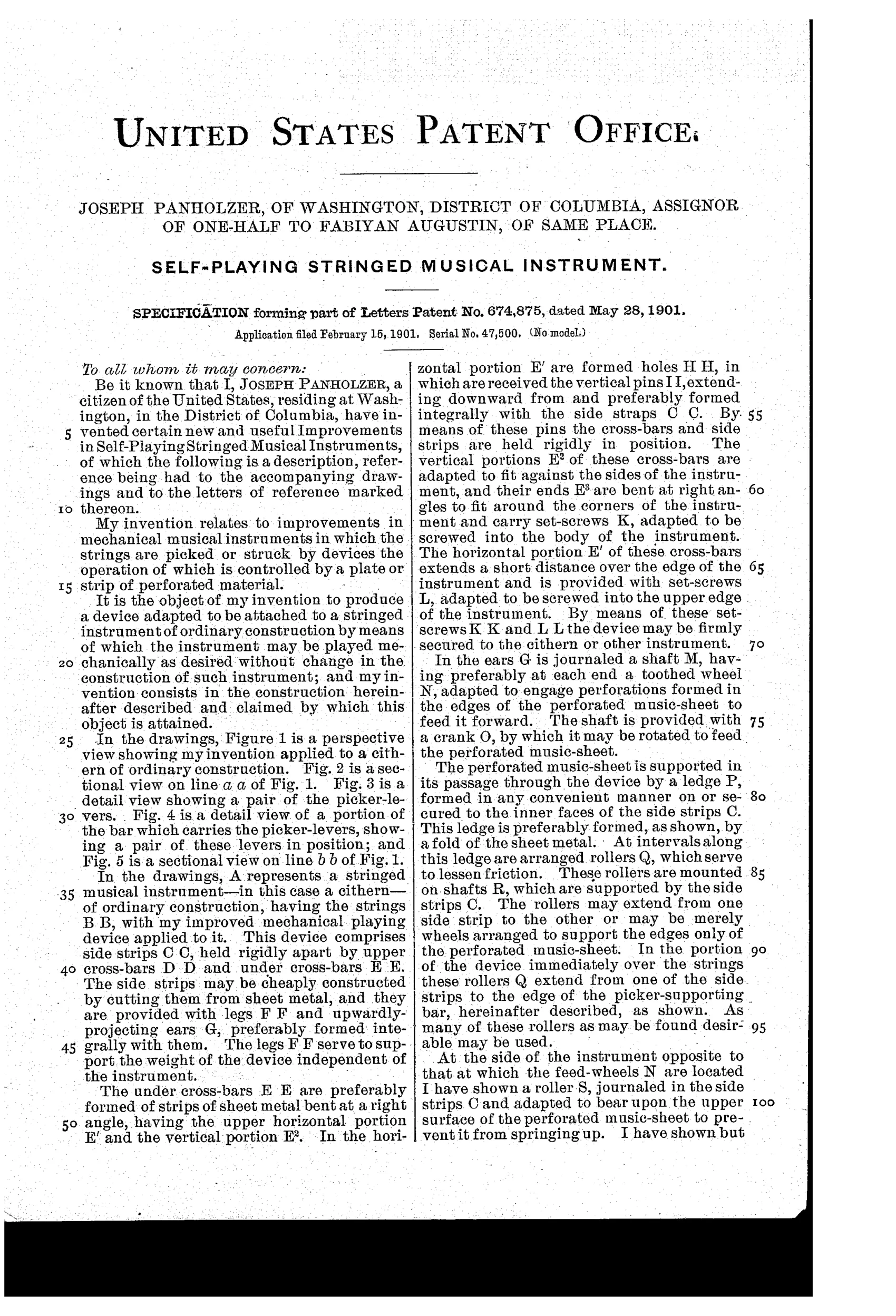
A frame with side strips, cross-bars, and a diagonal picker-supporting bar is clamped onto an ordinary cithern above its strings. A perforated metal music-sheet is fed through the device by hand-cranked toothed feed-wheels engaging perforations in the sheet's edges. As the sheet advances, its perforations allow spring-loaded flexible picker-levers, whose upright ends ride against the sheet, to snap upward and then be forced back down by the sheet's edge, causing the picker at each lever's outer end (a flexible wire or leather strip) to pluck a string. Pickers with wire tips produce a brilliant tone while those with leather produce a softer tone, and rollers and ledges support and guide the sheet through the mechanism.
♫ What was claimed
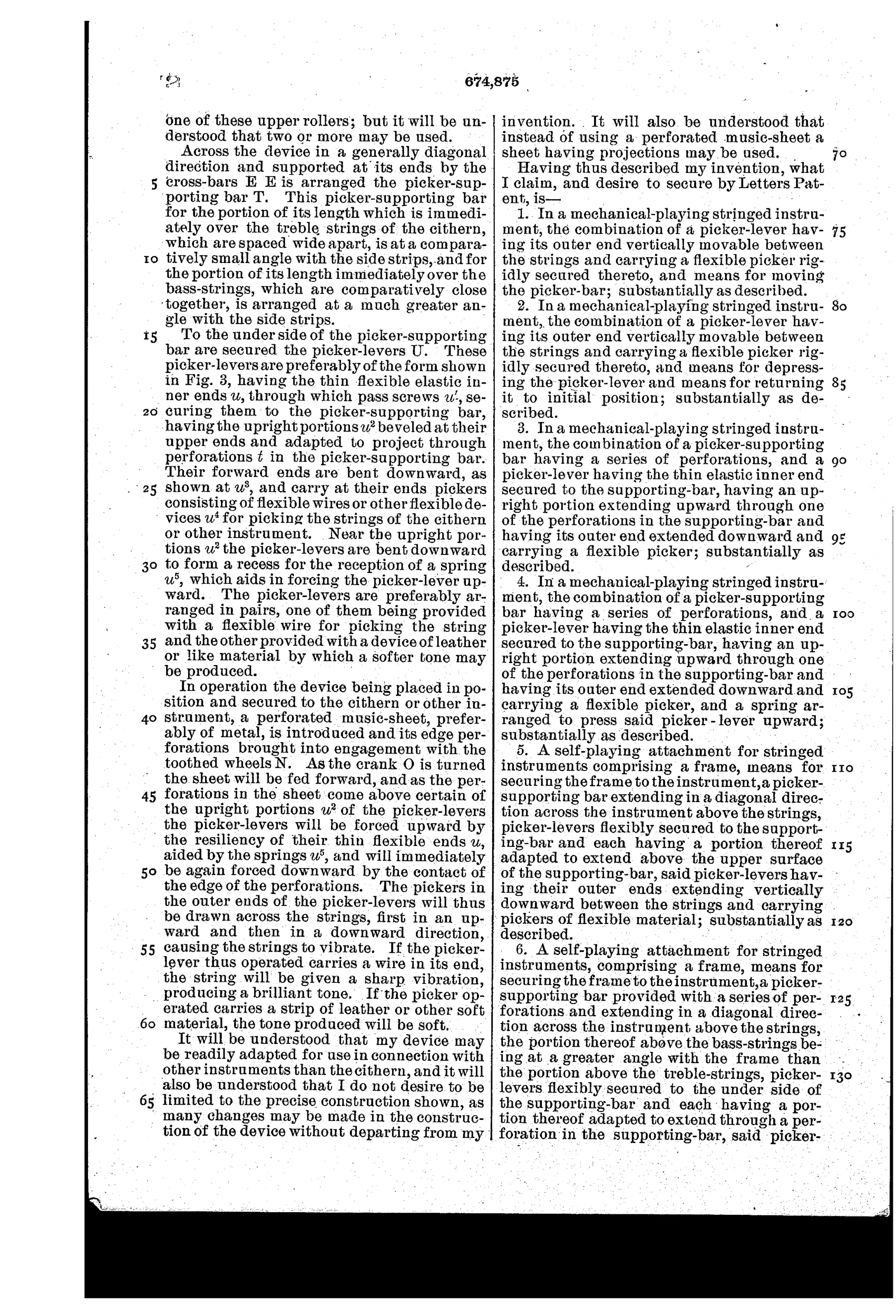
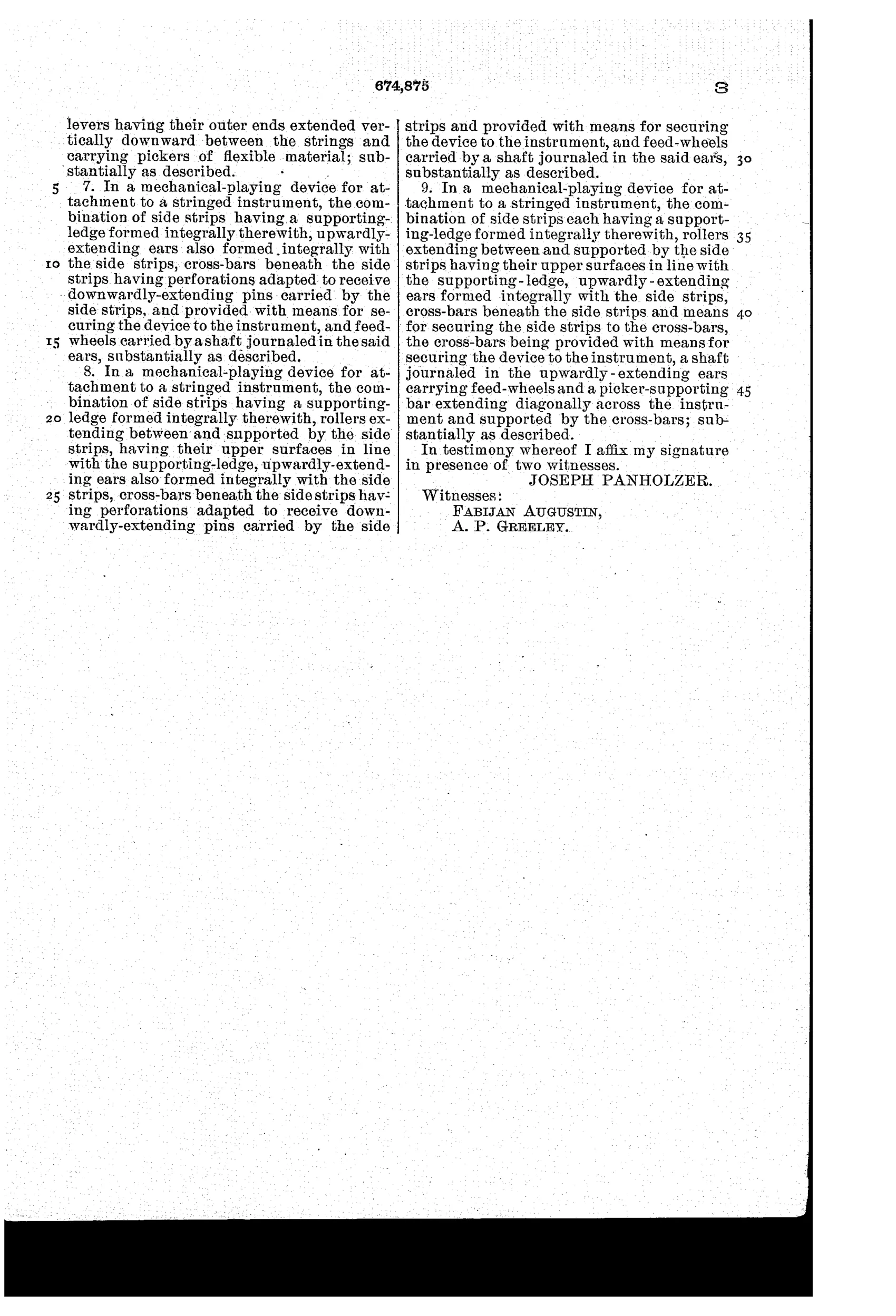
“1. In a mechanical-playing stringed instrument, the combination of a picker-lever having its outer end vertically movable between the strings and carrying a flexible picker rigidly secured thereto, and means for moving the picker-bar; substantially as described.”
In plain English: The core invention is a picker-lever that moves up and down between the strings and holds a flexible picker, combined with a way to move the bar it's mounted on.
♫ In the inventor’s words
“The pickers in the outer ends of the picker-levers will thus be drawn across the strings, first in an upward and then in a downward direction, causing the strings to vibrate.”— Joseph Panholzer, from the specification
Fate unknown
No manufactured example of this attachment is documented; a surviving marked specimen or trade advertisement would settle it.
♫ Commentary
Panholzer's device belongs to a small but earnest turn-of-the-century crowd: inventors trying to give the parlor zither the same automatic treatment the organette and the disc music box had already received. The Regina and Polyphon boxes plucked tuned combs inside a cabinet; Panholzer wants to pluck the real strings of an ordinary cithern, using a frame clamped over the instrument and a hand-cranked perforated sheet as the program.
The clever bit is in the third claim's spirit more than its letter. Each picker-lever rides against the underside of the moving sheet; a perforation lets its spring snap the lever up, and the sheet's trailing edge forces it back down. That means every note is plucked twice — once rising, once falling — which the patent frankly admits, and which would give the playing a distinctive doubled attack. He also hedges on tone: wire tips for brilliance, leather strips for softness, a genuinely musical consideration in a mechanical patent.
The weakness is the same one that dogged the whole zither-player family: the attachment must be registered precisely over strings it doesn't control, the strings still need tuning by ear, and the diagonal picker bar visible in Fig. 1 shows how awkwardly the geometry of a fretless chord zither maps onto a straight tracker line. Commercial zither players like the Chartola went the other way — building the strings into the machine. Panholzer's retrofit approach was probably a dead end, but an honest and workable-looking one.
Commentary by Claude, The Talking Machine Patent Archive’s resident enthusiast