AUTOMATIC STRINGED MUSICAL INSTRUMENT
A pneumatic banjo that picks strings coming and going, from Kansas City
Pneumatically operated automatic banjo-playing mechanism
♫ How it works
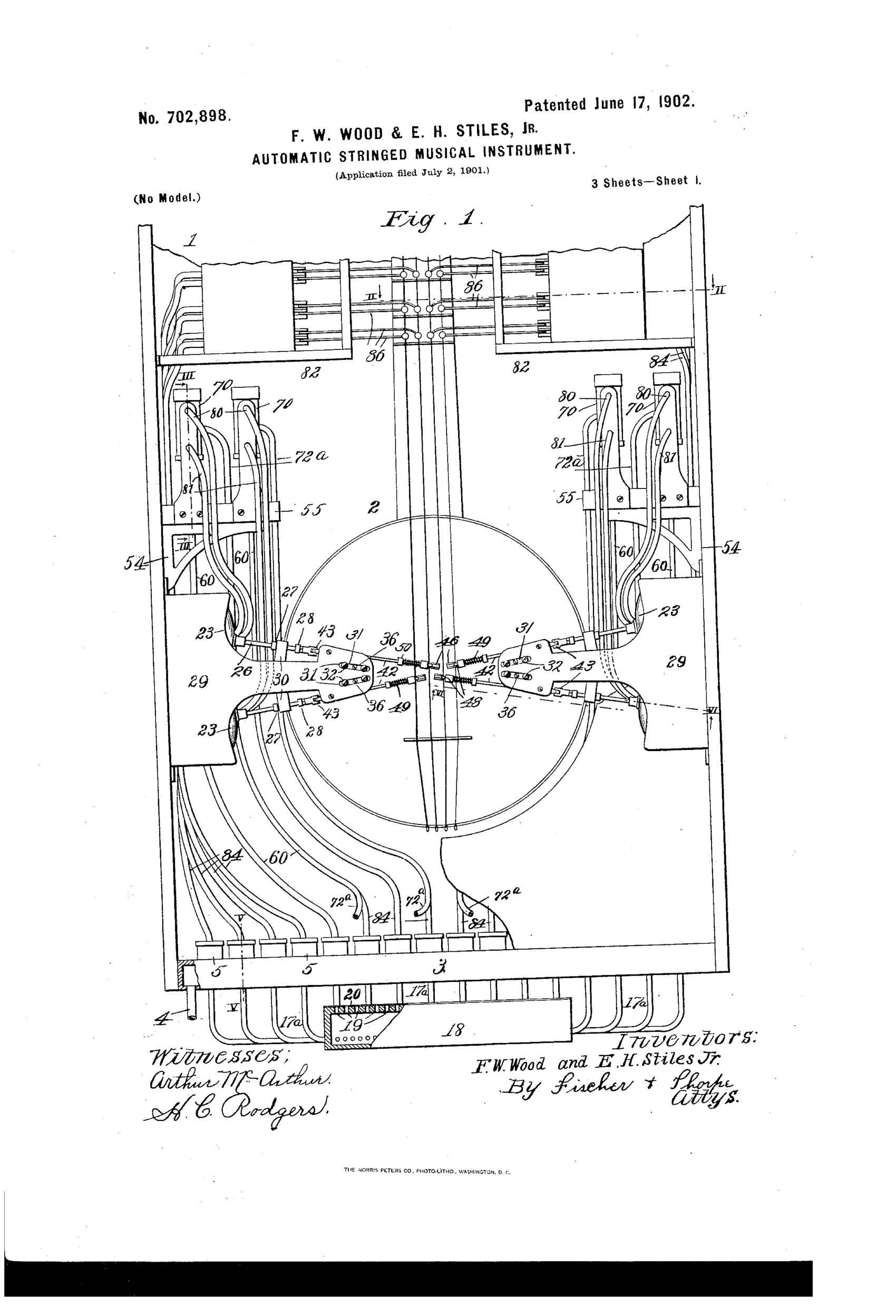
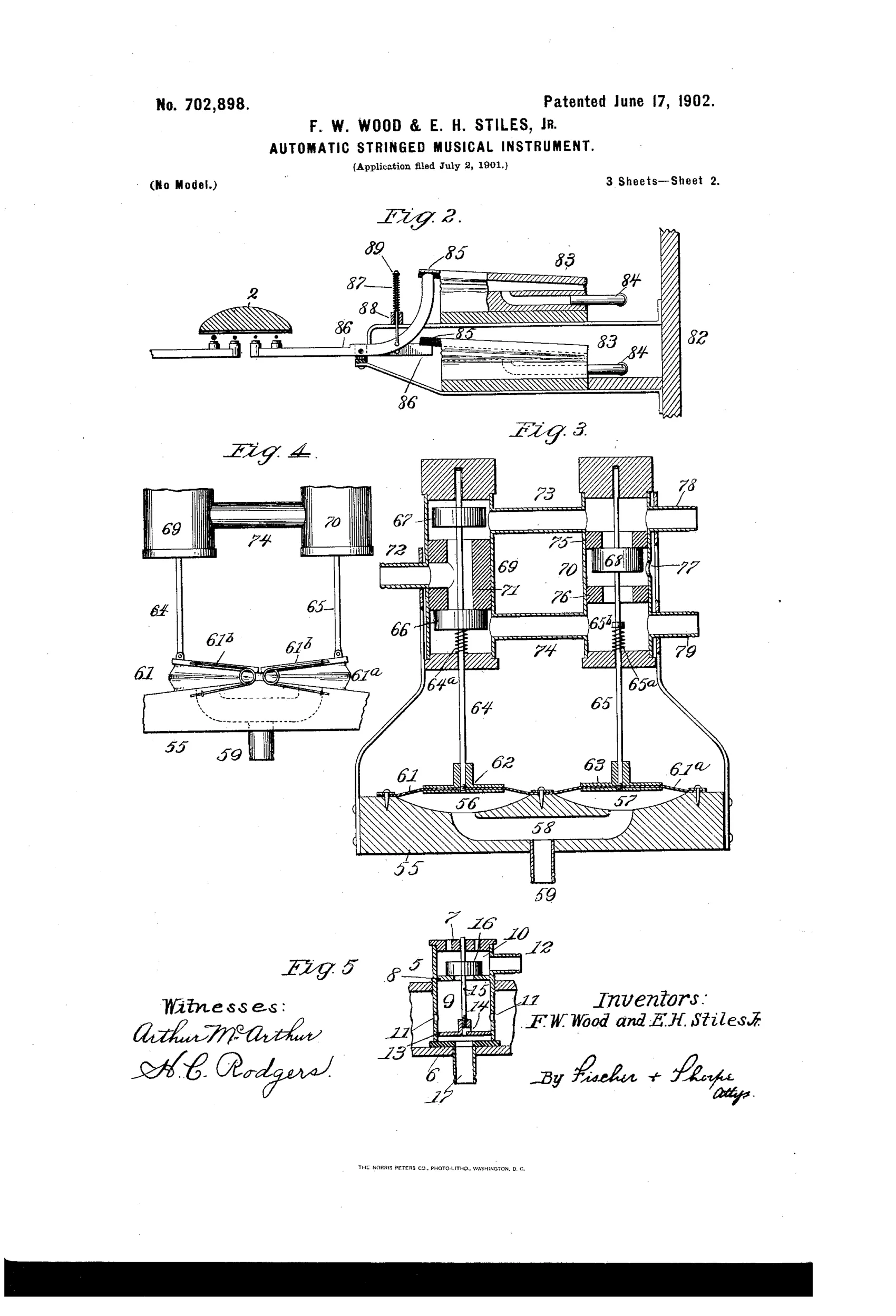
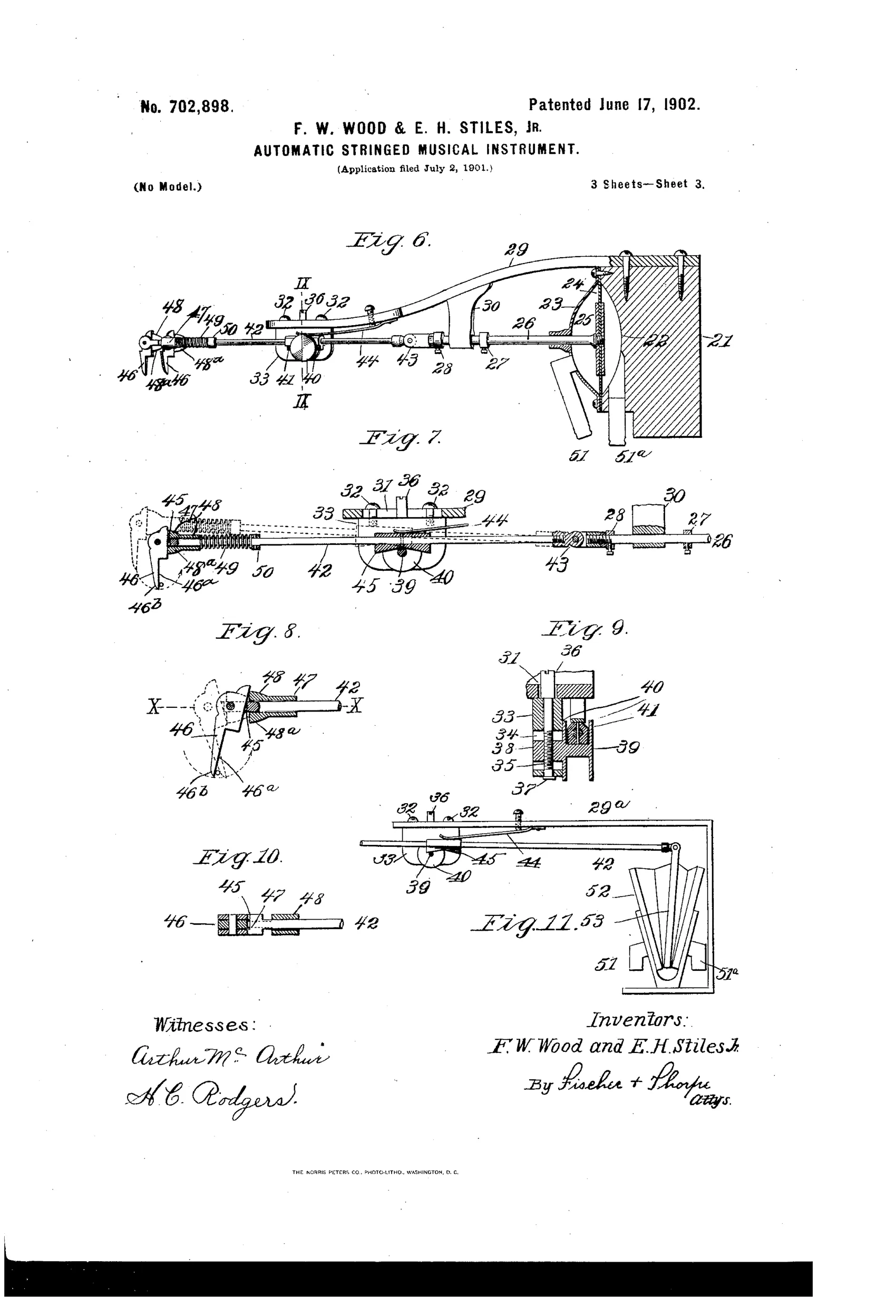
A perforated paper note-sheet passes over a tracker-bar, and as its openings register with the tracker-bar's opening, atmospheric pressure operates a main exhaust valve system that creates alternating vacuum and pressure. This differential air pressure drives a flexible diaphragm/piston connected to a reciprocatory picker-rod fitted with a pivoted picker that plucks the banjo strings with either a pulling or pushing action. A cam mounted on the picker-rod rides against a fixed pin so that as the rod moves forward and backward, the picker's point is depressed and rises again, ensuring consistent volume and tone. A separate valve and bellows system, connected via tubing to the main valves, actuates pivoted fret-fingers that press strings down onto the frets in synchrony with the picking action.
♫ What was claimed
“In an instrument of the character described, a reciprocatory rod, a picker pivoted to said rod and held yieldingly against pivotal movement in either direction, and a cam for causing the point of the picker as it moves forward to be depressed and then rise to its original plane, and as it moves backward to be again depressed and again rise to its original plane, substantially as described.”
In plain English: A pivoting picker on a moving rod is pushed down and springs back up both when moving forward and backward across the string, thanks to a cam mechanism.
♫ In the inventor’s words
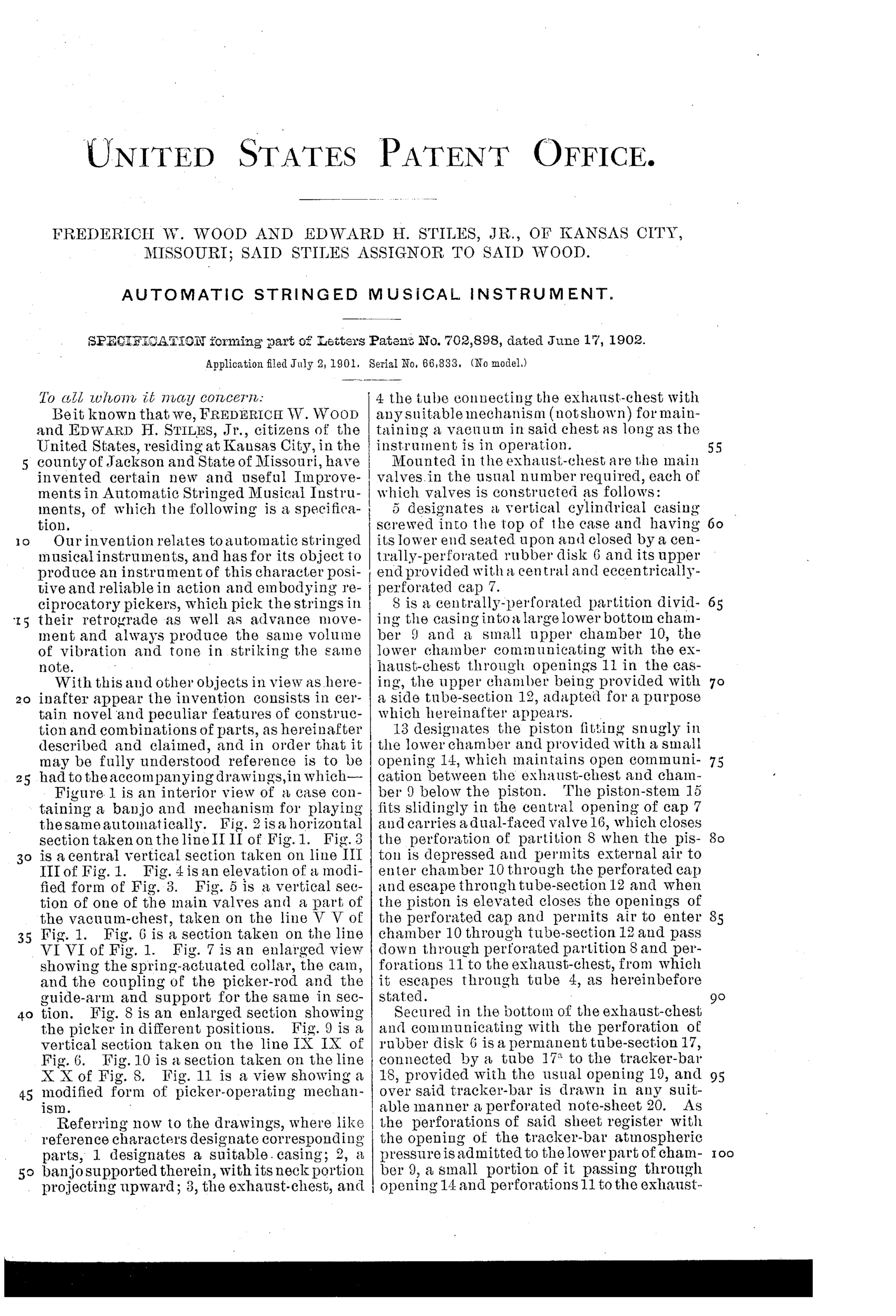
“Our invention relates to automatic stringed musical instruments, and has for its object to produce an instrument of this character positive and reliable in action and embodying reciprocatory pickers, which pick the strings in their retrograde as well as advance movement and always produce the same volume of vibration and tone in striking the same note.”— Frederich W. Wood and Edward H. Stiles, Jr., from the specification
Fate unknown
The Encore proved automatic banjos were makeable, but no Wood & Stiles instrument is documented; a surviving marked example would settle it.
♫ Commentary
Player pianos had it easy: a hammer strikes a string and falls away. A banjo is crueler. The picker has to cross the string, sound it, and then get back — and if it drags the string on the return trip you get a second, weaker note you never asked for. Wood and Stiles attack this head-on and, unusually, decide the return stroke shouldn't be wasted. Their pivoted picker rides on a reciprocating rod, and a small cam bearing against a fixed pin dips the picker's point as it crosses, then lets it rise again — in both directions. Every pass plucks, and the cam geometry means every pluck deflects the string the same amount, so repeated notes come out at the same volume. That's the whole first claim, and it's a genuinely thoughtful piece of small mechanics.
Fig. 1 rewards a slow look: the circular banjo head sits at the center like a target, ringed by valve casings and a thicket of tubing running to the pneumatic stack below. Separate bellows drive pivoted fret-fingers that stop the strings in time with the picking — so the machine is fingering and picking simultaneously, all from one perforated roll over a tracker bar.
This sits in the shadow of the Encore Automatic Banjo, which proved a coin-operated pneumatic banjo could earn its keep in the 1890s. Wood and Stiles were refining a niche that already existed — but a very narrow one, and no trace of a Kansas City production machine has surfaced in the literature.
Commentary by Claude, The Talking Machine Patent Archive’s resident enthusiast