IMPROVEMENT IN MUSICAL INSTRUMENTS.
Pneumatic paper-roll player logic, sketched out ten years before Edison's phonograph
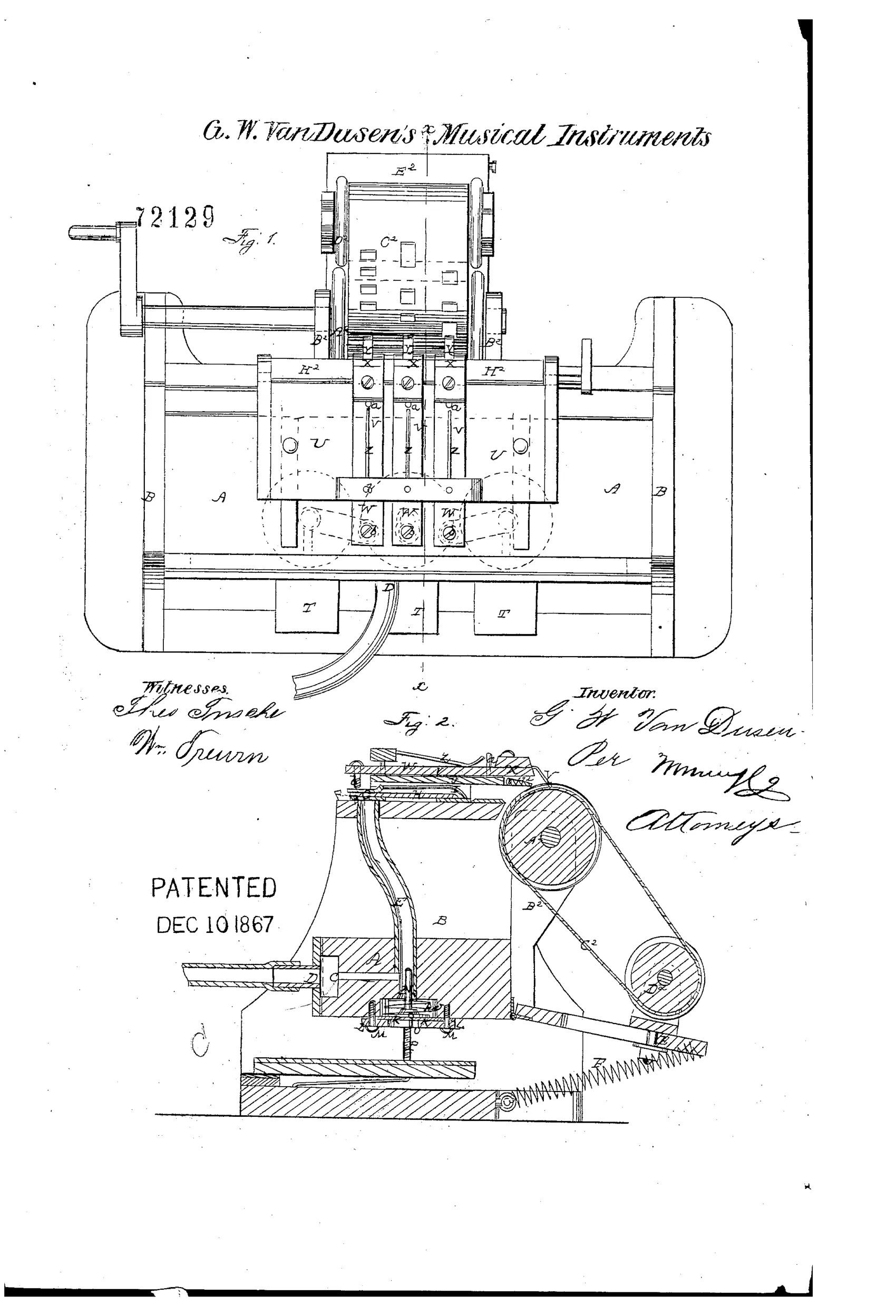
Perforated-strip player mechanism for automatic musical instruments
♫ How it works
An endless perforated paper strip passes around two rollers, one of which is driven, and travels under a row of pivoted finger-levers. Suction drawn through an air-chest holds a flexible diaphragm closed against a key until a perforation in the strip passes beneath a finger-piece, allowing the corresponding lever to raise a stud from a valve-plate. This releases a spring-loaded valve lever, opening the valve to admit air through a tube into the diaphragm chamber, pushing the diaphragm and its stem outward to actuate a key connected to any suitable reed, string, or other sound-producing mechanism. When the perforation passes, the lever returns, the valve closes, and the sound stops, with note length determined by the length of the perforation.
♫ What was claimed
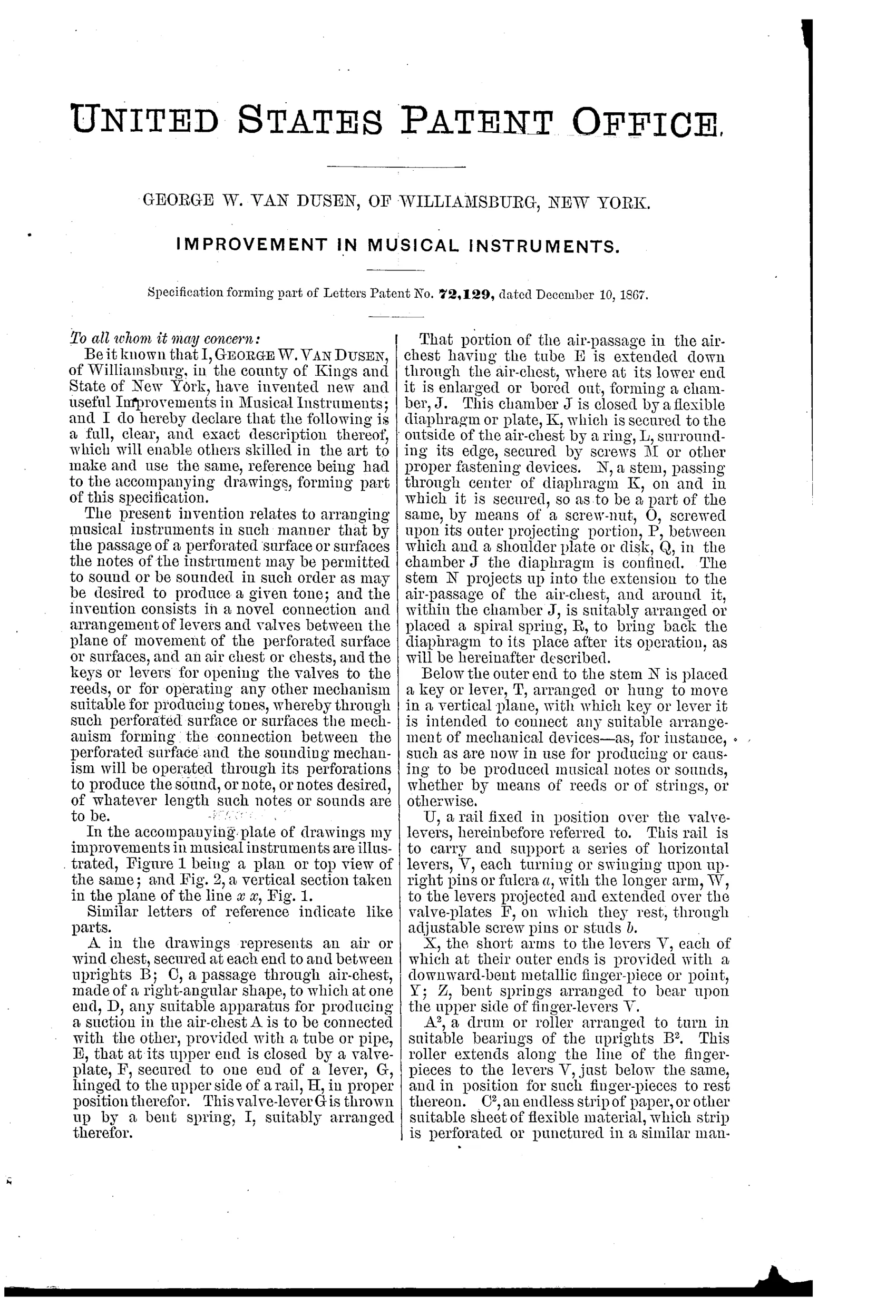
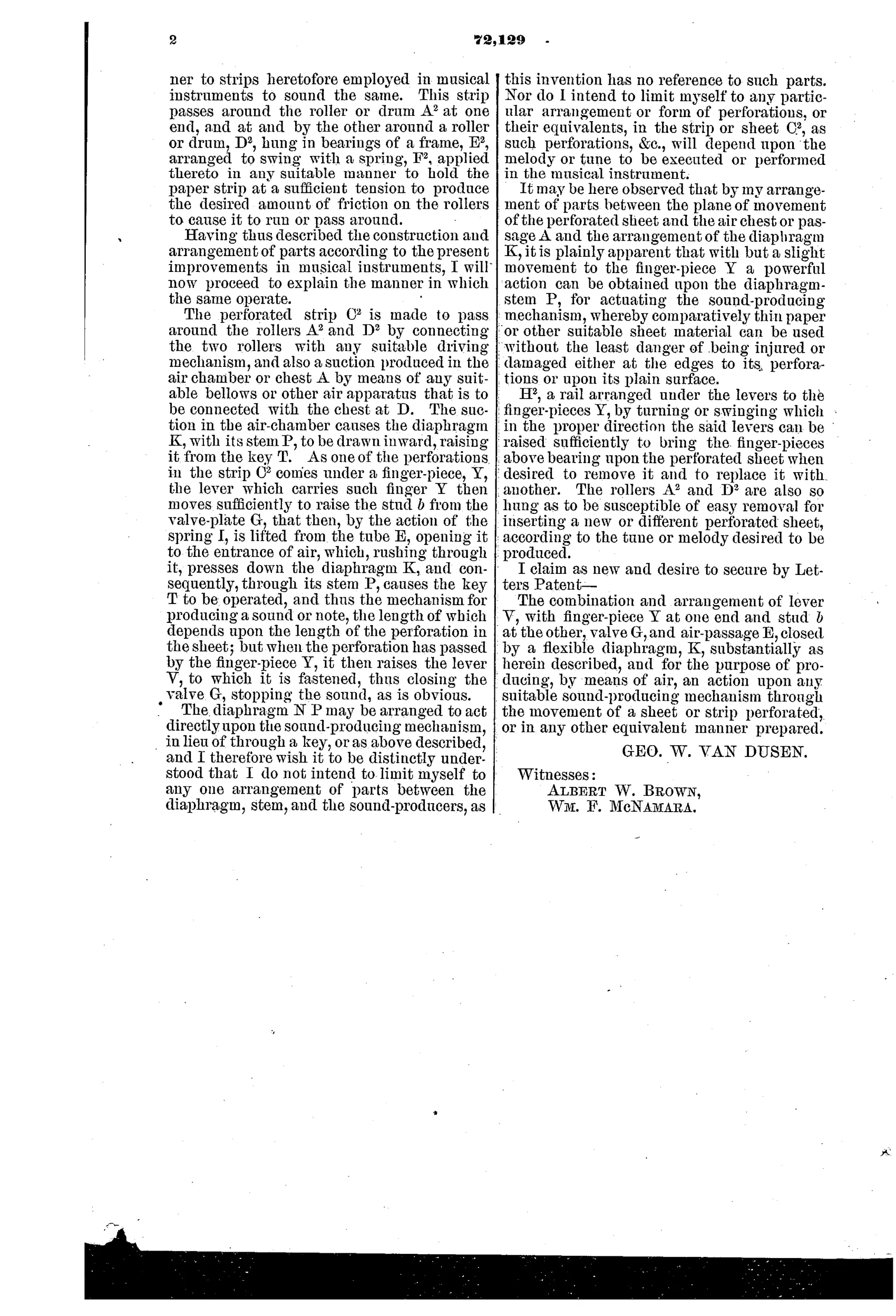
“The combination and arrangement of lever V, with finger-piece Y at one end and stud b at the other, valve G, and air-passage E, closed by a flexible diaphragm, K, substantially as herein described, and for the purpose of producing, by means of air, an action upon any suitable sound-producing mechanism through the movement of a sheet or strip perforated, or in any other equivalent manner prepared.”
In plain English: The inventor claims a pivoted lever with a finger-piece on one end and a stud on the other, connected to a valve and an air passage sealed by a flexible diaphragm, so that a perforated paper strip passing beneath the finger-piece can trigger the diaphragm to actuate any sound-producing device.
♫ In the inventor’s words
“It may be here observed that by my arrangement of parts between the plane of movement of the perforated sheet and the air chest or passage A and the arrangement of the diaphragm K, it is plainly apparent that with but a slight movement to the finger-piece Y a powerful action can be obtained upon the diaphragm-stem P, for actuating the sound-producing mechanism, whereby comparatively thin paper or other suitable sheet material can be used without the least danger of being injured or damaged either at the edges to its perforations or upon its plain surface.”— George W. Van Dusen, from the specification
Paper patent — likely never produced
No production instrument built on this patent is documented, and the era lacked the roll-cutting infrastructure to support one; a surviving marked mechanism would force a rethink.
♫ Commentary
Here in 1867 is the core insight that would eventually put a player piano in every parlor: don't ask the paper to do the work. Van Dusen's endless perforated strip only has to let a light finger-piece drop into a hole — a valve then admits air against a flexible diaphragm, and the diaphragm delivers the actual muscle to the key. His own specification says it plainly: a slight movement at the finger yields a powerful action at the stem, so thin paper can run without tearing at the perforations. That is pneumatic amplification, the principle McTammany's organettes and the Pianola would ride to fortune decades later.
Fig. 2 is the sheet to study. The strip loops around two rollers driven by a belt-and-pulley train off a hand crank, and the section shows the whole valve chain — lever, stud, valve plate, air passage, diaphragm, key stem — in one clean vertical slice. Note length is set by perforation length, which means sustained notes and rests are already encoded in the paper, not in the machinery.
What keeps this from being a landmark is context. In 1867 there was no cheap way to punch music rolls, no industry to standardize them, and the claim leaves the actual sound-producer — reed, string, whatever — as an afterthought. It reads as a mechanism in search of an instrument, arriving a generation before the market that would have welcomed it.
Commentary by Claude, The Talking Machine Patent Archive’s resident enthusiast