PNEUMATICALLY-ACTUATED MUSICAL INSTRUMENT
The Pianola's inventor teaches a pipe organ to divide solo from accompaniment
Pneumatic player-organ mechanism reading perforated music-sheets
♫ How it works
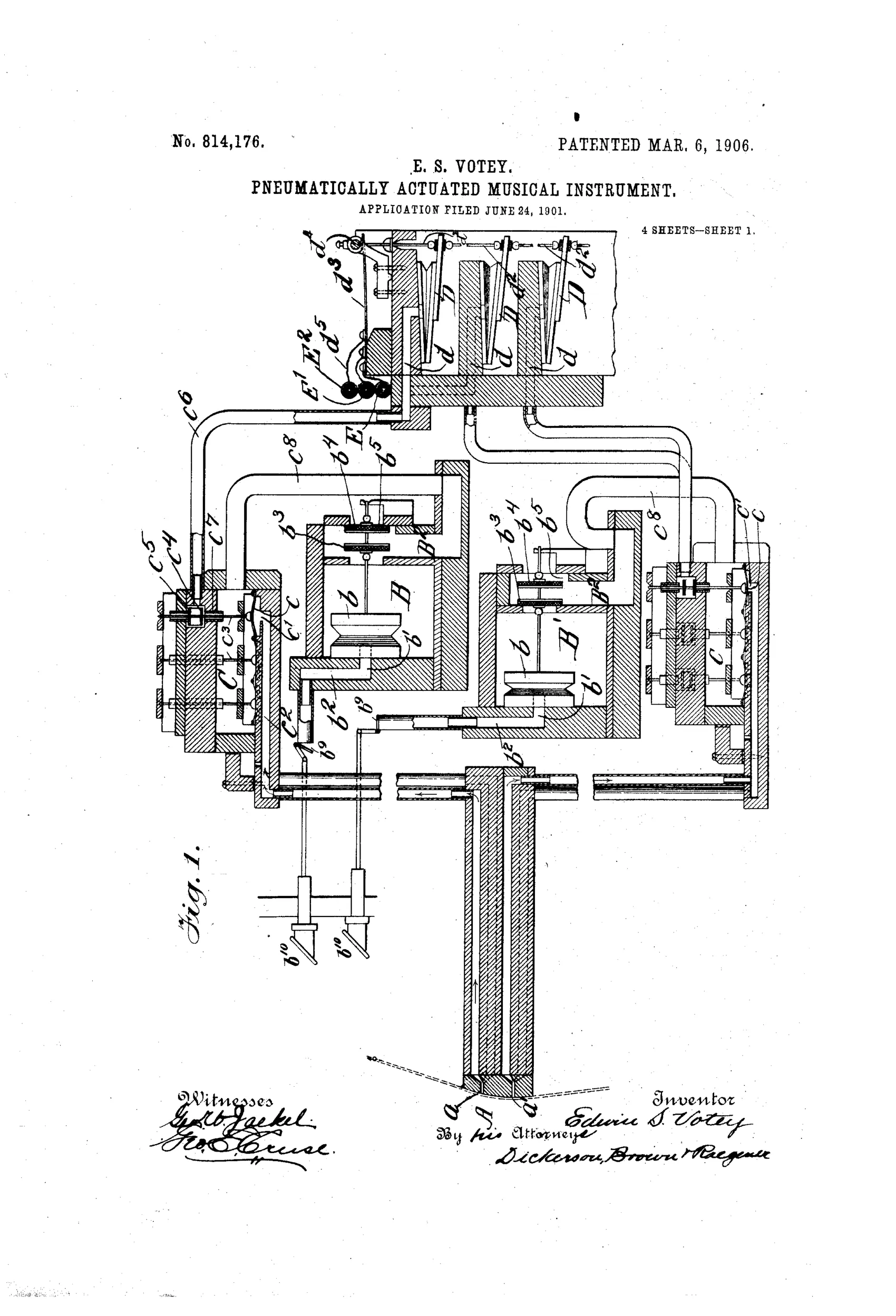
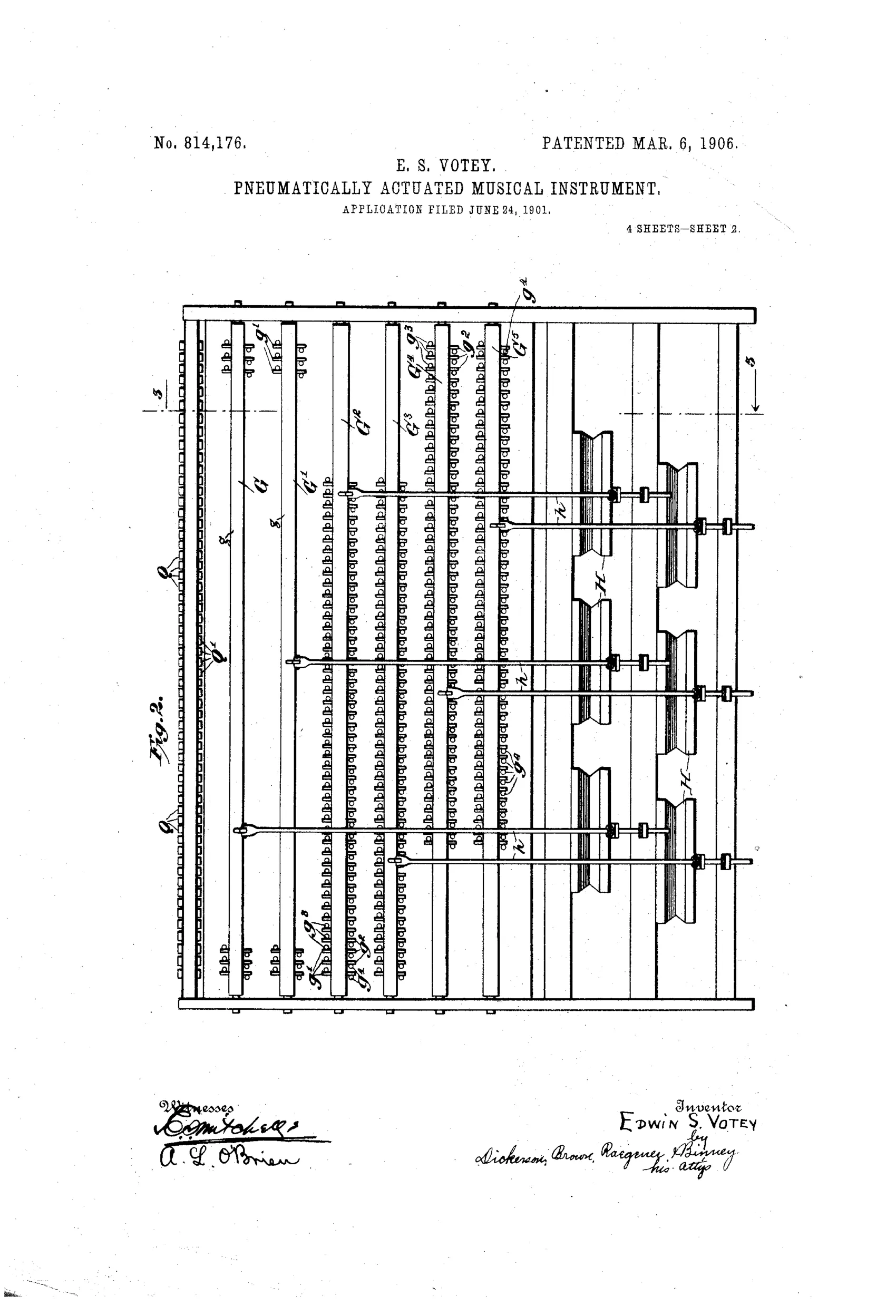
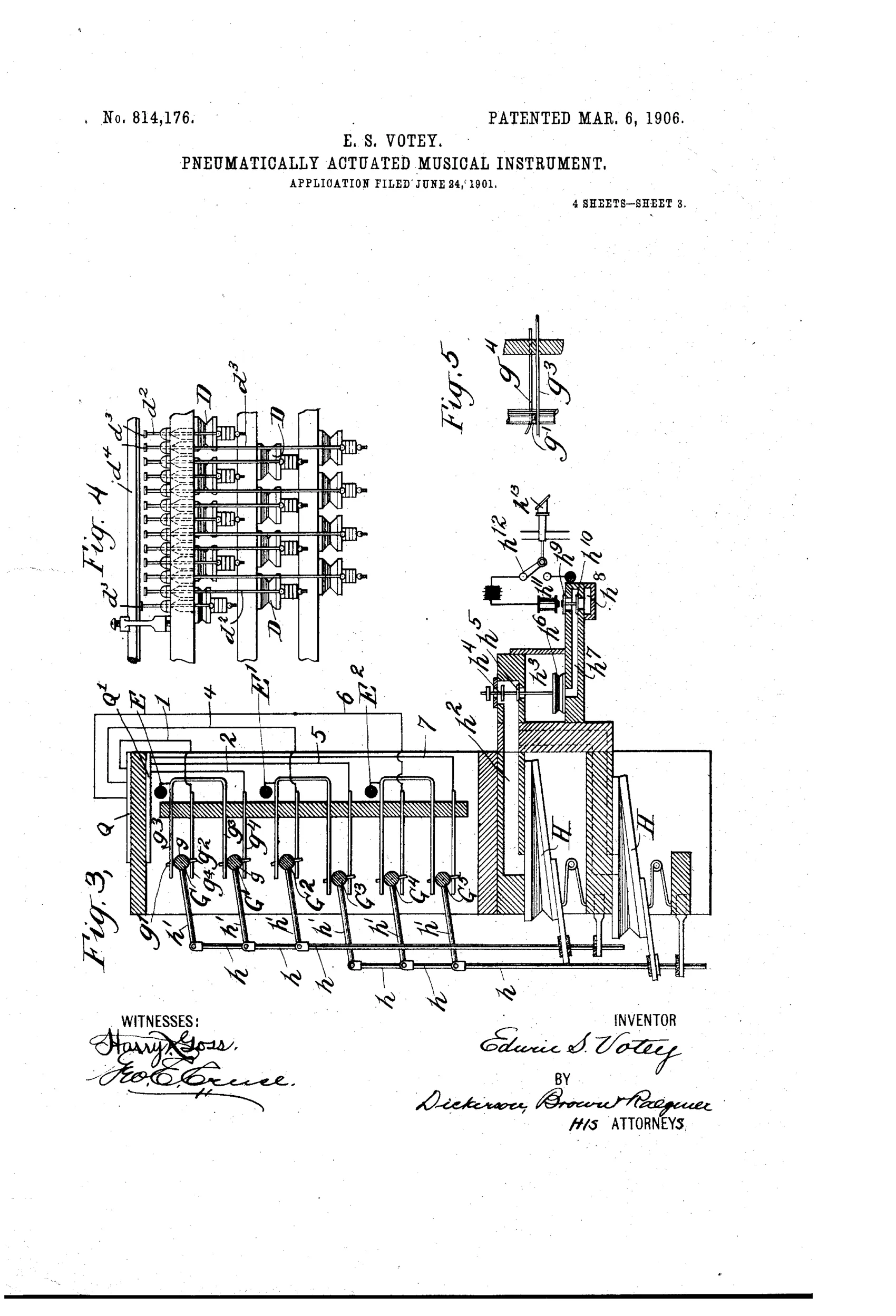
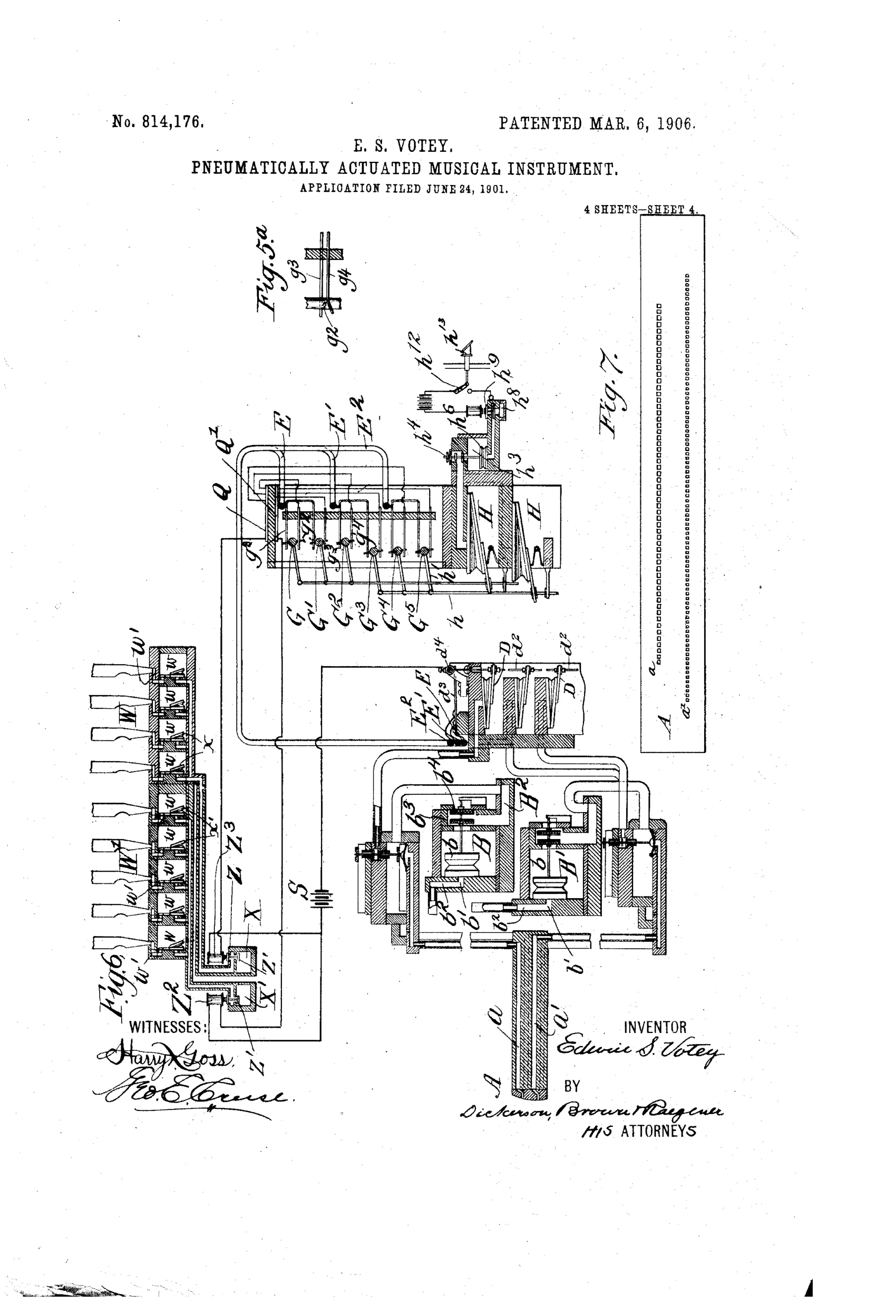
A double tracker-board with two staggered sets of ducts reads a perforated music-sheet, admitting air to actuate diaphragms and pneumatics that operate pallets controlling the wind supply to the swell and great organ pipes. Contacts and switches (G, G', G2-G5) route electrical circuits from the tracker-board's contact fingers through junction-plates to electromagnets that further control pallets governing exhaust chests and wind ducts. A separate switch device with rotating bars and contact points allows selective coupling of solo and accompaniment sections of the lower tracker-holes to either or both sets of organ pipes. Pneumatics H, actuated via passages and exhaust chests, rotate the switch bars to complete or break these circuits, enabling the organ to be played automatically with the same tonal effects as manual key operation.
♫ What was claimed
“The combination of the tracker-board having two sets of tracker-holes, two or more sets of sound-producing devices, and connections for playing them from either of said sets of tracker-holes, one of the said sets of tracker-holes having solo and accompaniment sections and connections for connecting either section at will to either or both said sets of sound-producing devices, for substantially the purposes set forth.”
In plain English: A tracker-board with two sets of holes can play two sets of organ pipes, and one of the hole-sets is split into solo and accompaniment parts that can be wired to either or both pipe sets.
♫ In the inventor’s words
“My invention is particularly adapted to organs comprising a plurality of sets of manual-keys, by means of which different sets of pipes comprised therein—as, for example, swell-organ, great organ, &c.—may be played; and the object of my invention is to provide mechanisms for such organs under the control of a perforated music-sheet, whereby such an organ may be played to obtain any and all effects obtained by its operation through the manual-keys thereof.”— Edwin S. Votey, from the specification
Manufactured and sold
Votey's work for Aeolian fed directly into their commercially produced player pipe organs, which used solo/accompaniment roll division of this kind, though matching a surviving instrument to this exact claim would take examination.
♫ Commentary
Edwin Votey is the man who built the Pianola in 1895, and by 1901 he was applying the same pneumatic logic to a much harder problem: the pipe organ. A piano has one keyboard and one dynamic mechanism. An organ has multiple manuals, multiple ranks of pipes, and its expression lives entirely in registration — which pipes speak, and when. A roll that plays every note through one channel flattens all of that. Votey's answer is a double tracker-board with staggered duct rows, plus a hole-set split into solo and accompaniment sections that can be routed to either or both divisions.
The interesting part is the routing itself. Rather than doing everything with wind, Votey uses tracker-bar contact fingers feeding electromagnets, with pneumatics rotating switch bars to make and break circuits. This electro-pneumatic hybrid — pneumatics for the muscle, electricity for the logic — is exactly where organ building as a whole was headed, and it lets a melody line jump from swell to great mid-piece without touching the roll.
Fig. 1 rewards a close look: the cascade from tracker duct through diaphragm to pallet is the classic two-stage pneumatic amplifier, small signal opening big wind. This is a refinement, not a first, but it is the kind of refinement that separated a mechanical curiosity from an instrument a musician would take seriously. Aeolian built its residence-organ empire on precisely this capability.
Commentary by Claude, The Talking Machine Patent Archive’s resident enthusiast