PNEUMATIC CONTROLLER FOR MECHANICAL PIANO-PLAYERS
Motor suction meets foot treadles — a hybrid drive for the player piano
Blower/exhaust valve controller for player pianos
♫ How it works
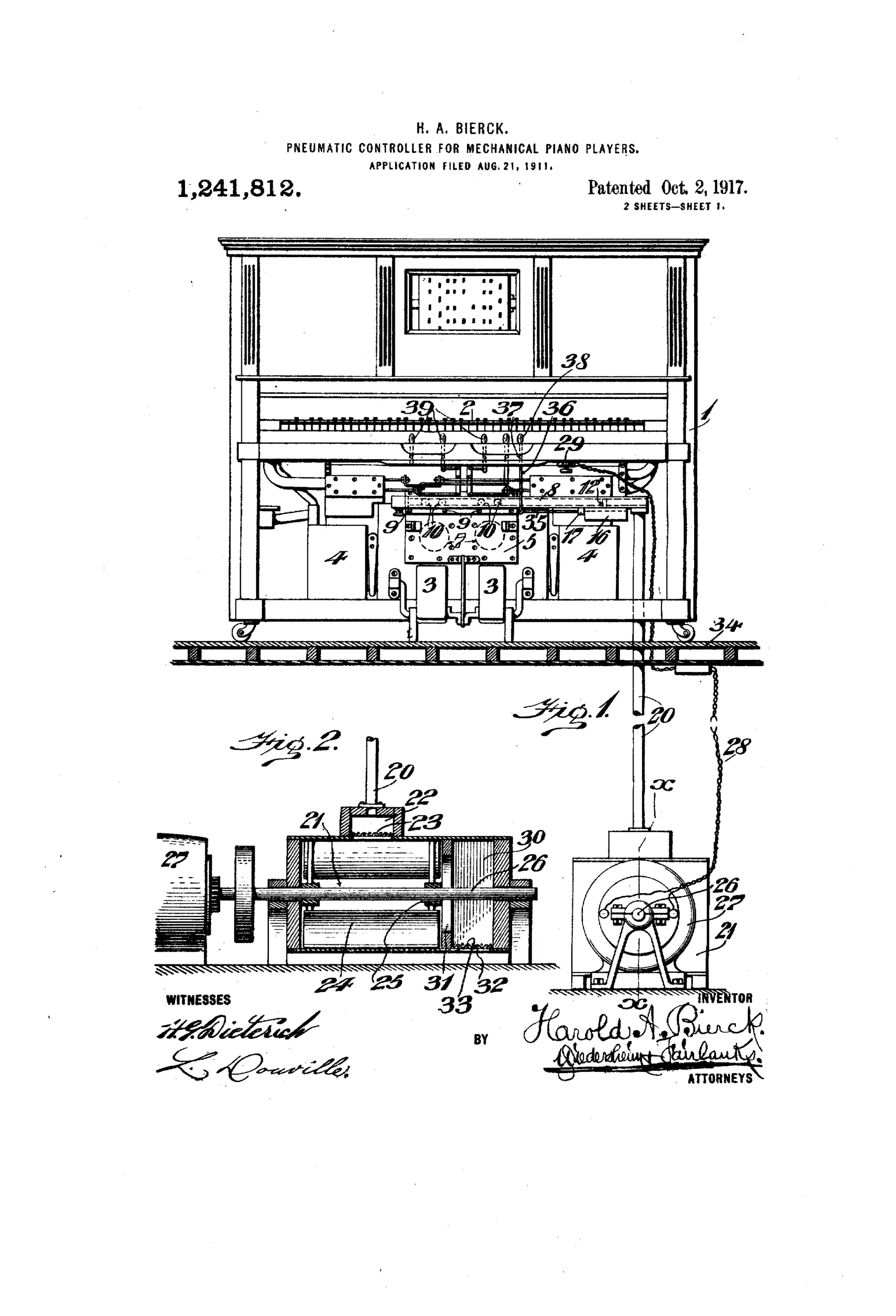
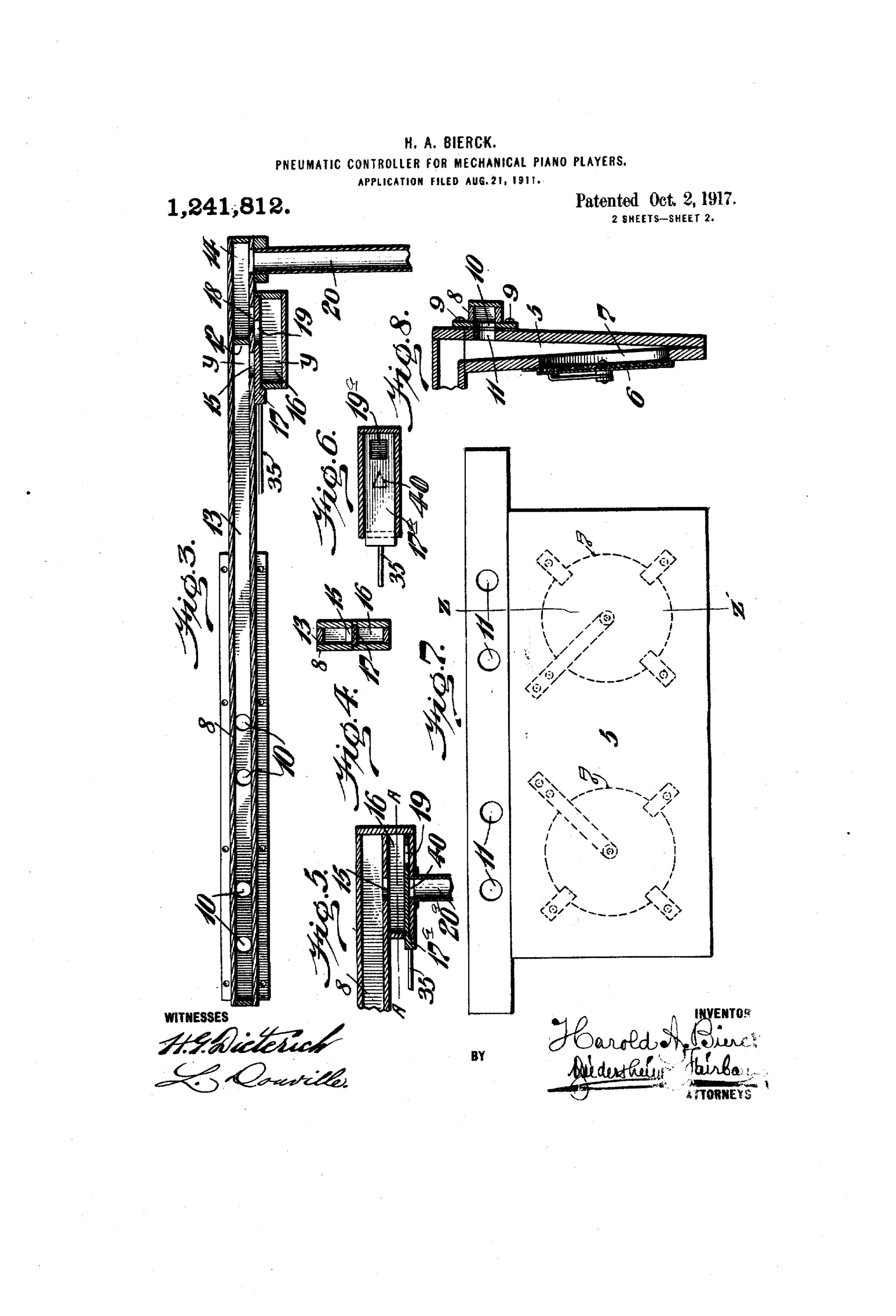
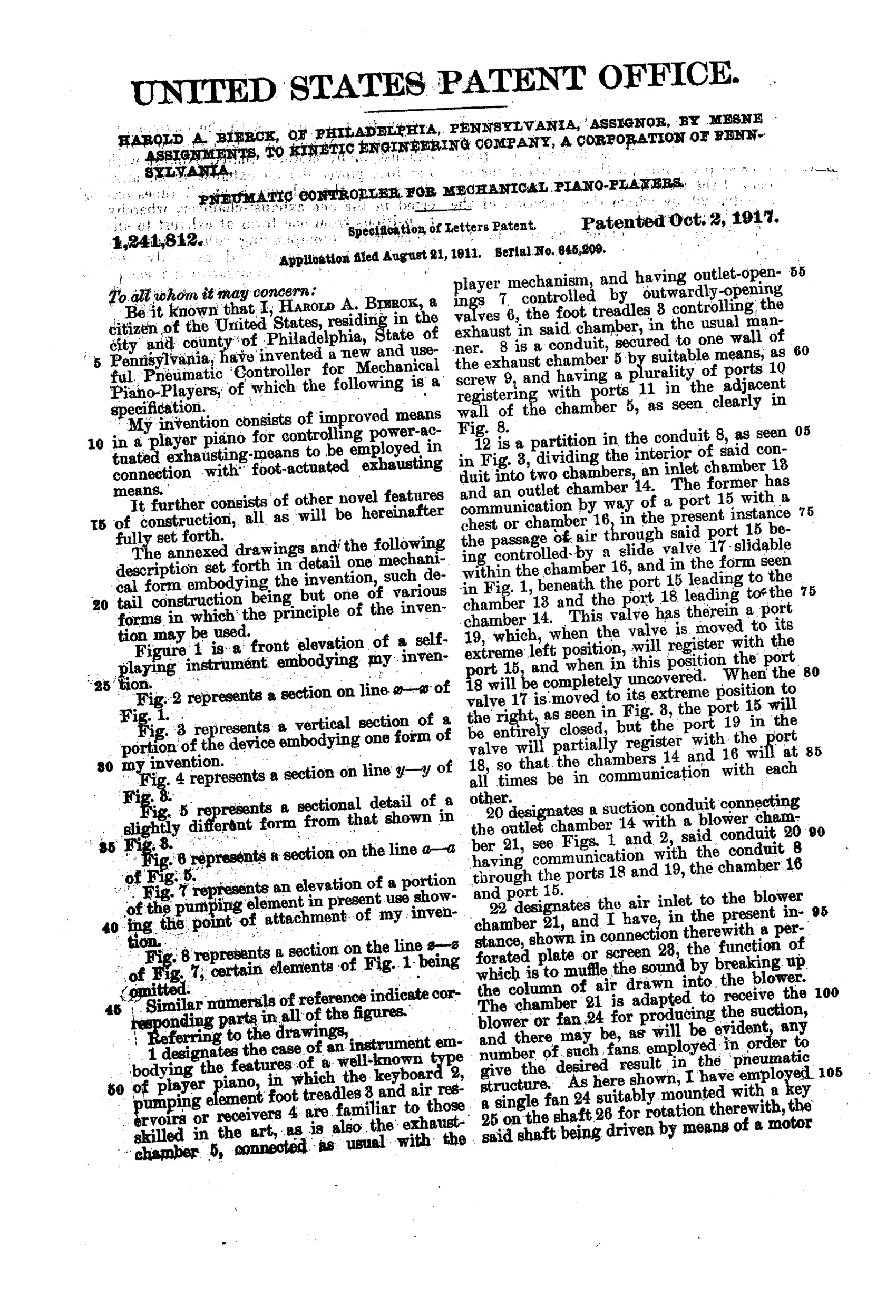
A slide valve within a conduit selectively connects a motor-driven blower's suction chamber to the piano's foot-actuated exhaust chamber, allowing smooth transition between foot power and motor power. The valve has a port that can register with, partially overlap, or fully uncover ports leading to inlet and outlet chambers, regulating airflow. A hand lever near the keyboard shifts the valve rod to control this transition, while perforated screens over the blower's inlet and outlet muffle fan noise. When power-driven exhaust is engaged, foot pumping is cut off, preventing air leakage through the bellows and reservoirs.
♫ What was claimed
“In a device of the character stated, a blower chamber, an outlet chamber, a suction conduit connecting said chambers, an exhaust chamber, a conduit communicating with said exhaust chamber, a slide valve having a port controlling the communication between the suction conduit and the conduit communicating with the exhaust chamber, the said outlet chamber having a port adapted to overlap the port in the slide valve when the latter is in one of its extreme positions.”
In plain English: A sliding valve with a port controls airflow between a motor-driven blower and the piano's foot-exhaust system, and one chamber's port overlaps the valve's port at an extreme position to fully open or close the connection.
♫ In the inventor’s words
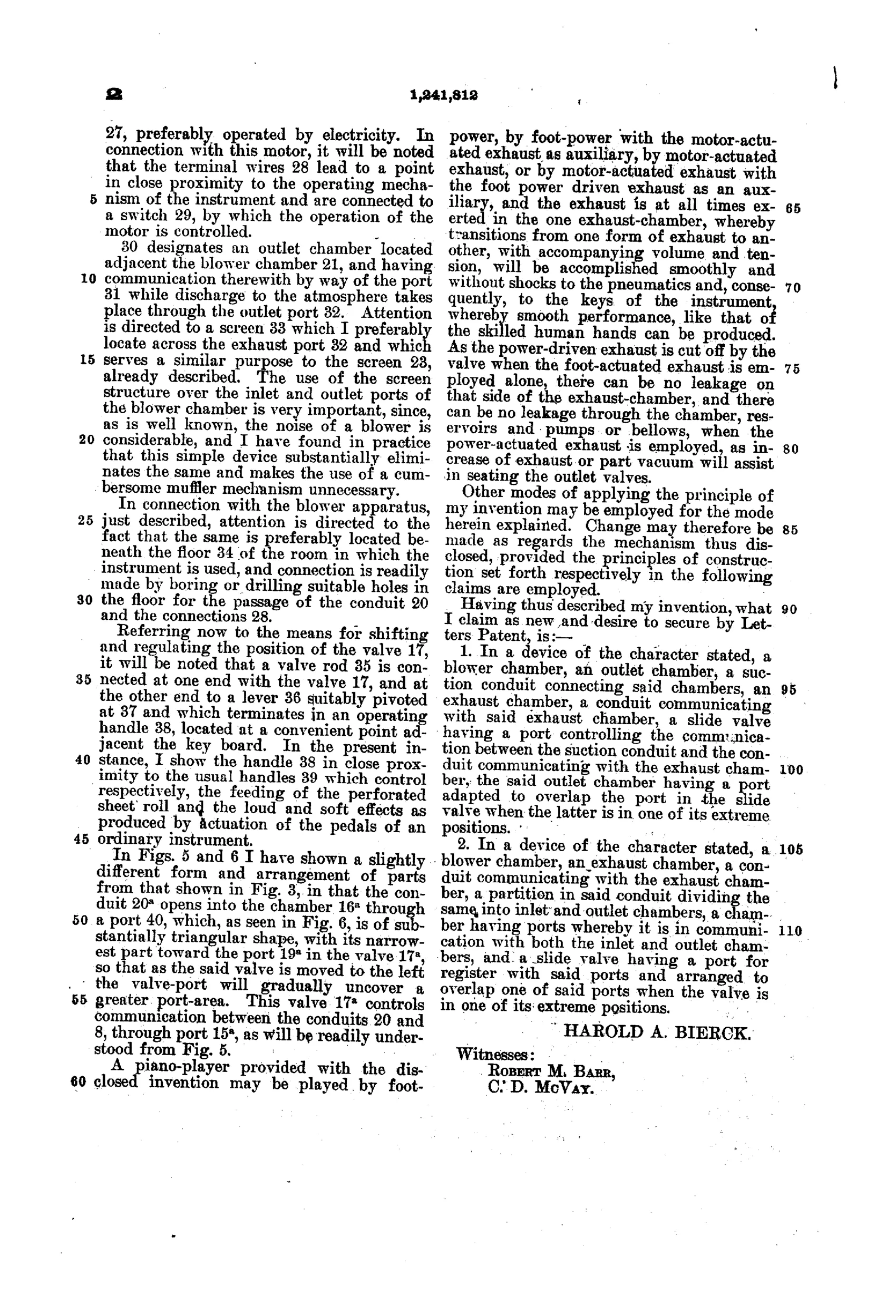
“A piano-player provided with the disclosed invention may be played by foot-power, by foot-power with the motor-actuated exhaust as auxiliary, by motor-actuated exhaust, or by motor-actuated exhaust with the foot power driven exhaust as an auxiliary, and the exhaust is at all times exerted in the one exhaust-chamber, whereby transitions from one form of exhaust to another, with accompanying volume and tension, will be accomplished smoothly and without shocks to the pneumatics and, consequently, to the keys of the instrument, whereby smooth performance, like that of the skilled human hands can be produced.”— Harold A. Bierck, from the specification
Fate unknown
Kinetic Engineering was a real Philadelphia blower manufacturer, but I know of no documented player-piano installation using this specific controller; a surviving marked unit would settle it.
♫ Commentary
Bierck's problem is a real one that player-piano owners knew intimately: pumping the treadles is work, and an electric blower solves that — but bolting a motor onto a foot-pumped instrument creates its own trouble. Switch abruptly from one suction source to the other and the sudden change in vacuum tension slams every pneumatic in the stack, producing a lurch you can hear in the music. His answer is a slide valve in the conduit between the motor-driven blower and the piano's own exhaust chamber, with ports sized so they can overlap partially or fully. A lever at the keyboard lets the player fade from foot power to motor power gradually, or run both at once, and the claim language is careful to note that all four combinations work.
The drawing rewards a close look at Fig. 1: the blower unit sits below the floor, connected up through the boards by conduit 20 — the noisy machinery banished to the cellar, with perforated screens over the fan's inlet and outlet to muffle what remains. That attention to noise is telling; a whirring fan in the parlor defeats the whole point.
The assignee matters here. Kinetic Engineering of Philadelphia was a genuine blower house, best known for the organ blowers that electrified thousands of pipe organs in exactly this era. This patent reads as their bid to do the same for the player piano — a sensible, workmanlike transition piece between the treadle age and the fully electric reproducing pianos that followed.
Commentary by Claude, The Talking Machine Patent Archive’s resident enthusiast