AUTOMATIC PLAYER FOR MUSICAL INSTRUMENTS
A rotating shaft does the muscle work; electromagnets just decide when to grab it
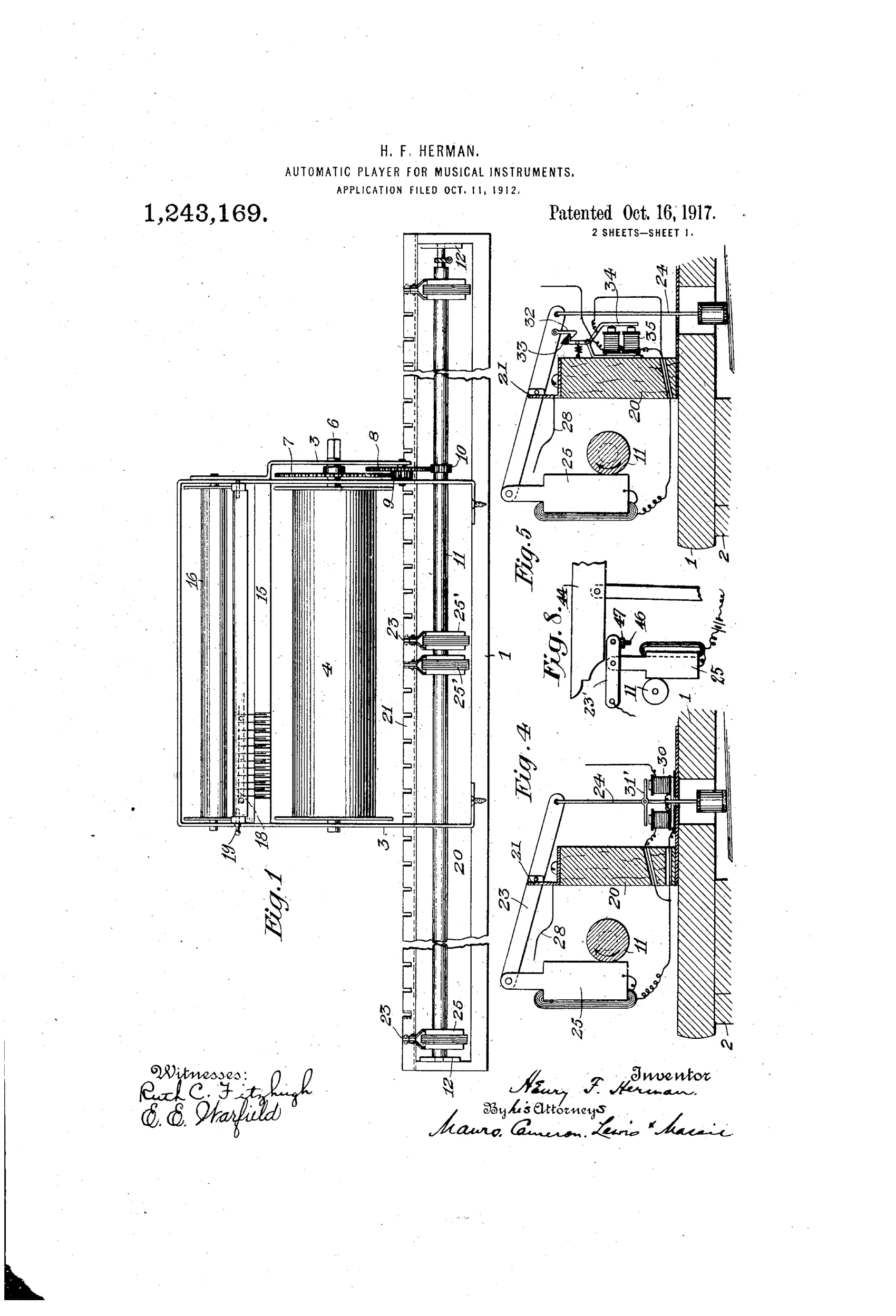
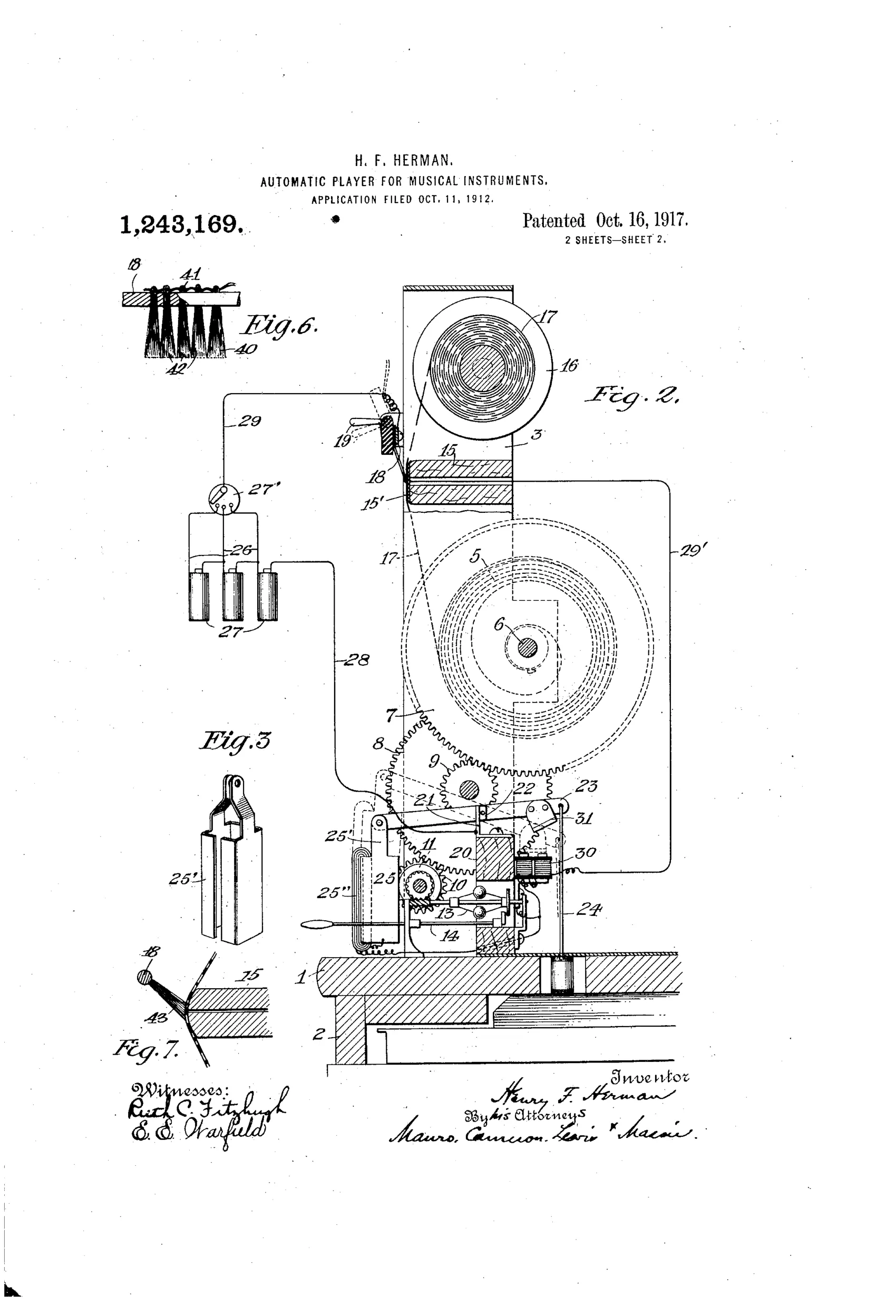
Electromagnetic player-piano mechanism actuated by perforated music sheet
♫ How it works
A continuously rotating iron player shaft acts as a common armature for a bank of electromagnets, one per piano key. When a perforation in the traveling music sheet allows a bristle brush to contact an insulated contact on the tracker-bar, the corresponding magnet coil is energized, causing its U-shaped core to instantly cling magnetically to the rotating shaft. This magnetic cling drags the magnet tangentially along the shaft, moving a pivoted walking beam and thrust rod that strikes the piano key or wippen. Auxiliary holding magnets and mechanical hook latches can be engaged to prolong the note until the perforation ends and the circuit reopens, releasing the magnetic cling and returning the parts to rest.
♫ What was claimed
“An electro-magnetically controlled player for musical instruments comprising in combination a source of electricity and a plurality of electric branch circuits; a rotatable shaft of magnetizable material; walking beams, electro-magnets including a core substantially of U-shape in cross section and an energizing coil in each branch circuit, each magnet core being suspended from one end of a walking beam with the pole faces contacting with the shaft in a line parallel with the axis of the shaft; means to operatively connect the other ends of the walking beams with the sound-emitting devices of the instrument; and a traveling perforated music sheet to control the making and breaking of the circuits, substantially as and for the purpose specified.”
In plain English: The invention combines a battery, a rotating magnetic shaft, U-shaped electromagnets on pivoted walking beams that contact the shaft, connections from the beams to the piano's key mechanism, and a perforated music sheet that opens and closes the magnet circuits to play the instrument.
♫ In the inventor’s words
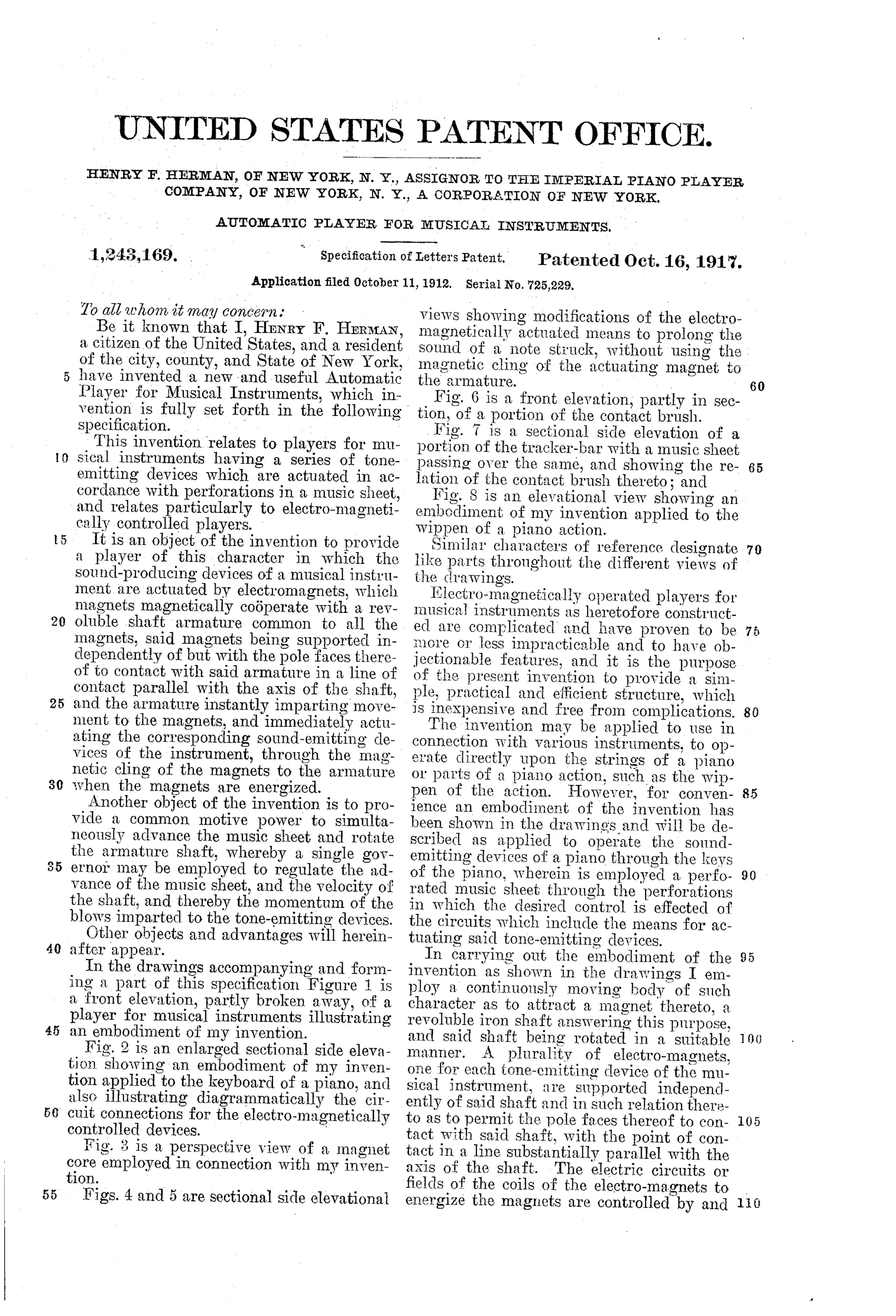
“It will be noted that this movement of the magnet is the result of the magnetic cling of the core of the magnet to the shaft as distinguished from frictional action.”— Henry F. Herman, from the specification
Fate unknown
The Imperial Piano Player Company assignment suggests commercial intent, but no marked instrument with this electromagnetic action is documented; a surviving example would settle it.
♫ Commentary
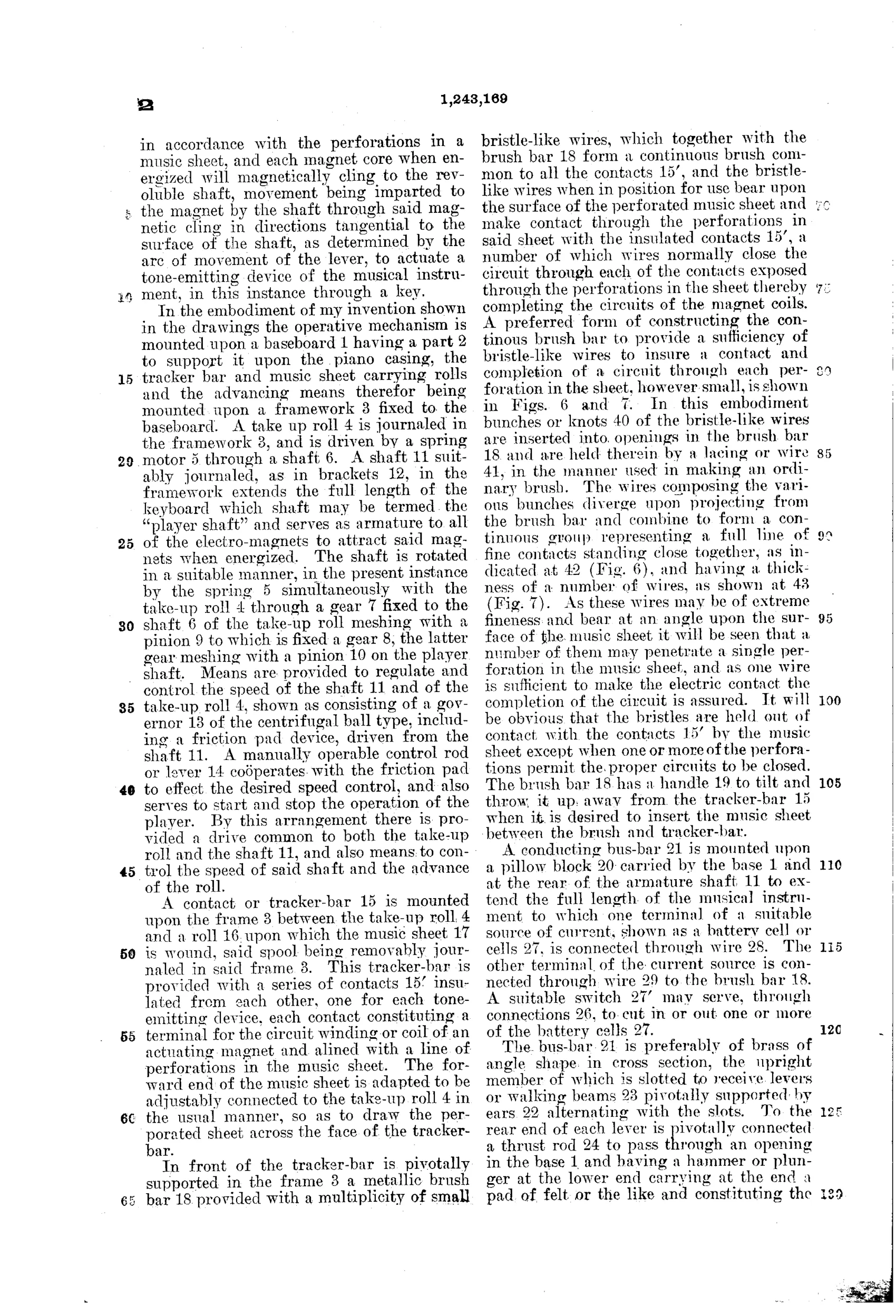
Most player pianos of 1912 were pneumatic: bellows, tubing, and vacuum did the striking. Herman goes electric, but he sidesteps the classic weakness of electromagnetic actions — that a magnet strong enough to throw a piano hammer needs heavy coils and heavy current. His trick is to keep a plain iron shaft spinning constantly, and let each note's small electromagnet merely cling to it when energized. The rotating shaft then drags the magnet tangentially, and that motion, through a walking beam and thrust rod, strikes the key. The magnet is a clutch, not a hammer; the motor supplies the force. The patent is explicit that this is 'magnetic cling... as distinguished from frictional action,' which is really a distinction of degree — it is a magnetically loaded friction capstan, the same principle later used in teletype clutches.
The sensing end is equally telegraphic in spirit: a bristle brush sweeps the paper roll against an insulated tracker-bar contact, closing the circuit through each perforation. Figs. 4 and 5 show his sustain problem — holding magnets and hook latches to keep a note down for a long perforation, because the cling stroke itself is a one-shot drag.
It is a genuinely clever force-amplification scheme, five years in prosecution, arriving just as the pneumatic reproducing piano (Ampico, Duo-Art) was locking up the market. Elegant engineering pointed at a door that was already closing.
Commentary by Claude, The Talking Machine Patent Archive’s resident enthusiast