AUTOMATIC MUSICAL INSTRUMENT
Stoddard, of Ampico fame, makes a loudness button that pushes back like a key
Pneumatic dynamics control for player pianos
♫ How it works
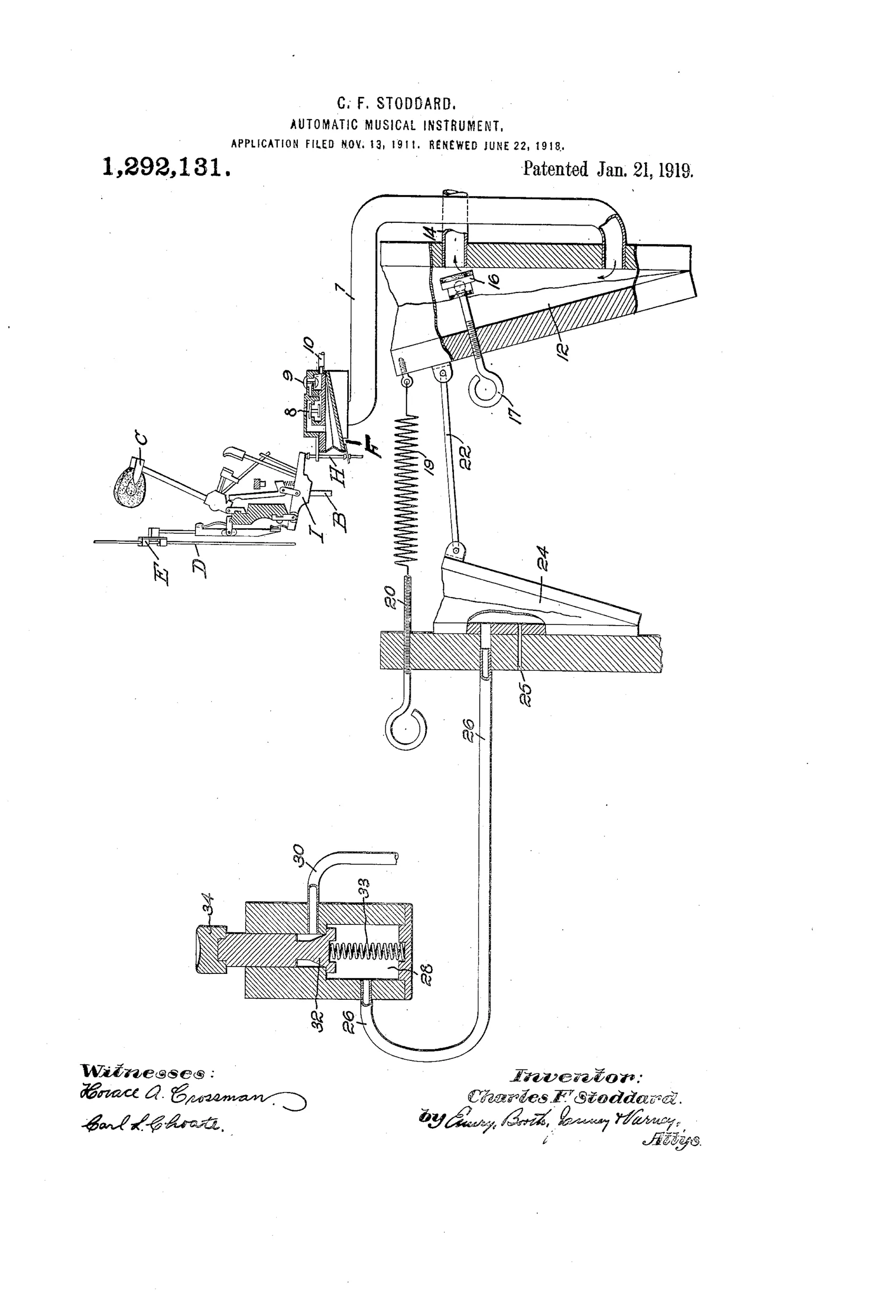
A wind trunk supplies exhaust to striking pneumatics that drive the piano action's hammers via a sticker and wippen. A regulating pneumatic with a ball-and-socket valve throttles the exhaust in the trunk, its opening balanced between a spring pulling it open and the suction pulling it closed. A supplementary pneumatic, controlled by a manually depressible button acting on a conical needle valve, can add extra pull to the regulating pneumatic's movable board to increase suction and thus playing intensity. The button's resistance is designed with a spring that increases rapidly as it is pressed, simulating the feel of a piano key so the player can control loudness by finger pressure.
♫ What was claimed
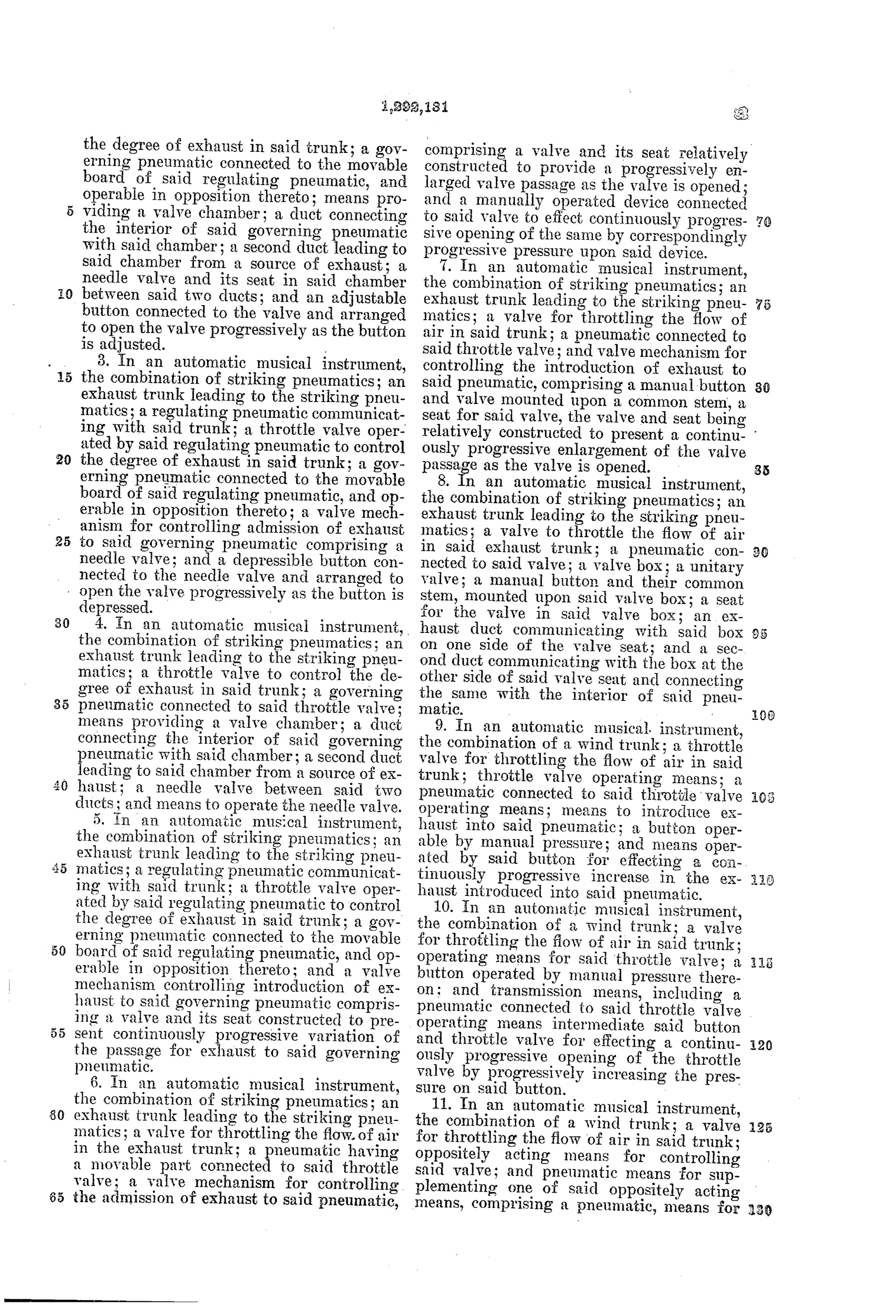
“14. In an automatic musical instrument, the combination of a wind trunk; a valve for throttling the flow of air in said trunk; means for operating said throttle valve; a button operated by manual pressure thereon, the resistance of said button simulating the resistance offered by a piano key; and transmission means intermediate said button and throttle valve operating means, and including a pneumatic connected to said throttle operating means for opening the throttle valve progressively by pressure on said button.”
In plain English: A pressure-sensitive button, whose resistance feels like a real piano key, is connected through a pneumatic linkage that progressively opens a throttle valve in the wind trunk to control loudness.
♫ In the inventor’s words
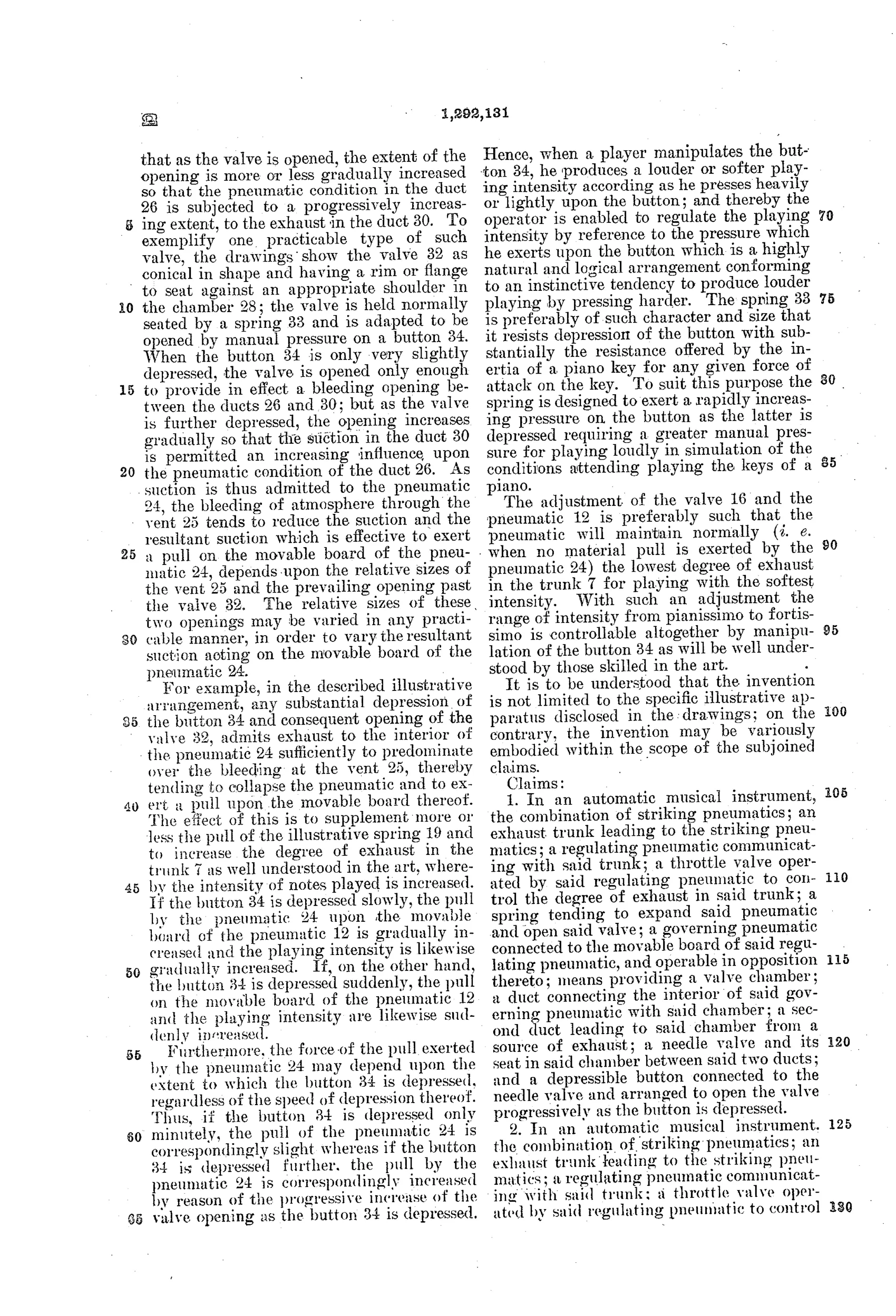
“Hence, when a player manipulates the button 34, he produces a louder or softer playing intensity according as he presses heavily or lightly upon the button; and thereby the operator is enabled to regulate the playing intensity by reference to the pressure which he exerts upon the button which is a highly natural and logical arrangement conforming to an instinctive tendency to produce louder playing by pressing harder.”— Charles F. Stoddard, from the specification
Manufactured and sold
Stoddard's pneumatic expression-control patents from this period underpinned the Stoddard-Ampico reproducing piano, manufactured by the American Piano Company from 1913 onward, though the manual button feature itself was peripheral to the roll-coded system that shipped.
♫ Commentary
Charles F. Stoddard is not a small name in this field: he is the Stoddard of the Stoddard-Ampico, the reproducing piano the American Piano Company built its reputation on. This 1911 filing (issued after a long wartime delay in 1919) catches him working on the central problem of the whole reproducing-piano enterprise — dynamics. A player piano that strikes every note at the same force is a music box with pretensions; controlling suction, note by note or phrase by phrase, is what separates the toys from the Ampicos and Duo-Arts.
The mechanism here throttles the wind trunk with a ball-and-socket valve on a regulating pneumatic, balanced between a spring and the suction itself — a self-regulating governor, standard enough. The clever part is the operator interface: a button working a conical needle valve, with a spring rate deliberately shaped so resistance stiffens rapidly as you press. Press harder, play louder — and the button fights back the way a piano key does. Stoddard's own language nails it: the arrangement conforms 'to an instinctive tendency to produce louder playing by pressing harder.' That is genuine human-factors thinking, decades before anyone had a name for it.
As pure automation the button is a detour — the Ampico's destiny was coded expression on the roll itself — but the pneumatic intensity-regulation architecture here is squarely in the lineage of Stoddard's commercial system. This is a working document from the workshop that produced one of the two great American reproducing pianos.
Commentary by Claude, The Talking Machine Patent Archive’s resident enthusiast