IMPROVEMENT IN AUTOMATIC MUSICAL INSTRUMENTS
Tempo encoded in the paper's edge, weeks before Edison's tinfoil
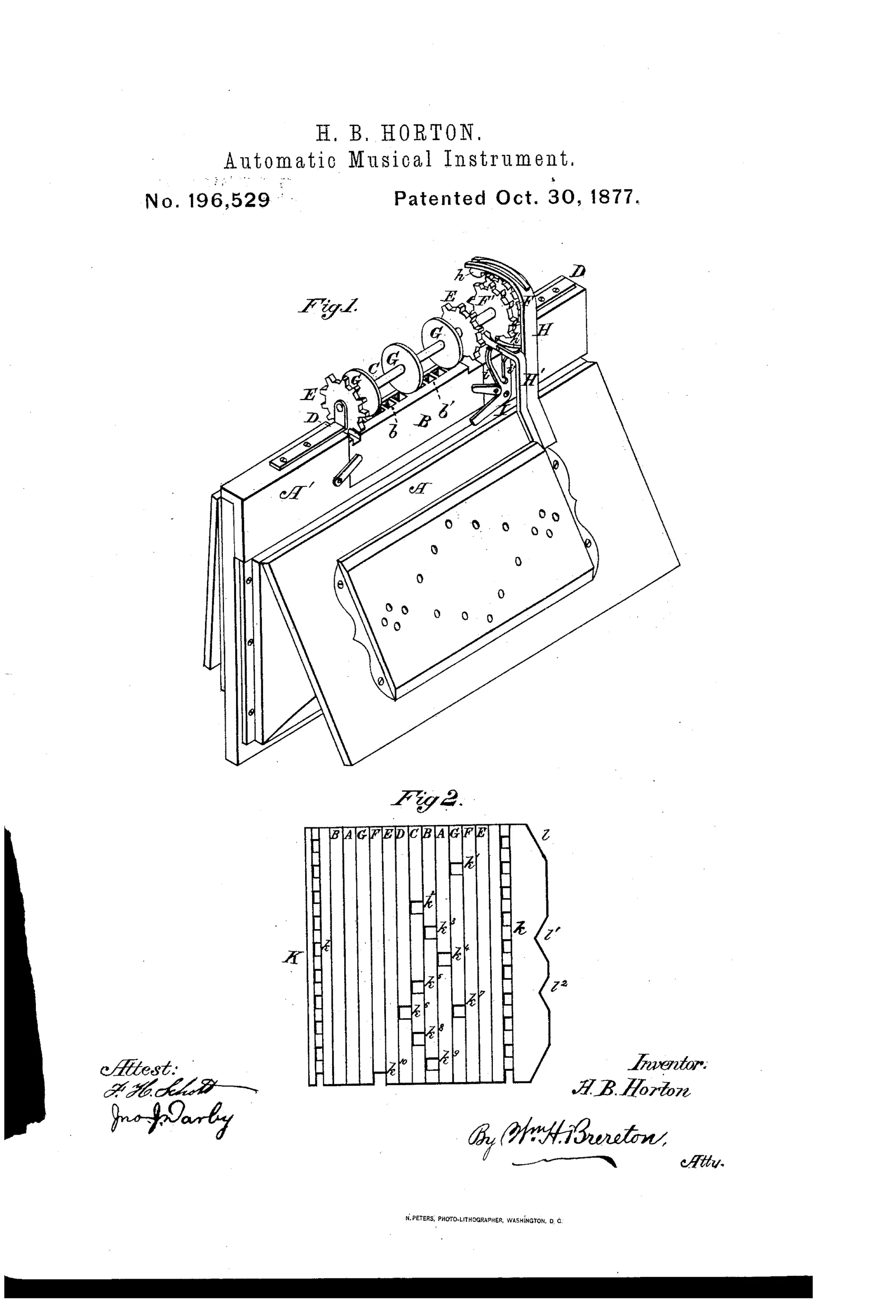
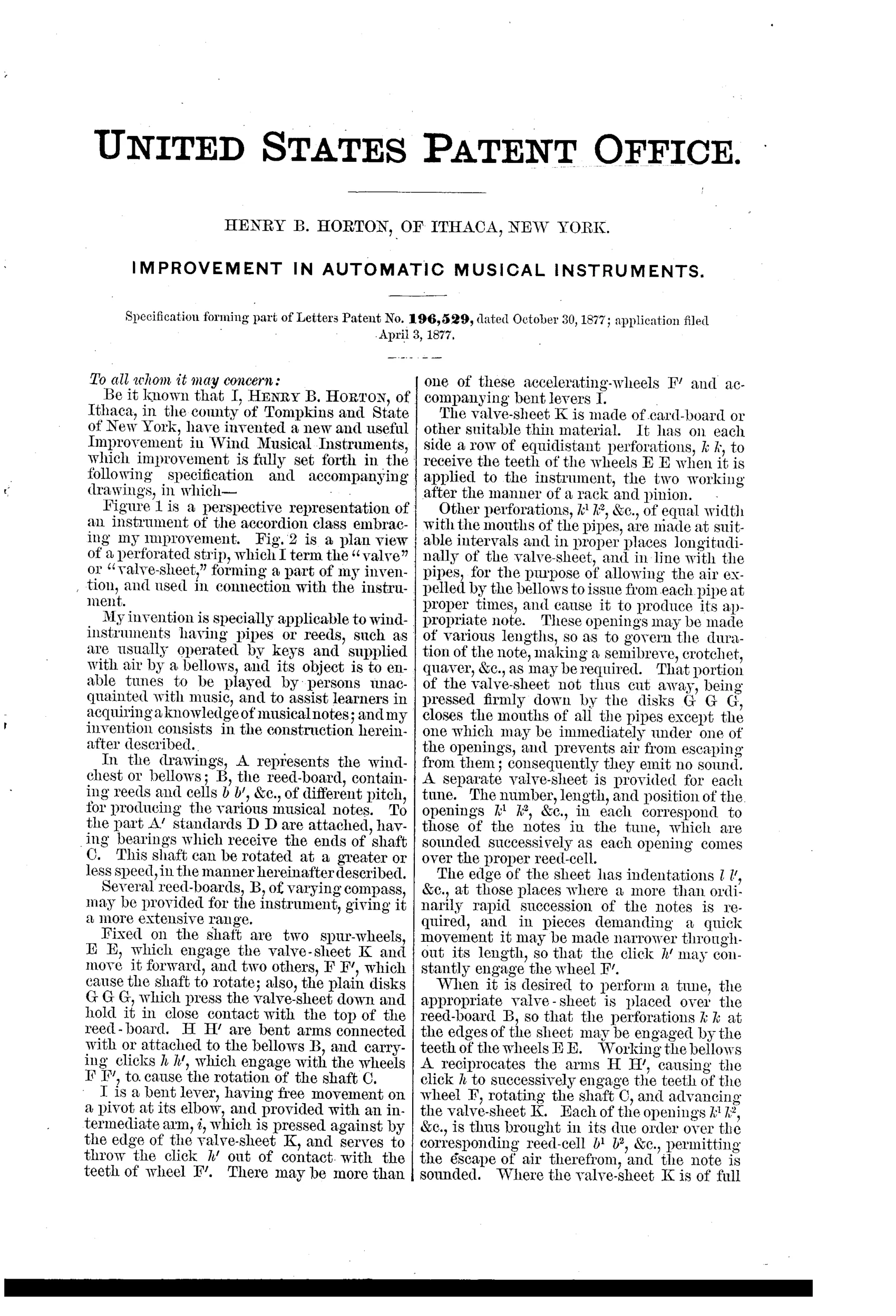
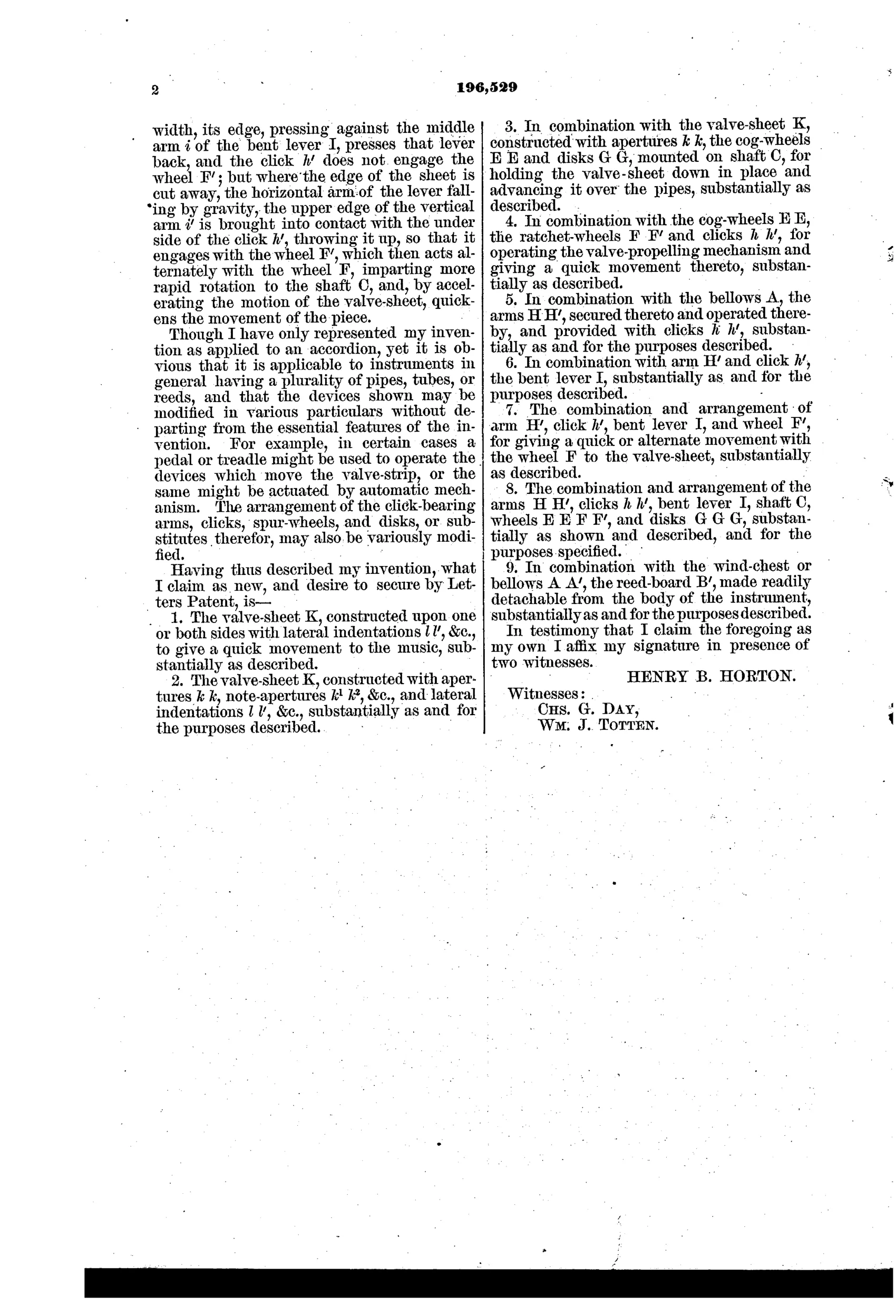
Perforated valve-sheet mechanism for playing wind instruments automatically
♫ How it works
A perforated card-board valve-sheet, engaged by cog-wheels acting as a rack and pinion, is drawn across a reed-board to selectively expose reed-cells and sound notes in sequence. Working the bellows reciprocates bent arms carrying clicks that engage ratchet-wheels on a rotating shaft, advancing the valve-sheet. A bent lever with an arm riding the edge of the sheet throws a second click into or out of engagement with an auxiliary ratchet-wheel, giving the shaft alternate normal or accelerated rotation. Lateral indentations in the sheet edge thus control the click engagement to quicken the tune's tempo where rapid note succession is required.
♫ What was claimed
“7. The combination and arrangement of arm H', click h', bent lever I, and wheel F', for giving a quick or alternate movement with the wheel F to the valve-sheet, substantially as described.”
In plain English: The patent claims the specific combination of a pivoted arm, click, bent lever, and ratchet wheel that together speed up or vary the valve-sheet's movement.
♫ In the inventor’s words
“My invention is specially applicable to wind-instruments having pipes or reeds, such as are usually operated by keys and supplied with air by a bellows, and its object is to enable tunes to be played by persons unacquainted with music, and to assist learners in acquiring a knowledge of musical notes.”— Henry B. Horton, from the specification
Fate unknown
Horton had real manufacturing behind him at Ithaca Calendar Clock, but no surviving instrument with this edge-notch tempo feed is documented; a marked specimen would settle it.
♫ Commentary
Perforated-sheet reed organs were a crowded idea by 1877, and most patents in the pile solve the same two problems: how to seal the sheet against the reed-cells, and how to pull it through evenly. Horton's entry earns its keep on a third problem nobody else was addressing this directly — tempo. His claim 7 is the heart of it: a bent lever rides the edge of the cardboard sheet, and notches cut into that edge throw a second click into engagement with an auxiliary ratchet wheel, kicking the feed into a faster gear. The music sheet doesn't just carry the notes; its silhouette carries the speed changes. That is program control encoded in two dimensions of the same strip, and it's genuinely clever.
Fig. 2 rewards a close look. The note letters B-A-G-F-E-D-C run across the top, and the staggered apertures marked k through k9 map a tune directly — you can almost sight-read it. Fig. 1 shows the bellows-driven ratchet feed, meaning the player's pumping both makes the wind and advances the sheet, so tempo tracks effort unless the edge-notch mechanism intervenes.
Horton was the Ithaca man behind the famous calendar clocks, so he knew ratchets and escapement-like logic cold. But the organette trade that boomed in the 1880s went with simpler constant-speed feeds, and the edge-notch tempo trick appears to be a road not taken. Issued three months before Edison's phonograph patent, it's a snapshot of mechanical music at its last unchallenged moment.
Commentary by Claude, The Talking Machine Patent Archive’s resident enthusiast