Improvement in Mechanical Musical Instruments
Horton's 'autophone' — Ithaca's paper-fed reed organette, a year after Edison's tinfoil
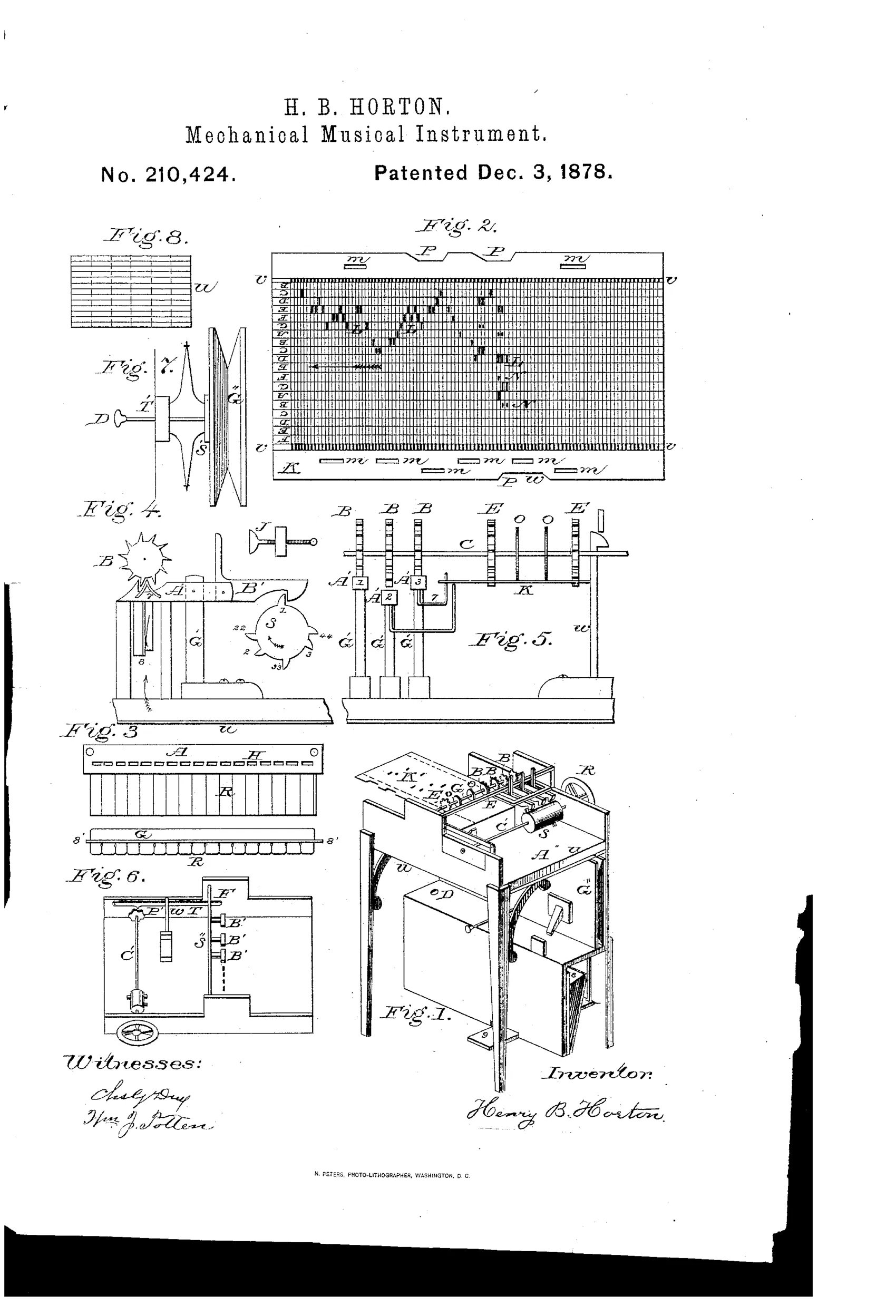
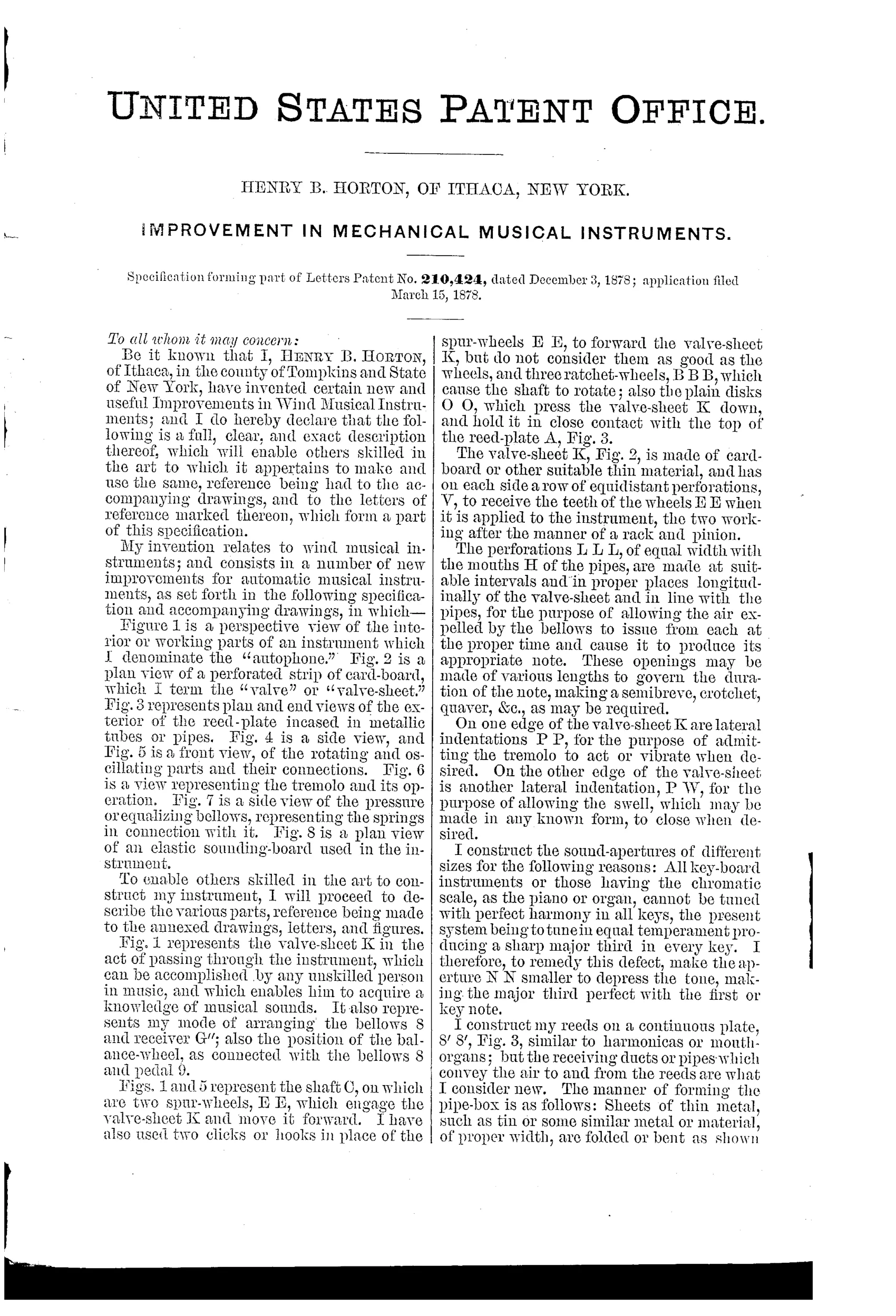
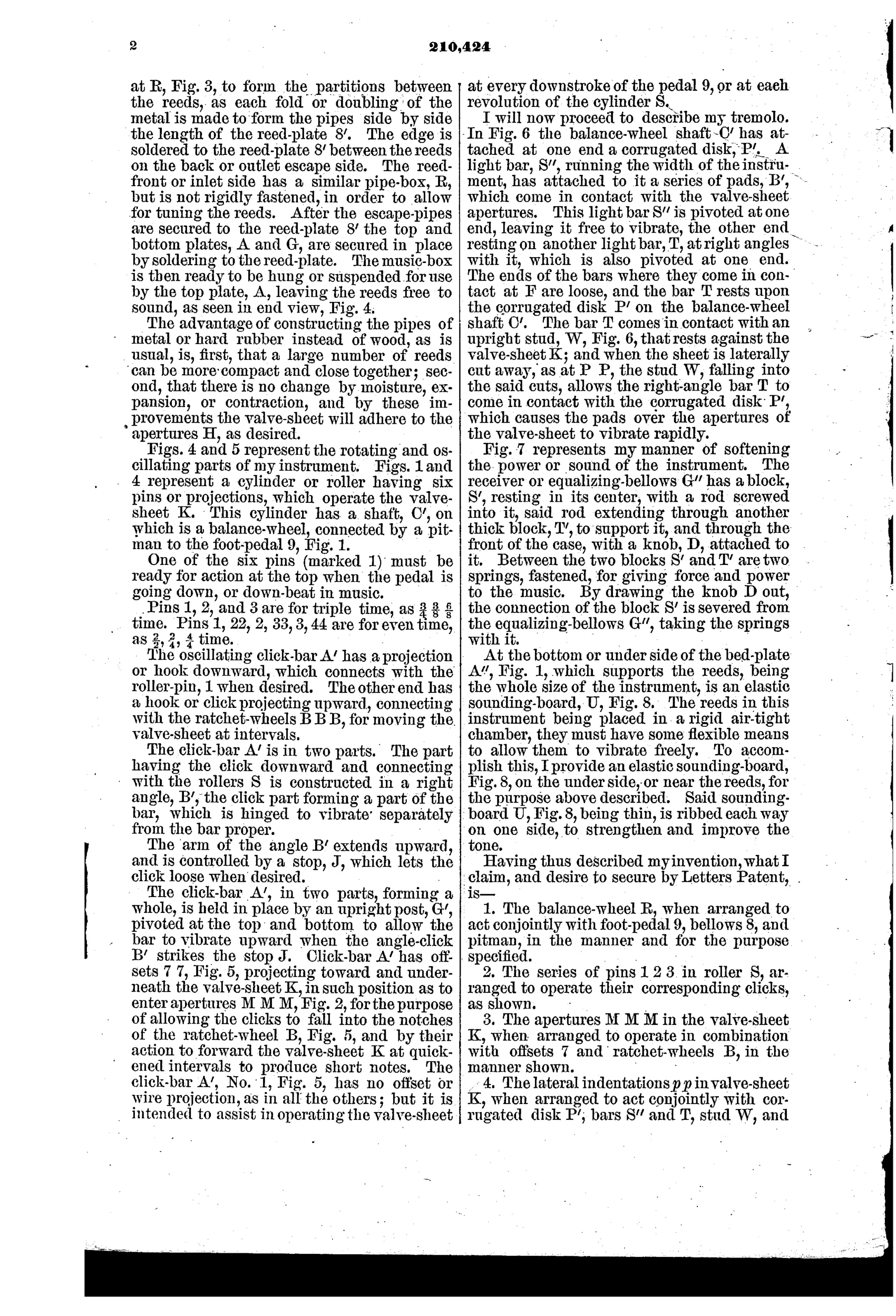
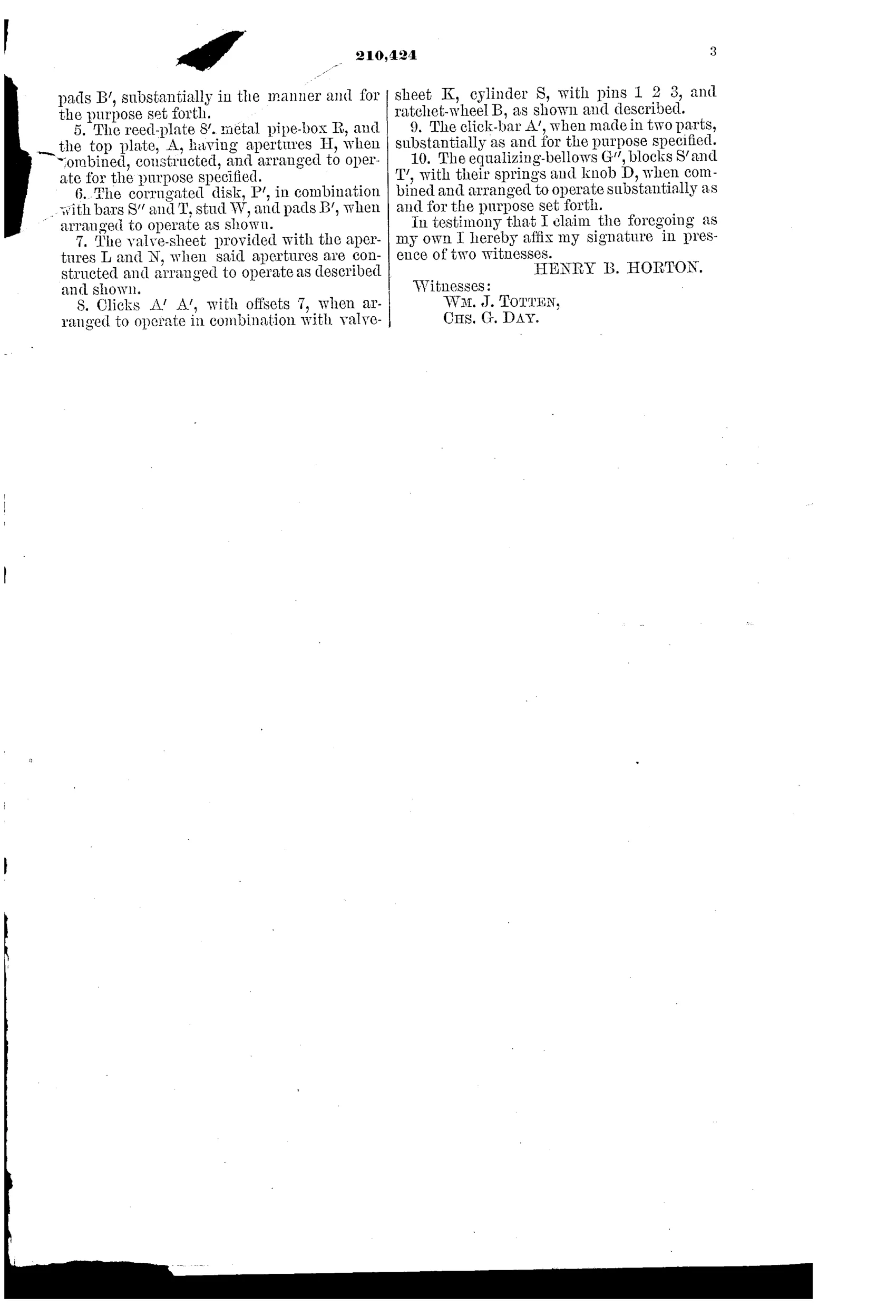
Automatic reed organ with perforated paper music sheet
♫ How it works
A perforated cardboard 'valve-sheet' is drawn across the top of a reed-plate by a rack-and-pinion arrangement of toothed spur-wheels, advancing the paper as air is admitted through its apertures to sound metal reeds housed in folded tin pipe-boxes. A rotating pin-cylinder connected by a balance-wheel and pitman to a foot pedal operates click-bars and ratchet-wheels that step the valve-sheet forward at variable intervals to produce notes of different duration. Lateral notches along the sheet's edges trigger a tremolo bar riding on a corrugated disk, causing pads to vibrate rapidly over the apertures, while a separate swell notch allows a shutter to open or close for dynamic effect. An equalizing bellows fitted with springs and a pull-knob softens or intensifies the air pressure delivered to the reeds, and a ribbed elastic sounding-board beneath the reed chamber lets the reeds vibrate freely within the otherwise airtight case.
♫ What was claimed
“The valve-sheet provided with the apertures L and N, when said apertures are constructed and arranged to operate as described and shown.”
In plain English: A patterned paper roll whose two different sizes of holes control both which note plays and how sharp or flat its pitch is tuned.
♫ In the inventor’s words
“Fig. 1 represents the valve-sheet K in the act of passing through the instrument, which can be accomplished by any unskilled person in music, and which enables him to acquire a knowledge of musical sounds.”— Henry B. Horton, from the specification
Manufactured and sold
Horton founded the Autophone Company of Ithaca, which manufactured paper-fed organettes on this design; surviving examples are documented in mechanical-music collections.
♫ Commentary
Henry Horton was already a serious mechanic — he's the Horton of the Ithaca Calendar Clock Company — and it shows in how this patent thinks. Where most organette designs simply drag a paper strip over reed openings at constant speed, Horton steps the sheet forward with ratchet-wheels and click-bars driven off a pin-cylinder, so the advance interval itself is variable. Note duration comes from the feed mechanism, not just from the length of the hole. That's a clockmaker's instinct applied to music.
Look closely at Fig. 2 and you'll see the edges of the valve-sheet are notched, not just perforated in the field. Those lateral notches trip a tremolo bar riding on a corrugated disk (Fig. 6), fluttering pads over the apertures, while a separate notch works a swell shutter. The paper isn't merely a note map — it's carrying expression commands, decades before player-piano expression coding became standard. The equalizing bellows with its pull-knob (Fig. 7) rounds out a surprisingly complete dynamic system for a foot-pumped box.
This one isn't a paper dream. Horton organized the Autophone Company in Ithaca, and its stepped-feed organettes were built and sold in real numbers through the 1880s — one of the earliest American successes in perforated-paper music, and part of the mechanical-music world that recorded sound would eventually eclipse.
Commentary by Claude, The Talking Machine Patent Archive’s resident enthusiast