IMPROVEMENT IN MECHANICAL MUSICAL INSTRUMENTS
The 'phuniphone': you hold the handle still and spin the whole instrument
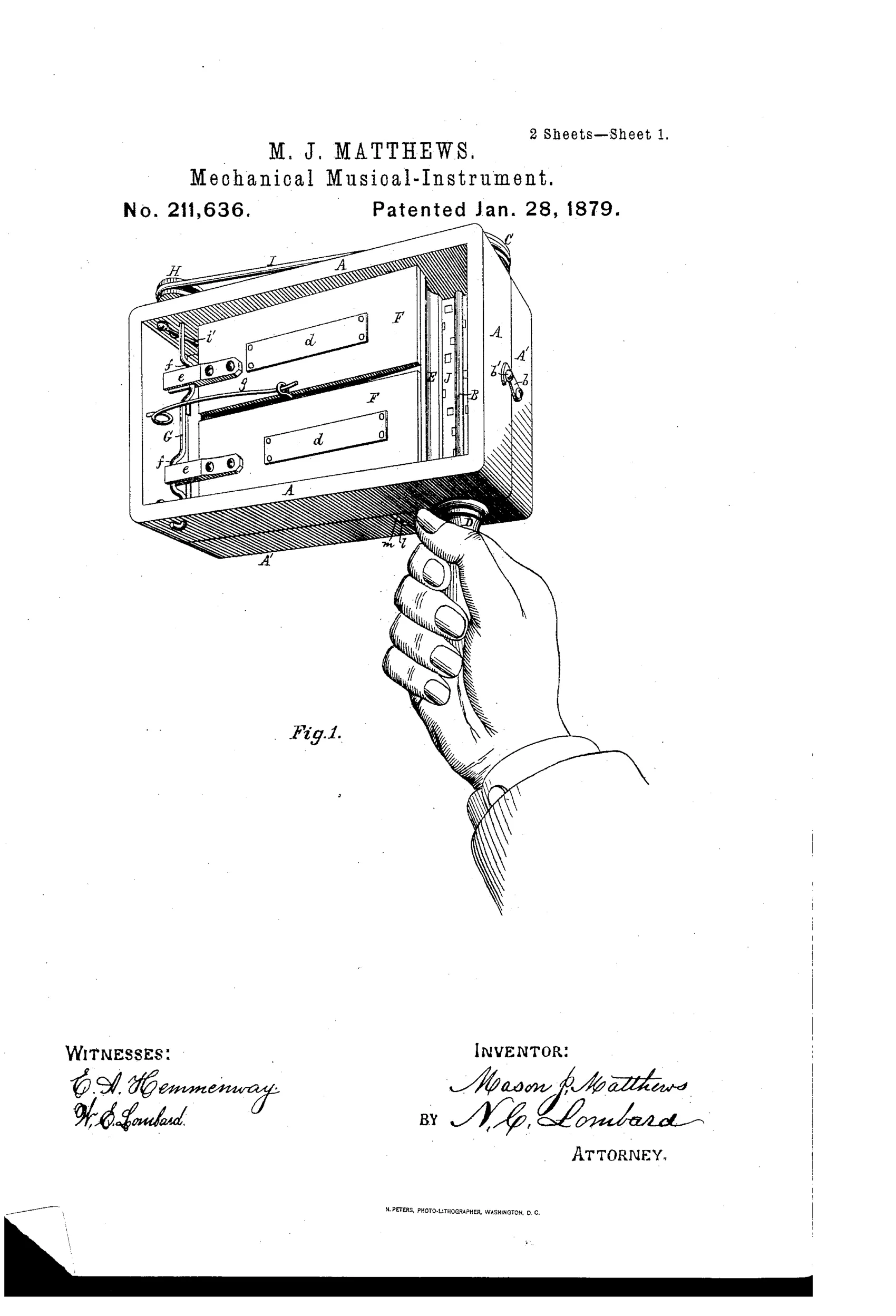
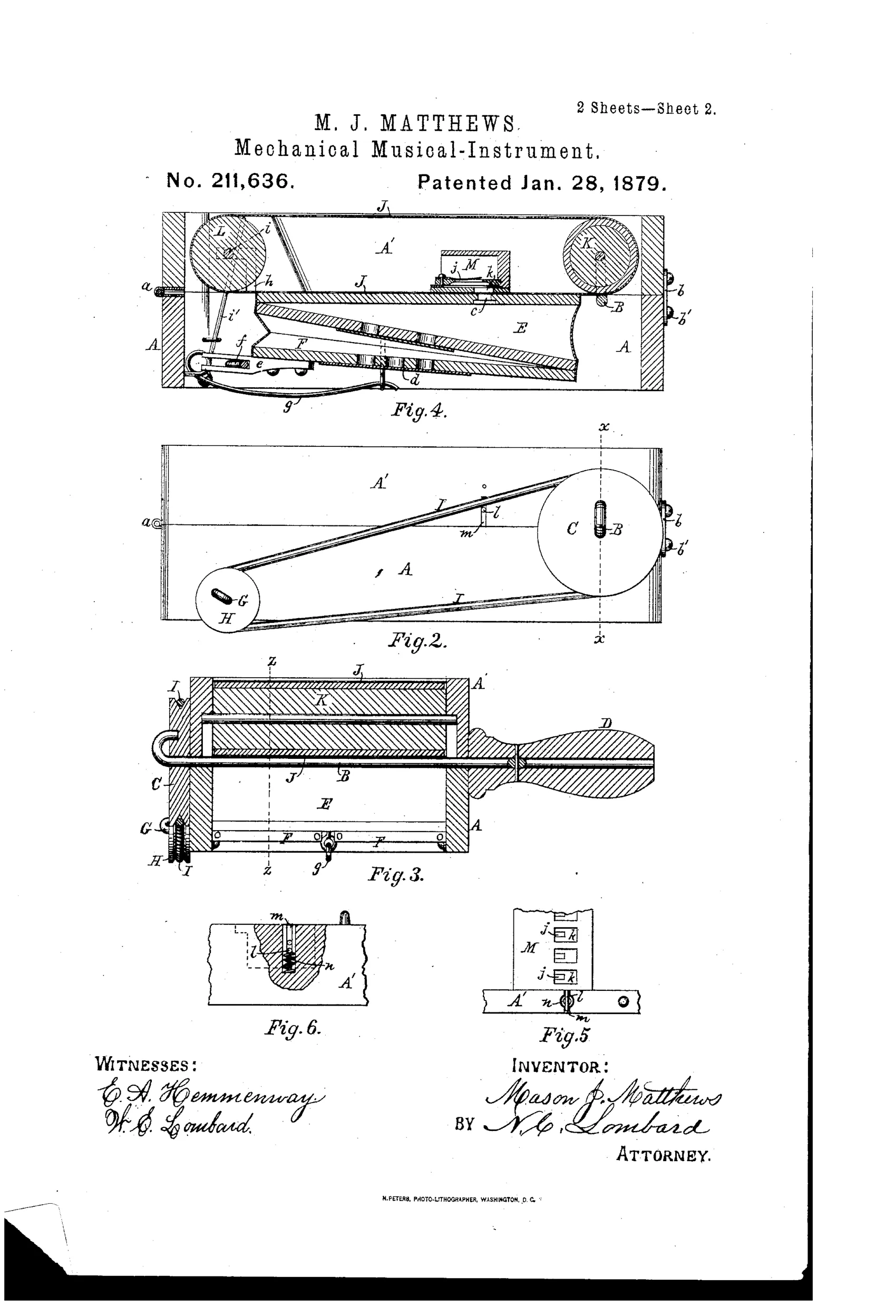
Hand-cranked, hand-held mechanical music box/organette
♫ How it works
A driving shaft with an axial handle is held fixed in the hand while the entire cased body of the instrument revolves around it. The revolving frame carries wind-moving suction bellows connected to a reed chamber with a series of reeds and wind-passages, plus a vacuum/reservoir chamber. An endless perforated paper band is stretched around two carrying rolls (drums) and moves between the reservoir and reed chambers as the body rotates, so perforations successively align with wind-passages to sound the reeds and play a tune. The two-part hinged casing can be opened to swap the paper band for a different tune, with springs and pins securing and tensioning the rolls and reed-chamber.
♫ What was claimed
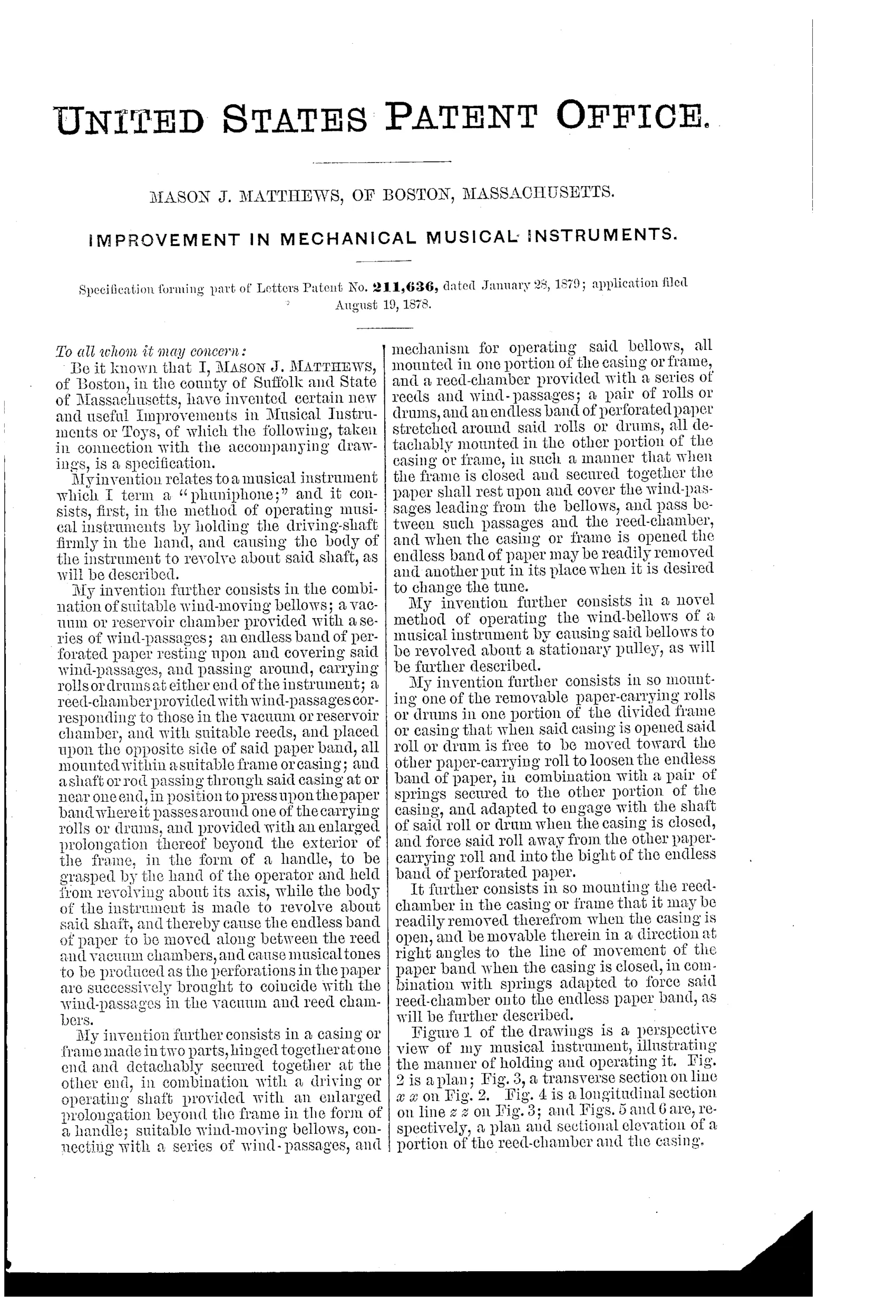
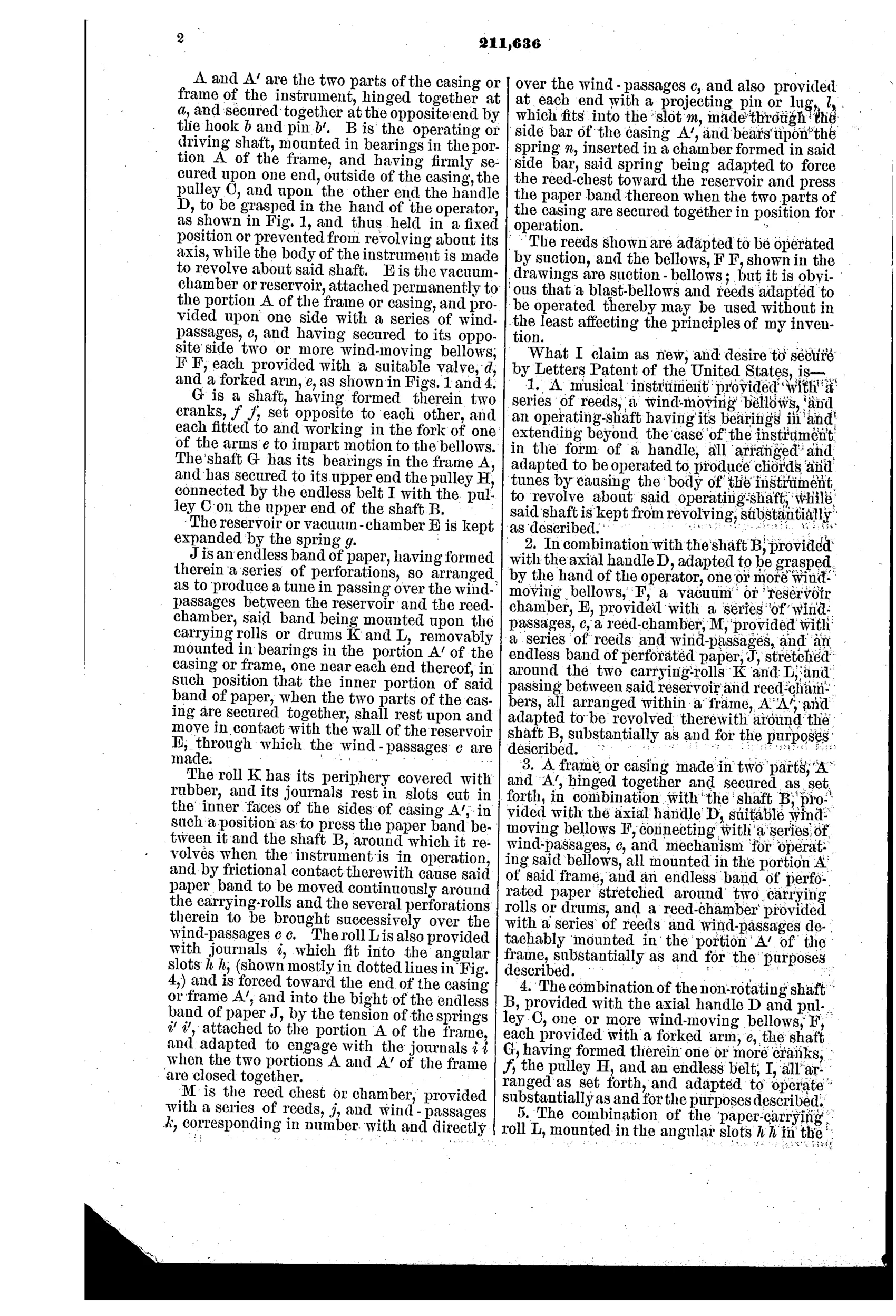
“1. A musical instrument provided with a series of reeds, a wind-moving bellows, and an operating-shaft having its bearings in and extending beyond the case of the instrument in the form of a handle, all arranged and adapted to be operated to produce chords and tunes by causing the body of the instrument to revolve about said operating-shaft, while said shaft is kept from revolving, substantially as described.”
In plain English: The invention is a musical instrument whose reed-and-bellows body spins around a fixed handle-shaft held in the operator's hand, producing tunes as it rotates.
♫ In the inventor’s words
“My invention relates to a musical instrument which I term a "phuniphone;" and it consists, first, in the method of operating musical instruments by holding the driving-shaft firmly in the hand, and causing the body of the instrument to revolve about said shaft, as will be described.”— Mason J. Matthews, from the specification
Fate unknown
Matthews was a real organette maker, but no surviving 'phuniphone' is documented to me; a marked specimen or period advertisement would settle it.
♫ Commentary
Most organettes work the obvious way: the case sits still and you turn a crank. Mason Matthews of Boston inverted that. Here the handle-shaft is what you grip, and the entire body of the instrument — bellows, reed chamber, reservoir, and an endless perforated paper band running between two rolls — whirls around your fist. Fig. 1 makes the point without a word of text: a hand grasping the axial handle while the boxy body hangs off it, ready to spin. The relative rotation between fixed shaft and revolving case is what pumps the suction bellows and advances the paper.
Mechanically it is the same kinematics as a normal crank, just with the frames of reference swapped, so there is no reason it wouldn't sound. What you gain is a party trick and a one-handed grip; what you lose is stability — whirling a box of reeds and bellows overhead is hard on the paper band and the player's wrist alike. Note the practical touches a casual reader would miss: the hinged two-part casing opens to swap tune bands, with spring-tensioned rolls so a fresh melody drops in quickly. That interchangeable-tune thinking is the real organette DNA here.
Matthews was a genuine figure in the Boston organette trade, which keeps this from being pure whimsy. Still, the revolving-body gimmick reads more like a toy novelty than a parlor instrument, and the name 'phuniphone' suggests he knew it.
Commentary by Claude, The Talking Machine Patent Archive’s resident enthusiast